


.png)





For decades, B2B marketing strategy started with one assumption:
If we rank on Google, we win.
But thanks to the rise of AI-powered answer engines like ChatGPT and Perplexity, that assumption no longer holds.
AI search tools are rapidly becoming the starting point for B2B research. In fact, recent data from The ABM Agency shows that 80% of B2B buyers now begin their journey in these AI engines, not through traditional search.
That evolution changes the dynamics of brand visibility.
Today, a buyer’s first impression of your brand often isn’t your website, ad, or sales team. It’s an answer generated and served by an AI model.
And in most cases, you aren’t even in the room when the AI model forms that answer.
Forrester has called this new reality the “GTM Singularity,” a structural break in how buyers discover, evaluate, and decide. When AI systems facilitate discovery, traditional visibility tactics lose leverage. Ranking alone is no longer enough.
For Chief Marketing Officers and their leadership teams, it’s time to change focus from optimizing for clicks to earning inclusion in the answers themselves. Visibility now depends on whether your brand is recognized as a credible source inside the AI systems your buyers rely on.
So the question is no longer “How do we rank?”
It’s “How do we show up in the answers?”
Visibility is no longer measured in clicks
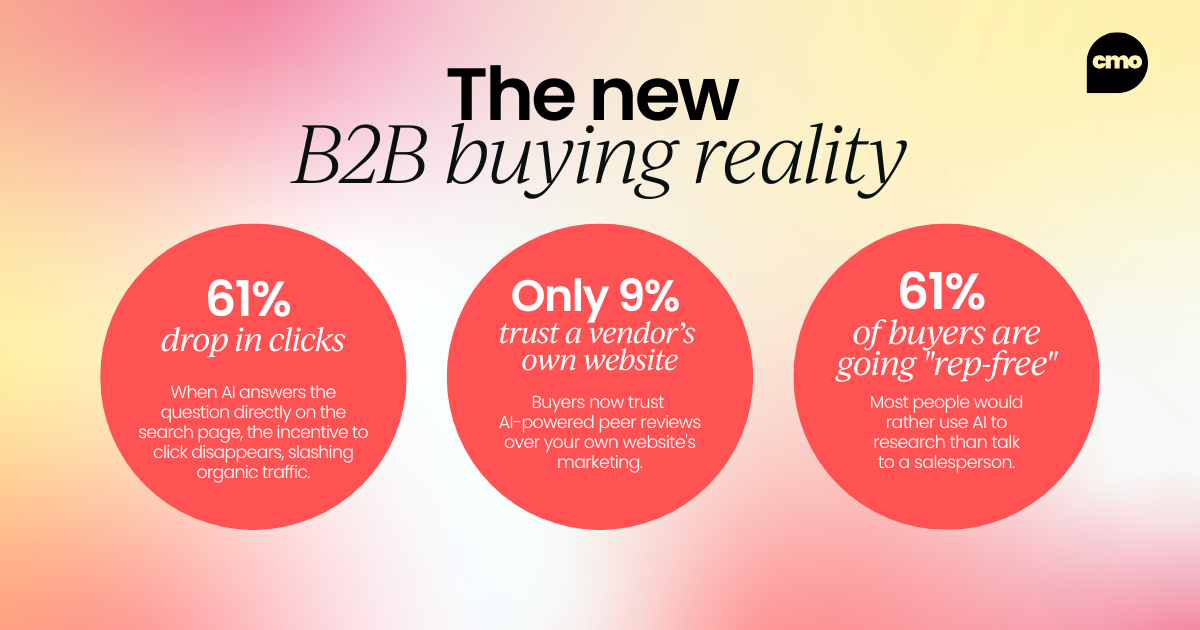
When AI overviews appear in B2B search results (now in over 70% of relevant cases), the consequences are immediate: Organic click-through rates drop by an average of 61%. Many organizations are already seeing a decline of 34% in organic traffic from search.
But the traffic loss is just a surface-level problem.
The deeper, more systemic change is behavioral:
- Buyers can compress weeks of research into just a few minutes
- 61% of B2B buyers now prefer a sales rep-free buying experience
- Only 9% of buyers consider vendor websites their most trusted source of information
So buyers aren’t so much browsing as they are interrogating.
AI allows buyers to compare vendors, test claims, surface objections, and explore use cases in a single continuous session.
By the time sales engages, a shortlist may already exist – influenced by an AI system trained on content you may not control.
That’s not a top-of-funnel challenge; it’s a market access challenge.
For years, demand generation assumed buyers would move through journeys on owned properties. Increasingly, that evaluation now happens inside AI environments that synthesize and filter information on the buyer’s behalf.
The buyer has a new intermediary
B2B marketing has adapted to major shifts before, like moving from desktop to mobile or widespread adoption of social media.
But this shift is different. This one changes who controls discovery.
AI answer engines don’t just provide links. They interpret, summarize, rank, and frame the market in real time. In fact, sessions on these platforms now average more than 14 minutes — much longer than traditional search behavior.
In that time, buyers are doing much more than simply consuming information. They’re refining requirements, testing assumptions, and reshaping evaluation criteria through a continuous dialogue.
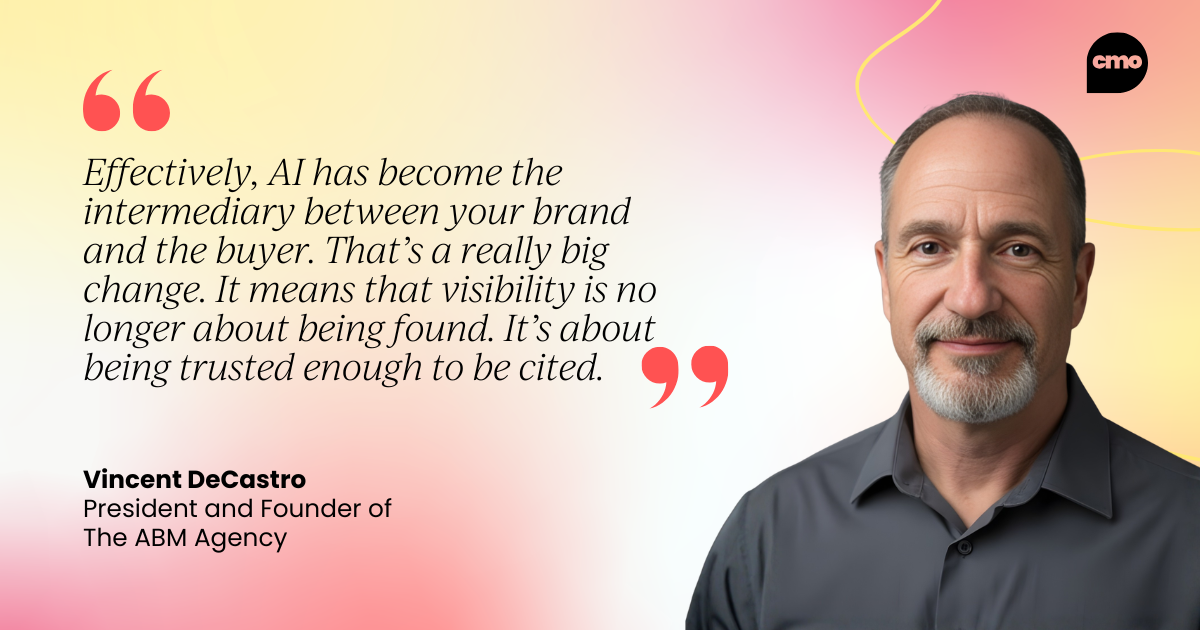
Effectively, AI has become the intermediary between your brand and the buyer.
As Forrester writes, AI has pushed buyer autonomy and information access into overdrive. Buying groups can simulate evaluation processes before speaking to a vendor.
That’s a really big change. It means that visibility is no longer about being found. It’s about being trusted enough to be cited.
In the AI-mediated buying journey, citation is the new visibility.
The first glimpse of measurement: Bing's AI performance report
One of the biggest challenges in this new environment is measurement.
If every conversation between AI and the buyer is unique, dynamic, and personalized … how can you track visibility?
Traditional metrics like rank, traffic, and impressions only tell part of the story now. They measure clicks, but not influence within AI-generated answers.
Microsoft’s new AI Performance Report in Bing Webmaster Tools offers the first meaningful step toward solving that. It gives brands visibility into whether their content is being cited within AI-generated responses across Microsoft Copilot and related experiences.
As Microsoft puts it: “Visibility is not only about blue links. It is also about whether your content is cited and referenced when AI systems generate answers.”
And that changes the measurement model.
Instead of asking whether your brand ranked or got the click, you can (and should) now ask:
- Were we referenced?
- On which queries?
- Which content is being trusted?
The AI Performance dashboard includes four core indicators:
- Total citations: The raw number of times your content has been referenced, providing a baseline for your brand's authority in the eyes of the AI.
- Average cited pages: The number of unique pages being used as sources, indicating the breadth of your content's influence.
- Grounding queries: A sample of the key phrases the AI used to retrieve your content, offering unprecedented insight into the specific questions your content is answering.
- Page-level citation activity: A URL-by-URL breakdown of citation counts, allowing you to identify your most authoritative content and spot opportunities for improvement.
This marks the beginning of Generative Engine Optimization (GEO) as a measurable discipline.
With a tool like this, CMOs can now identify:
- Where their brand is recognized as authoritative
- Where competitors are being cited instead
- Which topics AI most strongly associates with them
- Where content lacks clarity, structure, or evidentiary depth
Armed with this visibility, CMOs can make sharper decisions about where to invest — strengthening high-performing authority areas and closing gaps with content that is clear, structured, and evidence-backed enough to earn AI trust.
Owning the topic, not the keyword
Tools like Bing’s AI Performance report point to a larger strategic imperative: authority must be built intentionally.
Brands can no longer rely on visibility tactics alone. They must rethink how their organization defines, demonstrates, and distributes expertise.
That begins with uncomfortable but necessary questions many companies haven’t fully answered:
- What problem do we truly solve?
- What expertise do we demonstrably own?
- Which topics should the market associate with our brand — and which ones shouldn’t?
- For which audience are we the most credible voice?
The goal is to move from being one of many vendors to being a trusted source. The brands that succeed here will move beyond talking about their products and into thought leaders who define their industries, whose expertise is widely trusted by AI models.
Consider two examples that built authority well before AI reshaped visibility
HubSpot didn’t simply sell marketing automation; they systematized and popularized inbound marketing. ADP didn’t just process payroll; they turned proprietary data into workforce insights that shape economic conversations.
In both cases, the product absolutely matters — but the authority and relevance extend beyond it.
That’s the blueprint to follow.
When AI systems synthesize answers, they prioritize sustained topical depth over promotional volume. Brands that consistently publish structured, evidence-backed insight are far more likely to be cited.
Authority cannot be asserted.
It must be demonstrated.
The CMO as Chief Authority Officer
Thriving in the age of AI-powered buying requires leadership that extends far beyond the marketing department. It won’t be a task to delegate to SEO — it’s a C-suite-level imperative.
Authority in an AI-mediated market isn’t created by content alone. It’s created through alignment.
The new GTM mandate requires a deliberate, top-down effort to:
- Define topical authority: Formally identify and commit to the specific domains where your organization will be the undisputed expert.
- Establish insight loops: Create continuous feedback mechanisms to understand the evolving questions and challenges of your ideal customers.
- Audit for authority: Conduct a ruthless audit of your existing content, evaluating it not for keywords, but for its readiness to serve as a trusted, authoritative source.
- Build an internal ontology: Develop the internal structure and processes to consistently produce and distribute high-value, evidence-based, and trustworthy information.
None of this works in silos. Cross-functional collaboration and alignment are key. Sales teams must understand how buyers are using AI to self-educate. Customer success must recognize that existing customers are also using AI to evaluate alternatives and expansion opportunities. And product teams must articulate innovation in ways that reinforce topical leadership.
Authority can no longer live in campaigns or content calendars. It has to be embedded in how the company operates.
In an AI-mediated market, authority determines visibility. Visibility determines consideration. And consideration determines growth.
CMOs now sit at the center of that equation.
The choice ahead
Forrester’s framing of the “GTM Singularity” captures the scale of what’s happening:
It recognizes that buyer behavior has already evolved
When 80% of B2B buyers are using AI to inform decisions, and adoption is accelerating four times faster than search ever did, this stops being a marketing experiment.
CMOs know that AI matters. That’s well established.
But now their task is to ensure their organization builds durable authority in the environments where buyers are now forming opinions and narrowing options.
Some teams will respond with the usual suspects in terms of tactics — adjusting SEO playbooks, publishing more content, watching citation reports.
But that won’t be enough.
Content volume and incremental optimization aren’t strong signals of trust. What matters is whether your brand becomes a consistent reference point when AI systems synthesize answers about your category.
Over time, consistent citation reinforces perceived authority, and perceived authority drives recurring inclusion in AI-generated answers.
Brands that are regularly cited become the default options. Brands that aren’t slowly disappear from consideration.
Of course, that divergence won’t happen overnight. But it will happen.
And the organizations that treat authority as a strategic asset, not a campaign outcome, will be the ones that benefit most from this shift.
About the author
Vincent DeCastro is President and Founder of The ABM Agency, a pioneering force in the evolution of B2B marketing with over 20 years of experience helping enterprise organizations navigate the intersection of Account-Based Marketing (ABM), Artificial Intelligence, and Generative Engine Optimization (GEO).
Vincent has established himself as a thought leader in transforming how businesses approach the modern, AI-first buyer's journey. His expertise spans the full spectrum of account-based marketing strategies, from highly personalized 1:1 ABM campaigns to scalable 1:Few approaches. He has served as a trusted advisor to organizations across industries including industrial manufacturing, SaaS, cybersecurity, fintech, pharmaceutical, and healthcare.
In late 2024, Vincent led The ABM Agency's pioneering launch of Generative Engine Optimization services, positioning the agency at the forefront of a fundamental shift in how organizations build digital visibility and authority. His research backed approach to GEO has helped organizations adapt to the reality that the majority of B2B buyers now use AI search in their procurement and vendor research process.
Vincent is a published author and frequent speaker whose insights have been featured in Entrepreneur, Forbes, Search Engine Land, MarketingProfs, and LinkedIn, where he shares practical frameworks that enterprise marketing teams can implement immediately.


Become a CMO Insider
Thank you for subscribing
Get exclusive insights, frameworks, and strategies from marketing leaders driving real business impact.
An email has been successfully sent to confirm your subscription.
 Follow us on LinkedIn