.png)







If you’re anything like me, you read the headline, corrected it in your head to “Due Diligence”, and silently judged me.
I chose these words deliberately, in what I hope is a clarion call to CMOs everywhere: adopt an investor mindset to elevate your role (and your department) from operational to transformative long before you need to.
This will benefit you, your company, your team, and any future ownership.
Investment groups don't buy "good ideas"; they buy repeatable systems. I have been involved in acquisition discussions with serious investors that result in high-stakes acquisitions, and throughout, the marketing function is being evaluated as a predictable revenue engine.
Put simply, when an investment group conducts due diligence on a potential acquisition, they are looking for evidence that marketing spend is an investment with a measurable, scalable return. If, for example, you can show the marketing function is leveraging behavioral data to predict churn and automate upsells, you aren't a cost center but the architect of the company’s future cash flow.
I believe that many CMOs could benefit from applying this diligence process to their operation long before any acquirers show interest.
Savvy CMOs should adopt the private equity diligence process as a "stress test" for their own operational maturity. By adopting an investor mindset, a CMO evolves from being a creative leader or operational steward to a business propellant and revenue driver who naturally speaks the language of the CEO and Board.
What gets measured
During the due diligence phase, deal teams will scrutinize the "unit economics" of the marketing department. They tend to ignore vanity metrics (likes, impressions, brand awareness), seeking financial performance data like:
- CAC-to-LTV ratio: In SaaS, a 3:1 ratio is generally considered the minimum viable benchmark, so getting north of that can help you pass the initial profitability sniff test. They will seek to determine whether this ratio is improving or decaying over time.
- Cohort analysis: Track customer groups acquired in specific months. Does a customer acquired in January 2024 behave as well as one from January 2022? This reveals the “quality of the growth”.
- Payback period: How quickly does the company recoup the cost of acquiring a customer? In a high-interest-rate environment, cash efficiency is king, and this metric means more than margin.
- Pipeline coverage: Investors may seek a 3x to 4x pipeline-to-revenue ratio. If marketing isn't fueling the sales team with enough qualified leads to hit the next 12 months' targets, valuations get questioned.
Why it matters
As an investor leans in to learn more about an operation, their paramount objective is to accurately measure risk versus opportunity.
The marketing audit serves two primary purposes for the acquisition team:
- Identify "The Leaky Bucket": If the target company has high churn but masks it with aggressive (and expensive) new customer acquisition or steady price increases, the PE firm sees a high-risk asset. Behavioral data can help predict cohorts with higher churn likelihood.
- Assess scalability: Investors sometimes explicitly ask: "If we double the marketing budget on the day after the close, when will revenue double, and how will CAC be impacted?" They are hunting for efficient frontiers where the company can grow without diminishing returns (as in, they want confidence that they can generate returns for their partners.)
How CMOs "prove themselves" to investors
Because of the blunt nature of the diligence process, it's easy for marketing leaders at a target firm to get defensive during an acquisition. Questions like “Why not just focus on the top five performing campaigns and ignore all the rest?” can feel uninformed and get repetitive.
To prove your value to an investment group (your future bosses), focus on the basics:
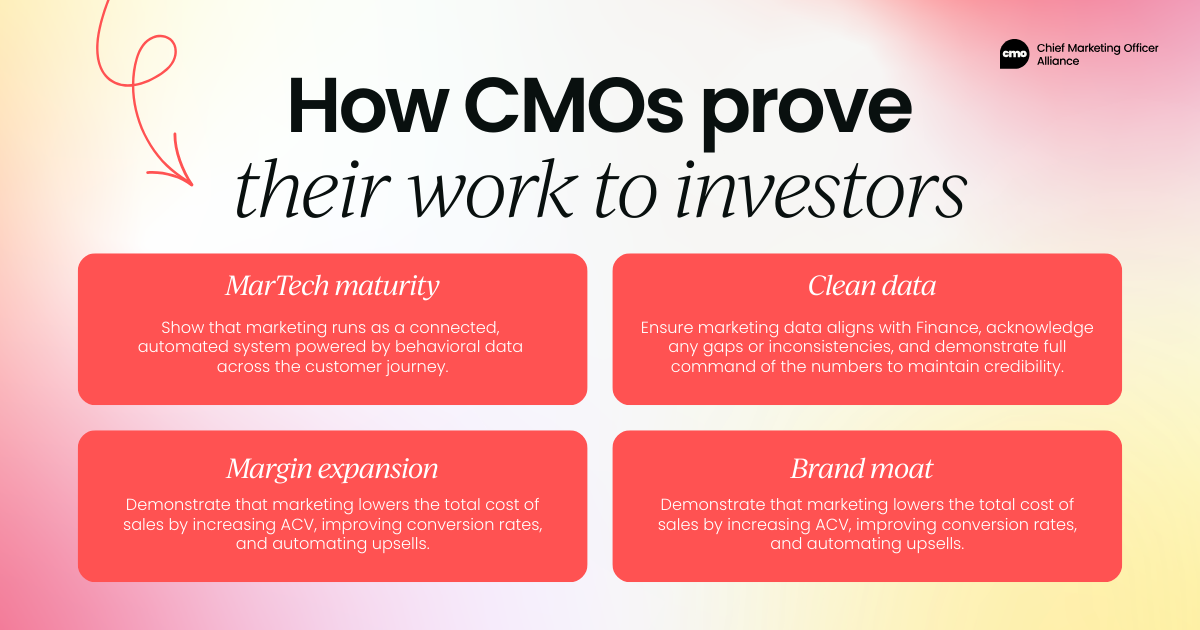
MarTech maturity
Demonstrate you aren't just sending emails, but tracking the customer journey. Map out the system handoffs and enrichment points, identify current or future behavioral data, and determine how it impacts outreach. You want to describe an automated flywheel, not a series of manual campaigns.
“Clean” data
Nothing kills confidence faster than dubious data. If you don't match Finance's numbers, everyone assumes marketing doesn’t have a handle on things. Admit ambiguity (we have dupes in the CRM), clarify where appropriate (lead scores differ by source), and above all, understand the data.
Margin expansion
Show marketing reduces the cost of sales. If marketing-led leads close faster or at a higher price point than cold-outreach leads, you are not a lead source; you are a value creator, a reducer of sales friction. Grow ACV, optimize conversion rates, and automate upsell opportunities.
Brand moat
Find data to support brand defensibility and tout your differentiation. What is your moat? Brand? Switching Costs? Network Effect? Investors will (rightly) ask, “What protects this company from competitors simply outspending them in paid display ads?”
You need a concise and compelling answer to that.
How to adopt this mindset
At this point, I hope it's clear that even without an impending acquisition, there is real benefit to adopting due diligence as an operating mindset to “do diligence.”
Even if an acquisition never comes, CMOs can use the framework to drive internal efficiency, elevate marketing's status within the organization, and maybe even secure more budget!
What actions can interested CMOs take to embrace this?
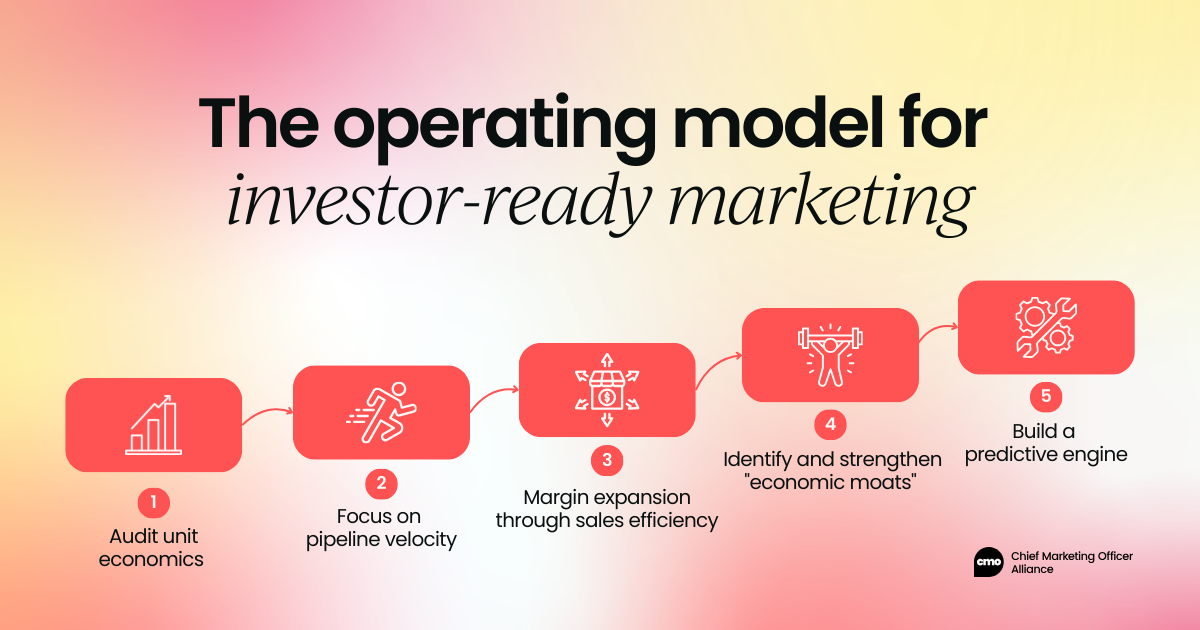
Audit unit economics
PE firms first look at the LTV:CAC ratio and Payback Period. Don’t wait for a sale to track these. Go back as far as you can to establish run rates and model patterns. This is also a good place to start carving up cohorts to understand how behavior may have changed over time.
Establish a "Unit Economics Dashboard" to be shared with the CFO at regular meetings to align on available data and to commit to working with your finance partner to derive business meaning and gain buy-in.
When you can prove that every dollar invested in a specific channel yields four in lifetime value (and that conclusion is endorsed by Finance) budgets morph from educated guesses and line item negotiation into pretty simple math for growth.
Focus on pipeline velocity
Due diligence often exposes "lead inflation," where marketing generates thousands of leads that never turn into revenue. While we know the truth is more nuanced than that, it is a helpful lens when assessing spending efficiency.
Instead, it’s worth doing the following:
Stop incentivizing your team on MQLs or general funnel figures. Instead, tie KPIs (and thereby bring focus to) pipeline velocity (how fast leads close) and analyze sales acceptance rates (by month, by rep, by source)
Get beyond lead quotas and funnel figures and focus on intention and behavioral signals wherever possible. Getting more of the fastest-moving leads will yield multiple improvements — not just to the metrics.
Margin expansion through sales efficiency
A big part of the CMO job is to focus on the total cost of sales. It is not enough to administer the marketing budget to minimize waste; CMOs need to reduce sales friction everywhere.
Explore these margin-expanding signals:
- Higher average contract value (ACV): Assume marketing leads are educated on the value proposition and close at a 20% higher price point than cold outreach (because they buy a higher tier), thereby directly expanding gross margin.
- Reduced sales touch: If marketing content answers 80% of a prospect's questions before they speak to a rep, did marketing not reduce the Sales Engineering hours required to close a deal?
- Improved win rates: Do higher-quality leads or content-driven nurture result in higher win rates, reducing the expense of sales labor on lost deals?
- Automated upsells: Using behavioral data to trigger expansion revenue (upsells) without needing a salesperson to pick up the phone is the ultimate form of margin expansion. Understand your base and target your offers.
Identify and strengthen "economic moats"
Investors love "moats" – the conceptual barriers to entry that protect profits from competitive threats or market erosion. Once the vision statement is written, this often falls to the bottom of priorities, but CMOs are responsible for building (or at least measuring) several types of moats:
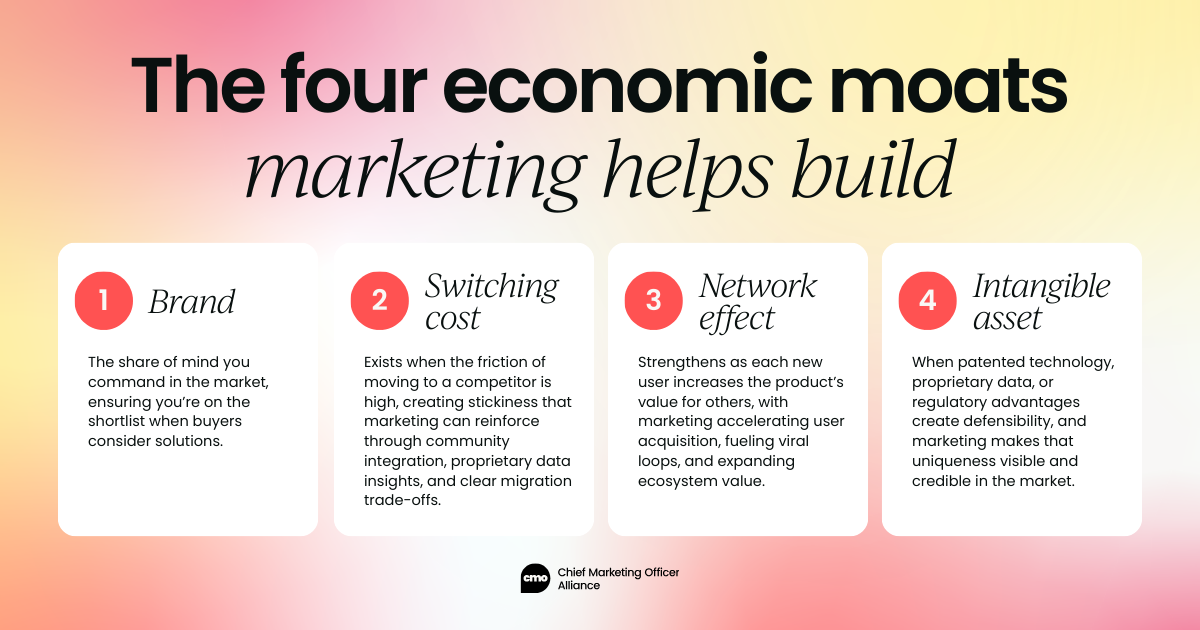
- Brand moat: The share of mind you command in the market. When solutions are considered, are you on the short list or an afterthought? Ideally, you want to own the category (e.g., Kleenex vs. tissues), but any level of recognition reduces reliance on paid acquisition.
- Switching Cost moat: When the friction of moving to a competitor is too high, the incumbent benefits from a certain stickiness. Marketing can assist here by deepening community integration, leveraging proprietary data insights, or highlighting costly migration use cases.
- Network effect moat: When each new user makes the product more valuable for everyone else (e.g., Slack or LinkedIn), marketing’s role is to cost-effectively acquire users, drive viral loops, and define new ways to increase the ecosystem's value.
- Intangible asset moat: If patented technology, proprietary data, or unique regulatory requirements make your product a seemingly safe harbor for discerning users, marketing must showcase the uniqueness that competitors cannot replicate.
Build a predictive engine
Investors value repeatable systems.
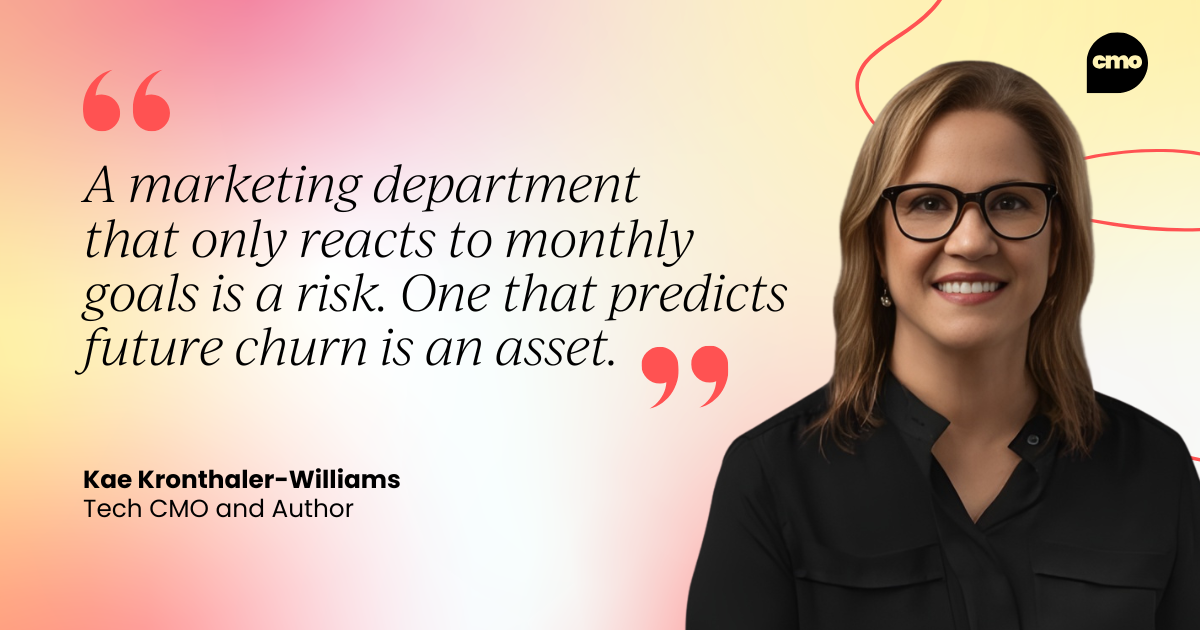
A marketing department that only reacts to monthly goals is a risk; one that predicts future churn is an asset.
Implement "Propensity Modeling" using behavioral data. For example, automate outreach to customers whose usage frequency has dropped before they reach the churn window.
You move from defensive marketing (finding more customers to replace those you've lost) to offensive marketing (securing future revenue efficiently).
Master the narrative on data
We all know that making decisions based on incorrect or incomplete data isn’t pretty.
During diligence, dirty data leads to valuation haircuts, which cost stakeholders real money. In daily operations, it complicates our lives, pollutes our dashboards, and impedes progress. Do everything you can to improve data integrity.
Treat your CRM and MarTech stack as a financial ledger. Conduct audits to ensure marketing attribution aligns with the revenue recognized by the finance team.
When the numbers are aligned and verified, the marketing function is seen as trusted to lead strategic growth initiatives. The result is you gain credibility with your peers, your CEO, and your Board. The ultimate lesson from any diligence process is that transparency is the goal.
A smart CMO operates as if they are constantly building the "data room" of a billion-dollar deal. By maintaining this level of rigor, you ensure that marketing is never the first place people look when it’s time to cut costs—instead, it’s the first place they look when they want to invest for growth.
So, long before it’s time for due diligence, I encourage you to do diligence!


Become a CMO Insider
Thank you for subscribing
Get exclusive insights, frameworks, and strategies from marketing leaders driving real business impact.
An email has been successfully sent to confirm your subscription.
 Follow us on LinkedIn