.png)





2025 has been a year of recalibration for marketers.
The pressure hasn't let up. If anything, it's intensified.
AI is reshaping workflows faster than most teams can adapt, budgets are under scrutiny, and the expectation to deliver measurable results with fewer resources has become the norm rather than the exception.
But here's what's shifted: marketers are getting clearer about what they actually need from their careers. Not just what sounds good in a job description, but what makes the difference between building something meaningful and burning out.
So when you're looking at new opportunities, what should you actually prioritize? What matters most when the market feels overwhelming, and every role seems to want someone who can do everything?
In this article, we'll look at:
- What top marketers are prioritizing when they evaluate roles,
- Which skills will keep you competitive as the landscape shifts, and
- What compensation looks like across different industries and experience levels.
What do marketers prioritize when choosing roles?
Let’s unpack some of our Future of Marketing report findings.
Company culture matters more than you think
Most of us have worked somewhere that looked great on paper but not so good in practice.
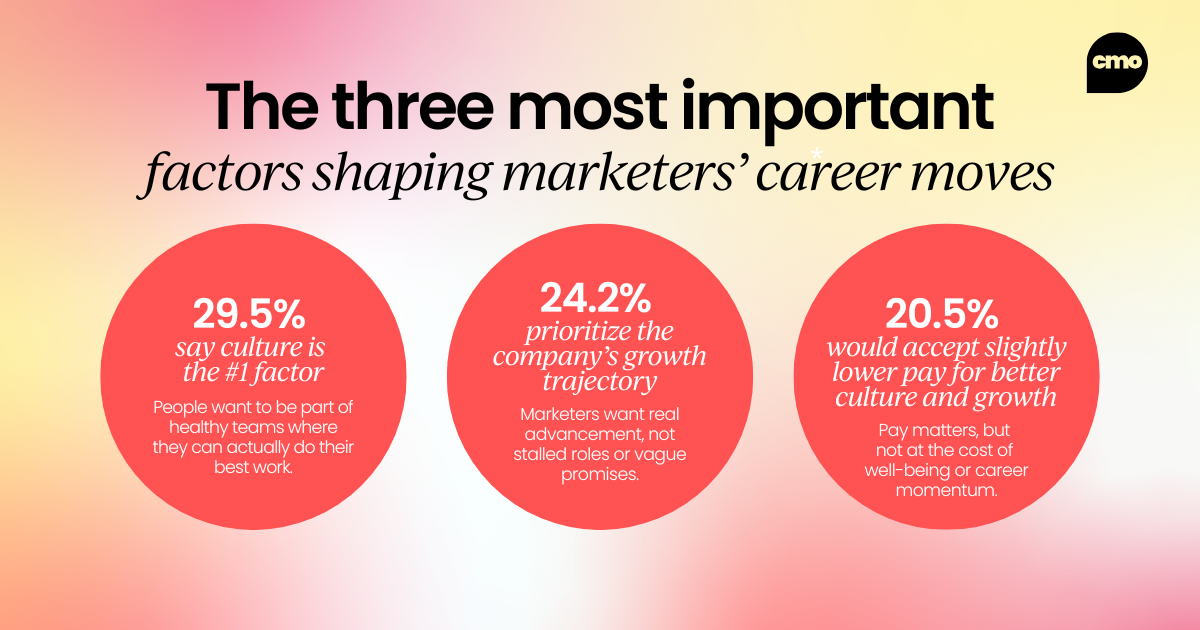
And now 29.5% of marketers say company culture is their number one consideration when applying for roles.
The reason being that culture directly affects whether you'll be able to do your best work, grow in your career, and still want to get out of bed and go to work a year from now.
This finding lines up with what some other marketing leaders have suggested will be central to great marketing: authenticity. More and more, people are leaning towards those human qualities that are irreplaceable and the values that make us show up for work meaningfully.
Another piece of data backs this up.
When you look at what's keeping marketing leaders up at night, burnout and overwork top the list at 25.9%. That's more than a quarter of marketing teams dealing with people who are stretched too thin, stressed out, and headed for the exit.
So when we say culture matters, we're talking about finding a place where you can build something meaningful without sacrificing too much in the process.
Company growth trajectory
Coming in second is the company's growth ambitions (24.2%). You want to work at a company that's actually going somewhere.
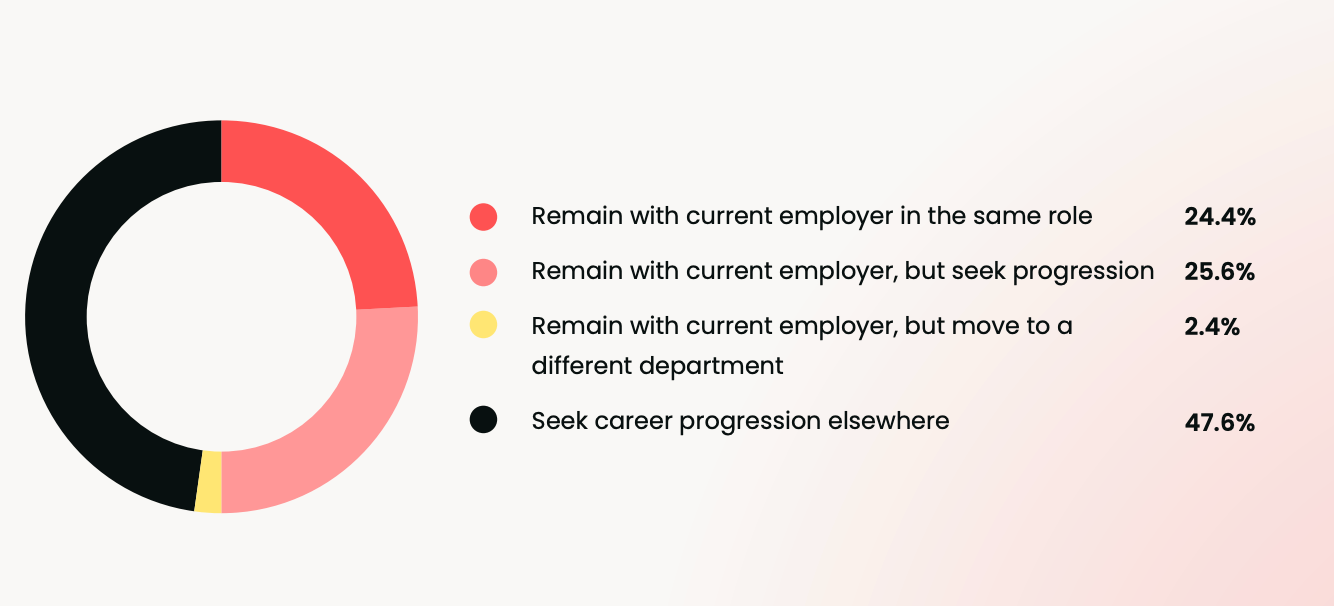
To make matters even more interesting, here’s another stat: 47.6% of marketers plan to seek career progression outside their current organization. That's nearly half.
What does that tell you?
People are looking for actual upward mobility, not empty promises about "future opportunities" that never materialize.
Stagnant companies mean stagnant careers. If a company isn't growing, very likely there's nowhere for you to grow either.
Salary is not the most important factor
That’s not to say salary doesn’t matter at all, because of course it does.
But data shows 20.5% of marketers would rather take a slightly lower salary at a company with strong culture and real growth potential than chase the biggest number.
That said, there's a difference between prioritizing culture over a marginal salary difference and accepting significantly below-market rates because a company seems a better fit culturally.
The skills that'll keep you competitive
So, now we’ve got a sense of the factors that matter most at the time of applying, let’s look at the skills that'll keep you valuable as the industry evolves.
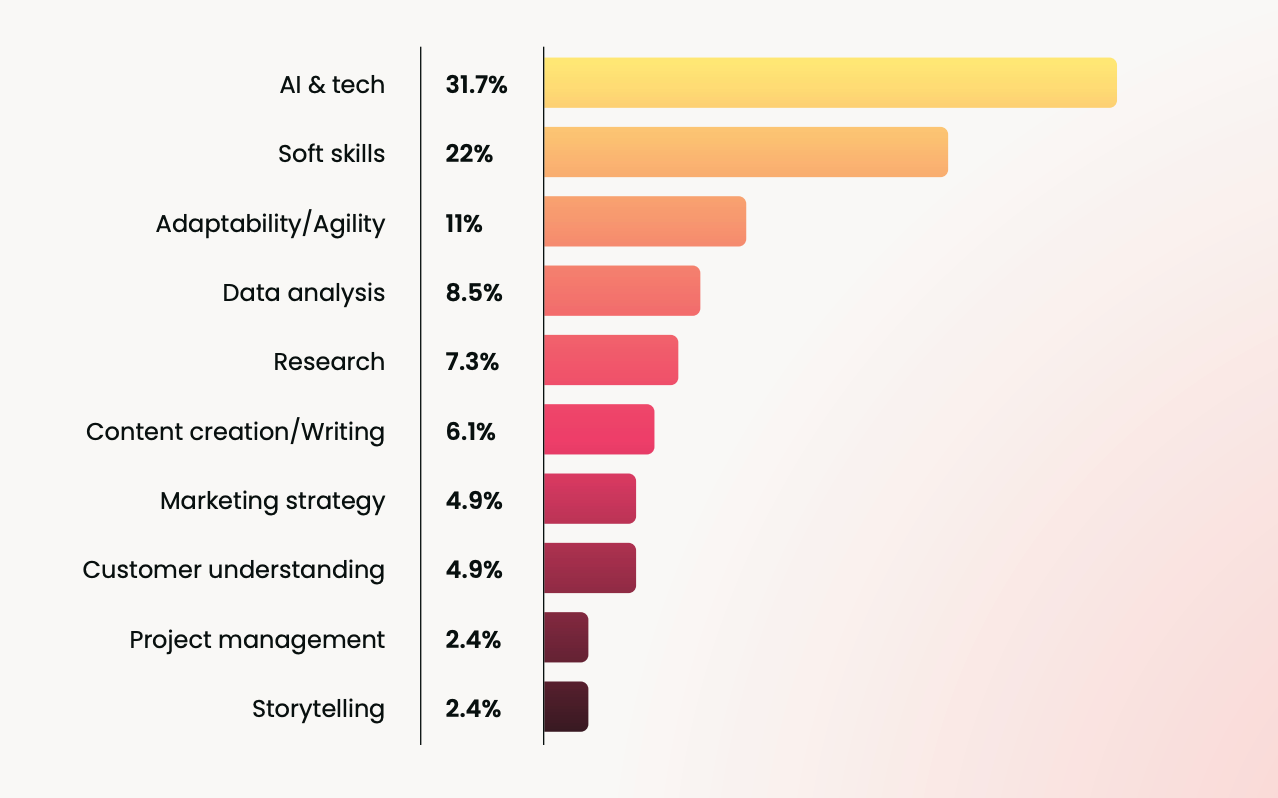
AI and tech proficiency are non-negotiable
This is the top future skill marketers need, identified by 31.7% of respondents. And it makes sense: 61.8% of marketers already say AI makes them more efficient at their jobs.
Now, before you panic thinking you need to learn to code, don’t worry. All you need is to be comfortable piloting and experimenting with AI tools and thinking strategically about where they add value.
But where are marketers using AI the most? Well, most marketers are currently using AI primarily for written content creation (63%). The real opportunity, however, is in becoming an "AI operator," someone who leverages these tools for research, automation, content variation, and analysis without losing the human touch that makes marketing actually work.
According to Chloe Addis (Head of Marketing at Headley Media), “many roles will have a greater focus on prompt engineering, and the true skills will lie in interpretation of results/data and strategic application.”
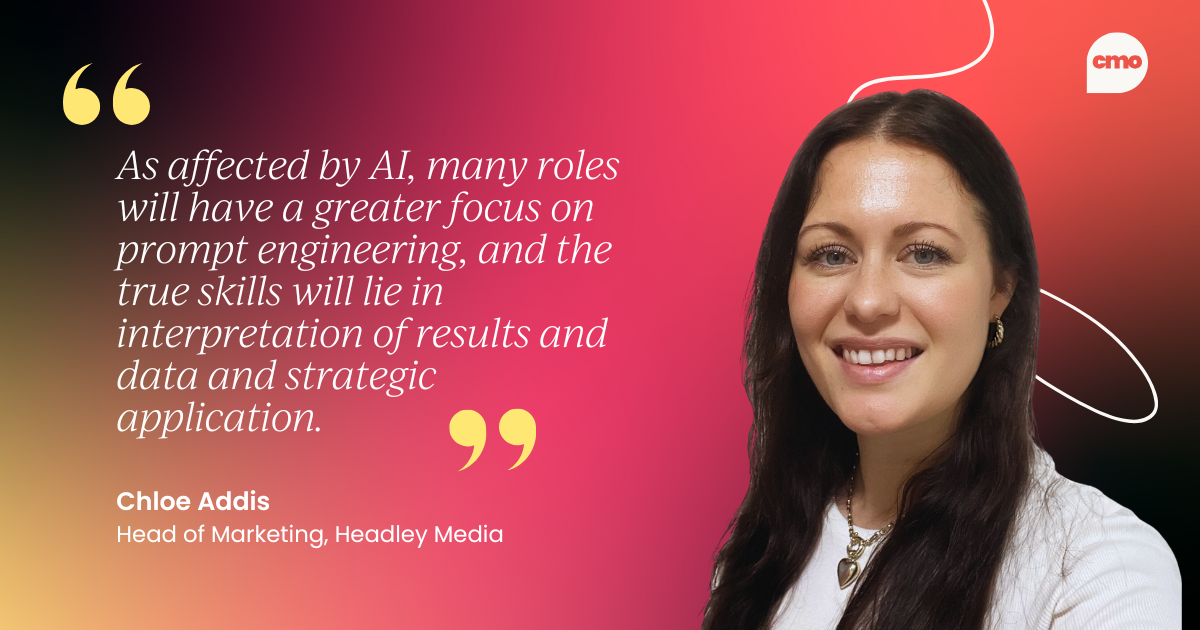
Clearly, human interpretation and analytical skills remain crucial.
Creativity and soft skills are more valuable than ever
As AI handles more of the generic stuff, human creativity becomes more valuable.
Soft skills (including creativity, empathy, and strategic thinking) are the second most valued trait at 22%.
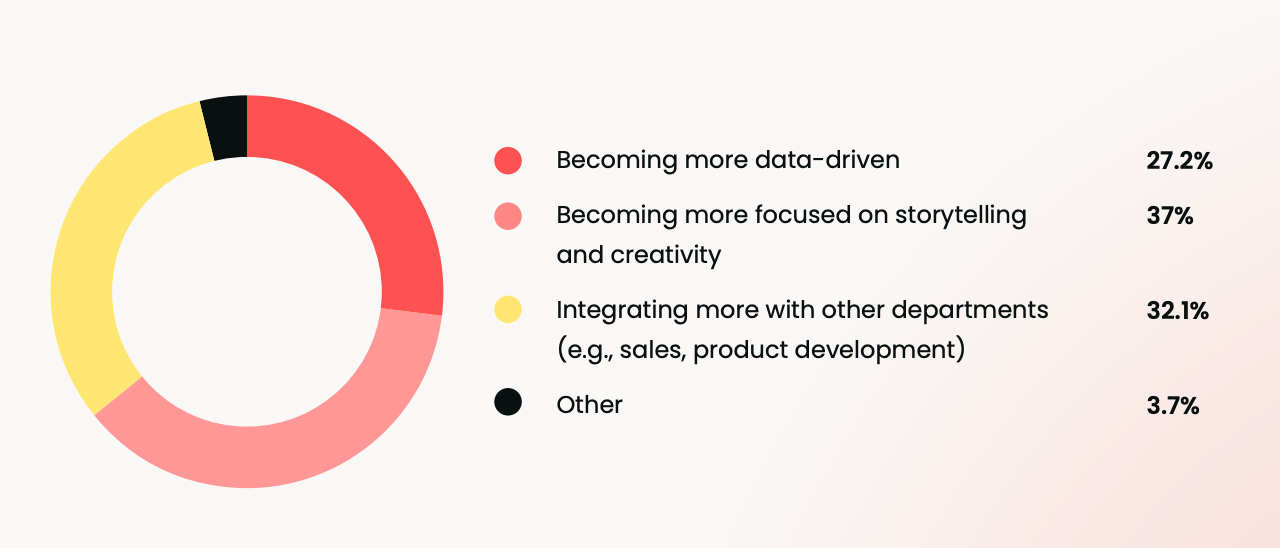
In fact, the data shows that 37% of marketers expect an increased focus on storytelling and creativity as teams evolve over the next five years.
Why? Because AI can churn out competent but generic content all day long. What it can't do is understand human emotion, create genuine connections, or tell stories that actually resonate.
Your ability to think differently, understand what makes people tick, and create something that cuts through the noise—that's what keeps you relevant. That's what AI can't replace.
Alberto Gerin (CMO at Modefinance) shared some insight into this combination of technical and human skills:
“The real opportunity is combining AI-powered personalization with first-party data and emotional intelligence, to make marketing feel not just relevant, but human. Pretty sure that the winners will be those who master both the technical architecture and the empathetic storytelling.”
Cross-functional collaboration is the new normal
Marketing isn't happening in a silo anymore.
It's becoming more integrated with sales, product development, and other departments. In fact, 32.1% of teams are moving in this direction.
What does that mean for you? You need to be able to speak the language of other departments. You need to understand how your marketing connects to sales goals, product roadmaps, and overall business strategy.
Roles are shifting toward being internal strategy functions, connecting dots across the organization and revealing meaning inside the company, not just broadcasting messages outside of it.
Marketing doesn't work without resources. You can't create great content, run effective campaigns, and drive meaningful results with nothing but good intentions.
Let's talk a bit about compensation
Though culture ranked highest in our report, salary plays a massive role in anyone’s career development. Here's what you need to know about competitive compensation in marketing right now.
The most common base salary band for marketers is $101,000 to $150,000 annually. That's your baseline for understanding whether an offer is in the ballpark.
But that varies significantly based on several factors, which we'll break down.
Company size and revenue
Bigger companies generally pay more, but it's not just about employee count. It's also about revenue. Marketers at companies generating $2 billion or more in annual revenue earn a median salary of $190,000.
That's substantially higher than smaller companies, and it makes sense. Larger companies have bigger budgets, more complex challenges, and typically more resources to pay competitive salaries.
Industry makes a huge difference
The truth is some industries just pay better than others.
Jelle Boeser (Head of Brand and Digital Marketing at Royal Canin) explains the reality: “As marketing roles get more complex and more strategic, salaries will follow.”
So, if your skills are transferable, it's worth looking at where the money is.
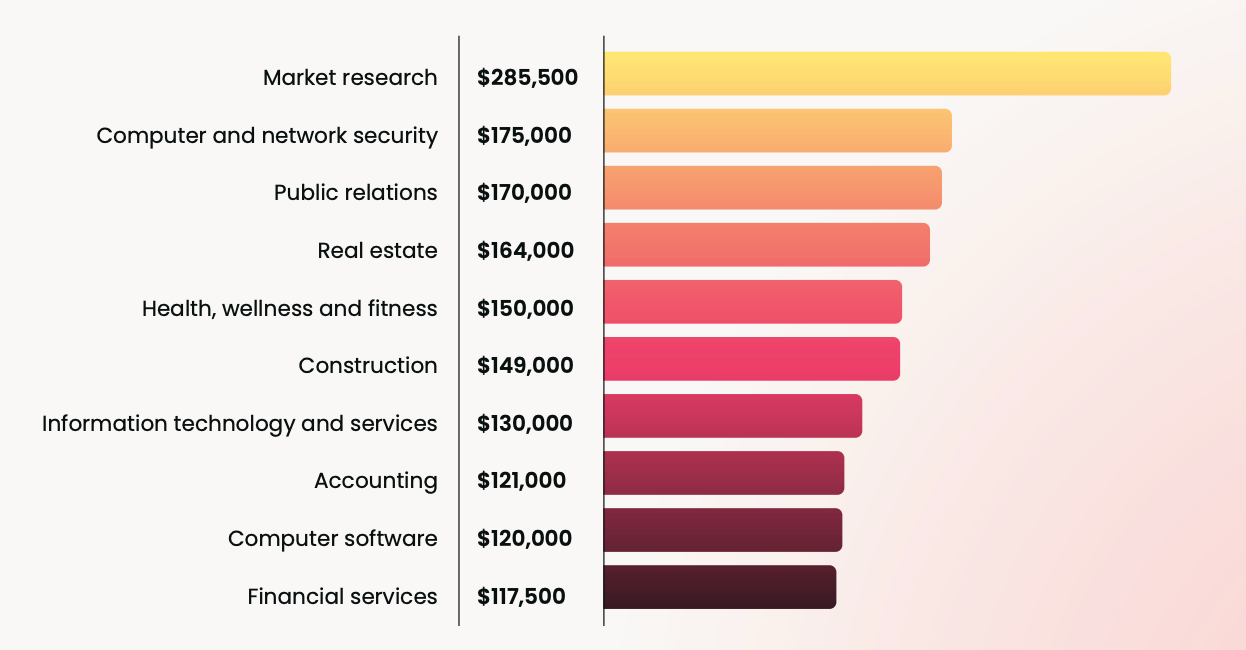
For example, market research tops the list with a median salary of $285,500. Companies really value data-driven insights that can shape strategy and give them a competitive edge.
Computer and network security comes in second at $175,000, followed by public relations at $170,000. On the other end, industries like accounting ($121,000) and financial services ($117,500) pay less for marketing roles.
Computer software, despite being one of the most common industries for marketers (17.7% of respondents work in this space), only has a median salary of $120,000. So don't assume tech companies automatically pay more.
B2C vs. B2B Compensation
Here's an interesting one: B2C roles have a higher median salary at $130,000 compared to B2B's $121,000. Clearly, professionals who understand how to scale and optimize direct consumer engagement are in high demand.
If you can find B2C roles that fit your experience, you're looking at a premium. The skills are often transferable, so it's worth considering.
Experience level
Your years of experience directly impact your earning potential, but not in a linear way.
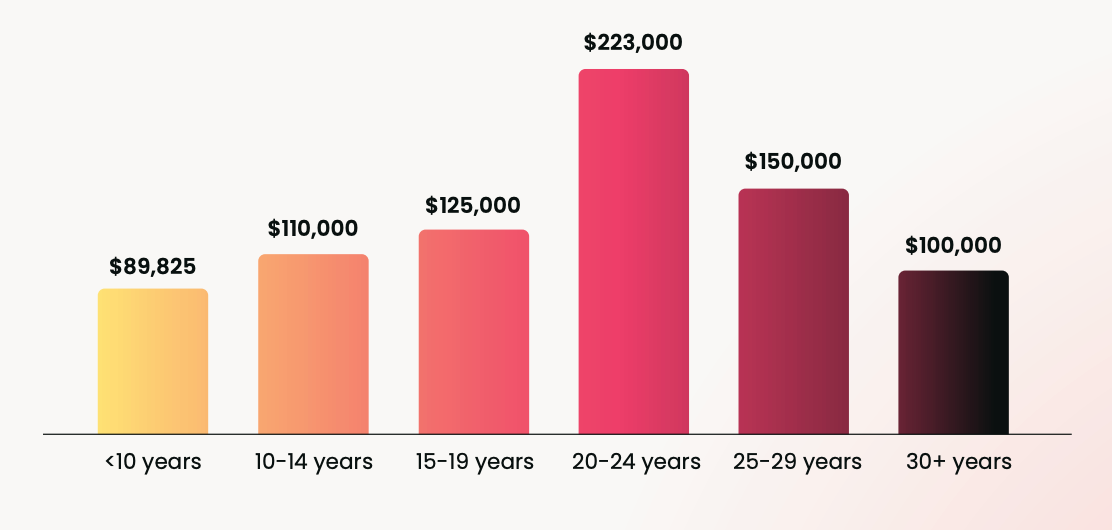
The most dramatic salary jump happens between 15–19 years of experience (median of $125,000) and 20–24 years of experience (median of $223,000). That's nearly double.
What's happening there? That's the point where marketers are typically stepping into executive roles or highly specialized positions. You're no longer just a senior team member. You're setting strategy, leading organizations, and your decisions have major business impact.
Interestingly, compensation dips after 24 years. Professionals with 25–29 years of experience report a median salary of $150,000, and those with 30+ years drop to $100,000. That's likely because many people at that stage are transitioning into retirement, taking part-time or advisory roles, or downshifting from high-pressure leadership positions.
Finally, remember the market reality
The market is tough right now, and here's the reality: 41.5% of marketers cite staffing limitations as one of their biggest barriers to achieving goals.
As Heather Hurd from Zander Labs put it, "The best talent is willing to wait for that perfect fit, and those plummeting salaries are going to cost companies the amazing people who will really drive results."
Translation: you don't have to settle. Companies need good marketers, and the smart ones know they need to treat their people right to keep them.
So, play to your strengths
If you're not advancing where you are, the problem might not be you.
It might be the environment.
Look for places that value what you bring to the table. Look for cultures where you can do your best work without fighting the system every single day. Look for teams that are going somewhere and want you to be part of that journey.
At the end of the day, finding the right marketing role comes down to being honest about what you need and what you're worth.
To wrap up
With burnout affecting more than a quarter of marketing teams and 47.6% of professionals already planning to leave their current organizations for better opportunities, the stakes are high.
You can't afford to ignore culture in favor of a bigger paycheck or a more impressive company name.
But culture alone isn't enough.
You also need to think strategically about your skill development, especially around AI and tech proficiency. You need to find companies with real growth ambitions, and yes, you need fair compensation that reflects your experience and the value you bring.
The good news?
The framework for evaluating opportunities is straightforward. Ask the hard questions during interviews. Trust your gut when something feels off. Don't settle for roles that want you to be everything to everyone without the resources to succeed. And remember that the best talent can afford to wait for the right fit.
Whether you're just starting your job search or you're in the middle of evaluating offers, keep these priorities in mind.
Find a place that actually values what you bring to the table, a culture where you can do your best work, and a team that's going somewhere worth following.
Want a clearer picture of where marketing is really heading?
Our Future of Marketing report cuts through assumptions with real data on budgets, priorities, challenges, and how AI is actually being used by marketers today.
If you’re wondering what your peers are doubling down on, and what they’re shifting away from, it’s all in here.
 Charley Gale


Become a CMO Insider
Thank you for subscribing
Get exclusive insights, frameworks, and strategies from marketing leaders driving real business impact.
An email has been successfully sent to confirm your subscription.
 Follow us on LinkedIn