.png)




There is a growth ceiling that nearly every digital product company reaches. The product itself, the onboarding process, or the paid acquisition funnel might all seem fine. However, conversion rates drop, retention becomes unpredictable, and the data makes it hard to identify a clear reason for these issues.
I encountered this very much underexplored pattern in several digital products during my career. I worked with a digital insurance platform, a B2B fintech product, a professional EdTech platform, and a few others. I noticed the same issue across very different sectors, markets, and founding teams. It took me building the go-to-market strategy for several products, as well as exploring other markets and industries, to realize what they had in common.
In nearly every case, we targeted the right end user, but overlooked the person who actually had a much greater influence on product adoption.
I refer to this as the Trust Layer problem. The method I developed to address it is the Trust Layer Method, and I want to guide you through it now.
Why is this a digital technology challenge specifically?
Before discussing the method, it's important to explain why this issue matters for digital product companies across markets right now.
Digital products exist in an environment where trust is declining. The Thales 2025 Digital Trust Index, which surveyed over 14,000 consumers across more than 10 countries, found that no sector achieved more than 50% trust. Even more concerning, over 88% of consumers say it has become harder to tell what is real online than a year ago. Essentially, the main value of digital products relies on users trusting something they can’t physically see or touch. This trend is actually rising globally.
On the other hand, the cost of acquiring users with low intent has dropped significantly. Cheap targeting tools, testing programmatic advertising across markets, and AI-driven campaign management are now pretty easy to implement.
A combination of all the above gives digital product companies a great opportunity to reach large audiences at low cost. However, they can’t tell which users are really interested in adopting the product and which ones are just browsing.
As a result, companies have traffic-filled funnels, dashboards showing activity, and conversion rates that never meet expectations. The problem isn’t with the funnel or the product itself. Competitors are making better adoption decisions than the user, leaving your product somewhat out of the conversation.
What is the Trust Layer Method?
The Trust Layer Method is a framework I developed and used myself while working directly with digital product companies across insurtech, fintech, EdTech, and healthtech. It’s built around three distinct audiences that every B2B2C digital product is dealing with, whether the GTM strategy acknowledges them or not.
- The Seeker – this is your end user who ultimately uses and benefits from your product. They want a solution, but they don’t decide alone, particularly for digital products that involve personal data, transactions, or professional development.
- The Gatekeeper is the third party who holds disproportionate trust with the Seeker. They influence or recommend your digital product. They are often invisible in your analytics, but they’re the reason your highest-converting users convert.
- The Builder – this is you and your product – essentially the digital product company that has to earn trust from both layers simultaneously, at different speeds, often with different tools and messages.
And there are five pillars the method runs across:
- Diagnose
- Map
- Research
- Enable
- Measure
Step 1: Diagnose – Are you in a Trust Layer ecosystem?
Ask yourself: do your Seekers arrive already partially convinced, but not by your marketing? Is conversion lower than expected despite strong awareness? Are your best-converting users coming from one source you haven't invested in? If yes, you have a Trust Layer problem… and an opportunity.
Step 2: Map – Who is your Gatekeeper?
Once you have confirmed the Trust Layer exists, get specific. "Healthcare professionals" are not Gatekeepers. "The GP who introduces a digital health tool during an annual review" is. Know exactly who they are, where they meet your Seeker, what they gain from recommending you, and what they risk.
Step 3: Research – Talk to both layers
Plan five conversations with Gatekeepers and five with Seekers. For Gatekeepers, prepare questions to help them feel confident recommending you. On the other hand, ask Seekers who exactly influenced their decision. Make notes and write down their exact words.
Ask Gatekeepers:
- What frustrates them most about similar digital products they have encountered?
- What would make them confident in recommending your platform to someone they advise?
- What is the single biggest risk they see in doing so?
Ask Seekers:
- How did they first hear about your product?
- Who else did they consult before making a decision?
- What would make them trust a recommendation from [Gatekeeper role] about a digital product like yours?
Step 4: Enable – Design for the conversation you cannot control
You won't be in the room when your Gatekeeper recommends you. Make it easy. Can they explain your product in one sentence? Have you removed any reputational risk in doing so? Do you have a feedback loop that captures what Gatekeepers are hearing from Seekers after they recommend you?
The thinking behind this step didn't start with a framework. It started with a specific problem encountered while leading marketing at a UK digital pet tech startup – where vets, not ads, not pricing, were the primary conversion driver. The Gatekeeper was already there, already influencing every adoption decision, just completely absent from the analytics.
I wrote about this in detail in What Pettech Taught Me About Marketing in B2B2C Industries, where I introduced the core principle: in trust-gated digital products, the person you cannot control is often the person who matters most. That piece focused on pettech specifically, but the pattern turned out to be consistent across every digital product sector I subsequently worked in – insurtech, fintech, EdTech, healthtech.
Step 5: Measure – Add a Gatekeeper track to your reporting
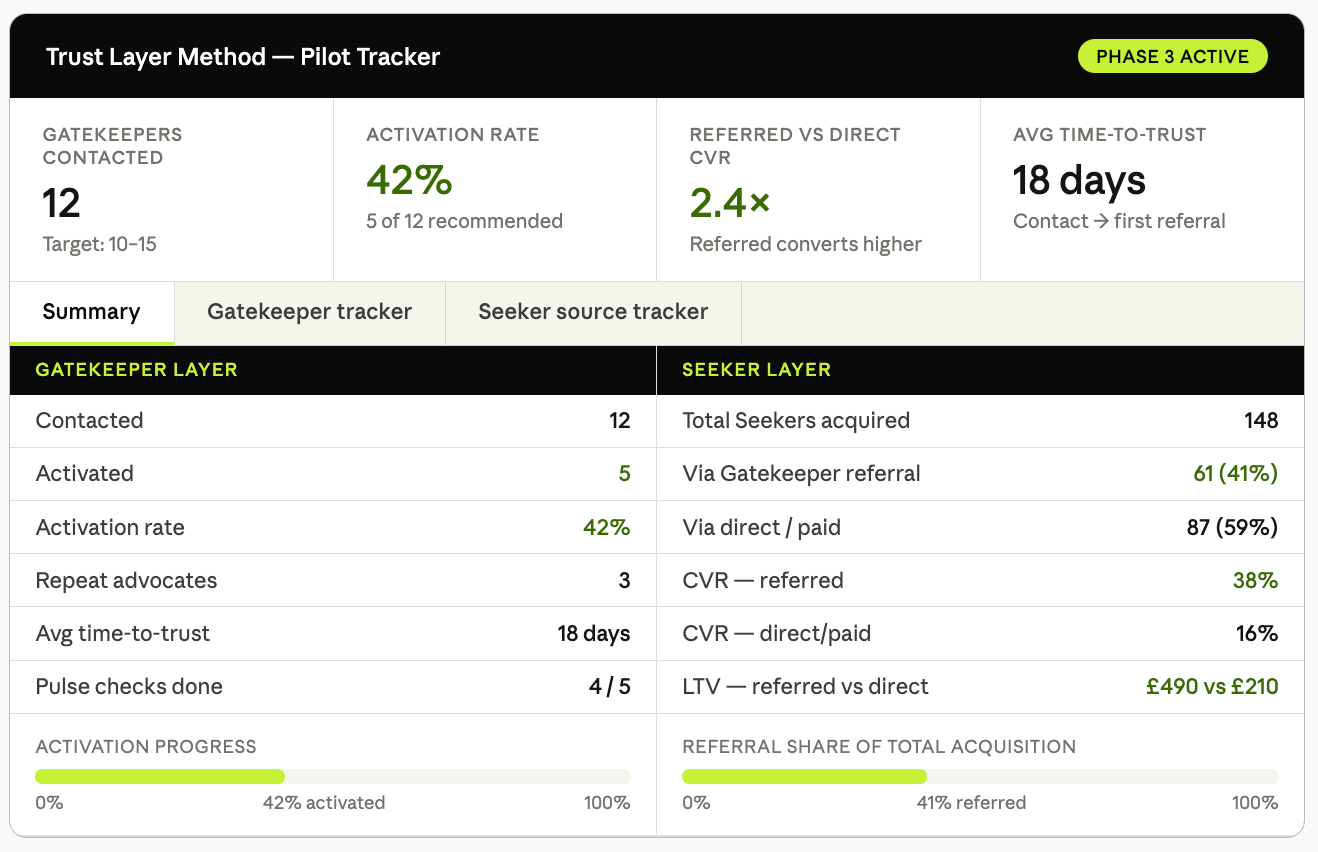
This is a stage where your reporting becomes dual, as you’ll add a Gatekeeper track. I suggest measuring the activation rate, referral conversion, and LTV by source. In every product I've worked on, Gatekeeper-referred users retained longer and converted at a higher rate than direct acquisition.
I suggest creating a reporting framework, which I’ll showcase below, and adding these to it:
- Gatekeeper activation rate: What percentage of Gatekeepers in your pilot cohort have recommended your product at least once or more times?
- Referral source conversion rate: How does the conversion of Seekers referred by Gatekeepers compare to direct acquisition through other channels?
- Gatekeeper retention: Are they recommending repeatedly over time, or was the first recommendation a one-off?
- Time-to-trust: How long from first Gatekeeper contact to first active recommendation?
- LTV by acquisition source: Are Gatekeeper-referred customers retaining longer and generating more revenue?
Running a pilot: three phases
Don't deploy across your entire market at once. Start structured.
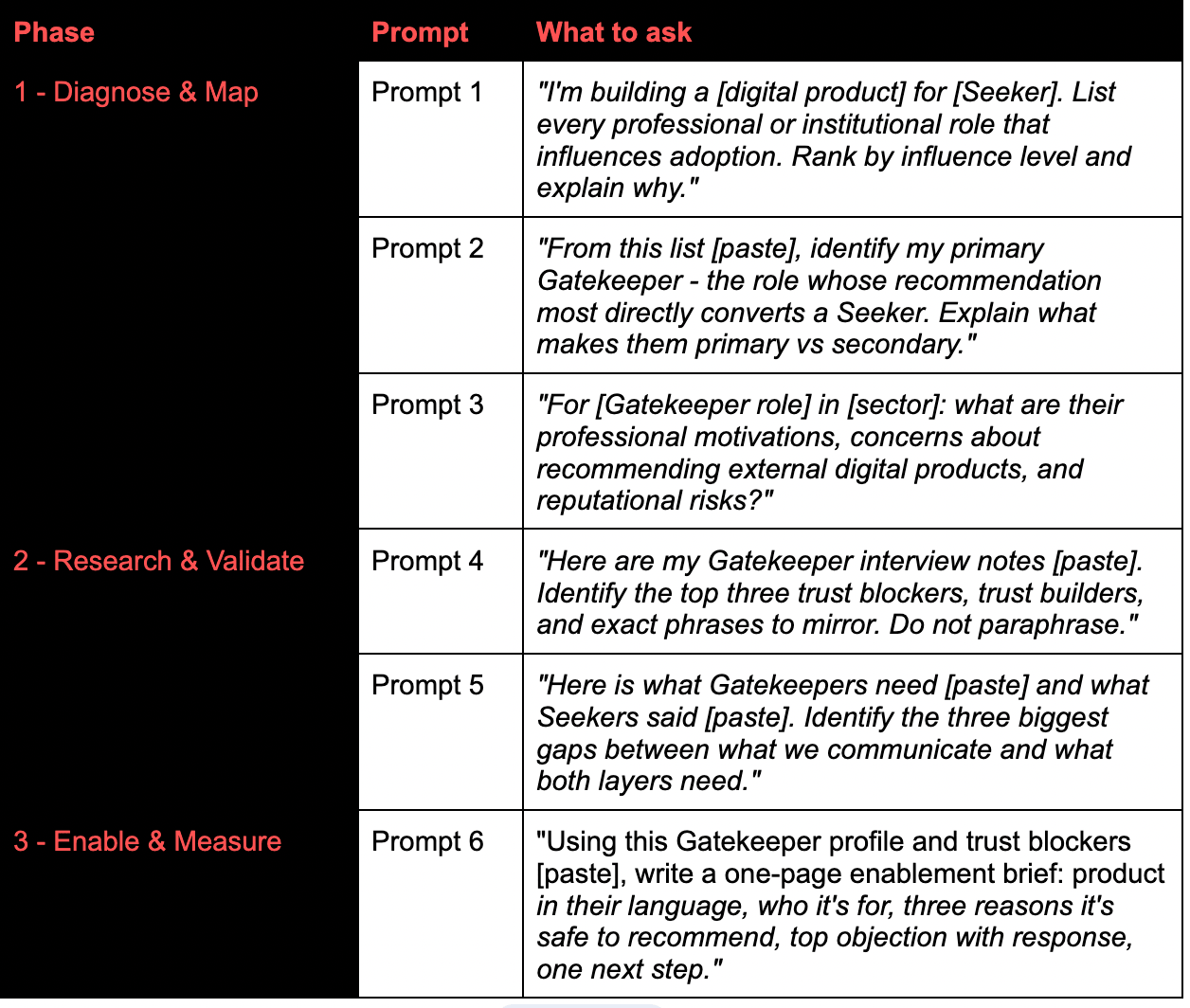
Using AI to accelerate the Trust Layer Method
AI is a big help here, as it can meaningfully compress your research and approach phases for this method. Here’s a prompt approach that you can run in sequence, feeding the output of each into the next. Use an agent that you feel comfortable with, whether that's Claude, ChatGPT, Gemini, or another tool. My personal preference is Claude.
You can copy the full pilot tracking template – Gatekeeper tracker, Seeker source tracker, and summary dashboard – and adapt it directly to your product. Grab your template here.
What changes when you apply this
- Acquisition becomes more efficient → You start investing in channels that produce Gatekeeper-referred Seekers - who convert better and retain longer;
- Messaging becomes more precise → Your language becomes theirs, and you gain consistency between what the Gatekeeper says and what your product communicates. It is actually one of the most underrated drivers of digital product trust
- GTM strategy becomes defensible → Your relationships with Gatekeepers become unique, and it becomes way more complicated for competitors to replicate it even if they operate with larger budgets.
The Trust Layer was already there
In every product I've worked on, the Gatekeeper was already there, influencing adoption; we just weren't paying attention. The fastest-growing digital product companies aren't always the best-funded or the most technically advanced. They're the ones who figured out who their end user actually listens to - and built for that.
Discover the Trust Layer Method in our exclusive live session
Join Yuliia Krupenko on June 30 for The Trust Layer Method: Find Your Gatekeeper and Grow Faster.
You'll learn a practical five-step framework to identify the people who drive trust, improve conversion rates, and build a reporting system that proves their impact.
Register now and start applying the framework to your product this week!


Become a CMO Insider
Thank you for subscribing
Get exclusive insights, frameworks, and strategies from marketing leaders driving real business impact.
An email has been successfully sent to confirm your subscription.
 Follow us on LinkedIn