.png)





There’s no shortage of AI in marketing right now.
Every team is experimenting. Every vendor is shipping new capabilities. Every roadmap has “AI” threaded through it somewhere. And yet, when you step back and look at how most marketing organizations actually operate, the change is incremental at best.
Execution is faster, and output is higher, but the team’s operating model remains unchanged. This creates a disconnect between the power of AI and its ability to actually amplify the effectiveness of the people using it.
The marketing teams that are winning with AI use it to make decisions, process market signals, and translate insight into execution. Yes, efficiency is important, but impact is the top priority here.
Naturally, AI agents are integral to elevating that impact. And with agents becoming easier to create, connect, and iterate, the sheer volume of possibilities makes it tough to even decide where to start.
Here’s a shortlist of AI agents that are changing the game for high-performing marketing teams.
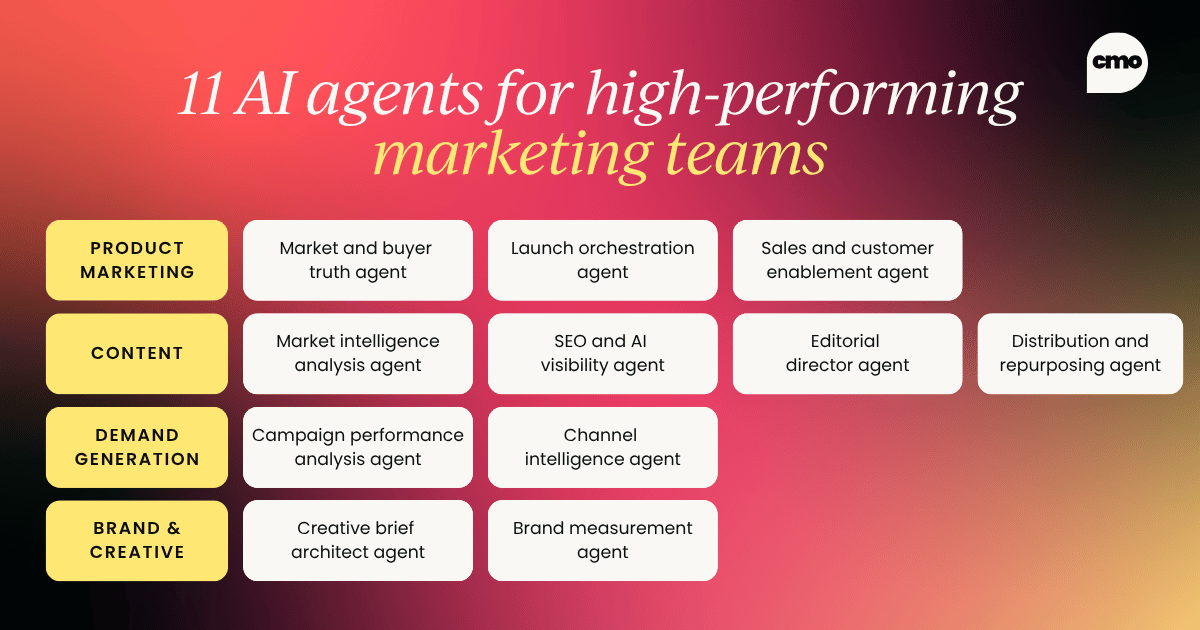
Product marketing agents: Turning market signals into strategic action
Product marketing connects what you build with how the market understands it. The challenge is that most organizations operate with incomplete or outdated views of buyer behavior. AI agents change that by continuously feeding real-world signals into the strategy.
Market and buyer truth agent
This agent directly impacts conversion rates, sales alignment, and overall GTM effectiveness. It replaces internal assumptions with real buyer behavior.
For CMOs, this is one of the highest-leverage investments across the entire marketing function.
Core responsibilities:
- Analyze sales calls, CRM data, and win/loss reports at scale
- Identify buying triggers, objections, and decision criteria
- Surface patterns in how buyers describe problems and evaluate solutions
- Continuously update messaging inputs based on real-world data
Real-world use cases:
- A company shifts messaging from “cost savings” to “speed and confidence in decision-making,” leading to higher mid-funnel conversion
- Sales and marketing align around a unified understanding of buyer priorities, improving consistency across touchpoints
- Product teams incorporate buyer insights into roadmap prioritization
Launch orchestration agent
This agent makes product launches significantly smoother and sets them up for a way bigger and longer-lasting splash. For leadership teams, it reduces operational friction and improves predictability.
Core responsibilities:
- Translate launch strategy into detailed execution plans
- Map dependencies across marketing, product, and sales
- Define timelines, ownership, and deliverables
- Monitor progress and identify risks early
Real-world use cases:
- A product launch plan is executed with reduced planning time and fewer last-minute issues
- Cross-functional teams operate from a single source of truth, improving alignment and accountability
- Marketing leaders gain visibility into execution gaps before they impact launch outcomes
Sales and customer enablement agent
This agent connects marketing output directly to revenue impact. It ensures that insights from customer interactions are reflected in messaging and enablement.
When deployed correctly, these agents redefine GTM by strengthening the feedback loop between marketing, sales, and customer success.
Core responsibilities:
- Analyze customer conversations for recurring objections and questions
- Generate talk tracks, follow-up messaging, and enablement assets
- Identify gaps between marketing messaging and sales reality
- Standardize responses to common friction points
Real-world use cases:
- A recurring objection around implementation complexity is addressed with consistent messaging, improving close rates
- Sales teams adopt standardized follow-up frameworks, reducing variability in performance
- Customer success teams use aligned messaging to improve onboarding and retention
Content agents: Turning content into a competitive intelligence system
Content sits at the intersection of brand, demand, and product marketing. It’s how your company shows up in the market. But in most organizations, content is still treated as a production function. Calendars drive output. Channels dictate format. Performance is measured in isolation.
AI agents change that dynamic, connecting content to market intelligence.
Market intelligence analysis agent
This agent directly impacts positioning, narrative strategy, and competitive differentiation. It enables marketing to move from reactive messaging to proactive category shaping. Instead of relying on periodic research or anecdotal feedback, this agent creates a continuous view of how the market is evolving and where your company can win.
Core responsibilities:
- Aggregate competitor messaging, campaign shifts, and positioning changes
- Analyze buyer conversations across sales calls, CRM notes, and community channels
- Identify emerging themes, language patterns, and unmet needs
- Surface strategic opportunities for differentiation and narrative ownership
Real-world use cases:
- A B2B SaaS company identifies a shift in buyer language from “automation” toward “control and auditability,” leading to a repositioning that resonates with enterprise buyers
- A global marketing team detects early signals of a new category narrative and builds thought leadership before competitors react
- Product marketing uses insights from this agent to refine messaging ahead of a major launch, increasing relevance in initial market reception
SEO and AI visibility agent
This agent impacts inbound pipeline quality and long-term discoverability. As search behavior evolves, the AI search game (AEO and GEO) is becoming increasingly important. While legacy tools have been helpful, creating an agent custom-tailored to your brand and ICP will go a long way.
Notably, a big shift here is from traffic volume to traffic quality.
Core responsibilities:
- Identify high-value keyword and topic clusters across traditional and AI-driven search
- Evaluate content for structure, clarity, and “answer readiness”
- Recommend improvements for semantic depth, internal linking, and topic authority
- Track visibility across both search engines and AI platforms
Real-world use cases:
- A company restructures core content pages to improve clarity and definition, leading to increased inclusion in AI-generated answers and higher-intent inbound traffic
- Marketing teams identify gaps in topic coverage that limit visibility in emerging search patterns and close them with targeted content
- SEO leaders use this agent to prioritize updates that improve both rankings and conversion quality
Editorial director agent
This agent improves content quality, executive communication, and brand clarity. It ensures that messaging reflects strong thinking, not just polished language.
Your editorial director agent is essentially a second set of eyes combing through any asset before it reaches a physical team member (the first being the AI creating the content around guidelines you set).
For anyone who’s been burdened with scrutinizing copy from new hires, partners, and anyone having an off day, this agent takes a huge weight off your shoulders.
Core responsibilities:
- Identify and eliminate competing ideas within a single piece of content
- Strengthen POV and ensure alignment with brand voice
- Remove generic or low-impact language
- Improve structure, flow, and clarity of argument
Real-world use cases:
- A senior executive refines thought leadership content to focus on a single, high-impact idea, improving engagement and shareability
- Marketing teams standardize messaging quality across contributors, reducing variability in tone and effectiveness
- Product marketing sharpens positioning documents to better align with buyer expectations
Distribution and repurposing agent
This agent has a direct impact on ROI from content investments and overall marketing efficiency. It ensures that high-value content drives sustained impact across channels and teams.
It shifts content from campaign-based output to compounding assets.
Core responsibilities:
- Deconstruct long-form assets into multiple channel-specific formats
- Align content outputs with marketing, sales, and executive use cases
- Build distribution plans that extend content lifespan
- Identify underutilized assets and opportunities for reuse
Real-world use cases:
- A webinar is transformed into a multi-channel campaign, including sales enablement materials and executive content, resulting in a 5x increase in reach
- A research report is repurposed into a series of targeted campaigns, extending its influence over multiple quarters
- Sales teams leverage repurposed content to improve follow-up engagement and accelerate deal progression
Demand generation agents: Improving decision quality across channels
Demand generation is already well-supported by tools. The opportunity with AI is not more automation, but rather better decision-making.
These agents help CMOs allocate resources more effectively and tie activity to outcomes.
Campaign performance analysis agent
This agent impacts budget allocation, pipeline efficiency, and marketing accountability. It ensures that decisions are grounded in revenue impact, not surface metrics.
Core responsibilities:
- Evaluate campaign performance across pipeline, conversion, and revenue
- Identify discrepancies between lead volume and deal quality
- Provide post-mortem analysis for continuous improvement
- Surface insights that inform future investment decisions
Real-world use cases:
- A team reallocates budget from high-volume, low-conversion channels to higher-performing programs, improving pipeline quality
- Marketing leadership gains clarity on which campaigns drive actual revenue impact
- Performance insights are used to refine targeting and messaging
Channel intelligence agent
This agent directly informs where to invest incremental budget. It provides clarity in an environment where channel performance can be difficult to compare. For CMOs, it reduces uncertainty in resource allocation.
Core responsibilities:
- Normalize performance data across channels
- Identify incremental vs. non-incremental pipeline
- Evaluate efficiency and scalability of each channel
- Recommend budget allocation based on impact
Real-world use cases:
- A company consolidates spend into fewer, higher-performing channels, improving ROI
- Marketing teams identify channels that capture existing demand rather than generate new opportunities
- Leadership aligns budget decisions with measurable outcomes
Brand and creative agents: Strengthening inputs and measurement
Brand and creative remain inherently human disciplines. The role of AI here is to improve inputs and provide better visibility into outcomes.
Creative brief architect agent
This agent impacts creative quality, alignment, and execution efficiency. It ensures that campaigns start with clarity.
Core responsibilities:
- Synthesize inputs from multiple sources into structured briefs
- Define objectives, audience, and messaging direction
- Align stakeholders before execution begins
- Reduce ambiguity in creative development
Real-world use cases:
- Campaign teams reduce revision cycles by starting with clearer direction
- Cross-regional teams align on messaging and execution strategy
- Creative output improves due to stronger foundational inputs
Brand measurement agent
This agent strengthens how brand investment is understood and justified at the executive level. It provides visibility into long-term impact.
Core responsibilities:
- Track branded search trends and share of voice
- Measure narrative traction across channels
- Connect brand activity to inbound interest and pipeline
- Provide reporting that supports strategic decision-making
Real-world use cases:
- A company links thought leadership efforts to increased inbound demand and brand recognition
- Marketing leaders use brand metrics to justify sustained investment
- Executive teams gain confidence in long-term brand strategy
How to get started with AI agents
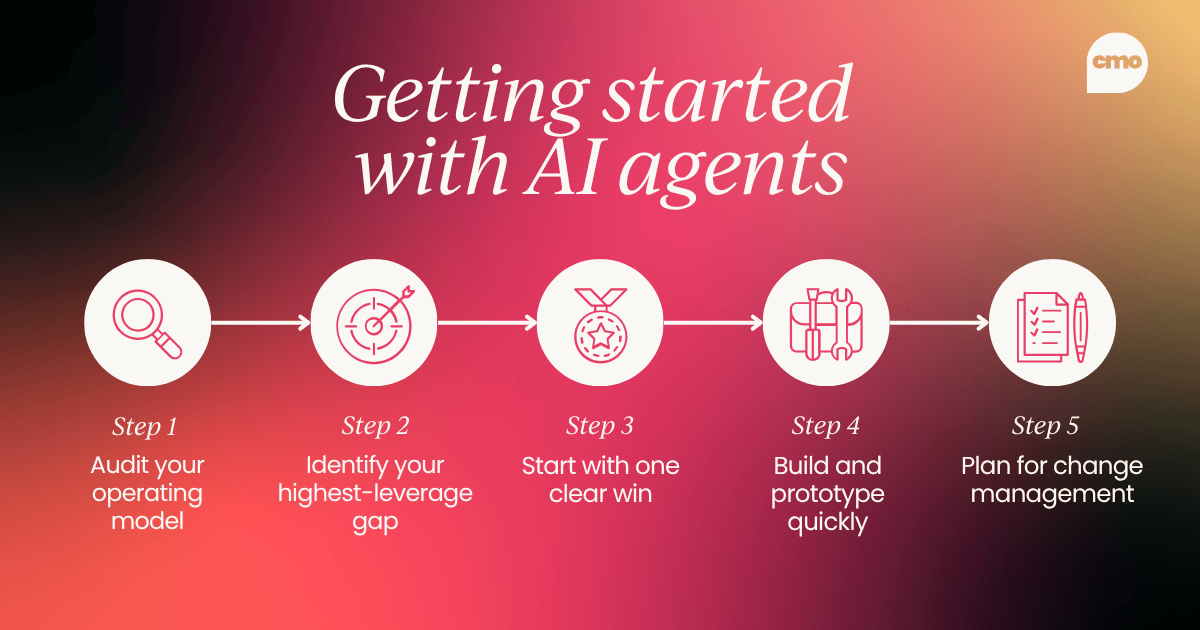
Most action-oriented leaders want to put agents in motion ASAP. As challenging as it may be, first try to take a step back and assess your operating model. Where do decisions slow down? Where does context break between teams? Where are your highest-leverage people stuck doing work that doesn’t require their level of judgment?
From there, identify one or two areas where an agent could create immediate impact. Not a full transformation, just a clear win. That might mean tightening feedback loops between sales and marketing, getting more mileage from existing content, or adding structure to campaign execution.
Once you’ve identified the opportunity, execution is more accessible than it seems. Tools like ChatGPT help shape prompts and logic, while Claude Code can take you from idea to working prototype quickly. Platforms like Replit, Lovable, and Base44 help scale with usable interfaces.
Start small, get a quick win, and scale from there. Change management will ultimately be your biggest hurdle, so this gradual transition may be your best bet for an AI-forward operating model that sticks.


Become a CMO Insider
Thank you for subscribing
Get exclusive insights, frameworks, and strategies from marketing leaders driving real business impact.
An email has been successfully sent to confirm your subscription.
 Follow us on LinkedIn