.png)




What is emotional marketing?
Emotional marketing is a strategy that uses emotions to make connections with consumers. It leverages happiness, fear, sadness, nostalgia, etc. to influence buying decisions and boost brand loyalty.
This type of marketing relies on:
- Storytelling: This is about creating compelling narratives that resonate with your audience, mainly their experiences and emotions.
- Relatability: You have to align your messaging with your audience’s values, challenges, or pain points to create that emotional bond.
- Brand personality: Make sure you’re presenting your brand in a way that feels human, authentic, and emotionally engaging.
- Visual and sensory appeal: This means using images, colors, music, design, etc. that evoke strong emotions.
- Social proof: A key element of emotional marketing is leveraging testimonials and user-generated content to build trust and connections.
Does emotional marketing work?
The short answer is yes, it works (with a caveat: most of the time). Think about Coca-Cola’s “Share a Coke” campaign, which is meant as a positive message to inspire joy and happiness, or consider any insurance or cybersecurity ads you may have seen, which rely on people’s fears and worries to make them buy a product.
But how exactly does emotional marketing work?
First of all, it triggers decision-making. Harvard Business School professor Gerald Zaltman says that 95% of our buying decisions happen in the subconscious mind. People tend to justify their emotional choices with logic.
Emotional marketing by the numbers
Research suggests that emotional connections don't just influence customer perceptions - they can also drive measurable business results:
- Emotionally connected customers are 52% more valuable than customers who are merely highly satisfied, according to research highlighted by Harvard Business Review.
- Advertisements that generate strong emotional responses can produce a 23% lift in sales volume, according to Nielsen Consumer Neuroscience research.
- Studies have also found that emotionally driven advertising can increase brand interest, online search activity, and purchase intent.
Emotional marketing also boosts your brand recall. This means that content that is emotionally charged is more memorable since people can remember how a brand made them feel, even if they don’t recall what was said.
It also improves engagement, since emotional content tends to perform better on social media, generating more comments and shares than purely informational content. The concept of “rage baiting” comes to mind, where people create content specifically to annoy others into commenting and interacting with their brand.
Brands that evoke emotions like happiness, trust, or sadness can create stronger connections to keep people coming back – so, emotional marketing is good for customer retention and brand loyalty.
Emotional branding can also help you justify higher prices, as customers are happier to pay for products that align with their values and emotions.
Pitfalls of emotional marketing
However, while it’s clear emotional marketing has many benefits, it also comes with pitfalls to avoid. For example:
Emotional fatigue
Overusing emotional appeals, especially if you’re attempting to evoke sadness, can desensitize people. On top of this, people might also feel emotionally manipulated – in this case, they might develop a negative perception of your brand.
Concerns with authenticity
With emotional marketing, you also have to be careful when it comes to authenticity. People might consider your campaign insincere or opportunistic, which means appealing to emotions could backfire.
Overall, consumers are savvy and can detect when brands are exploiting emotions instead of being genuine.
Short-lived impact
Relying solely on emotional marketing might be an issue, since these campaigns might generate short-term buzz and engagement but might not translate into a long-term sales plan.
Misaligned with values
Another thing to take into account is that emotional storytelling should align with your core values and mission, and shouldn't feel disconnected, since that can lead to confusion – and you can also lose the trust of your consumers.
Negative emotional associations
Overly dramatic or fear-based campaigns can sometimes create negative associations with your brand. For instance, if you rely heavily on leaving people feeling guilty or anxious, they might become uncomfortable instead of inspired to buy your product or follow your brand.
When emotional marketing backfires
The 2017 Pepsi “Live for Now” campaign with Kendall Jenner is a famous example of emotional marketing gone wrong.
Pepsi created an ad featuring Jenner leaving a glamorous photoshoot to join a crowd of protestors, offering a can of Pepsi to a police officer to diffuse tensions and bring protestors and law enforcement together.
Instead of appealing to their audience, Pepsi was accused of tone-deafness to social issues, co-opting activism for commercial gain, using a celebrity with no known connection to activism (which came across as inauthentic), and mirroring and exploiting real-life events.
Pepsi quickly removed the ad and issued a public apology for “missing the mark”.
How to use emotional marketing effectively
1. Know your audience and their triggers
What makes your audience tick? What are their concerns and pain points? Carry out customer research and identify the key emotions driving their decisions. You can also make use of social listening and surveys. Once you’re ready, segment your audience based on their emotional needs, be it security or nostalgia.
2. Tell good stories
It goes without saying that good storytelling is key to a strong emotional marketing campaign. Use narratives that reflect real-life challenges, successes, and aspirations, and be authentic, so that people can connect with your brand. Incorporate characters, themes, and scenarios your audience can identify with.
For example, every year, Google releases their Year in Search, which highlights the most popular search trends and events of the year. 2024’s edition, like previous years, focused on emotions, driving nostalgia, happiness, and inspiration, just to name a few, to create a story of what the year was all about.
3. Choose an emotion to leverage
If you try to appeal to many different emotions, your message will be diluted. Instead, focus on what you want to achieve. Do you want to inspire action with a happiness-filled video? Do you want to create fear in order to encourage a sense of urgency? Or do you aim to surprise your audience so that you can better capture their attention?
Make sure your emotional triggers are aligned with your customer journey.
4. Consider the visual appeal
Colors, music, and tone should all work together to evoke a specific emotion. Also, images and videos can help tell an emotional story more effectively than just text.
5. Engage with user-generated content
Encourage customers to share their stories and experiences with your brand, and showcase testimonials and personal stories that evoke emotions and build social proof.
6. Choose emotional language
Whether crafting headlines or text to go on a video, make sure you’re choosing emotional language. E.g., instead of “buy now”, try “start your journey today”.
How to measure emotional marketing effectiveness
Creating an emotional connection with your audience is one thing, but understanding whether your campaigns are delivering results is another.
Quantifying emotional responses can be difficult, but it is possible. To get it right, though, you need to combine brand, engagement, and customer loyalty metrics to assess the impact of your emotional marketing efforts.
Here’s a breakdown of the emotional marketing metrics that matter most:
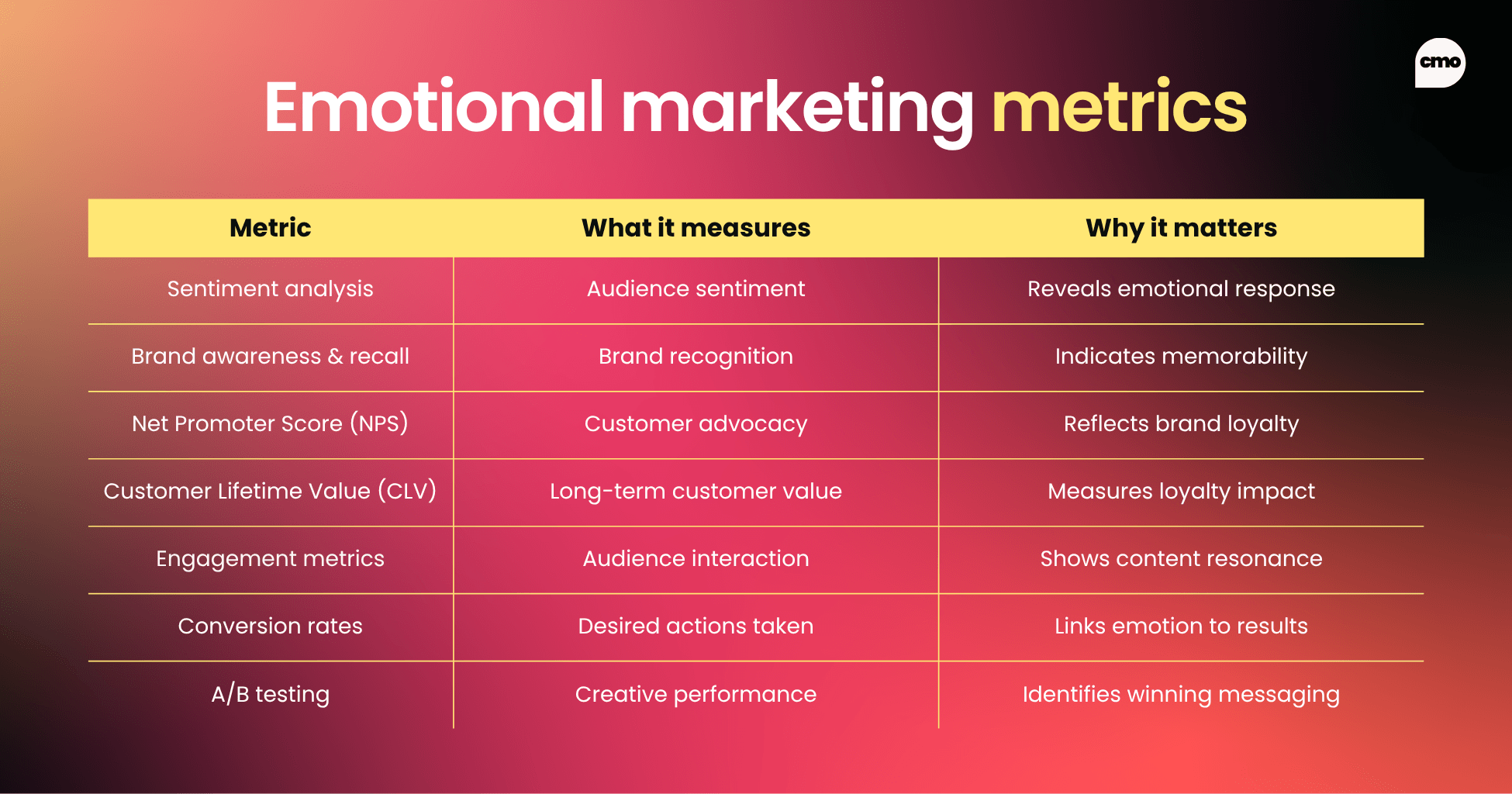
To expand on the overview above, here’s how each metric works:
Sentiment analysis
Instead of just counting how many people are talking about you, sentiment analysis tracks the overall emotional tone of your customer feedback, reviews, and social media mentions. This is the most direct way to validate whether an emotional campaign sparked the positive connection you intended or accidentally missed the mark.
Brand awareness and recall
Brand awareness measures how easily consumers remember your brand after seeing a campaign. Because the human brain naturally prioritizes emotional memories over neutral ones, high recall is a strong indicator of success.
So, if your target audience can vividly remember your ad weeks later, your messaging struck a genuine emotional chord rather than just passing through their feed unnoticed.
Net Promoter Score (NPS)
NPS relies on a single question: How likely are you to recommend us to a friend?
This score measures advocacy, which is the ultimate by-product of an emotional connection. Customers rarely risk their personal reputation by recommending a brand unless they feel a deep sense of trust and loyalty toward it.
Customer Lifetime Value (CLV)
CLV tracks the total revenue a single customer generates over their entire relationship with your business. This makes CLV the best emotional marketing metric to assess long-term brand health.
Remember that satisfied customers buy from you when it’s convenient, but emotionally connected customers buy from you repeatedly, ignore competitors, and stay loyal for years.
Engagement metrics
Moving past passive "likes," true engagement focuses on deeper interactions like shares, comments, video completion rates, and time spent on a page. High engagement means your content didn't just grab attention but forced a reaction.
When someone takes the time to comment or share a video, the content resonated enough to make them want to align their own online identity with your message.
Conversion rates
While emotional marketing is a long-term strategy, it still needs to inspire action by tracking the percentage of users who complete a specific goal. Measuring conversions helps you prove that your emotional narrative isn't just "feel-good" content, but a powerful motivator that pushes people past analysis paralysis and into a buying decision.
A/B testing results
A/B testing gives you concrete, side-by-side data by comparing emotional creative variations against purely functional ones. By isolating these variables (like testing a benefit-driven headline against an emotion-driven one) you get definitive proof of exactly how much heavy lifting the emotional angle is doing for your ROI.
Examples of successful emotional marketing
We already gave you a few emotional marketing examples to inspire you, but here are some more to cement the idea of using emotions in your ads.
Dove
Dove’s #TurnYourBack campaign continues its long-standing focus on real beauty and self-acceptance. The campaign highlights the impact of social media filters on young women’s self-esteem and encourages audiences to reject unrealistic beauty standards shaped by digital alteration.
The emotional trigger used is self-esteem and empowerment, encouraging viewers to feel confident in their natural appearance.
The campaign generated millions of views on TikTok, driven by strong engagement around the hashtag and widespread discussion on body image and digital authenticity.
@dove No filter should tell you how to look. 80% of girls are already using filters by the age of 13. It’s no wonder their perception of beauty and their self-esteem are distorted. Help reverse the damage. #TurnYourBack on the Bold Glamour filter and digital distortion. Real beauty is bold. #RealBeautyIsBold #Dove #LetsChangeBeauty #NoDigitalDistortion #BeautyCommunity #SelfEsteem ♬ original sound - Dove Beauty & Personal Care
Heinz and Absolut
Heinz and Absolut collaborated to create a “Tomato Vodka Pasta Sauce” blending two iconic brands into a single unexpected product concept.
The emotional triggers used are nostalgia and curiosity, combining familiar household brands in a way that encouraged audience intrigue.
The campaign drove significant social media conversation and earned widespread PR coverage, with audiences engaging heavily due to its novelty and cultural references to classic vodka pasta recipes.

1Password and Ryan Reynolds
Actor and entrepreneur Ryan Reynolds partnered with 1Password in a humorous campaign filmed at Wrexham AFC, where he delivers an unconventional team talk focused on cybersecurity instead of football strategy.
The emotional triggers used are humour and surprise, transforming a typically dry topic like password security into entertaining storytelling.
The campaign helped make cybersecurity more memorable and accessible, driving high engagement across social platforms and increasing brand recall through comedic association.
Specsavers
“Should have gone to Specsavers” is a fun, popular series of ads created by Specsavers to bring awareness to their products with a dash of humor, mainly showcasing people’s poor eyesight and how the company could have prevented the issue.
These ads are relatable, as they use everyday situations like mistaking objects and people, and have a memorable tagline, making it easy for people to recall the brand.
John Lewis
This UK-based department store creates annual Christmas ads that tug at people’s heartstrings, and use love and kindness as emotional hooks.
The ads tend to use popular songs mixed with visual storytelling, such as their “Man on the Moon” ad, where a girl sees an elderly man living on the moon and sends him a gift so he’s not as lonely or isolated (to a cover of Oasis’ Half the World Away).
Despite it being an older ad, it’s a testament to its emotional appeal that many people still remember it by name. Last year’s ad shows a woman on a last-minute quest to find the perfect gift for her sister.
Emotional marketing in B2B vs B2C contexts
Emotional marketing is often associated with consumer brands, but its influence extends well beyond B2C advertising. In both B2B and B2C worlds, purchases are driven by feelings. The only real difference is which emotions are doing the heavy lifting, and what triggers them.
Emotional marketing in B2C
In consumer marketing, emotion is usually fast, loud, and immediate. Campaigns tend to lean into instant feelings like joy, nostalgia, humor, or excitement to drive relatively quick buying decisions.
Because consumers are buying for themselves, the emotional triggers are deeply personal. Brands like Coca-Cola or Dove aren't just selling products; they are selling a reflection of how the buyer wants to see themselves, tying the purchase directly to lifestyle and identity.
Emotional marketing in B2B
B2B emotional marketing is much quieter, but the stakes are actually a lot higher. While B2B buyers like to wrap their final choices in logic, spreadsheets, and ROI calculations, their initial pull is driven by emotions like trust, security, and a very real fear of making a mistake.
Remember, B2B buyers are still people. They are dealing with professional pressure, corporate politics, and the pressure to make the "right" call for their company. In this environment, the emotional drivers look a bit different.
For example:
- Trust and credibility become central emotional drivers in vendor selection.
- Risk reduction plays a major role in software and service decisions.
- Confidence in outcomes often outweighs feature comparisons.
- Personal reputation can influence whether a decision-maker feels safe choosing a particular solution.
The overlap between B2B and B2C emotional marketing
While the execution looks different, the core psychology is identical: people make decisions emotionally and justify them rationally afterward.
This is exactly why enterprise software companies are ditching dry tech jargon and moving toward human-centered storytelling and customer success narratives. Strategies that once belonged entirely to B2C (like personalization, heavy social proof, and value-based messaging) are now staples of great B2B marketing.
Ultimately, emotional marketing isn't a strategy built for a specific audience. It's a universal truth about how humans make choices, adapting seamlessly whether you're selling a $5 latte or a $50,000 piece of software.
In short
Yes, emotional marketing works, but only when it’s authentic, relevant, and includes a deep understanding of your audience.
Make sure your campaigns are genuine and aligned with brand identity, balance emotional appeals with rational elements (i.e., the benefits of your product), and be aware of feedback, so you can tweak and improve your emotional campaigns if they’re not working.
Join our growing Slack channel and connect with other revenue marketers like yourself, stay on top of the latest trends, get answers to all your burning questions, and so much more.
 Revenue Marketing Alliance


Become a CMO Insider
Thank you for subscribing
Get exclusive insights, frameworks, and strategies from marketing leaders driving real business impact.
An email has been successfully sent to confirm your subscription.
 Follow us on LinkedIn