


.png)




My career has been a game of two halves.
I started out studying mechanical engineering with dreams of being a Formula One engineer, but after a couple of years filled with maths, I realized my forte was communication.
For the last eight years, I’ve been at the Financial Times in a role that ties everything together for me.
There’s nothing like being in a news organization when the world is upside down; for all the stress, it’s incredibly exciting, and I feel privileged to be doing something I truly enjoy.
But how do you maintain a premium brand identity when the very ground beneath your industry is shifting every six months?
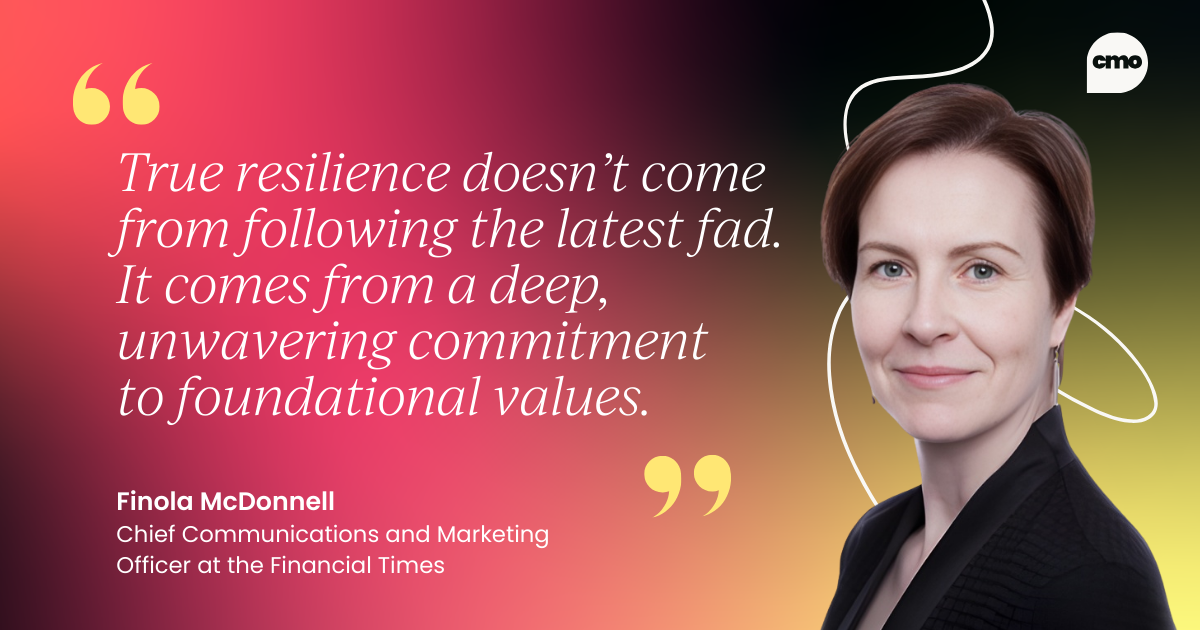
In an era where social platforms disrupt traditional reach overnight and synthetic content is accelerating, the temptation is to chase every passing whim. However, true resilience doesn’t come from following the latest fad. It comes from a deep, unwavering commitment to foundational values.
In this article, I’ll explore the vital distinction between truth and trust, the role of human oversight in an AI-driven reality, and why doubling down on your core strengths is the ultimate strategy for 2026.
Specifically, we'll cover:
- The mechanics of brand resilience and consistency.
- Balancing human integrity with AI efficiency.
- The evolution of media from a product to a community.
- Navigating organizational change in a global landscape.
Defining brand resilience in a world of constant change
If you look up a dictionary definition of resilience, you'll find different takes on it.
Some see it as the ability to bounce back after a hit. I think it’s more about consistency and, to some extent, predictability. In the media sector, everything is unpredictable, from the news cycle itself to the constant disruption from AI, social media, and new consumption habits.
Within all that chaos, you have to keep your bearings. You need foundational truths that hold steady no matter what.
It’s like being in a storm; you need an anchor.
The dual nature of truth and trust
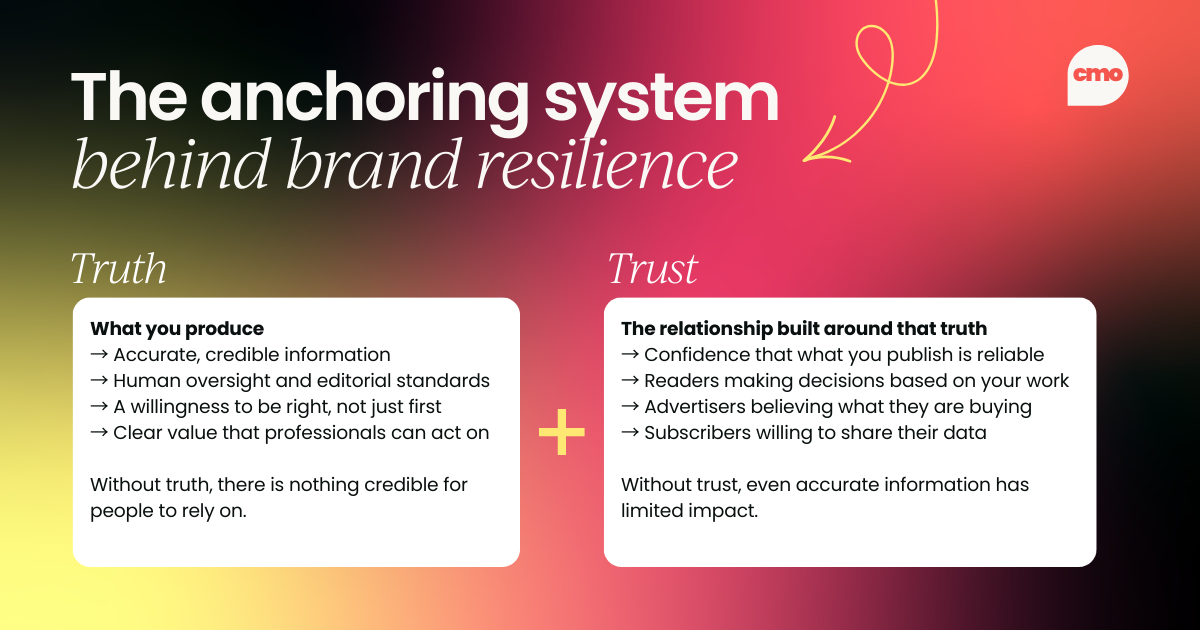
For a quality media brand like the FT, a big part of that anchor is the combination of truth and trust.
I differentiate the two.
Truth is something you produce, but trust is the relational aspect of that. Our readers need to trust that what they see in the FT is credible and accurate, so they can make decisions based on our information.
This trust extends to our advertisers, who need to know we’re selling them what we say we are, and to our subscribers, who give us their data. These fundamental principles give us our differentiation, even if it feels a bit old-school. In a world saturated with glitzy, untrustworthy content, being a reliable source is what sets us apart.
Balancing core principles with market dynamics
Our readers are professionals and decision-makers.
They need accurate information and want to know they don't have to work hard to find it. That’s what differentiates us from the endless scroll of influencer content you might find on TikTok.
This doesn't mean we can ignore new trends. We have to respond to new channels and consumer desires. People want podcasts, so we produce podcasts. They want us on social channels, so we’re on YouTube.
The key is to combine our core principles with the ability to sway in the wind and adapt to the market. Our resilience comes from being rooted in principles we don’t compromise, which gives us the strength to survive any storm.
Navigating the 'frenemy' of innovation: AI
Now, with AI in the mix, you have to be dynamic, but you still have to know who you are.
This comes down to our internal values: trust, integrity, and accuracy. We probe for these values in our interview process because everyone who works at the FT, from journalists to techies to marketers, has to be passionate about our mission of providing quality, truthful information.
This commitment is sometimes challenging. In an era where 80% of internet content is said to be "synthetic" or not generated by a human, we insist on human oversight for all our journalism. You will not read any content on FT.com that is scraped from another site; it's all edited by a real journalist with rigorous standards.
This means we aren't always first with the news. When I worked in broadcast news, there was immense pressure to be first. That race to report inevitably puts downward pressure on accuracy and thoughtfulness.
What I like about the FT is our focus on being right, not just being first. We are prepared to say, "Let's do this right, rather than do it extremely quickly." We would rather miss out on what some might call a "scoop" to ensure the quality and caliber of what we produce is second to none.
We apply this same measured approach to new technologies like AI. AI is a bit of a "frenemy" for publishers. It's a problem when AI companies scrape our paid content and churn it out for free in inaccurate summaries.
At the same time, AI tools and large language models are very helpful.
We use them for what we call "story discovery," allowing us to analyze large amounts of data to find patterns and potential stories. We are quite advanced in using AI, but we use it sensibly. Our readers can be assured that the final product they read is always human-supervised and created. We're driving a good sports car, but we're driving it at the speed limit.
From one-way broadcast to two-way community
The news industry is fascinating.
Most major newspapers like the FT, The Times of London, or The New York Times were founded in the late 19th century. For 100 years, the industry saw very little meaningful innovation. The model was simple: it was paid for by advertisers and cover price, and we told you the news. It was a one-way street.
Then, about 30 or 40 years ago, everything changed with the arrival of the World Wide Web. It was like a big bang, and it continues today with a new disruption almost daily.
The challenge of a changing landscape
You simply wouldn't survive in this industry if you weren't nimble.
Many newspapers have gone to the wall because they couldn't adapt when Google and Facebook took their ad revenue. This has been especially tragic for local publications, which affects democracy and closes off a vital training ground for future journalists.
For marketers, the ground is always shifting.
Before COVID, I was putting up billboards in Canary Wharf to reach the business community. I don't do much of that anymore. The work-from-home era forced a pivot to digital, and now we're constantly rethinking how to find people, especially younger readers who might discover us through ChatGPT instead of our homepage.
Monetizing trust: the core of modern brand strategy
At the FT, we have a relatively complex marketing organization serving different audiences, from individual readers to corporate clients. My focus is always on the brand, and for us, that means leaning into consumer trust.
We're not the cheapest subscription on the market, but we position it as an investment in yourself and your company. We often talk internally about selling truth, but as I said, trust is the relationship built around that truth. Our brand strategy is about expanding and monetizing that trust.
Building an exclusive club
For years, we were a newspaper telling you what we thought. Now, the comment section on our website is often as lively as the article itself. The content is a catalyst for a community of people who love the FT and want to debate with each other and our journalists.
Our multi-million-pound live events business exists because this community wants to convene in the same room. The journalism on stage is important, but so is the community aspect. The FT brand tells people they are in a safe space with intelligent, global peers they can learn from. My job is to make them feel like they are in a special club they don’t want to leave.
The intangible value of brand investment
This "special sauce" is the experience on top of the utility of the product. It’s what makes the FT feel boutique, personal, and even luxurious. It’s what brings someone to our app when they have countless other options on their phone.
Traditionally, brand investment is seen as an intangible, making it a harder sell to a CEO than a performance campaign.
But in a world that is busier than ever, a strong brand pays off. It creates an experience that feels seamless and high-quality, a place where people feel at home and want to return again and again.
Leading through change in a high-stress environment
Nobody loves change.
The older I get, the more I understand that. Even moving a piece of furniture can be jarring. In a news organization, there's a latent stress that comes with the job; you're hyped up because so much is happening all the time. It can feel like everything, everywhere, all at once.
On top of that, you have the intentional change you want to create as a leader. Bringing deep organizational change across a global business with offices in different time zones and cultures is tricky.
Painting a picture of a better future
I don't have a guru's guide to change management, but I do know you have to paint a strong picture of where the change will take you and why it will be an improvement. You need to show people how it will make their jobs easier or better.
The shift to remote work during COVID showed us how quickly people can adapt when there's a deadline. But for a planned change process, you need to create feedback loops, listen to people, and find ambassadors who are willing to lead the way.
Embracing a culture of dynamic change
Ultimately, the key is building a mindset that accepts change as a constant.
In the news industry, I can't expect to wake up and find everything the same. The core of being a successful news organization is having a dynamic culture and the ability to change. Most people who work in our industry understand that.
Consumers change, generations change, and we have to adapt with them.
A return to core strengths
So, what should marketers focus on?
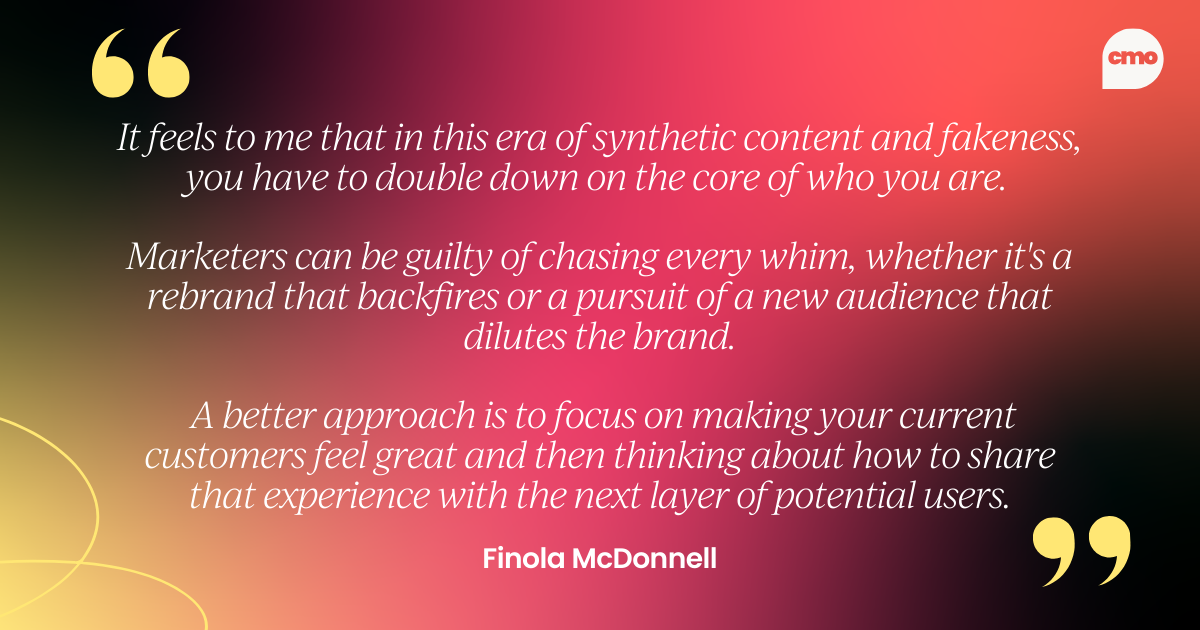
It feels to me that in this era of synthetic content and fakeness, you have to double down on the core of who you are. Marketers can be guilty of chasing every whim, whether it's a rebrand that backfires or a pursuit of a new audience that dilutes the brand.
I think we sometimes spread ourselves too thin trying to serve every potential customer. A better approach is to focus on making your current customers feel great and then thinking about how to share that experience with the next layer of potential users.
As we write our strategy for the next four years, we're thinking about the future, but we're also asking: what are our core strengths? How do we invest in them and build them up for a modern era? You don't have to mimic what every other cool brand is doing.
You just have to do you. Let your team be creative and innovate, but don't try to do everything at once.
Focus on what makes you strong.


Become a CMO Insider
Thank you for subscribing
Get exclusive insights, frameworks, and strategies from marketing leaders driving real business impact.
An email has been successfully sent to confirm your subscription.
 Follow us on LinkedIn