.png)




It’s time to move away from tradition and embrace change - embrace fun.
It’s time to start seeking more innovative ways to stand out from the noise and forge meaningful connections with your customers.
“But, Charley, how do I do this? Our customers are inundated with advertising messages at every turn, and everything I try just isn’t cutting it anymore.”
Enter experiential marketing.
The power of experiential marketing lies in its ability to engage, not only the mind but also the senses and emotions. This, in turn, creates memorable interactions that leave a lasting impact.
In this article, we’re gonna talk all about how to effectively craft an experiential marketing strategy that transcends the transactional and transforms ordinary interactions into extraordinary memories.
- What is experiential marketing?
- Why is experiential marketing important for field marketers and revenue marketers?
- 4 real-life experiential marketing examples
- How to build an experiential marketing strategy
What is experiential marketing?
Experiential marketing is about creating live experiences that allow customers to engage with a brand in an interactive, hands-on way. The goal is to make these experiences memorable and shareable, forming an emotional connection between the consumer and the brand.
Immersive, interactive experiences
Rather than passive advertising, experiential marketing lets consumers actively participate. This could involve things like pop-up shops, brand activations at events and festivals, virtual or augmented reality (VR or AR) experiences, and other ways for customers to immerse themselves in branded interactions. The key is letting people engage on their own terms.
Memorable encounters that resonate
This marketing strategy aims to provide unique encounters that stand out from typical ads and resonate on a personal, emotional level. Using things like free samples, games, VR, contests, and other participatory experiences, brands can shape more meaningful impressions that last. When done right, these types of live brand experiences become unforgettable.
Consumers as active participants
In experiential marketing, the consumer takes an active role rather than just receiving brand messages passively. By letting customers interact with products and services directly, they can shape their own brand perceptions through these immersive experiences. Participation makes for deeper engagement.
Real-world, public spaces
Rather than mass media ads, experiential marketing unfolds in real-world public spaces where audiences already gather - think events, festivals, street teams, pop-up shops, etc. This allows brands to mesh with moments in consumers' lifestyles and become part of the experience in an organic way.
Multisensory for maximum impact
Experiential marketing uses multiple senses like touch, sight, sound, and even smell and taste sometimes. This multisensory approach drives a deeper emotional impact and impression than ads that only use a single sense, like visuals or audio. The more senses involved, the more memorable the experience.
Shareable moments that spread
A core goal of experiential marketing is creating shareable moments that consumers will want to talk about and post on social media. These viral earned media moments organically spread brand awareness. By crafting experiences people find exciting and worthwhile to share, brands gain extended reach.
Experiential marketing vs. traditional marketing
At first glance, experiential marketing and traditional marketing might seem like they're trying to achieve the same thing, but they’re actually very different.
Traditional marketing is usually more of a one-way conversation. Brands push messages out through channels like TV, radio, print ads, billboards, and digital advertising, and audiences receive those messages passively.
Experiential marketing, on the other hand, invites people to actively participate. Customers get the chance to interact with it first-hand through experiences, events, activations, and immersive campaigns.
Here's a quick breakdown of how the two approaches compare:
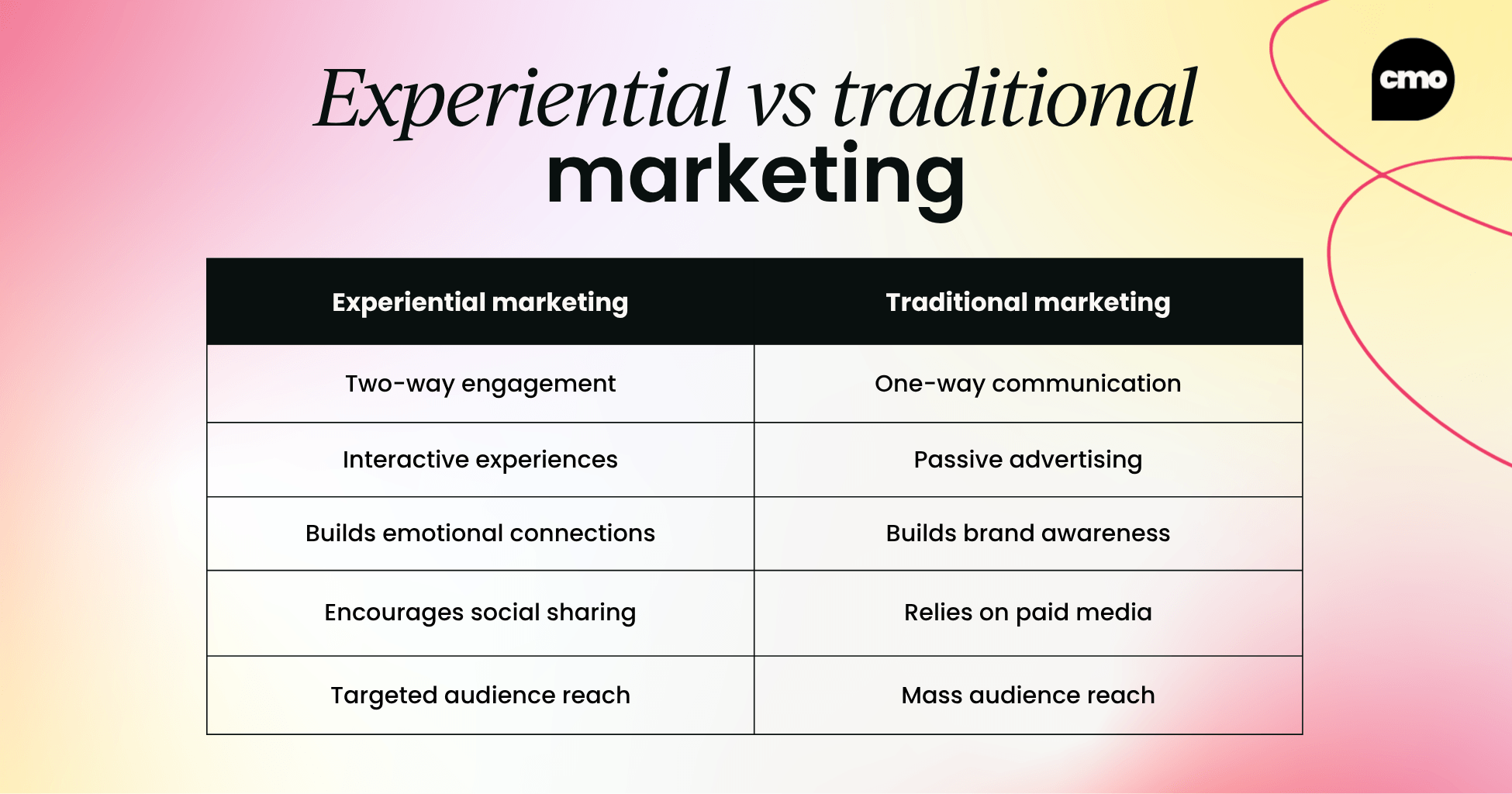
When used together, traditional marketing and experiential marketing can be a powerful combination for driving both awareness and engagement.
Types of experiential marketing
One of the best things about experiential marketing is that there isn't a one-size-fits-all approach. But that’s also the challenge. Choosing the right type of experiential marketing is important because not every experience will resonate with every audience, so picking the right approach can make all the difference when it comes to engagement, brand awareness, and results.
To help you figure out which direction to take, here’s a breakdown of the most common types of experiential marketing brands are using right now.
Brand activations
Brand activations are all about getting people to engage directly with your brand. These campaigns are designed to create memorable interactions that leave a lasting impression. Think of things like live demonstrations, interactive installations, giveaways, or hands-on experiences.
Event marketing
Instead of shouting into the digital void and hoping someone hears you, event marketing gives you a literal platform to chat face-to-face. It flips your marketing from a boring one-way broadcast into an actual conversation.
What it looks like: Setting up camp at trade shows, festivals, conferences, or even hosting your own branded party.
Pop-up shops
Pop-up shops are temporary retail spaces or branded experiences that create a sense of excitement and exclusivity. Because they're only around for a limited time, they naturally create a sense of FOMO that drives immediate foot traffic and social shares.
In reality, your pop-up could be anything from a sudden, beautifully designed retail space to a mini-experience that drops into a city center.
Guerrilla marketing
Guerrilla marketing relies on creative brainpower over massive ad budgets. The goal is to drop an unconventional, high-impact stunt in an unexpected public space to hijack people's attention.
It’s a high-ROI strategy designed to disrupt a competitor's market share and get people talking, turning a localized stunt into a global, digitally shared brand moment.
Virtual reality (VR) and augmented reality (AR) experiences
Using VR and AR, brands can create immersive experiences that allow customers to explore products, interact with virtual environments, or experience a story in a completely new way.
These are great for product demonstrations, storytelling, and creating highly memorable customer experiences.
Some examples of this in action include putting on a headset to tour a factory halfway across the world or using a phone app to see how a piece of furniture looks in your actual living room. It makes product demos incredibly immersive and memorable.
Product sampling and demonstrations
Sometimes the simplest experiences are the most effective. Giving people the opportunity to try a product for themselves can be a powerful way to build trust and influence purchasing decisions. Product sampling and live demonstrations let customers experience the value of a product before committing to a purchase.
Hybrid and digital experiences
Experiential marketing doesn't always have to happen in person. Virtual events, livestreams, interactive online experiences, and digital communities can all be used to create engaging brand experiences for audiences wherever they are. In many cases, brands combine physical and digital experiences to maximise reach and engagement.
No matter which approach you choose, the goal remains the same: create an experience that people remember, enjoy, and want to talk about long after it's over.
 Sabrinthia Donnelly
Why is experiential marketing important for field marketers and revenue marketers?
Benefits for field marketers
Experiential marketing is a valuable strategy for field marketers because it enables direct consumer engagement in public spaces where field marketers operate. It also complements other field efforts like sampling and events by adding an interactive element.
Hands-on interactions allow field marketers to shape brand impressions in real time through consumers' experience. An experiential approach also utilizes field marketing strengths in rapid deployment and consumer engagement.
Benefits for revenue marketers
For revenue marketers, experiential marketing creates an interactive sales channel to actively pitch and close deals rather than passive advertising. Events and activations generate sales leads by capturing contact info. Product demos and trials fuel sales by allowing hands-on engagement before purchase.
The exciting experiential environment is more dynamic for sales than stale stores. And positive brand impressions developed through experiential participation encourage purchasing.
6 experiential marketing real-life examples
Red Bull Stratos
Brand: Red Bull
Campaign: Red Bull Stratos
Tactic used: Live-streamed extreme sports stunt and global brand activation.
Result: Over 50 million people watched the jump live, generating worldwide media coverage and reinforcing Red Bull's adventurous brand identity.
In 2012, Red Bull sponsored Austrian Skydiver Felix Baumgartner's record-breaking high-altitude skydive from 24 miles above Earth. This stunt generated huge publicity and reinforced Red Bull's energetic brand image.
- Pushing human limits - By supporting Felix Baumgartner’s record skydive, Red Bull associated themselves with doing groundbreaking things never been done before. It embodied their slogan “Red Bull Gives You Wings”.
- Global live-stream - The jump was live-streamed worldwide, giving massive exposure to Red Bull's brand and logo as Felix descended. Over 50 million people tuned in.
- Social media buzz - The event generated huge buzz and viral discussion on social media, reinforcing Red Bull's image as a daring and trendy brand.
The Ice Hotel
Brand: Icehotel
Campaign: Annual Icehotel Experience
Tactic used: Immersive hospitality experience and experiential tourism attraction.
Result: Attracts visitors from around the world each year, generating ongoing publicity, social media buzz, and repeat visitation through its ever-changing design.
Every year, the Ice Hotel in Sweden is rebuilt using just snow and ice. Guests can have a unique experience staying overnight in this unusual hotel. It aligns with their brand promise of providing exceptional experiences.
Staying in a hotel made of ice is a once-in-a-lifetime experience that aligns with the brand's focus on extraordinary experiences. It generates free publicity and word-of-mouth buzz each year.
- Unique experience - Staying overnight in a hotel made of ice and snow is something you can’t do anywhere else. The novelty provides a once-in-a-lifetime memory.
- Changes annually - The hotel is rebuilt with new designs each year, giving returning guests a fresh experience and fueling social media interest.
- Natural materials - Using just ice and snow plays up the brand's connection to nature and the environment in a stunning way.
Disney ‘Wonder of Friendship’ pop-up stores
Brand: Disney
Campaign: Wonder of Friendship Pop-up Stores
Tactic used: Immersive pop-up retail experience and interactive brand activation.
Result: Generated excitement around Disney's film releases, encouraged social sharing, and deepened audience engagement through interactive storytelling.
To promote new films, Disney has created highly themed multi-sensory pop-up stores in big cities that immerse customers in the movie's world.
These immersive stores allowed customers to interact with the movie universes in a deeper way. They generated hype and anticipation for the films leading up to their launch.
- Themed interiors - Disney recreated the movie worlds through detailed props, music, and environments, letting customers feel immersed in the films.
- Movie previews - Advance movie trailers and exclusive clips helped build buzz and anticipation leading up to premieres.
- Social media engagement - Interactive photo ops in the stores drove social sharing and word-of-mouth marketing.
Cisco Live
Brand: Cisco
Campaign: Cisco Live
Tactic used: Large-scale B2B event marketing featuring product demonstrations, training sessions, and networking opportunities.
Result: Increased customer engagement, strengthened partner relationships, and helped attendees better understand and adopt Cisco's products and solutions.
Cisco's big annual IT conference Cisco Live involves inspirational keynotes, training sessions, and interactive product demos to engage customers and partners with the Cisco brand. They even have a World of Solutions center that resembles a tech theme park.
- Interactive product demos - At their World of Solutions exhibit hall, Cisco essentially recreates their technologies in engaging hands-on displays and simulations. Attendees can interact with new networking gear and see infrastructure in action. This educational approach helps customers learn.
- Inspiring keynotes - Cisco brings in high-profile speakers like celebrities and CEOs to give inspiring keynotes on innovation and leadership. This helps associate their brand with being visionary.
- Customized training - Breakout sessions allow customers to learn how to optimize Cisco products for their specific company's needs. The hands-on, tailored training has practical value.
Spotify Wrapped experiential campaign
Brand: Spotify
Campaign: Annual personalised “Wrapped” experience.
Tactic used: Data-driven personalised digital experience.
Result: Massive yearly social media engagement and global organic sharing at scale.
Spotify Wrapped turns users' listening data into a personalised yearly summary that highlights each user's unique music habits.
It has become one of the most anticipated digital experiences each year.
- Highly personalised insights make each experience feel unique.
- Built-in social sharing drives massive organic reach every year.
- Encourages users to reflect on their listening behaviour.
- Strengthens long-term engagement with the Spotify platform.
Coca-Cola “Share a Coke” experiential activation
Brand: Coca-Cola
Campaign: Personalised “Share a Coke” bottles campaign.
Tactic used: Mass personalisation and retail experiential rollout.
Result: Significant uplift in sales and global social sharing driven by personalised products.
Coca-Cola replaced its iconic logo with popular names, encouraging customers to find bottles with their own name or someone they know.
This simple idea turned a standard product into a personalised, shareable experience.
- Personalization created an emotional connection with consumers.
- In-store activations encouraged people to search for their names.
- Strong social media sharing amplified reach organically.
- The campaign was rolled out globally and adapted for different markets.
How to build an experiential marketing strategy
Building an effective experiential marketing strategy involves many steps, and it has to be focused on creating an immersive and memorable experience that connects with your target audience on a deeper level. After all, that’s what experiential marketing is all about.
Admittedly, there’s a lot that goes into any given marketing strategy, and experiential marketing is no different. So, we can only really give a general overview of the process you must follow to build a successful experiential marketing strategy. The rest is up to you to bulk out with your idea and fine-tune it to your company’s goals, budget, team size, and so on.
With that in mind, here is a step-by-step approach to an experiential marketing strategy.
Define your goals
Like with any marketing strategy, you must start out by clearly outlining your objectives. Are you looking to increase brand awareness, drive sales, improve customer loyalty, or launch a new product? Your goals are going to guide the entire strategy.
Know your audience
Again, this is the same for any marketing strategy. But with an experiential marketing strategy, you need to be tailoring the experience to resonate with them emotionally. So, you really need to understand their preferences, interests, behaviors, pain points, and so on.
 James Shaw
Craft a compelling concept
Next, you need to develop a creative and innovative concept that aligns with your brand’s identity and resonates with your audience.
Choose the correct channels
Choosing the correct channel is then the next step. This means figuring out where your experiential marketing campaign is going to take place. Is it going to be at a physical location like a pop-up shop, trade show, or other event? Or, is it going to be online, perhaps on social media or hosted on your website, or a combination of different platforms?
Design the experience
When it comes to designing the experience, it needs to be immersive and engaging to multiple senses (last time we say it, promise!). So, consider things like storytelling, interactive elements, visuals, sounds, scents, and even taste if applicable!
These things will go a long way to making the experience leave a lasting impression on your audience.
Integrate your brand values
You wanna make sure that, above all, your marketing strategy doesn’t stray from your brand values. In order to make your entire brand identity cohesive, ensure that the experience aligns with your brand’s core values and messaging. Your experience isn’t separate from your brand, it should reflect what your brand stands for.
Leverage technology
Using technology, like augmented reality or virtual reality gives you the opportunity to take the experience to that next level and create a sense of novelty for your audience.
Generate buzz (market, market, market!)
Now, the experience can’t be a hit if no one hears of it. So, ensure that leading up to the event, you’re building anticipation for the experience.
Use teasers, social media campaigns, influencers, and email marketing to create a sense of excitement around the event.
Create shareable moments
User-generated content is your friend. Design moments within the experience that are worthy of your audience sharing across their social media platforms. Encourage your audience to share their pictures and videos on social media to help create that buzz for you.
Measure the success/collect feedback
After the event, gather feedback from attendees to understand what worked well and what could be improved for future events. This can be incredibly valuable for refining your strategy further, especially if you have the same event happening at a different date and location.
Don’t forget to define your KPIs (key performance indicators) to measure the success of your strategy. These could include metrics such as:
- Foot traffic
- Social media engagement
- Website traffic
- Sales conversions
- Customer feedback
Iterate and improve
And finally, remind yourself that experiential marketing is an evolving process. Analyze your results, learn from your experiences, and use the insights to refine and improve your future strategies.
You likely won’t get it 100% right the first time, but that’s the whole fun of it!
How to measure experiential marketing ROI
Experiential marketing can deliver strong results, but you need the right measurement approach to understand its true impact.
The key is to track performance against clear goals and compare results before and after your campaign.
Key KPIs to keep an eye on
You don't need to track everything, but here are the most common metrics brands use to measure success:
- Social media buzz: Are people tagging your brand, sharing photos, and talking about the experience online?
- Brand sentiment: Did the experience actually make people like your brand more?
- Lead generation: How many new email sign-ups, inquiries, or qualified leads did you reel in?
- The awareness "lift": Did your overall brand awareness go up after the campaign compared to before you started?
- Attribution modeling: How did the event connect the dots to sales later down the road? (e.g., did someone visit your pop-up and then buy from your website a week later?)
- Web traffic & sales: Look for noticeable spikes in website visitors and revenue during or right after the activation.
- On-site engagement: How many people actually showed up, and how long did they stay?
- Real feedback: What are attendees saying in post-event surveys? (The qualitative stuff matters just as much as the numbers!)
A simple ROI framework
Measuring your return on investment doesn't have to be a headache. Just follow these six steps:
- Define your goal: Decide right out of the gate what success looks like. Is it raw brand awareness, fresh leads, direct sales, or customer loyalty?
- Set a baseline: Grab a snapshot of your current metrics (traffic, sales, awareness) before the campaign launches so you have something to compare against.
- Track the action: Keep a close eye on live KPIs while the experience is running - things like foot traffic and real-time lead capture.
- Measure the impact: Once the dust settles, compare your post-campaign numbers to your baseline to see the exact "lift" you achieved.
- Crunch the numbers: If your goal is direct revenue, plug your stats into this classic formula:
ROI = ((Revenue - Campaign cost) ÷ Campaign cost) × 100
6. Analyse and improve
Use insights from attribution data and feedback to refine future campaigns.
Experiential marketing trends to watch
Experiential marketing doesn't stand still. While the main goal hasn't changed (you're still trying to create unforgettable moments that connect people to your brand), the tools and tactics are moving fast.
If you want to keep your campaigns feeling fresh, here are the biggest trends shaping the industry today:
1. Personalisation powered by real-time data
Nobody wants a cookie-cutter experience anymore. Today, audiences expect things to feel tailored specifically to them. Brands are using real-time data to customize activations on the fly based on a visitor's location, past purchases, or behavior.
Whether it’s a personalized event schedule or a custom product recommendation built just for them on-site, making it personal makes it memorable.
2. Next-gen VR and AR
Virtual and Augmented Reality aren't just gimmicks anymore. They're both becoming standard tools for storytelling. Brands are using them to pull off the impossible, like letting someone step inside a virtual showroom or using an AR app to overlay digital interactive art onto a busy city street. As the tech gets cheaper and more accessible, expect to see way more of this.
3. Livestreaming and hybrid experiences
Your experience shouldn't be limited to the people who can physically make it through the front door. The smartest brands are massively expanding their reach by building hybrid experiences. By combining physical events with high-quality livestreams, virtual interactive hubs, and online communities, you can turn a local 200-person event into a global moment.
4. AI-driven audience segmentation
Artificial intelligence is doing a lot of the heavy lifting behind the scenes. By crunching mountainloads of customer data, AI can instantly predict behaviors, spot trends, and segment your audience. This means you can design your experiences with laser-like precision, delivering the exact right message to the right person at the absolute perfect time.
5. Seamless user-generated content (UGC)
The best experiential campaigns don't just entertain people; they turn them into content creators. Brands are now designing spaces with social sharing baked right into the blueprint. Think interactive photo backdrops, unique lighting setups, creator partnerships, and highly shareable "moments" that practically beg to be posted on TikTok or Instagram. When your attendees do the marketing for you, your reach explodes.
To wrap up…
Remember that experiential marketing is about creating those memorable moments that forge emotional connections between your brand and your audience. This strategy should, first and foremost, be customer-centric and focused on delivering value to your customers in a unique and impactful way.
This is your opportunity to experiment and have fun with thinking outside the box and bringing a whole new level to your marketing campaigns that’ll rake in sales and leave your audience coming back for more.


Become a CMO Insider
Thank you for subscribing
Get exclusive insights, frameworks, and strategies from marketing leaders driving real business impact.
An email has been successfully sent to confirm your subscription.
 Follow us on LinkedIn