



.png)







More and more savvy CEOs are asking their CMOs to contribute to NRR (net revenue retention) and GRR (gross revenue retention), and rightly so. Regardless of the industry you're in, customer retention matters.
So, why don't marketing teams work just as hard to keep our customers as we do to win them in the first place?
At the core of everything we do in demand generation – the campaigns, the messaging, the sales alignment – we're really doing one thing: building belief in value. But belief doesn't become permanent the moment a customer signs the contract. It's something we need to reinforce, deepen, and expand over time.
Wondering how to get started? You’ve come to the right place. In this article, we'll explore:
- Why customers don't renew, and how marketing can help
- How to move from funnel thinking to a customer life cycle approach
- What "demand retention" and "demand expansion" look like in practice
- How to measure marketing's contribution to retention and growth
Demand is how we build belief in value
As marketers, we’re great at helping customers believe in potential value. We understand how to reach the right people, tell them what matters most, and get them to take action. We've built entire marketing systems and teams to do exactly that.
Those same techniques, tools, and teams can be leveraged to reinforce value after the sale.
Why customers don’t renew
According to Gartner, approximately 60% of software buyers regret their purchase. Those regretful customers are a churn risk. Of course, we're not all in the software business, but regardless of your sector, customer retention is crucial.
Buyer’s remorse is driven by four main factors:
- Complexity and uncertainty: Most B2B purchases are triggered by organizational change, and that change can be a lot to manage. Large buying groups, unclear requirements, and internal disruption can combine to produce poor purchase decisions. A little bit their fault, a little bit ours.
- Poor value understanding: Customers often struggle to contextualize the value they're getting for their specific needs and use case. Value framing and value affirmation can help reduce that regret.
- Implementation surprises: Customers often encounter unexpected costs or complexity they hadn't planned for.
- A lack of guidance in their digital journeys: Customers are increasingly navigating purchases and onboarding independently, without meaningful human support. When that digital experience is confusing or incomplete, customers can quickly lose confidence.
Are those things marketing can help with? Absolutely.
Maybe we can't directly do much about implementation surprises. Still, across all four of these issues, the core problem is effective communication, expectation management, and value alignment – and that’s where marketing shines.
For expert insights like this straight to your inbox twice a month, sign up for Pro+ membership.
You'll also get access to a range of certifications, a complimentary Summit ticket, 50+ tried-and-true templates, members-only workshops, and much more.
So, what are you waiting for?
Demand gen is the beginning of value creation
Now that we know what we’re up against, let's explore how to tackle retention problems.
We all think in terms of the funnel. It's the most practical framing in the world. Funnels have made marketing more accountable and more effective over the years.
We've also recognized the linear fallacy that's inherent to the traditional demand funnel, especially when we want customers to buy again or buy more in the future. Because at the moment they make a purchase decision, all we've really convinced them of is to believe in potential value. That's just the beginning.
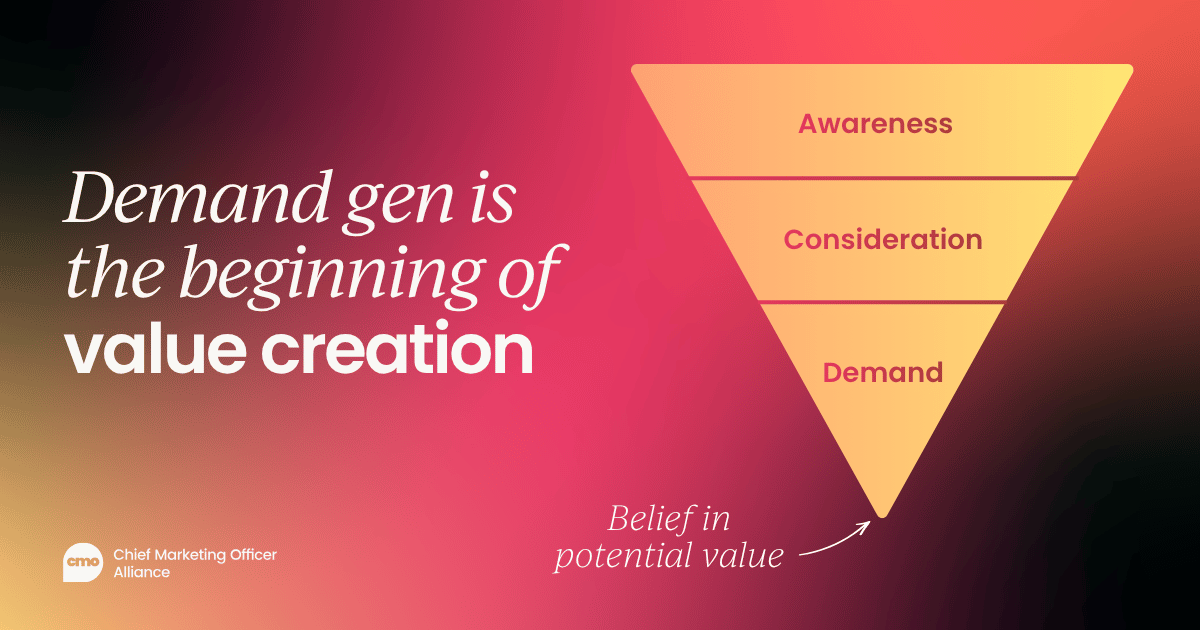
Some of us have evolved to think about this as a cyclical process rather than a linear one, and that's progress. We've also acknowledged that the awareness, consideration, and decision stages aren't as customer-centric as they could be.
Some marketers have tweaked the language to acknowledge customers' jobs to be done. That’s definitely an improvement. But we're still missing something really important:
The purchase is only the beginning of the relationship.
Before the purchase, demand reflects belief in potential value. During that time, marketing is helping customers find and choose the best solution to drive business outcomes and deliver value.
Once the deal is closed, customers shift from evaluating potential value to experiencing it – or expecting to experience it. Sometimes it takes time and effort to extract value from the product or service they bought. After the purchase, customers start asking different questions:


Become a CMO Insider
Thank you for subscribing
Get exclusive insights, frameworks, and strategies from marketing leaders driving real business impact.
An email has been successfully sent to confirm your subscription.
 Follow us on LinkedIn