.png)






There is a meeting that happens in almost every global organization.
Group marketing presents the new brand guidelines. Regional teams nod politely. Then they go back to their markets and continue doing what they were already doing.
I've been in that room twice. Once as the regional marketer nodding along, and once as the person presenting. Both times taught me something different about why the gap between brand standard and brand reality is so hard to close.
Now I'm VP Marketing at PriceHubble, and a full company rebrand this past year gave me a front-row seat to just how hard this is to get right, even with executive buy-in and a dedicated team.
Research shows that consistent brand presentation across channels can drive revenue uplifts of 10 to 33%, and yet only around 30% of companies report that their brand guidelines are widely known and used. The gap between having a brand standard and actually living it is where most of the work lives.
So, here's what I've learned so far.
Not the theory. The practice.
Define what “unified” actually means
The word 'unified' is where most organizations trip up before they've even started.
It tends to get interpreted as 'identical everywhere,' which immediately triggers resistance from local teams. And honestly, they're right to resist. That's not what you're building, and if that's the brief you take to your regional leads, you'll lose them in the first meeting.
Think about Taylor Swift across her eras. Production, themes, and aesthetics shift dramatically. Yet her voice, storytelling, and fan connection remain unmistakably hers. That's global brand voice: a fixed core that flexes without breaking.
In practice, this means separating your brand voice into two layers: what must stay fixed, and what can flex.
 Robin Karakash
The fixed layer is your core: your personality traits, your values, the principles that define how you communicate regardless of language or market. These don't change based on geography.
The flexible layer is everything that sits on top of that foundation: i.e. how formal you are in your communications, or whether a particular success story lands better in one country than another.
In practical terms, this is how I think about it:
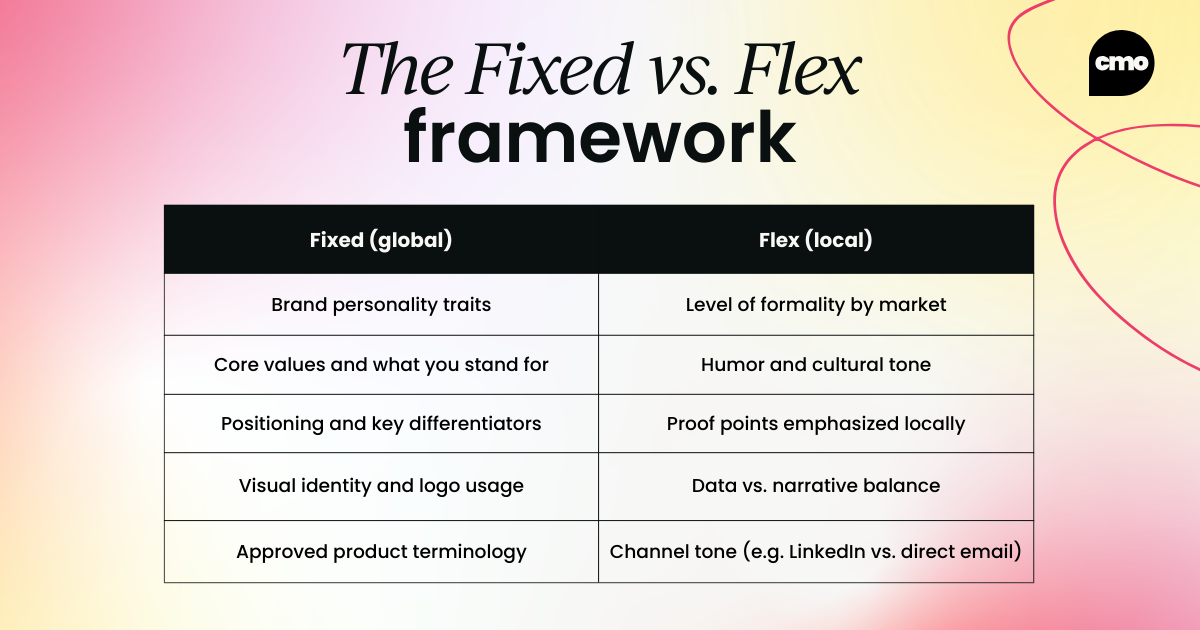
Getting this distinction documented and aligned before you cascade it across the organization is the single most important step. Our rebrand gave us the forcing function to have this conversation properly as a leadership team. Without it, every debate about brand voice becomes a debate about first principles, and you'll have the same conversation on repeat.
Localization is not translation
One of the most persistent misconceptions in global marketing is the conflation of translation and localization. Translation converts words. Localization adapts meaning. They are not the same thing, and treating them as such is how you end up with content that is technically accurate…and completely flat.
Think of it like makeup.
The same person, the same face, but a different look for a job interview, a Saturday night out, or a Sunday morning.
The base stays consistent. The expression changes with the context. Nobody looks at those three versions and thinks they're looking at different people. But everyone would notice immediately if you wore the wrong one for the occasion. A deep red lip and smokey eyes are probably not something you would wear on a Sunday morning coffee walk (but if you do, go for it, I’m not here to judge anyone 🙂).
I've felt this acutely at PriceHubble.
The way we talk about our solutions lands differently with a French institutional investor than with a German property developer, not because the product changes, but because what they need from us is different. But neither wants marketing jargon. And both want to feel seen and understood.
Building localization into your brand voice process, rather than bolting it on at the end, requires a few practical shifts. The most important one: involve local market leads early in messaging development, not just at the review stage.
When I was on the regional side, nothing was more frustrating than receiving a campaign brief that was 90% baked and being asked to check if it works locally.
The goal is for a potential client in Munich and one in Paris to have the same emotional experience of your brand, even if the words and the emphasis are different. That's a much higher bar than a simple translation. It's also where real equity is built.
The consistency vs. relevance trade-off
There is a real trade-off between global brand consistency and local market relevance, and it will never fully resolve. The best you can do is make a thoughtful, explicit choice about where you land on that spectrum and then build your operating model around that choice.
 Finola McDonnell
I've seen organizations land too far on both sides.
The 'consistency at all costs' camp produces beautiful brand guidelines that local teams ignore because they feel disconnected from the reality of their market. I've ignored quite a few in my time, if I'm honest.
The 'local empowerment at all costs' camp ends up with a brand that looks and sounds like a different company in every geography. In enterprise B2B, where buyers encounter your brand in multiple contexts before they even talk to sales, that's a trust problem.
The framework I have found most useful treats roughly 70 to 80% of brand output as globally defined and 20 to 30% as locally adaptable. That space is meaningful enough to ensure local relevance while keeping the whole thing coherent.
Contentful's analysis of how global brands like BMW manage this is a useful illustration: global content provides the foundation, local teams add personality and context. The result feels native without feeling disconnected from the wider brand.
When your local teams deeply understand why the brand sounds the way it does, they make better decisions at the edges without needing approval for every word.
This is something I'm actively working on at PriceHubble: building a shared understanding of the 'why' behind our brand voice, not just the rules. The rebrand gave us a moment to reset and explain, not just 'here's the new logo,' but here's what we're trying to communicate, and why, and for whom.
Because context travels further than any style guide.
Where most of the friction lives: getting non-marketing stakeholders on board
The hardest part of building a unified brand voice in a global organization is usually not the brand work. As so often in business, it’s the internal politics.
Sales teams have their own language for talking about the product, developed through hundreds of customer conversations. Product teams have their own terminology. Regional marketing leads have their own intuition about what resonates in their market. And all of them, not unreasonably, feel like they know their audience better than the central marketing team does.
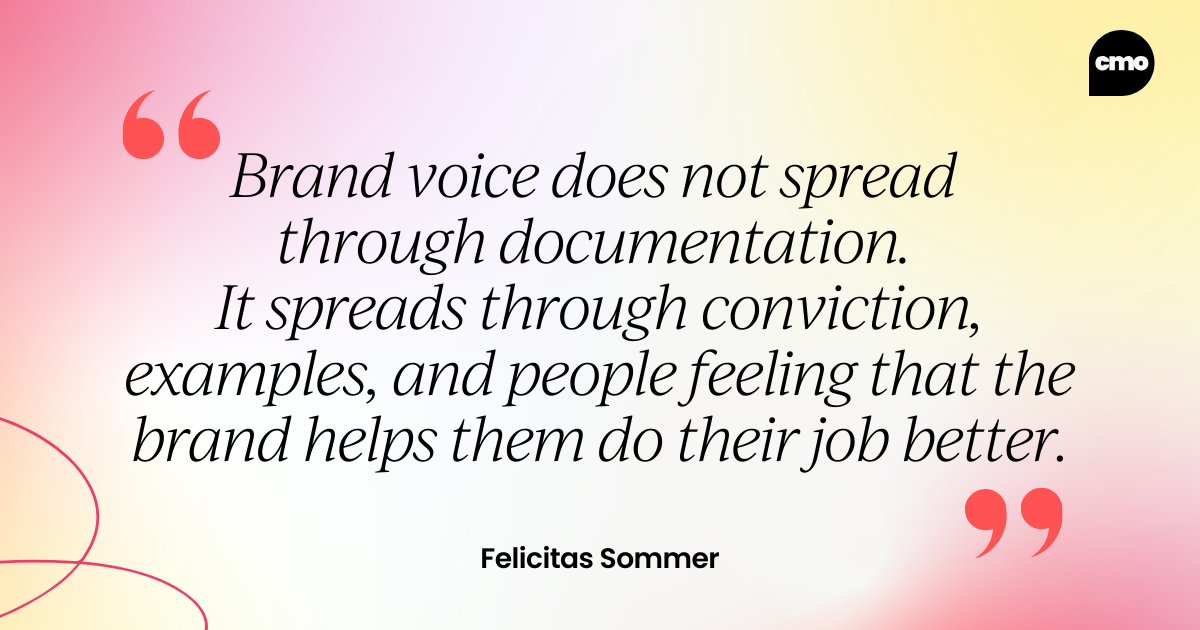
If you walk in a meeting with a brand guidelines document and expect compliance, you will fail. Brand voice does not spread through documentation. It spreads through conviction, examples and people feeling that the brand helps them do their job better.
The solution?
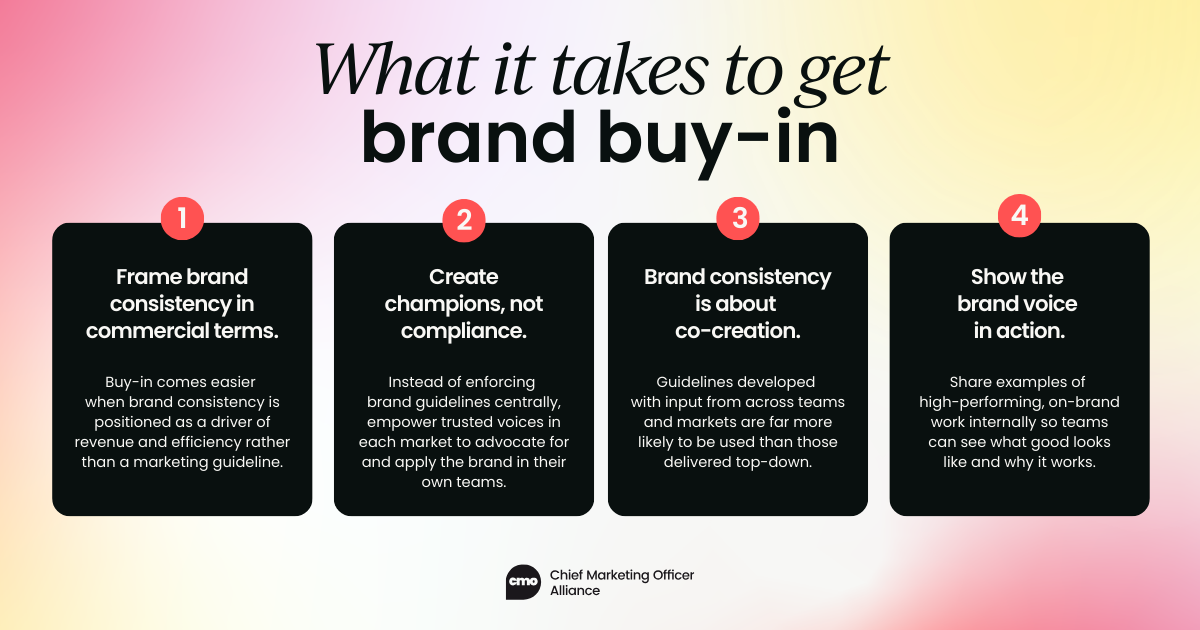
Make the business case in their language
Sales leaders respond to revenue arguments.
Research links consistent brand presentation to a 23% average revenue uplift, and notes that marketing teams can spend up to 20% of their time correcting off-brand materials.
When the conversation shifts from 'why are you asking us to change how we talk' to 'what do we need to do to capture that upside,' you've moved from a marketing project to a commercial priority. That framing matters enormously, especially when you're trying to get buy-in from a country lead who has their own targets to hit.
Create champions, not compliance
Rather than building a centralized brand police function, which creates resentment and bottlenecks, I've found more success identifying brand champions within each market. These are people who already communicate well, who care about how the company comes across, and who have credibility with their colleagues. Give them training, tools, a degree of authority, and let them be the guardians of brand standards in their corner of the organization.
Involve people before you finalize anything
One of the most robust findings in brand consistency research is that 95% of organizations have brand guidelines, but only 25 to 30% actively use them. Sounds like an internal comms problem? Well, not really. It's a co-creation problem.
Guidelines that people helped build feel like shared principles. Guidelines that arrived from central marketing feel like constraints. Where possible, involve cross-functional and cross-market voices in the development of your brand voice framework. Yes, it takes longer. But the output is much better, and it actually gets used instead of sitting untouched on the intranet.
Show, don't tell
Brand guidelines are necessary but not sufficient. What changes behaviour is seeing the brand voice in action, in content that performs, in sales materials that close deals, in campaigns that generate pipeline. I’m a huge fan of sharing examples of great on-brand work internally, with context about why it works. Over time, that builds a shared aesthetic sense that no document can replicate.
The infrastructure that makes brand voice stick
Even the best brand strategy falls apart without operational infrastructure to support it. Good intentions don't create consistency. Systems do.
Here's a checklist of what I consider non-negotiable:
Brand voice foundation
- A brand voice guide with concrete before/after examples, not just descriptions of traits. If your team has to interpret the guidelines to answer a real question, the guidelines aren't specific enough.
- Guidance on how voice adapts across channels and contexts
- Fixed vs. flex documentation that is signed off at leadership level before it is cascaded to teams.
Operational infrastructure
- Centralized digital asset management that is surfaced in the tools teams already use. When it's easier to use the right asset than to find an old one, compliance becomes the path of least resistance.
- Brand-aware localization workflows: translation memories, approved glossaries per language, and human review built into the process, not bolted on afterwards.
- Regular brand audits and feedback loops across markets and channels to catch drift early. Treat them as intelligence, not just quality control. Drift is usually a signal that something in your process or guidelines needs updating.
People and enablement
- Named brand champions in each market and function, with training, tools, and authority to act.
- Internal examples library: a living collection of on-brand content shared across the organization, with brief notes on why it works.
- Onboarding that includes brand voice, not just as a module, but as something a new joiner hears about from their first week.
A word on AI and what it means for brand voice
It would feel strange to write about brand voice in 2026 without addressing the role of AI in content production. It's changing the operating context for all of us, and the implications for brand voice specifically are significant.
The optimistic version: AI tools can help teams produce more content, faster, and with greater consistency if the inputs are right. Think of your brand voice guide as the strategic source code for your company’s AI. Feed a well-trained language model your fixed principles, your approved terminology, and a clear brief, and you can dramatically reduce the inconsistency that comes from a dozen different people writing in a dozen different styles. That's genuinely useful, especially at scale across multiple markets.
The more complicated version: AI often sounds flat and boring. The more your teams rely on AI-generated content without strong brand inputs and human editing, the more your brand voice risks drifting toward a kind of generic B2B average that is technically competent…and completely unmemorable. RWS's research on global brand voice makes this point well: the brands that will stand out in an AI-saturated content environment are those with the most distinctive and well-documented voices, because those are the ones that can actually instruct the tools rather than be shaped by them.
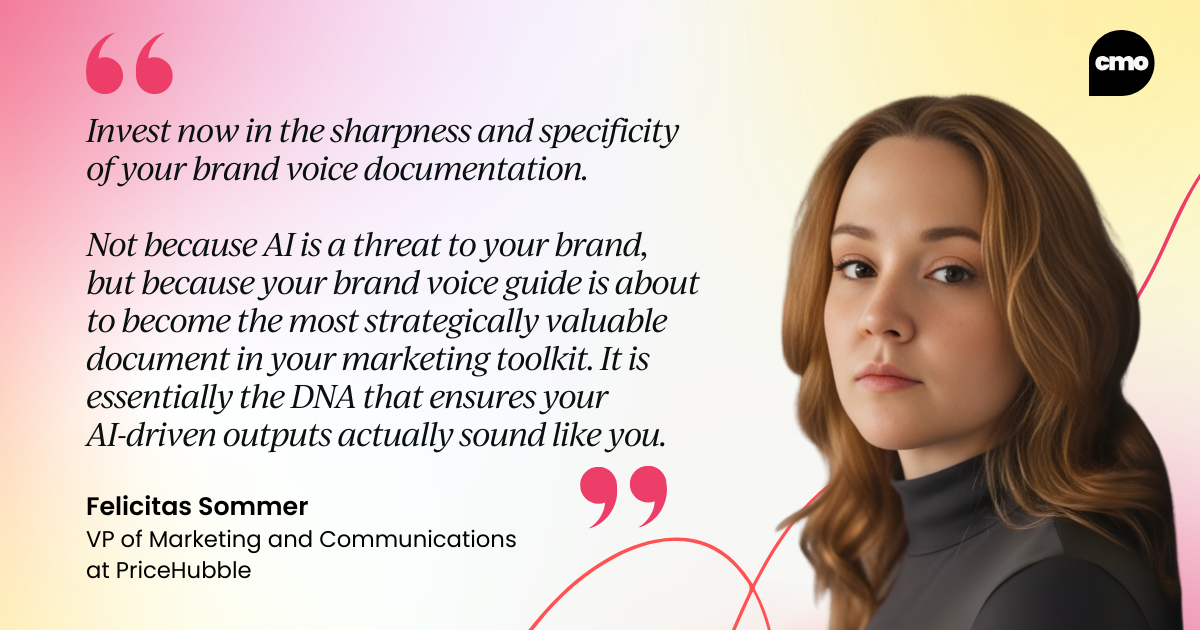
My practical conclusion: Invest now in the sharpness and specificity of your brand voice documentation. Not because AI is a threat to your brand, but because your brand voice guide is about to become the most strategically valuable document in your marketing toolkit. It is essentially the DNA that ensures your AI-driven outputs actually sound like you. The clearer your inputs, the better your outputs, whether those outputs are written by humans, machines, or a combination of both.
The thing I'd tell myself before I stepped into this role
If I could go back and give myself one piece of advice, either as a regional director about to step up to a global role, or as the person who had to make sense of global guidelines that didn't quite fit, it would be this: start with empathy, not control.
The instinct when you're trying to create consistency is to centralize, to standardize, to put guardrails everywhere. And some of that is necessary.
But the organizations that build genuinely strong global brand voices don't do it by tightening the reins. They do it by investing deeply in the clarity of their principles, by making the brand voice so well understood, so well exemplified, and so obviously connected to what the company stands for, that people across the organization want to embody it.
Having been on the regional side, I know what it feels like when global brand guidelines land as a constraint rather than a gift. I'm trying to build something at PriceHubble where our regional teams feel like the brand is genuinely serving them, giving them language and tools that make their jobs easier, not harder.
I have seen enough to know that teams who approach global brand voice with patience, curiosity about their markets and a willingness to listen to regional teams build something far stronger than those who try to impose consistency from the centre.
I hope this is useful. If it sparks a different perspective or a question, I'm very glad to hear it!


Become a CMO Insider
Thank you for subscribing
Get exclusive insights, frameworks, and strategies from marketing leaders driving real business impact.
An email has been successfully sent to confirm your subscription.
 Follow us on LinkedIn