


.png)





There’s a silent crisis draining organizations right now.
I call it the misalignment tax: brilliant people working hard but pulling in different directions.
It never shows up on the P&L, yet it quietly destroys speed, execution, and competitive advantage.
The question organizations lose sight of in these rapidly changing times is also a great reminder: What are we actually here to resolve and for whom?
What I’ve witnessed over and over again is what’s often missing: narrative architecture, a sense-making system that answers why we’re doing this, why now, and how this turns into action. It’s the layer that connects strategy and execution and creates relevance and trust with consumers.
And AI just made this crisis exponentially worse. Technology accelerates execution, but it also accelerates misalignment.
This is why the CMO role is shifting and why "owning the narrative" is becoming business critical.
In a world where AI commoditizes tactics, advantage shifts to organizations that can scale with coherence. When that ownership is real, decisions start to align across teams instead of fragmenting under pressure. Consumers experience the same intent across products, communication, and behavior.
That consistency is what builds trust on the outside, and it’s also what restores confidence and direction on the inside.
In this article, I’ll explore three things:
- The difference between storytelling and narrative,
- Why misalignment is stalling your team, and
- How to build a "narrative architecture" that fosters trust and speed.
We will also explore the evolution of the CMO into what I call the “Chief Narrative Officer,” a strategic architect capable of turning complexity into clarity through narrative leadership.
The difference between storytelling and strategic narrative
Let's start by defining our terms, because while "storytelling" and "narrative" are often used interchangeably, they serve very different functions.
Storytelling is an art. Think of it as the “packaging,” the compelling way we bring ideas across so they stick. People love stories, and they remain one of the most powerful tools in a marketer’s toolkit.
But narrative goes much deeper.
It’s the sense-making tool, the strategic leadership instrument. I like to think of it as the glue that holds an organization together. You can feel its absence when different departments (like product, marketing, the C-suite, and HR) are all operating on different narratives.
The result is misalignment and confusion.
A true narrative is a unifying force that develops clear outcomes. It’s the foundational architecture that explains why you’re doing what you’re doing and what consumer tensions you’re resolving. When everyone understands this, it provides a compass to drive the entire organization forward, especially when you’re navigating the constant zigzag of change.
You can then tell stories from the narrative, but the narrative itself is the essential, profound foundation.
Why do organizations become so misaligned?
If everyone is working for the same company and toward the same goals, where does all this misalignment come from?
In my experience, it boils down to three key factors.
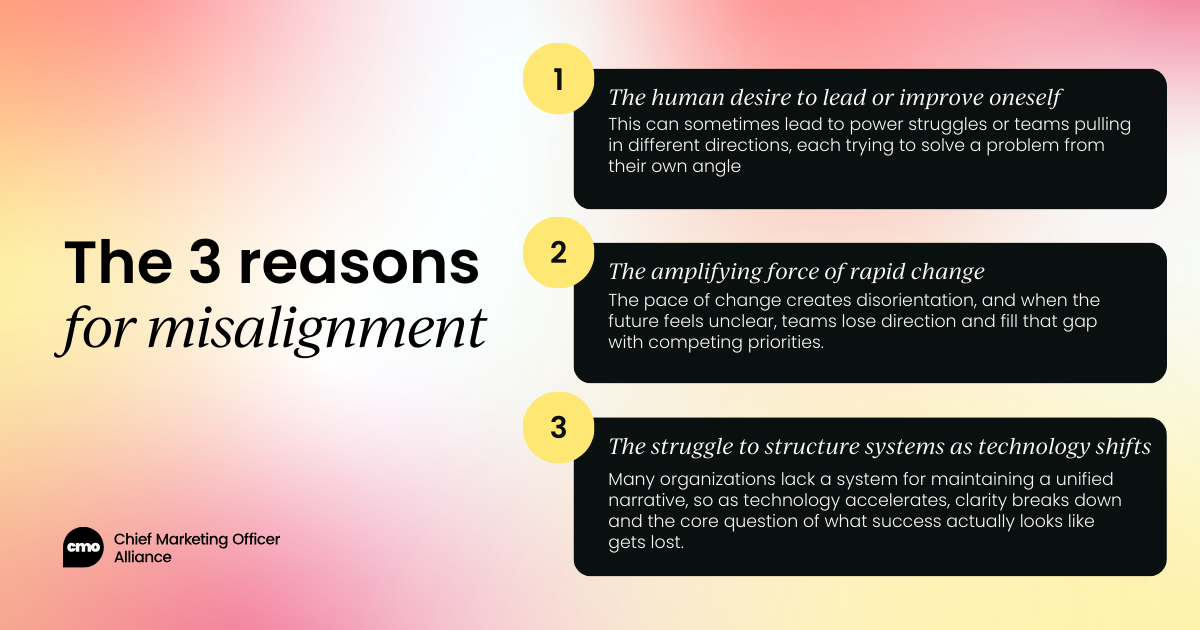
The human factor
First, there's the most complex one: human element.
In competitive environments, the pressure to prove value often turns into territorial behavior. Teams start optimizing for visibility instead of shared outcomes.
Without a common narrative, the system pulls itself apart. This can sometimes lead to unhealthy competition turning into political power struggles or teams pulling in different directions, each trying to prove themselves and solve a problem from their own angle without a shared sense of the bigger picture.
But a growing and connected system only works if all works.
The pressure of constant change
Second, the sheer pace of change creates disorientation and short-term vision.
Technology is evolving so rapidly, and the future feels uncertain whilst immediate results are becoming the only relevant currency with CFOs or investors seeking short term answers. Organizations lose altitude – the perspective to clearly outline and stay on their long-term growth path.
When the path forward isn't clear, and economic anxiety rises, teams can get fearful and lose their grounding. This creates a vacuum that gets filled with conflicting priorities and organizational irrationality.
In other words, you know what to do, but you move differently.
The capability and influence gap
Finally, there's an influence and capability crisis that most organizations don't even recognize.
CMOs are incentivized to build campaigns, optimize channels, and drive growth metrics. But narrative architecture comes with building even stronger internal influence and one that blends strategic thinking, system design, and sense-making.
You need to operate high enough to see all the patterns invisible at ground level, curious enough to question the misalignment, and brave enough to build the infrastructure to address it.
Most marketing leaders are stuck at the wrong altitude. Either they're drowning in execution and can't see the patterns or floating in abstraction and lose connection to creating the impact that creates internal influence.
Without this capability, organizations default to what they know: more campaigns, more tactics, more noise.
Avoiding the common pitfalls of leadership under pressure
When we're under pressure, it's easy to fall back into what psychology calls "basic assumptions." In other words, we go into survival mode. It’s that fight-or-flight response, and it triggers some common pitfalls in organizations.
Drowning in complexity
One of the biggest mistakes I see is teams creating more "stuff." When things feel chaotic, the instinct is to add more dashboards, information, and processes. We mistake complexity for depth.
But more often than not, people are just drowning in information. They’re stuck on a hamster wheel, creating a lot of output but doesn’t lead to real progress.
The better response is to call a timeout.
Stop, name the complexity, and take the time to de-complexify and simplify.
Losing your grounding
In times of change, companies risk losing their core identity.
They get self-conscious, copy other people's playbooks, and think they aren’t good enough anymore. They forget where they came from and what they’ve built and what consumer tensions they solved.
Even with technological disruption, you need to be clear about why you’re making changes before you pivot radically. Often, the pressure to change is a psychological feeling, not just a rational business need.
My advice is always to grow from the core by reconnecting, without sentimentalizing, to your unique strengths.. These are two sides of the same failure: when direction is lost, language is what restores grounding.
How to translate complexity into clarity
Throughout my career, I've witnessed the power of language in creating meaning, trust, and momentum. I've also witnessed the devastating cost of its absence.
So how does a leader turn all this complexity into coherent, actionable guidance for their teams?
That question sits at the heart of my leadership practice, and here's my advice:
Take an altitude to see the patterns
When you feel like you're drowning and clarity is gone, the first step is to take an altitude. Step up and look at the bigger picture to understand the patterns. When everyone is huddling in the mess, they can't see the way out.
Taking a moment to zoom out is crucial.
Use the "locate" exercise
I use an exercise I call "Locate. Locate. Locate." Every time things get crazy and complex, I ask the team: what is so complex about this? Let’s hear everyone out. You’d be surprised how often marketing leadership and product teams have totally different ideas about what the core consumer tension is.
This exercise forces you to ask simple questions that often get lost:
- What are we doing?
- Why are we doing this?
- What is the effect of doing this?
Too often, people are doing things because they "have to," but they can't even say who told them to.
Be curious. Understand the patterns before you jump to act.
A four-step framework for building your narrative architecture
To make this practical, I use a simple four-step stack to build a narrative system. You can use any methodology, but the key is to simplify.
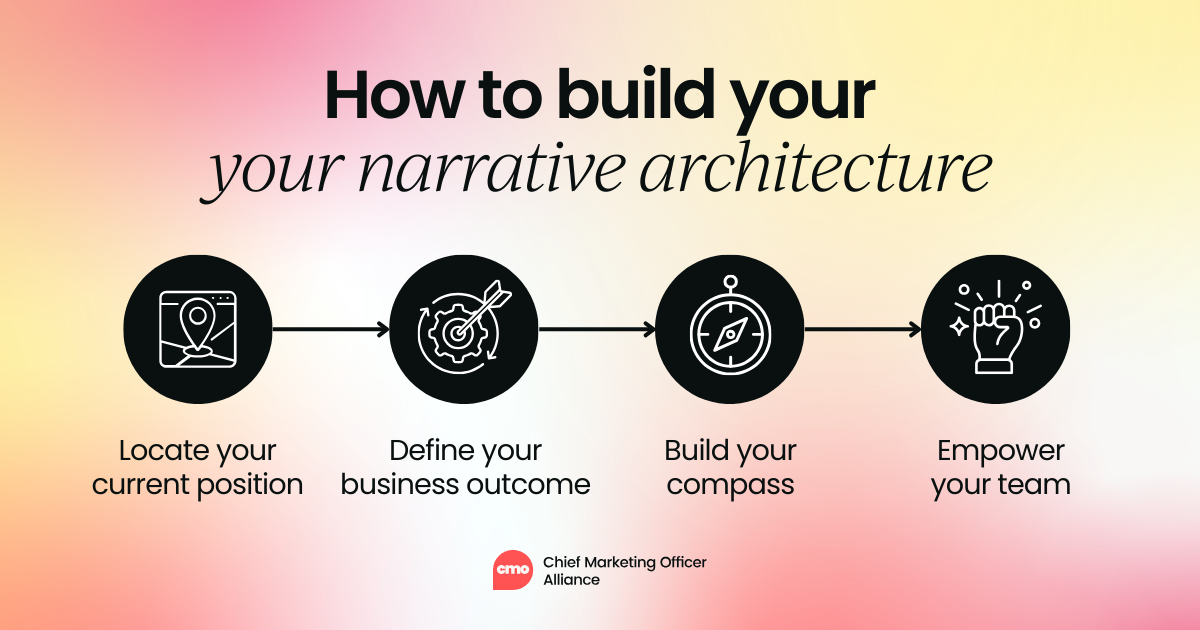
Step 1: Locate your current position
As I mentioned, start by locating where you are. What are the different storylines and narratives currently active in the organization? Are you clear on the consumer tension you’re solving? Be open and honest about any misalignment. You have to choose a direction, and this is the first step to getting there.
Step 2: Define your business outcome
Next, clarify what success looks like. What are you rallying around? This isn't just about the numbers. It’s also about what you need to achieve culturally as an organization to make that business outcome happen. What consumer shift are you trying to drive?
Step 3: Build your compass and decision filters
With a clear direction, you need to build a compass. This means creating simple decision filters so everyone knows how to make choices. Most companies over-complexify this part. Your framework can be very simple.
Just ask:
- Is this on brand?
- Does this support our core narrative?
- Does this help us hit our business goals?
Build one simple framework for how you filter decisions, and then get rid of the rest.
Step 4: Empower your team to swim
If you have these first three things clearly established, you can finally empower your people. You can let them swim. In so many organizations, there’s a "permission culture" where everyone has to ask for approval because the narrative isn't clear. No one is confident enough to make a decision.
When you’re grounded in a clear narrative, you can let your team fly because they know exactly how to execute. This builds immense trust.
Think about any organization where this isn't happening.
Trust erodes.
Putting narrative into practice: the ASICS turnaround
A great example of the power of story and narrative is my time with ASICS.
When I started, the running shoe brand was very stuck in the idea of "running as performance." It was trying to compete directly with Nike and Adidas, playing by category conventions.
But ASICS had something beautiful at its core that it had lost sight of. The name ASICS stands for Anima Sana In Corpore Sano, a Latin phrase meaning "a sound mind in a sound body." This was its founding principle.
We all feel this cultural tension, right? We don't just do sports to be performative; we do it because it’s good for our minds and our bodies. Yet, nobody at ASICS was telling that story.
It was inherent in the brand, but it was buried.
By going back to what made the brand strong from the beginning, we identified its unique narrative. This move gave the company more than just confidence; it gave it direction. Everyone suddenly knew what to do. The narrative became the filter for every decision. The brand stopped playing by the category’s rules and started writing its own.
It was a multi-year project, but if you look at the brand’s success since that shift, you can see how powerful rediscovering its core narrative was.
The evolving role of the CMO in the age of AI
With all this change, especially with the rise of AI, the role of the CMO is evolving.
I see it in three phases.
First, there was the brand storyteller through advertising. Then, with the digital age, came the growth and performance marketer, focused on conversion metrics. For a while, you had these two conflicting types of marketers, and the CMO role became a junk drawer of different disciplines.
Now, we're entering a new phase. I believe the future CMO is a Chief Narrative Officer, or, as I like to call it, a Chief Sense-Making Officer. This leader is an architect who builds the systems-infrastructure for narrative and strategic clarity to be executed with scale and speed that build consumer relevance and trust.
AI is a technology, a tool. It will likely automate much of the growth and performance side of marketing. But what AI can't do is identify the cultural tension you need to solve. It can’t build the human connection. The creative process and brand building will remain an art.
This new CMO is a systematic builder who takes the power of AI into account but focuses on taking the organization and its people along on the journey. This requires more than just brand and performance skills; it demands change management and true leadership.
A narrative is a leadership tool, and the CMO of the future will be the one who wields it most effectively.
A final thought: clarity is kind, and it takes courage
Someone once told me, providing "clarity is kindness" and it has stuck with me ever since.
I’d add that clarity also takes courage.
It’s easy to hide behind complex decks and vague numbers. Clarity makes you accountable, and a lot of people fear that. You have to be willing to put your head out there.
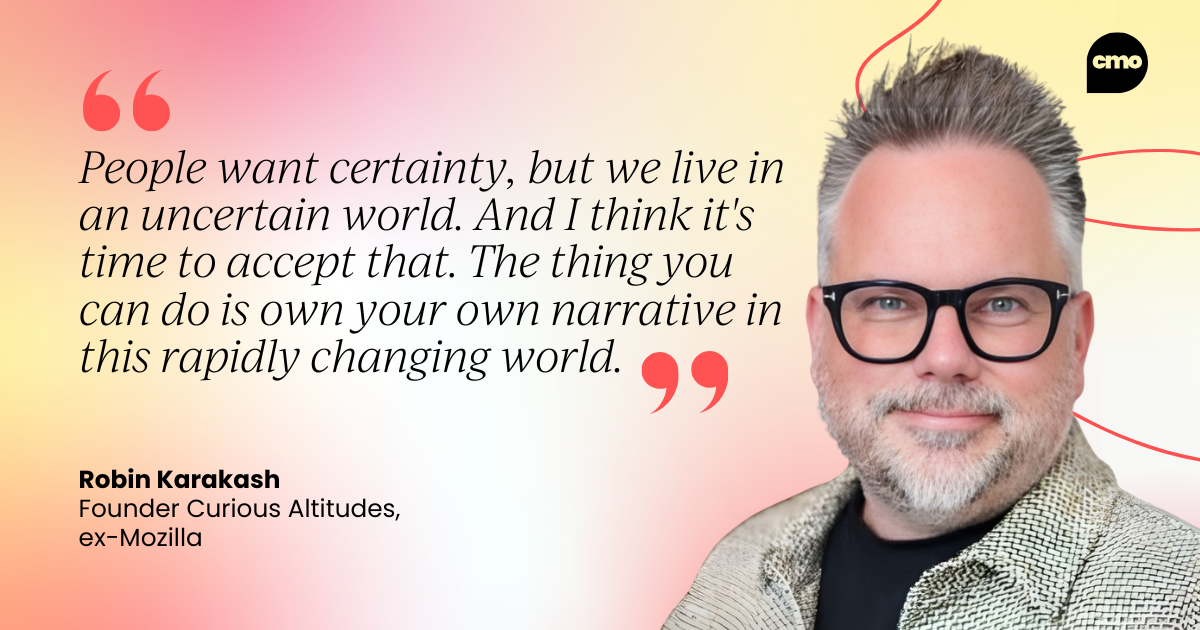
We live in an uncertain world, and it's time we accept that. The one thing that remains in your control is your ability to own your narrative. I practice this myself through curiosity and by always seeking altitude to see the bigger picture. I constantly check in to make sure I haven't lost my own sense of meaning in all the craze.
So, my final piece of advice is to always reconnect with yourself and your own story. Are you still clear about where you want to go, what you want to achieve, and why you're doing what you do?
That’s where it all begins.


Become a CMO Insider
Thank you for subscribing
Get exclusive insights, frameworks, and strategies from marketing leaders driving real business impact.
An email has been successfully sent to confirm your subscription.
 Follow us on LinkedIn