.png)







Marketing leadership is the art of holding a dozen plates while a board member walks by and hands you another one. You manage campaigns, budgets, brand, a team, vendors, and the moving target of a pipeline number. Your own head sits somewhere in that noise, and, if you do not tend to it, everything else eventually wobbles.
I won’t pretend that I have this figured out. I can, however, tell you what’s worked for me as a founding marketing leader at an early-stage company and as a person who wants to still enjoy her life after each quarter closes.
Know your brain and what it actually needs
Every practice I’m about to describe only works if it fits the person using it.
I’m neurodivergent, and, over the years, I’ve learned the specific conditions that my brain needs to function well. That knowledge changes everything. I know when I need quiet, when I need stimulation, when a task will cost me more than it looks like it should, and when something that seems small to someone else is actually going to drain me for the rest of the day.
You don’t have to be neurodivergent to benefit from this kind of self-knowledge. Everyone has needs, neurotypical or otherwise. Some people need a hard stop at six o’clock. Some people do their best thinking after a walk. Some people cannot focus without background noise, and others cannot focus with any.
Paying attention to what you need is not a weakness or a special accommodation. It’s the baseline work of being a human who wants to function well.
Needs aren’t deficits. They’re part of being human, and everyone has them. The leaders who know their own operating manual – and give themselves what the manual asks for – are the ones who last.

Take time for yourself, every single day
Even fifteen minutes counts. A walk around the block, a fresh matcha before replying to your emails, a stretch session with no podcast playing.
The point is not the activity. The point is giving your nervous system a moment where no one needs anything from you. If I skip this for more than a few days in a row, I can feel myself getting brittle, and brittle leaders make brittle decisions.
Protect family time with real walls
My family is not a line item that gets cut when the week goes sideways. I block real time with them the same way I block strategy meetings. The work will expand to fill whatever container you give it, so the container has to have walls. Putting my phone in another room at dinner is the smallest habit with the biggest return.
Take the vacation, and prepare your team to run without you
This is the part marketing leaders tend to skip. You earn the vacation by building a team and a set of systems that don’t fall apart when you step away. That means documented workflows, clear ownership, a simple decision matrix for the questions your team would otherwise Slack you about, and genuine trust that your people can make calls without you in the room.
If you can’t take a week off without anxiety, that’s not proof of indispensability; that’s a signal that something in your operation is too dependent on you, and fixing that is itself a leadership task. A well-prepared team is the most honest measure of whether you have built something durable.
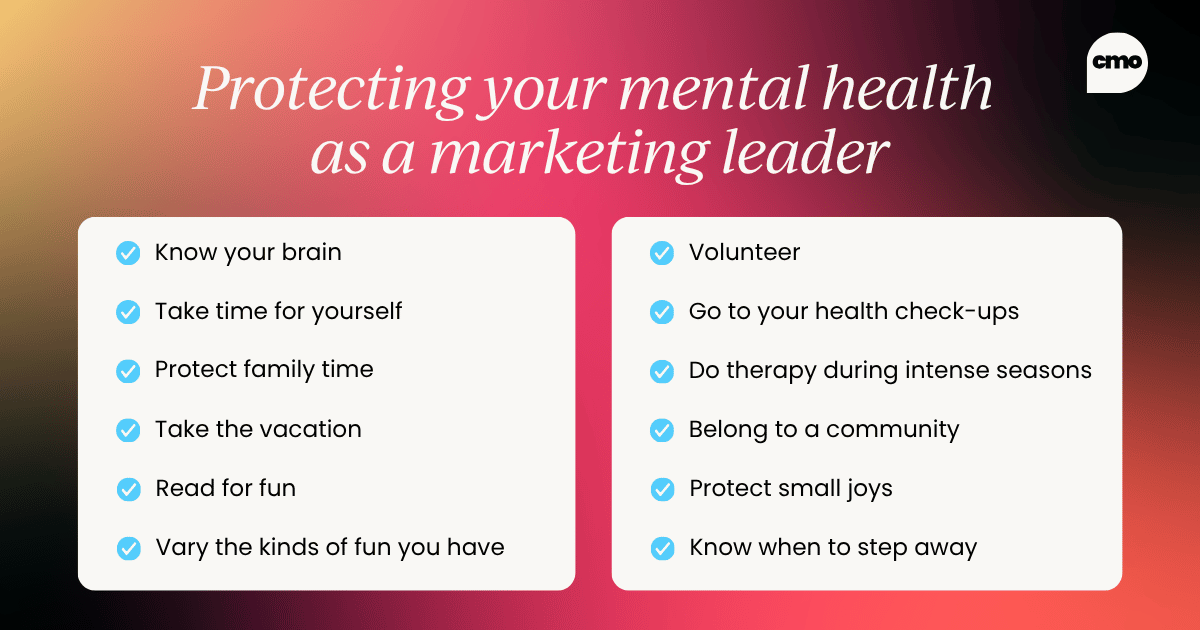
Read for fun, not just for work
I read a lot of books that have nothing to do with marketing, positioning, or leadership. Fiction, memoir, speculative stories, and the occasional cookbook I will never cook from.
Reading for pleasure is how I keep my imagination alive, and imagination is the muscle I use most at work. Marketing that feels fresh comes from a mind that is fed fresh things. A diet of business podcasts alone will make your creative output taste like dust.
Vary the kinds of fun you have
I mix it up on purpose. Some weeks, I exercise. Some weeks, I go to a concert or the theater. Some weeks, I spend hours around a table with friends.
Variety protects against the kind of flatline burnout where every week starts to blur together. Different kinds of joy use different parts of you, and rotating through them keeps any one area from getting exhausted.
Volunteer to stay grounded
When your whole job is talking about how a product helps enterprise customers, it’s easy to lose perspective. Volunteering, whatever the cause, puts me in rooms with real people and real problems that have nothing to do with my pipeline. It resets my sense of purpose. Nothing cures a bad week quite like spending an afternoon being useful to someone outside your industry.
Go to your health check-ups – all of them
This one is less glamorous, but it matters. I never skip my annual physical, my dental check-up, my eye doctor appointment, or any specialist on my list.
Marketers are very good at managing other people's metrics, like funnel velocity and CAC, and often quite bad at managing their own health. Your body is the infrastructure everything else runs on. Treat it with the same rigor you treat your tech stack.

Add therapy during intense seasons
When stress spikes, whether from a product launch, a reorg, a fundraise, or something personal, I don’t wait until I’m sinking – I put therapy back on the weekly calendar.
A good therapist during a hard season is less expensive, emotionally and practically, than trying to white-knuckle your way through it. If you’ve never tried it, treat it like any other performance tool.
Belong to a community that has nothing to do with work
I belong to a church community, and my life with them grounds me in ways that are hard to articulate. Being known by people who care about me for me, rather than my title or my KPIs, is a real gift.
You don’t have to be religious, though, for community to be meaningful. Find a group where you are a person first: a running club, a book club, a parents' group, a volunteer crew, or a standing dinner with old friends. When you find it, commit to belonging to them and value them in your own life. We’re not built to live inside work.
Protect your small, unreasonable joys
I have a puppy named Scuttle, and playing with him is one of the simplest, most restorative parts of my day. Dogs don’t care about the funnel. They don’t ask about the quarter. They just want the ball. You could fuss over a plant, keep picking up a bad guitar, or savor a ritual cup of tea.
Whatever joy you experience, protect it. These small joys don’t distract from your work; they sustain it.
Know when to step away
You cannot solve every mental health problem at work with a better routine. Sometimes, the environment itself is the problem, and no amount of therapy, exercise, or time with your puppy will fix a situation that is actively harming you.
I’ve been there. I once worked in a role where my direct manager was emotionally abusive, and no boundary that I set or habit I built was going to change that. I knew I had to leave, and that was one of the hardest calls I have ever made. It was also the correct one.
If you find yourself at an impasse after having done the honest work of trying to make it better, and the people who need to change cannot or will not, that is your signal. Protecting your mental health sometimes means protecting yourself from the place you are currently in. No title, paycheck, or line on your resume is worth losing yourself. Know when it is time to step away.

The quiet case for all of this
Martyrdom is not the deliverable of your job. Your job calls for good strategy, strong teams, and measurable results. None of those come out of a person who is running on fumes. Protecting your mental health is operational hygiene, not a weakness or a luxury you earn after the next launch.
The leaders I admire most are the ones who have figured out that taking care of themselves is part of taking care of the business. You’re allowed to close the laptop. You’re allowed to take a walk. You’re allowed to be a full human with a life outside the dashboard. In fact, if you want to do this job for the long haul, you have to.


Become a CMO Insider
Thank you for subscribing
Get exclusive insights, frameworks, and strategies from marketing leaders driving real business impact.
An email has been successfully sent to confirm your subscription.
 Follow us on LinkedIn