



.png)







I've been in marketing long enough to see the same frustrating pattern play out again and again.
You present your latest campaign results to the executive team, armed with impressive metrics about impressions and engagement rates. Meanwhile, your CEO's eyes glaze over as they wonder where the revenue impact is hiding.
Sound familiar? The statistics show that you’re in good company:
- Only 14% of CMOs play a direct role in enterprise growth strategy, according to Gartner.
- Just 52% of marketing leaders succeed in proving business value.
- 47% of CMOs feel their function is viewed more as a cost center than a growth driver.
And guess who tends to be most skeptical of marketing's value? CFOs and CEOs. The very people who control budgets and make strategic decisions about where to invest for growth.
So, how do you move from being seen as a tactical executor to being recognized as a growth partner?
It comes down to three shifts:
- Measuring performance in terms tied directly to business value
- Bringing valuable customer insights to executive stakeholders
- Upskilling your marketing teams to think like strategists
In this article, I’ll walk you through each shift, with real examples from my own experience.
Measuring what matters to the C-suite
Here’s what plays out in executive meetings all the time: marketing presents the results of a new campaign – millions of impressions, thousands of engagements, strong performance across key metrics. The CMO is understandably enthusiastic.
Then, the executive team responds with some tough questions: How did this grow pipeline? What’s the revenue impact? What was the return?
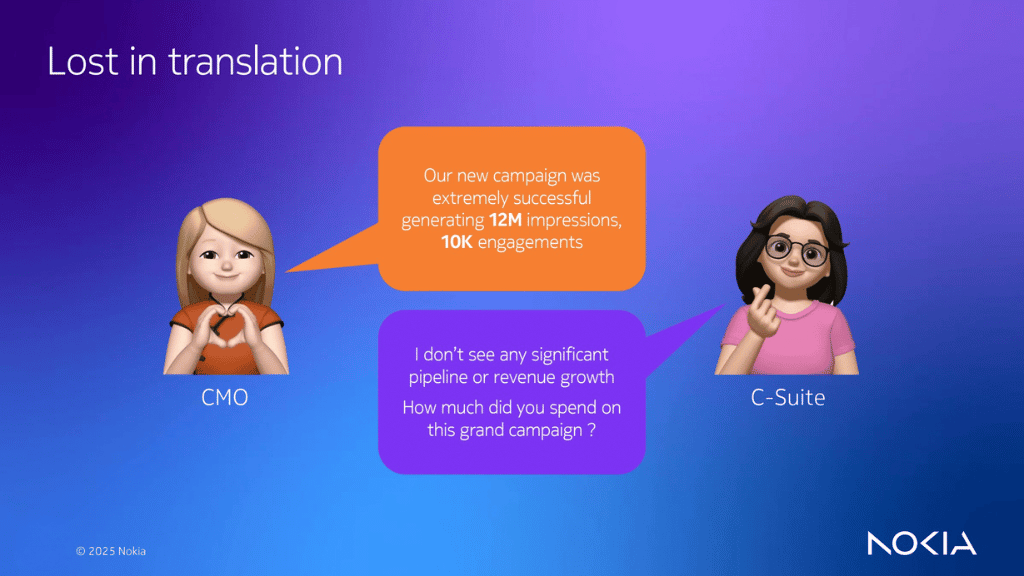
What marketing reports and what the C-suite needs to hear don’t always match – and that’s where value gets lost in translation.
For expert insights like this straight to your inbox twice a month, sign up for Pro+ membership.
You'll also get access to a range of certifications, a complimentary Summit ticket, 50+ tried-and-true templates, members-only workshops, and much more.
So, what are you waiting for?
Mapping C-suite priorities
To change this dynamic, one of my team members recently created a framework for thinking about what different executives actually care about.
For CEOs, it's all about pipeline growth and annual recurring revenue. They're focused on the top line, especially recurring revenue that provides predictable growth.
CFOs? They want to understand the return on marketing investment. In fact, my first conversation with our CFO started with: "If I give you a dollar, how much do I get back?"
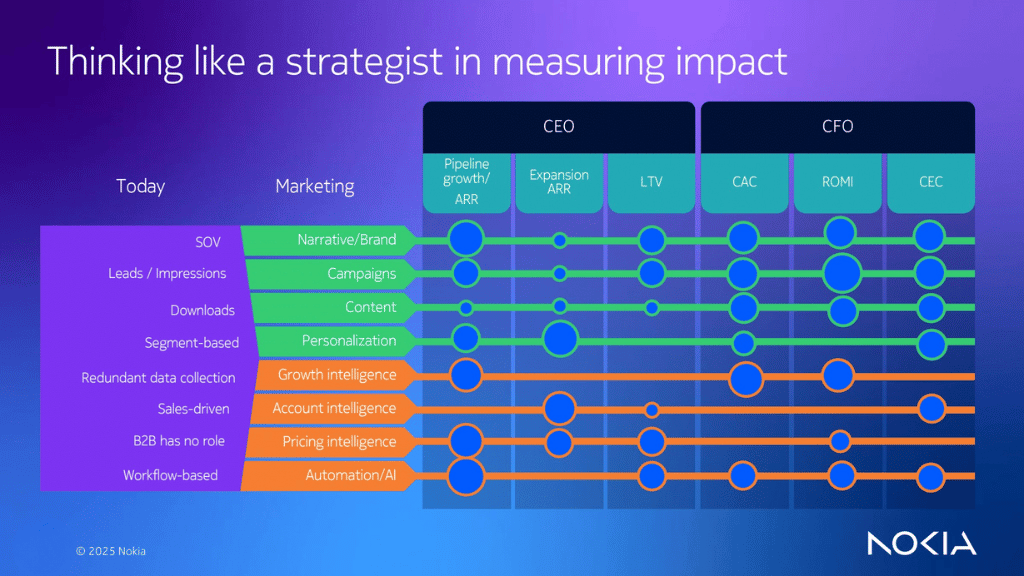
With this in mind, at Nokia, we've started tracking specific campaigns over multi-year periods, measuring both our spend and the resulting order intake.
Let me give you an example. For one campaign that we've been optimizing for over two years, we now generate €12.20 in order intake for every euro invested. The Gartner benchmark for comparable B2B technology companies is five to one.
Now we can show our CFO that we're delivering more than double the industry benchmark return, marketing looks less like a cost center and more like a growth engine.
Becoming the customer intelligence hub


Become a CMO Insider
Thank you for subscribing
Get exclusive insights, frameworks, and strategies from marketing leaders driving real business impact.
An email has been successfully sent to confirm your subscription.
 Follow us on LinkedIn