


.png)




If you've ever felt like you're the only CMO struggling to keep up, you're not. Not even close.
For our Future of Marketing Report 2025, we asked marketers what's standing between them and their goals. The top answer wasn't a lack of ideas or ambition, as you might expect. It was staffing limitations, with 41.5% saying their teams simply don't have enough people to do what's being asked of them. Following close behind, at 40.2%, was the challenge of measuring ROI and proving business impact.
Neither is a rare exception. Both are the norm, and they're not the only pressures CMOs are facing right now.
The full picture: what's really holding CMOs back
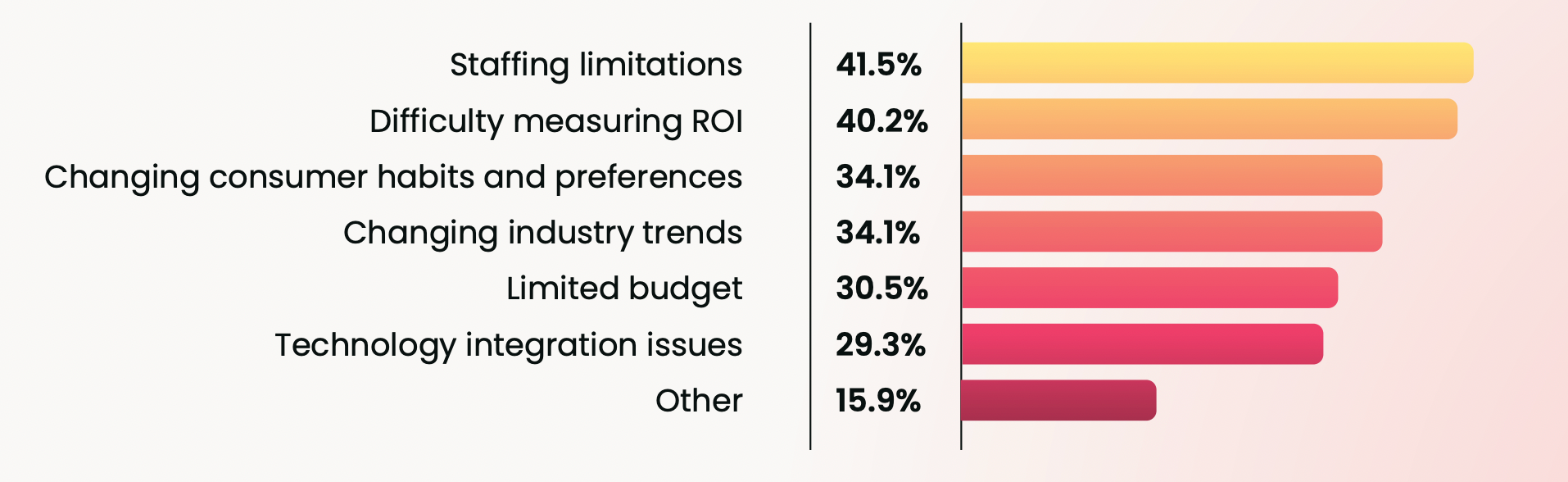
Beyond those two, changing consumer habits and shifting industry trends tied at 34.1%, limited budget came in at 30.5%, and technology integration issues sat at 29.3%. The results tell us that marketers are stretched thin, still guessing at what's working, and stuck trying to plan for a market that won't stay put.
Other obstacles worth mentioning included:
- Product capabilities and market demand
- Buy-in from financial and sales leaders
- Sales training
- Complex buying cycles
- Constantly changing priorities
Let's return to the core difficulties. The following section examines the most significant challenges marketing leaders are facing today.
1. Staffing limitations (doing more with fewer hands)
It's no surprise staffing limitations topped the list. Marketing teams have absorbed years of overwork and burnout. On top of that, finding the right talent for the job can be difficult, too, resulting in marketing teams being asked to do more with fewer people than the job actually requires.
Even if your company’s headcount is in a good place, you could still face layers of approval that can get in the way of your work. Gaby Carmichael, Director of Marketing at MSIG USA, stated that this was one of her top challenges, stating:
"Agility! We have to move quickly, and levels upon levels of approval do not let your experts do what they do best. To perform on social media, you have to bite quickly, and not let trends expire."
Having enough people is only half the problem. What actually matters is whether the people you've got are free to do their jobs. The fix isn't always more headcount.
Making the resourcing case to leadership with real data, and cutting unnecessary layers of sign-off, tends to get existing teams a lot further than waiting on a hiring freeze to lift.
2. Difficulty measuring ROI (proving the work paid off)
The second most common challenge CMOs reported facing was proving any of their hard work actually worked. 40.2% said that difficulty measuring ROI was their biggest struggle… and not for lack of trying.
Chloe Addis, Head of Marketing at Headley Media, points out this isn't even a new struggle.
"The challenges in marketing will be twofold: the first are challenges we've always faced - buy-in, alignment, budget, and proving ROI and results."
Clearly, ROI was a challenge that never really went away, even before AI and privacy regulations made it harder.
And it has gotten harder. Attribution is stretched thinner as privacy regulations tighten and customer journeys fragment. 73.4% of marketers told us data privacy rules, like cookieless advertising and GDPR, are having a significant impact on their strategy, a shift that lines up closely with the ROI struggle.
Paul Gray, Partner Marketing at Webflow, points to a newer issue on top of that: AI is changing who, or what, is actually doing the research.
"One of our biggest challenges now is adapting to changing user behavior driven by AI agents. Traditional funnel metrics don't apply when a product researcher is an LLM or autonomous assistant.
"We must rethink attribution, engagement, and how we create value at every digital touchpoint."
Put simply, buyer journeys have outgrown traditional tracking, and that's exactly why proving ROI feels harder than it used to.
 Hannah Wesson
3. Changing consumer habits and shifting industry trends
Consumer habits and industry trends tied for third place, both landing at 34.1%. The reasons are different, but the effect is the same. Just when you plan around something, it shifts.
Take loyalty as an example. It used to be something brands could bank on. Not anymore, says Jelle Boeser, Head of Brand and Digital Marketing at Royal Canin:
"In today's economy, premium means nothing if people don't feel the difference. You have to earn the price tag every day, or they'll trade down without blinking."
Trends are moving just as fast on the industry side, especially with AI reshaping how people find brands in the first place.
Rossana Rodgers, Chief Marketing Officer at Authena AG, calls it a two-front battle:
"The challenge is twofold: cutting through AI-generated noise and staying ahead of AI visibility algorithms. It's not enough to rank on Google anymore; you have to train the AI models to recognize your brand as the authority."
Ranking well used to be the finish line. Now it's barely the starting point. But none of this means CMOs are powerless. The way most CMOs worked in the past (setting a strategy once a year and leaving it alone) just won't cut it anymore.
The ones staying ahead build in shorter feedback loops. This means you’ve got to revisit your strategy quarterly instead of annually. You can do this by keeping a steady drip of customer listening through surveys or win-loss calls, and watching where people are actually discovering your brand today, not 12 months ago.
You'll never get the market to sit still. But you can get a lot better at noticing when it moves.
4. Limited budget (making the most of what you've got)
While 30.5% of marketing leaders cite a limited budget as a primary obstacle, a tight purse string is rarely the root problem. More often than not, it’s a symptom of something else.
Petr Hlousek, CMO at ALVAO, sees this constantly when he joins a new company.
"Founders focus on product and sales, and marketing gets added later, without direction. Fixing that, building a clear, focused strategy, is always step one."
The harsh reality?
Where marketing hasn't yet proven its value, the budget tends to follow last (if it comes at all). That's not a comfortable position to build a strategy from, but it does point to a fix: prove what the money you already have can do before asking for more.
A few tactics make that easier.
- Narrow in on the accounts most likely to close now, maybe the top 10 to 15%.
- Consider funding one strong asset per quarter, then squeeze everything out of it (social posts, blog articles, an email sequence, a webinar, etc.).
- Can't afford to build a big audience from scratch? Find a non-competing company that already has one. You could co-host a webinar, co-author some research, or swap newsletter mentions, etc., to help reach a larger audience.
5. Technology integration issues (when new tools create new problems)
Nearly 30% of marketers said that technology integration issues were a barrier to hitting their goals. When we asked specifically about adopting new tools, that number jumped even higher. 40.6% said integration with existing systems is the single biggest hurdle, well ahead of cost or training.
Jessica Ruffin, Director of Product Marketing, thinks the tools themselves are rarely the real problem.
"The biggest challenge isn't tools, it's alignment. Building real collaboration across product, marketing, and sales takes time, but it's where the most meaningful impact happens."
A new platform can't fix a team that isn't talking to each other in the first place.
AI is adding its own layer of friction on top of that. Chetan Baregar, Senior Director of Marketing at Recykal.com, has noticed it in the content coming out the other end. "Most content now feels the same," he says.
"Unless you guide it with real intent, AI ends up repeating the same trends, the same tone, the same ideas... audiences are starting to notice too, and they can tell when something's been written by a bot."
Adopting the tool was the easy part. Using it well is where things get harder.
Most integration headaches actually trace back to training. Teams that get proper onboarding tend to get far more value out of the tools they already have, without needing anything new. Treat AI output as a first draft that still needs a human to add judgment and intent.
Conclusion
Every challenge covered here, from staffing to ROI, budget, tech, and a market that won't hold still, shows up across company size, industry, and geography. The CMOs finding a way through aren't the ones with the biggest budgets or the newest tools. They're the ones prioritizing clarity. They know what actually matters and have the discipline to stick with it.
If you're stuck on any of this and want to talk it through with people who actually get it, that's exactly what the CMO Alliance community is for. Come swap notes with CMOs facing the same challenges, and find out what's actually working for them.


Become a CMO Insider
Thank you for subscribing
Get exclusive insights, frameworks, and strategies from marketing leaders driving real business impact.
An email has been successfully sent to confirm your subscription.
 Follow us on LinkedIn