.png)






Every marketing leader has had to justify quarterly or annual spend. And sometimes your answer, no matter how data-backed, doesn’t quite land.
You’re not alone.
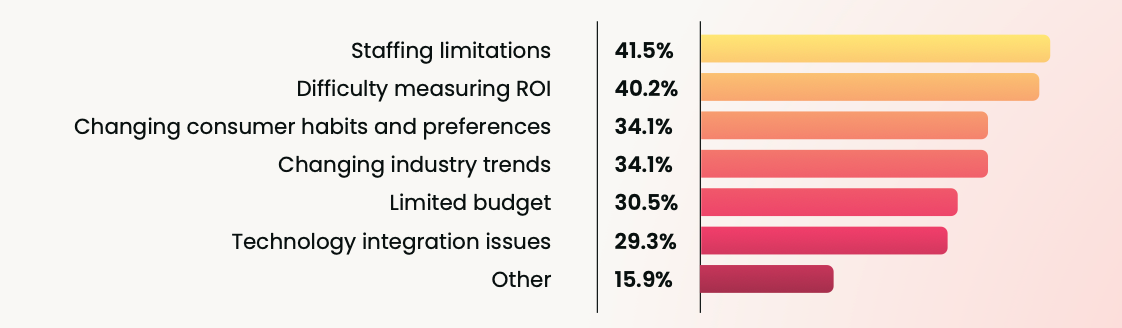
Difficulty measuring ROI is one of the top barriers marketing leaders face right now, cited by 40.2% of respondents in the Future of Marketing 2025 report. That comes as no surprise when the pressure to prove value has never been higher, yet the systems meant to support that work often fall short.
This tension sits at the center of modern marketing leadership: being asked to prove impact with confidence, while operating in systems that might not have been designed for the complexity of today’s channels, journeys, and constraints.
This article looks at a few critical things marketing leaders must consider when measuring and presenting ROI:
- Why ROI measurement keeps breaking down despite better tools
- What teams are actually measuring today and the trade-offs they're making
- What realistic measurement looks like when you're working with real constraints and stretched resources
The ROI problem marketing leaders are actually facing
“Most marketing teams are stuck between proving ROI yesterday and building a long-term brand tomorrow. The challenge? Leading both without burning out.” - Katherine Lehman (Fractional CMO at ReturnBear & Founder at KT Creativity)
According to our report, nearly half of marketers cite difficulty measuring ROI as one of their biggest barriers. That sits right next to staffing limitations at 41.5%.
These two challenges aren't separate.
When your team is stretched thin, and 25.9% are dealing with burnout, measurement quality suffers. You don't have time to build better systems. Instead, it might feel like you're just trying to get the reports out.
Leadership expects clear ROI measurement. It's not enough to say "engagement is up" or "the campaign performed well." They want to know what you got for that spend and where to invest next.
Now, when we look at the other challenges listed in our report, we can assume teams are struggling with structural problems: limited resources, unclear data, and constantly evolving markets and trends. The systems many teams use weren't built for the complexity of modern marketing. And fixing those systems takes time and money, which most teams don't have.
In that context, ROI measurement stops being just about the numbers and starts being about credibility. When you can't clearly show impact, it's harder to defend your budget, get buy-in for new initiatives, or make the case for resources your team needs.
What marketers measure today (and why)
Given the pressure to prove ROI and the constraints teams are working under, what are marketers actually measuring?
The data shows a clear pattern.
Leads generated (63.4%) and conversion rates (62.2%) top the list. These metrics are straightforward to track, easy to communicate to stakeholders, and closely tied to campaign objectives. This makes sense given that 73.4% of respondents work in B2B marketing, where lead generation is often the primary focus.
Revenue generated comes in at 46.3%, followed by customer acquisition cost at 41.5%. These tie marketing performance directly to business outcomes, which matters when you're defending budget allocations or making the case for more resources.
What's notably absent? Brand lift sits at just 11%. That's a tenth of what leads and conversions get.
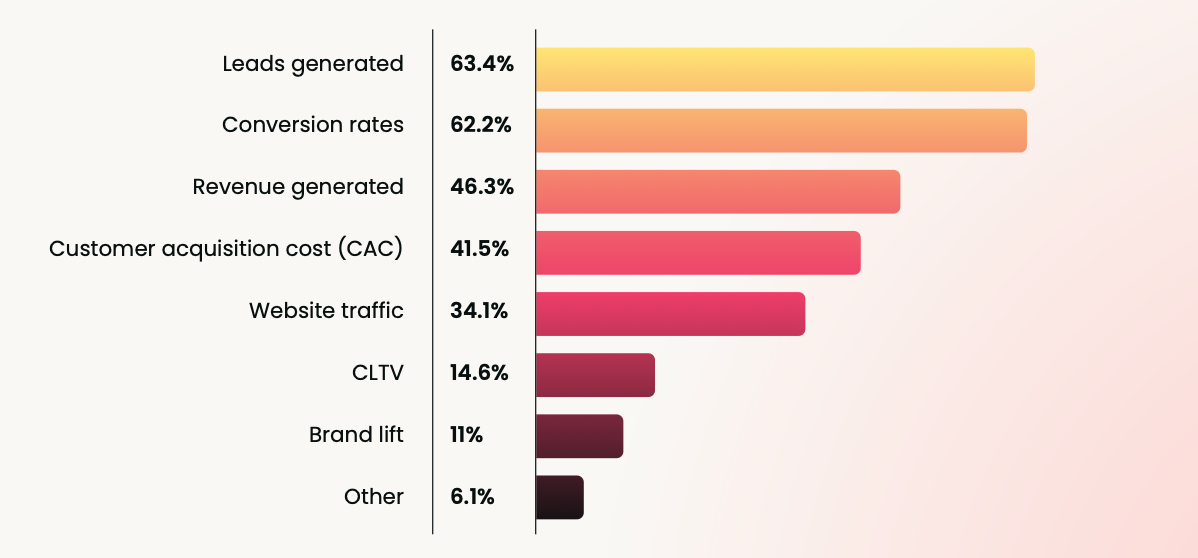
This isn't because marketers don't think brand matters. It's because teams choose metrics that are defensible, repeatable, and understood by leadership. Brand lift is harder to measure, report consistently, and tie directly to quarterly performance reviews.
When you prioritize metrics that are easier to track and communicate, you end up focusing on near-term, activity-linked indicators. The report notes that teams are measuring what's easiest to report and defend, not necessarily what captures the full picture of marketing's impact, especially across longer buying cycles or brand-building work.
This shapes behavior.
If your metrics are weighted toward leads and conversions, that's where your team's energy goes. If brand lift isn't measured, it doesn't get the same attention or investment, even when it might be what drives results six months from now.
Why attribution keeps breaking down
If measurement is hard, attribution is where it really falls apart.
Most marketers (36.1%) rely on first-touch attribution models, while 31.2% use last-touch. These simplified, single-point models dominate despite everyone knowing they don't reflect how buyers actually move through a journey, especially in B2B or longer sales cycles.
Why? Because they're easier to implement and easier to explain. First-touch works for teams focused on acquisition, tying value to that initial interaction. Last-touch appeals to performance-driven teams looking to credit the final conversion trigger.
However, let’s focus on the very real operational blockers to paint a clearer picture of why attribution overall proves challenging:
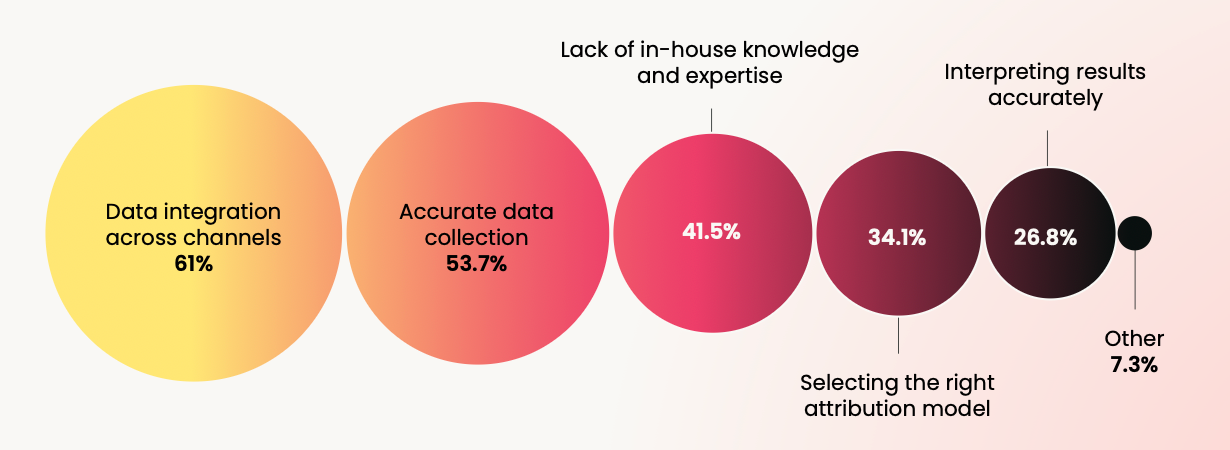
→ Data integration across channels affects 61% of teams.
→ Accurate data collection is a challenge for 53.7%.
When your touchpoints are scattered across platforms that don't talk to each other, you can't connect the dots between channels, campaigns, and conversions. But that's the reality most teams are operating in. Attribution isn't a precision tool but a directional signal used to inform decisions, not claim exact causality. And 41.5% of teams say they lack the in-house knowledge and expertise to do even that well.
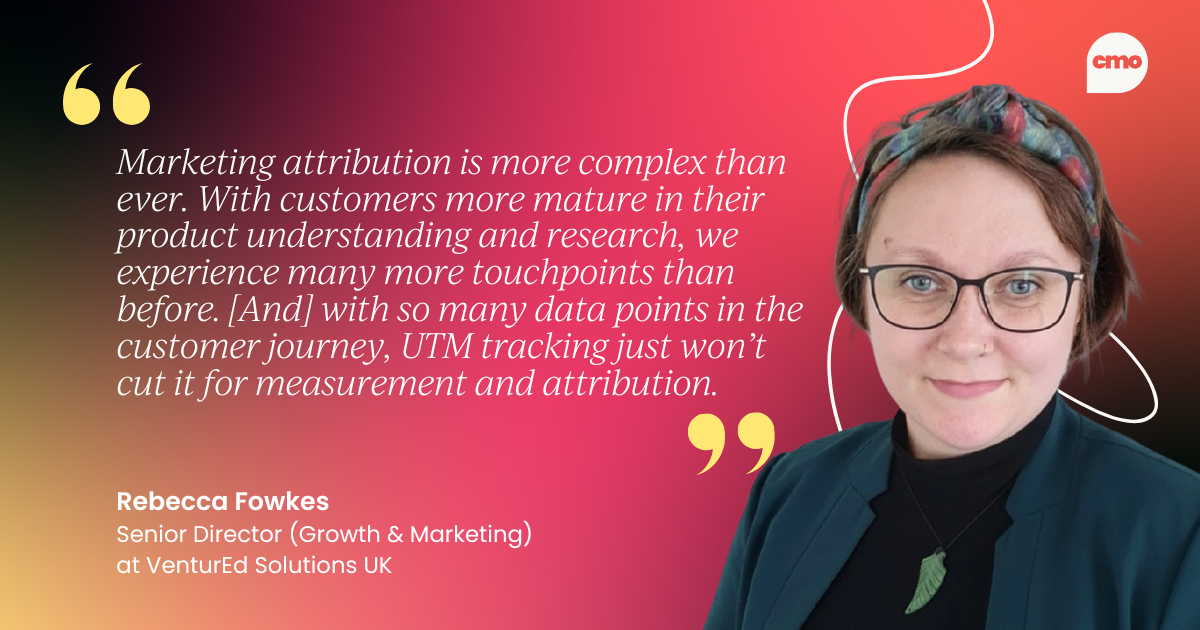
Rebecca Fowkes, Marketing Director at VenturEd Solutions UK, describes the challenge: "Marketing attribution is getting more complex than ever. With customers more mature in their product understanding and research, we experience many more touchpoints than before. With so many data points in the customer journey, UTM tracking just won't cut it for measurement and attribution."
Equally challenging (as the report notes) is that privacy and compliance concerns make tracking even harder. This ties directly to earlier findings where 72% of marketers said data quality and integration were the biggest blockers to personalization.
Chetan Baregar, Senior Director of Marketing at Recykal.com, gets at what this looks like in practice:
"In B2B, attribution is no longer a clean science. Dark social like WhatsApp forwards, internal Slack convos, and LinkedIn DMs are where product recommendations really happen, but they leave no trace in analytics. To get closer to the truth, we're layering CRM data with last-touch attribution, self-reported sources, and direct intel from sales. It's not perfect, but it's a much more honest view of today's B2B journey."
Budgets, channels, and the illusion of high ROI
Where marketing dollars go and which channels are perceived as delivering the best ROI tells you a lot about how measurement shapes investment decisions.
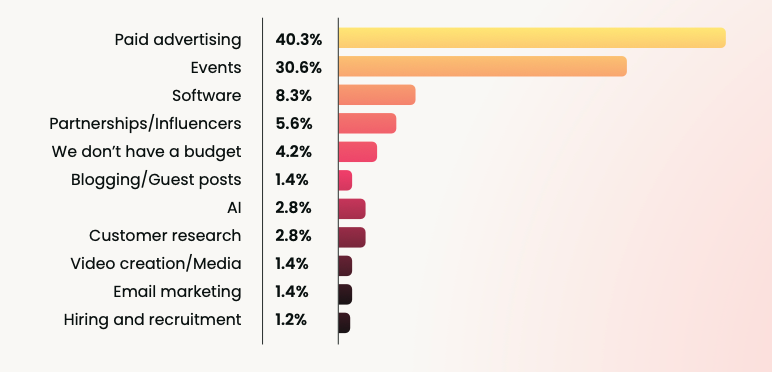
Paid advertising gets the largest budget share at 40.3%, followed by events at 30.6%. Meanwhile, over half of respondents (53.8%) expect budgets to grow, while 13.7% anticipate reductions. That creates pressure: more scrutiny over where money goes, alongside rising expectations to demonstrate impact.
When marketers talk about ROI, they’re often talking about different things.
On the content side, webinars (52%) and blog posts (45.3%) are seen as delivering the strongest returns, balancing lead capture with long-term discoverability. On the channel side, paid search (53%) and SEO (42.3%) lead, driven by clearer attribution and higher-intent traffic.
But here's where it gets interesting.
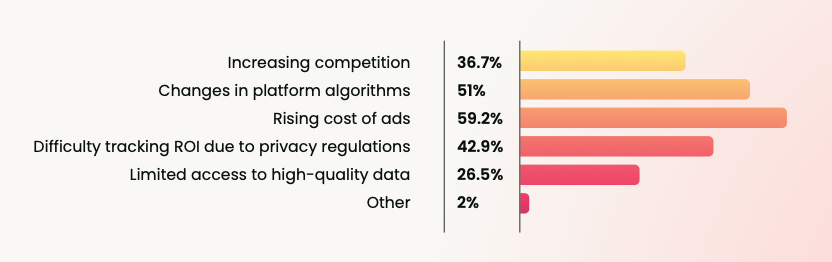
Rising costs and volatility complicate how confidently you can read these numbers. The report shows that 59.2% of marketers cite rising ad costs as their biggest challenge in performance marketing, and 51% point to changes in platform algorithms. Add in the fact that 42.9% say privacy regulations make it difficult to track ROI, and you start to see the problem.
Channels with clearer attribution often appear more successful, regardless of their actual contribution across the funnel. Measurability drives perceived ROI. If you can track it easily, it looks like it's working. If tracking is murky—like with brand-building work or upper-funnel content—it's harder to make the case that it's delivering value.
This is what Jelle Boeser from Royal Canin means when he says: "It's easy to measure the 40. That's why it gets the budget. But the 60 (the long-term brand building) only shows up in modeling and market share. If you don't protect it, you'll feel it a year too late."
The channels that are easiest to measure get the investment. The ones that are harder to track, but might be driving longer-term impact, struggle to justify their budget.
What pragmatic ROI measurement looks like in practice
So what do you actually do when you're working with imperfect systems, limited resources, and pressure to show results?
The answer isn't building a perfect measurement framework. Instead, it’s about starting with a small, defensible core set of metrics, not everything at once. Just the handful of metrics that leadership understands, that you can track consistently, and that tie to business outcomes. For most teams, that's leads, conversion rates, revenue, and CAC.
It also means consciously choosing simplified attribution models. First-touch and last-touch aren't perfect, but they're usable and consistent. As Katherine Lehman, Fractional CMO at ReturnBear, puts it: "Perfect attribution is a myth. Smart marketers triangulate insights from multiple sources, then use story and signal to drive decisions."
Consistency matters more than complexity. If your definitions shift every quarter, if your reporting cadence is irregular, if stakeholders don't trust the numbers because they keep changing… none of it works.
The report makes clear that integration and data quality are bigger problems than analytical sophistication.
Qualitative inputs matter, too. Sales insight, customer feedback, and context help fill in the gaps that data can't capture. This is especially true in B2B, where dark social, like WhatsApp forwards, Slack conversations, and LinkedIn DMs, influences decisions but leaves no trace in your analytics.
As measurement becomes more embedded in day-to-day decisions, it doesn’t just influence what gets reported; it shapes what gets prioritised, funded, and created in the first place.
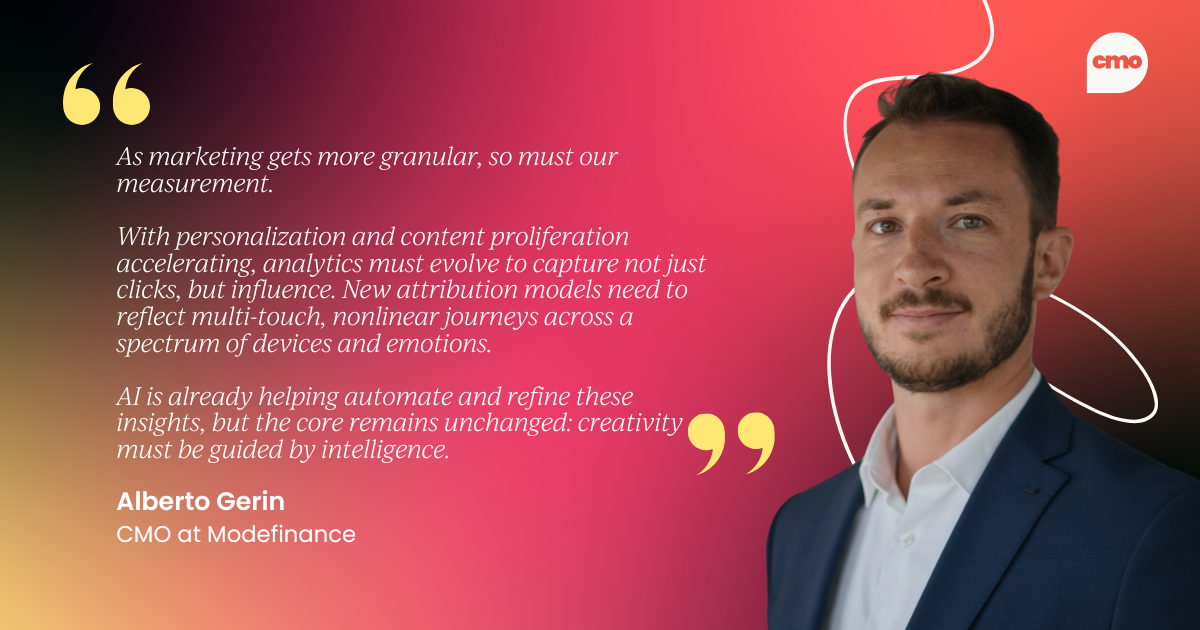
As Alberto Gerin, CMO at Modefinance, shares:
“As marketing gets more granular, so must our measurement… Data and attribution are no longer just for proving past performance; they are now strategic inputs into business decisions… The core remains unchanged: creativity must be guided by intelligence.”
The goal, however, isn't perfection. It's credibility. You're building a system that supports decisions, communicates clearly, and holds up when leadership asks where the money went and what came back.
To wrap up
Here's what we've covered:
40.2% of marketers struggle with measuring ROI, making it a structural challenge tied directly to staffing constraints and burnout. The metrics teams choose (leads, conversions, revenue, CAC) reflect what's defensible and repeatable, not necessarily what captures the full picture. Brand lift sits at just 11% because it's harder to measure and communicate.
Attribution keeps breaking down because of operational problems. Data integration affects 61% of teams, and simplified models dominate because they're usable. Attribution works as a directional signal, not a precision tool, and measurability often drives perceived ROI. Channels that are easier to track get the credit and the budget, even when other work might be driving longer-term impact.
Good ROI measurement supports decisions, not perfection. Transparency is a leadership strength. When you're clear about what you can and can't measure, when you explain the trade-offs you're making, when you use measurement as a communication tool and not just an analytical exercise, trust gets built.
The marketers who navigate this well are the ones who are honest about constraints, consistent in how they measure, and clear about what the numbers actually mean. This holds up in budget conversations, earns credibility with leadership, and lets you keep doing the work that matters, even when you can't measure every piece of it perfectly.


Become a CMO Insider
Thank you for subscribing
Get exclusive insights, frameworks, and strategies from marketing leaders driving real business impact.
An email has been successfully sent to confirm your subscription.
 Follow us on LinkedIn