.png)




Let me begin with a truth we can’t afford to ignore: marketing is being rebuilt in real time.
Consumer and business expectations keep rising while our budgets keep shrinking. Technology, particularly AI, is accelerating faster than our organizational structures can absorb.
What keeps me up at night is not the technology itself – as CMOs, we know how to handle tech. What worries me is the widening gap between what our systems can do and what our teams are designed to deliver.
If any of that sounds familiar, you're in the right place. What follows is a practical guide to understanding the forces reshaping marketing, what they mean for your team structure, and what you can do about it.
Here’s what we’ll cover:
- The five forces that are fundamentally reshaping how marketing teams work
- How to assess where AI fits into your team structure – and which roles will change first
- A real-world look at how I'm transforming my own team at RTM
- What it means to lead people – not just manage technology – through this shift
The forces reshaping how we work
A sea change is coming to marketing organizations of every industry and size. This change is so monumental that it's making us reinvent traditional ideas about how, when, and where work gets done, and what work itself means.
Five interlocking forces are sculpting the future of work in marketing, and we need to understand them all.
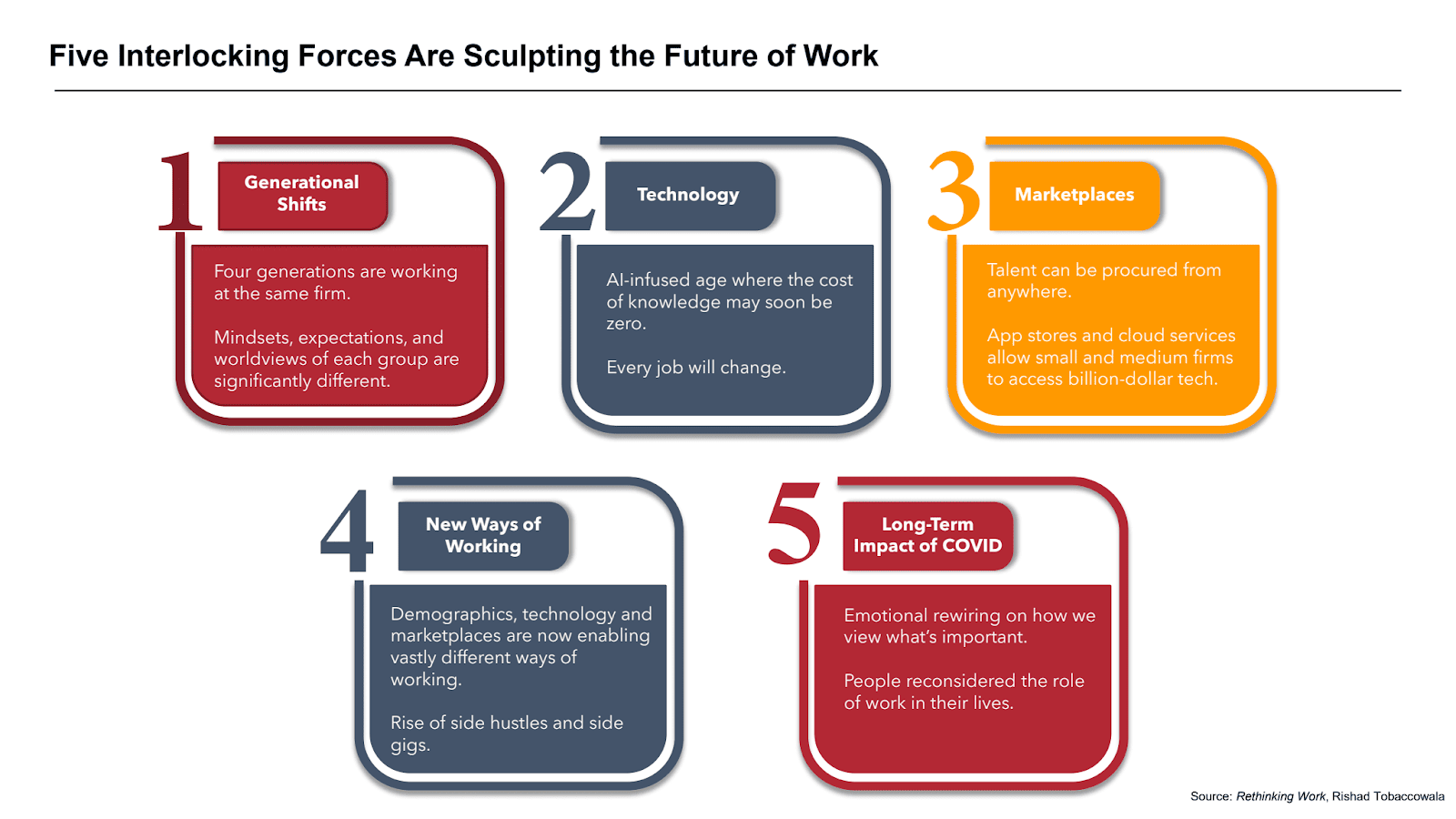
1. Generational shifts are creating complexity
For the first time ever, four generations work side by side in our marketing teams. Gen Z employees in their twenties are about to become the largest component of the workforce. Meanwhile, Baby Boomers in their sixties have been the largest group by numbers, income, and impact – until now. Between them, we have Millennials and Gen X.
The mindsets, expectations, beliefs, and communication styles of these four groups differ dramatically. We have to lead them all. The complexity keeps growing – even before we start talking about AI.
Beyond generational diversity, we're seeing rapid aging of the workforce combined with declining population growth. These demographic shifts create unprecedented challenges for team building and talent management.
2. Technology is approaching a tipping point
We're entering an AI-infused age where the cost of knowledge may soon approach zero. Think about the implications of that statement. Every job will change. We're already seeing roles disappear, but we're also watching new ones emerge.
Bill Gates recently shared his perspective on which jobs will survive the AI revolution. He mentioned three:
- Coders
- Energy experts
- Biologists
I'm not sure I agree with him completely, but it's worth considering why he chose those specific roles.
3. Marketplaces enable new talent models
Today, hundreds of marketplaces like Upwork allow us to procure talent from anywhere in the world. Platforms like Etsy and Shopify enable individuals to reach customers globally. App stores and cloud services from Apple, Google, and OpenAI are now accessible to small and medium firms, not just billion-dollar companies.
This democratization of access changes everything about how we build and manage teams.
4. New ways of working emerge
Demographics, technology, and marketplaces combine to enable vastly different working models. Side gigs and side hustles became mainstream in 2022, when the term "fractionalized employee" was born.
5. The long-term impact of COVID
The shift goes deeper than where people work. COVID's biggest impact might be the emotional rewiring it caused in all of us. We're all rethinking how we work, where we work, when we work, and what work actually means to us.
Income and title used to be the primary motivators. But younger generations, especially Gen Z, need their company to mean something. The organization must do work that matters. Social impact has become a requirement, not a nice-to-have.
Why this matters now
Technology is moving exponentially faster than any organization can absorb through incremental changes. By the time most marketing departments adapt to one wave, another one crashes over them. There's always something new to learn.
Rather than asking how we do more, we should ask how we design teams that move at the speed at which the world now operates.
Consider this statistic: according to a report by the World Economic Forum, 59% of the global workforce will need reskilling by 2030. If we don't redesign capabilities now, capability decay becomes our biggest threat.
For expert insights like this straight to your inbox twice a month, sign up for Pro+ membership.
You'll also get access to a range of certifications, a complimentary Summit ticket, 50+ tried-and-true templates, members-only workshops, and much more.
So, what are you waiting for?
The flip phone problem
Most marketing teams today operate with the equivalent of a flip phone. We're running 2026 marketing on 2010 org charts.
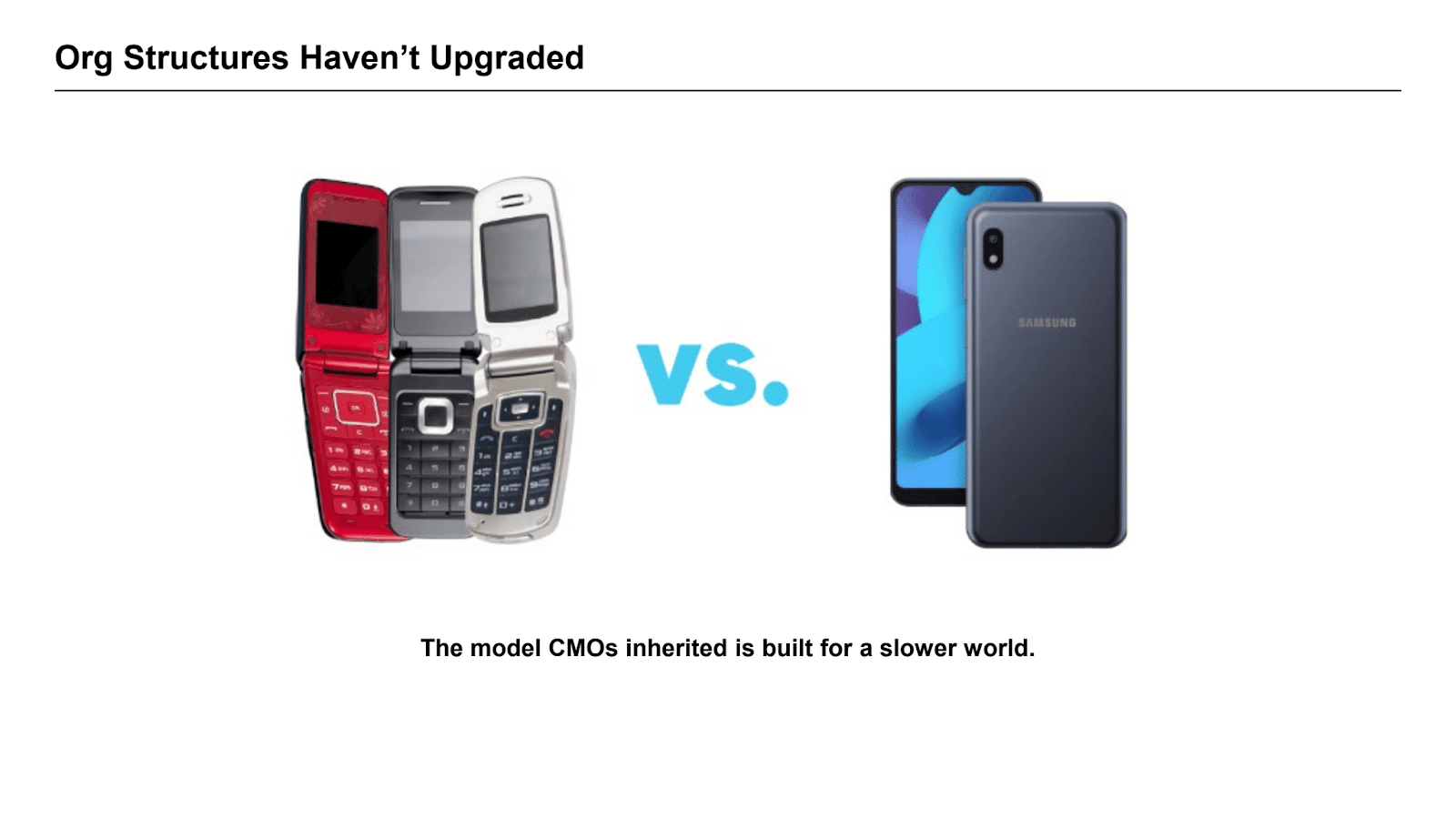
In my previous CMO role, I experienced what many of you know too well. Getting one thing done takes forever. We need meetings upon meetings, multiple team approvals, budget sign-offs, and maybe a prayer. The process feels endless.
But the world requires a smartphone right now. Our hardware – our org charts, workflows, and skills – has become outdated. No software layer can fix hardware that isn't built for today's world. Expectations have risen faster than our organizations can evolve.
That's why we feel underwater. It's not about effort – our teams are working their asses off. The problem is how marketing organizations are designed.
Three breaking points
When I see strain in my team, three things break fast:


Become a CMO Insider
Thank you for subscribing
Get exclusive insights, frameworks, and strategies from marketing leaders driving real business impact.
An email has been successfully sent to confirm your subscription.
 Follow us on LinkedIn