


.png)




I'm going to let you in on something that might ruffle a few feathers.
After building a marketing function from scratch at Advanced Call Center Technologies and watching countless teams struggle with the same challenges, I've come to a conclusion that goes against the zeitgeist: throwing AI at your marketing problems won't magically solve them.
In fact, it might make things worse.
When I joined ACT in 2022, I inherited what could generously be called a "challenging situation." Our CRM was literally an Excel spreadsheet on our CEO's hard drive. Our branding was outdated, to say the least. We'd been in business for 28 years and never had a marketing function.
I was basically handed ten dollars, some balsa wood, and a bag of rubber bands and told, "Good luck."
Being handed that blank slate taught me something invaluable about what really drives marketing success – and it's not the latest AI tool or platform. It's the fundamentals that we've somehow convinced ourselves are outdated in this age of artificial intelligence.
The AI hysteria is real (and it's exhausting)
Let me paint a picture of what's happening in marketing departments everywhere right now. The questions come fast and furious: Are we missing opportunities? Can we get more efficient? Do we seem old school? And my personal favorite: "Why don't you just use AI for that?"
Sometimes I feel like I'm in a room with Marie Antoinette. "Let them use AI," they say. Maybe AI can bake a cake for you while it's at it.

The question that really gets me, though – the one every CMO is thinking but is afraid to say out loud – is this: can I really do this? Do I have what it takes? Isn't there someone we can call for this?
Here's what I want you to know: You do know what you're doing. You've been doing it for a long time. The principles you understand intuitively are still important. More important than ever, actually.
For expert insights like this straight to your inbox twice a month, sign up for Pro+ membership.
You'll also get access to a range of certifications, a complimentary Summit ticket, 50+ tried-and-true templates, members-only workshops, and much more.
So, what are you waiting for?
The answer engine apocalypse
True story: The thing that freaked me out most about AI wasn't ChatGPT or content generation. It was answer engines. I'd spent years mastering SEO, feeling like I finally had it figured out. Then boom – everything changed overnight.
ChatGPT, Google Assistant, and all these new platforms fundamentally altered how people find information. But here's what they all boil down to: authority. And authority isn't something you can fake with AI-generated content.
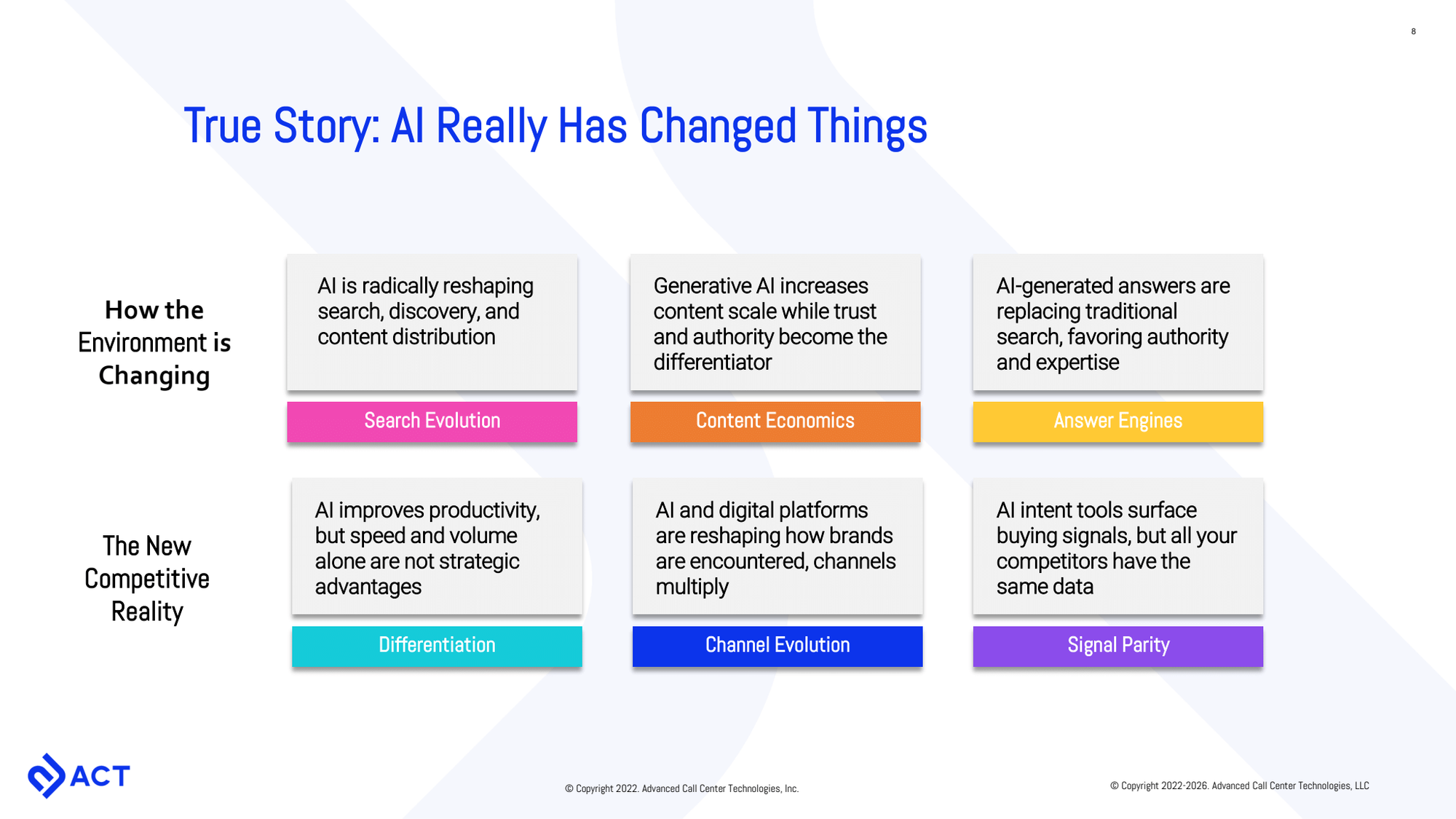
Search is evolving in ways we couldn't have imagined. People are getting answers from TikTok, Reddit, podcasts – everywhere except traditional search results.
Channels are fragmenting faster than we can keep up with, and content economics have gone haywire. We can crank out more content than ever before, but if it's not genuinely insightful, we're just flooding the market with noise. People roll their eyes. They check out. They think, "Oh great, another marketer using AI to spam me with generic content."
The framework that cut through the chaos
Over the years, I've developed a framework that cuts through all this chaos. It's not revolutionary. You've probably heard variations of it before – the four Ps, the three Cs, whatever acronym soup your organization favors – but the principles remain constant.
I organize everything around three core concepts: story, presence, and trust.
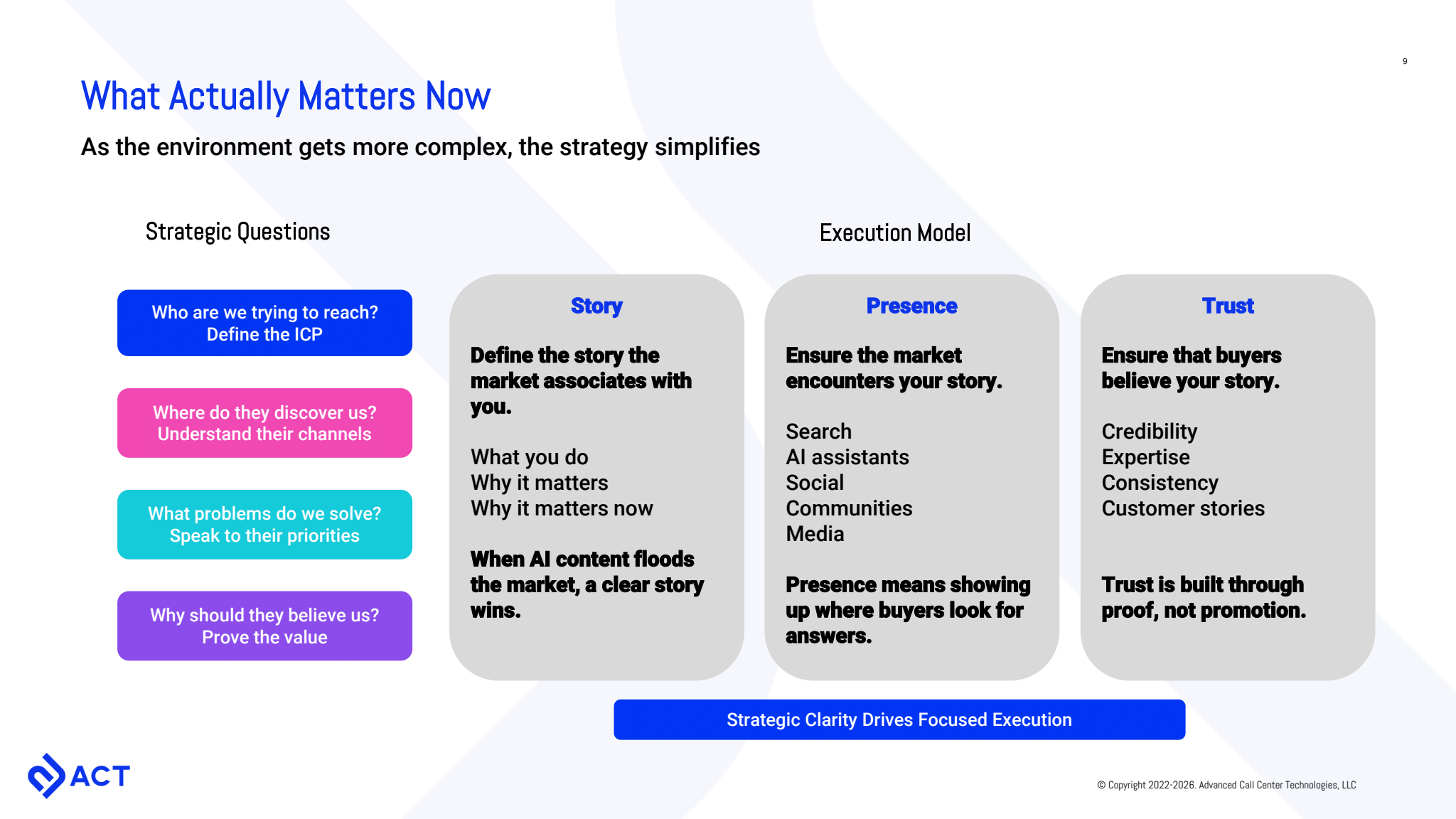
Story is about who we are, always in the context of who we're talking to and what problems we solve for them. It's not about us – it's about them, viewed through the lens of what we can do together.


Become a CMO Insider
Thank you for subscribing
Get exclusive insights, frameworks, and strategies from marketing leaders driving real business impact.
An email has been successfully sent to confirm your subscription.
 Follow us on LinkedIn