



.png)







What is marketing attribution?
Marketing attribution is the practice of identifying which marketing activities influence a customer’s decision to convert and how much credit each interaction deserves.
At its core, attribution answers one fundamental question:
What actually drove this result?
In 2026, buyers rarely convert after a single touchpoint. They discover a brand through paid social ads, reading blog content, attending a webinar, receiving retargeting ads, and engaging with sales – often across multiple devices and channels.
Marketing attribution provides visibility into this journey. It allows teams to understand which campaigns initiate interest, which nurture consideration, and which drive final action.
Rather than relying on assumptions or last-click metrics, attribution connects marketing activity to real business outcomes like pipeline, revenue, customer retention, and lifetime value.
Distinction from marketing mix modeling (MMM) and multi-touch attribution (MTA)
Marketing attribution is often confused with related measurement approaches like MMM and MTA. While connected, they serve different purposes.
Multi-touch attribution assigns fractional credit to various touchpoints across an individual user’s journey. It focuses on granular, user-level interactions (such as clicks, sessions, or conversions) and attempts to map influence at a detailed level.
Marketing mix modeling, on the other hand, uses statistical analysis and aggregated data to measure the broader impact of marketing channels over time. It evaluates trends across paid media, seasonality, pricing, promotions, and external factors to estimate contribution to revenue.
In simple terms:
- MTA looks at who did what and when.
- MMM looks at what worked at a macro level over time.
Modern attribution strategies in 2026 increasingly combine elements of both – blending granular behavioral data with high-level modeling to provide a more complete view of performance.
 Dr. Peter Cain
Why is marketing attribution important in 2026?
“The more you have attribution, the better you are able to make decisions as a team and inform the company of what you're doing and why you're doing it.”
Julia Hartwig, VP of Marketing at Nimble
Privacy landscape
The rules of data collection and tracking have fundamentally changed.
The deprecation of third-party cookies, stricter global privacy regulations, and platform-level changes like Apple’s iOS tracking restrictions have reduced visibility into user-level behavior. Marketers can no longer rely on platform-reported data alone.
This shift has forced organizations to rethink how they collect, manage, and activate first-party data. Attribution in 2026 requires privacy-conscious infrastructure, server-side tracking, clean data environments, and transparent consent practices.
The challenge is clear: balance personalization and measurement with compliance and user trust.
Rise of new channels
The media landscape is more fragmented than ever.
Connected TV (CTV), retail media networks, podcasts, creator partnerships, short-form video platforms, and community-driven channels have become core parts of the marketing mix. Many of these channels operate in environments where tracking is limited or opaque.
As marketers expand into emerging platforms, attribution must evolve beyond simple click-based measurement. Brand influence, assisted conversions, and cross-device journeys must be accounted for in smarter ways.
What worked in 2019 tracking infrastructure no longer works in 2026.
Focus on the unified customer journey
The current buyer journey is nonlinear, cross-device, and multi-channel.
Customers interact with brands across search, social, email, events, product experiences, sales conversations, and post-purchase engagement. Each touchpoint plays a role in shaping perception and decision-making.
Attribution in 2026 is about building a unified, end-to-end view of the customer journey, rather than purely isolating campaign reporting.
Organizations that succeed are those that:
- Own and centralize their data
- Connect marketing, product, and sales interactions
- Move beyond siloed channel reporting
- Tie marketing efforts directly to revenue and lifetime value
The fundamentals of marketing attribution
 Amelia Wilson
Single-touch attribution
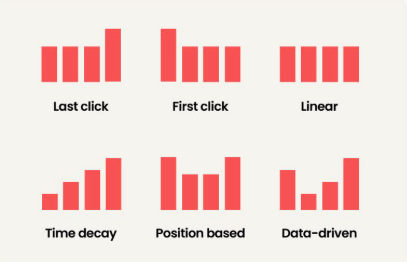
Single-touch attribution is exactly what it sounds like – you give credit to one single touchpoint in the customer journey for a conversion. While easy to track, single-touch models can be a bit... well, narrow.
They focus on just one part of the process, which means you’re missing out on the full picture of how your leads actually engage with your marketing.
Single-touch attribution models
There are two main types of single-touch attribution: first-click attribution and last-click attribution.
First-click attribution
In first-click attribution, you give 100% of the credit to the very first interaction a lead has with your business. Maybe they clicked on a Facebook ad or stumbled upon your blog from a Google search – whatever that first touchpoint is, it gets all the glory.
This model is helpful for understanding which marketing channels are grabbing attention and driving initial awareness, especially in top-of-funnel activities.
But here’s the catch – by only focusing on the first touch, you’re ignoring everything else that happens afterward. Sure, you might know that your social ad caught their eye, but what about the follow-up email that nudged them to make a purchase? First-click doesn’t give you any of that context.
Last-click attribution
On the flip side, last-click attribution credits the final touchpoint before the conversion. This is the last thing a lead interacts with before making that all-important decision to buy. Think of it like giving your sales team all the credit for closing the deal, without acknowledging the marketing efforts that got the customer there in the first place.
Last-click attribution can be useful in short sales cycles where there aren’t many touchpoints, but if your leads are interacting with multiple channels over time, this model overlooks the broader journey. It’s like watching the final play of a football game and assuming that’s the only reason the team won.
Multi-touch attribution
If single-touch attribution feels a bit like giving out participation trophies, multi-touch attribution is like running a relay race – everyone who contributes gets some of the credit. Instead of focusing on just one touchpoint, this model spreads the credit across all the interactions a lead has with your brand throughout their journey.
As the ways to engage with customers multiply, this approach gives you a much clearer understanding of how your marketing efforts work together to drive conversions. By tracking multiple touchpoints, you can see which channels, ads, and campaigns are nudging your leads toward that final decision. It’s not just about what gets their attention first or last – it’s about everything in between.
Better still, multi-touch attribution allows you to weigh the impact of different interactions. Not all touchpoints are created equal, and this model helps you figure out which moments are actually moving the needle.
As Jorgen Davison, Marketing Strategy and Operations Manager at Slack, said:
"Even though I don’t really believe that multi-touch attribution gives you the ability to say, ‘Here’s what every dollar delivered to the business,’ it does allow you to reverse-engineer the buyer’s journey.”
This makes it an incredibly useful tool for extracting insights about the mix of touchpoints that convert versus those that don’t.
Multi-touch attribution models
There are several ways to divvy up credit among touchpoints in multi-touch attribution. Each model offers a unique way to understand your customer’s journey, depending on what insights you’re looking for.
Linear attribution model
In the linear attribution model, every touchpoint gets equal credit. Whether it’s the first ad a customer clicks or the final email they open before converting, each interaction is treated with equal importance. This model is great for getting a holistic view of all your channels, but it doesn’t consider that some touchpoints might have more influence than others.
U-shaped attribution model
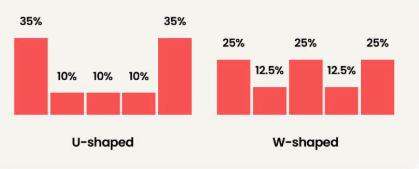
The U-shaped attribution model, also known as position-based attribution, places the most credit on two key moments – the first touchpoint and the point when the lead becomes qualified.
For example, if a social media ad grabs their attention and later, a whitepaper download converts them into a qualified lead, these touchpoints get the bulk of the credit. This model is perfect for understanding which acquisition channels are driving awareness and converting leads.
W-shaped attribution model
The W-shaped attribution model takes things a step further by adding a third key moment: when the lead converts into a customer.
This model gives 30% credit to the first touchpoint, the lead qualification touchpoint, and the final conversion touchpoint, with the remaining 10% spread across all other interactions. If you’re looking to see which channels help move leads through each major stage of the funnel, the W-shaped model is the one for you.
Time-decay attribution model
The time-decay attribution model gives more credit to the touchpoints that occur closest to the conversion. Think of it as rewarding the interactions that are freshest in your lead’s mind. This model is great for businesses with long sales cycles, as it recognizes that touchpoints closer to the purchase decision tend to have a bigger influence.
Full path attribution model
In the full path attribution model, you’re tracking four key touchpoints:
- The first interaction
- The lead-generation touchpoint
- The moment the lead becomes sales-ready
- The final conversion.
Any remaining credit is evenly distributed across other touchpoints in the journey. This model is particularly useful if you’re running account-based marketing or need a detailed look at the entire sales process.
Data-driven attribution model
Finally, we have the data-driven attribution model, where algorithms do the heavy lifting. This model uses machine learning to determine how much credit each touchpoint should get based on how effective it was in pushing the lead toward conversion. It’s smart, flexible, and perfect for marketers who want to let the data guide their decisions.
Multi-touch attribution might not be the magic bullet some make it out to be, but it’s a huge step up from single-touch models when you want a clearer understanding of your entire customer journey.
Challenges in attribution
In the quest for accurate marketing attribution, marketers face a myriad of obstacles. While the importance of attribution is widely recognized, implementing effective systems and processes remains a significant challenge for many organizations.
To shed light on this issue, we asked marketers about the specific hurdles they encounter when trying to achieve accurate attribution.
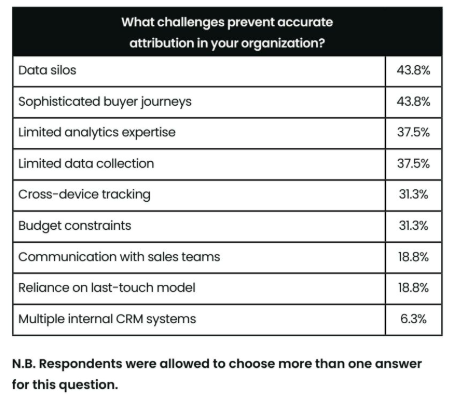
The most common challenges, such as data silos (43.8%) and sophisticated buyer journeys (43.8%), reflect the increasing complexity of marketing ecosystems. Disconnected systems limit visibility into customer behavior across touchpoints, while intricate buyer journeys make it harder to track each interaction’s contribution.
Limited analytics expertise (37.5%) further compounds these issues, signaling a need for more specialized skills within marketing teams. Cross-device tracking and reliance on outdated models, such as last-touch attribution (18.8%), also hinder accurate measurement.
Marketers must prioritize breaking down data silos and investing in analytics expertise to accurately attribute value in increasingly complex customer journeys.
Building a 2026 marketing attribution strategy
In 2026, building an effective attribution strategy requires clarity of purpose, resilient data infrastructure, and continuous validation.
A strong attribution strategy answers three core questions:
- What decisions are we trying to inform?
- What data do we need to answer those questions reliably?
- How do we ensure our measurement remains accurate as channels and privacy regulations evolve?
Let’s break that down.
Goals and KPIs
 Gabriel Gervelis
Defining the business questions your attribution model must answer
Before selecting tools or implementing tracking, define the strategic purpose of your attribution model.
Attribution should not exist for reporting’s sake. It should directly inform high-impact decisions such as:
- Which channels deserve incremental budget?
- What drives qualified pipeline, not just leads?
- How long does it take for different segments to convert?
- Which campaigns influence lifetime value rather than short-term conversions?
- Where are we overspending with minimal revenue impact?
When attribution is anchored to business questions, it becomes a decision engine — not a dashboard.
Clear questions also prevent over-engineering. Not every organization needs complex algorithmic modeling. What matters is whether your model answers the questions leadership cares about.
 David Barder
Aligning attribution data with key performance indicators (ROI, CPA, LTV)
Once business questions are defined, attribution data must connect directly to core KPIs.
In 2026, vanity metrics like clicks and impressions are insufficient. Attribution should tie marketing activity to measurable financial outcomes, including:
- Return on Investment (ROI) – Revenue generated relative to marketing spend
- Cost Per Acquisition (CPA) – True acquisition cost across touchpoints
- Customer Lifetime Value (LTV) – Long-term revenue contribution by source
- Pipeline contribution and revenue velocity
- Retention and expansion influence
The most effective attribution strategies move beyond “which channel drove the conversion” to “which channel drove profitable growth.”
This shift is what transforms attribution from tactical optimization into strategic growth modeling.
Data infrastructure and tools
Attribution accuracy is only as strong as the data infrastructure supporting it. In 2026, resilient first-party data systems are no longer optional.
Required data sources
A comprehensive attribution system integrates multiple data environments into a unified view. At minimum, this includes:
- CRM systems (sales interactions, opportunity stages, revenue data)
- Web analytics platforms (behavioral sessions, events, engagement metrics)
- Advertising platforms (spend data, campaign metadata, impressions, clicks)
- Marketing automation tools (email engagement, lead scoring, nurture paths)
- Product data (usage signals, activation milestones, churn indicators)
The goal is to connect the data. Siloed systems create fragmented attribution. A unified data architecture creates a coherent customer journey.
The role of customer data platforms (CDPs)
Customer data platforms play an increasingly critical role in 2026 attribution strategies.
A CDP centralizes and unifies customer-level data from multiple sources into persistent profiles. This allows organizations to:
- Resolve identities across devices and channels
- Maintain first-party data ownership
- Enrich attribution models with behavioral and transactional data
- Support privacy-compliant tracking and consent management
Where third-party cookies are deprecated and cross-platform visibility is limited, CDPs serve as the connective tissue between marketing activity and revenue outcomes.
They also create the foundation for advanced modeling approaches that blend user-level data with aggregated insights.
Selecting the right attribution solution (in-house vs. third-party)
Choosing the right attribution solution depends on organizational maturity, technical resources, and business complexity.
In-house solutions provide maximum flexibility and control. They allow custom modeling, deep CRM integration, and tailored reporting. However, they require strong data engineering capabilities and ongoing maintenance.
Third-party attribution platforms offer faster deployment and pre-built modeling frameworks. They reduce technical burden but may limit customization and create dependency on vendor methodologies.
In 2026, many organizations adopt a hybrid approach — leveraging third-party tools for channel-level measurement while building internal data warehouses for deeper revenue attribution.
The key is ensuring that whichever solution you choose:
- Integrates cleanly with your CRM and finance data
- Supports first-party data ownership
- Adapts to evolving privacy regulations
- Provides transparency into modeling methodology
Attribution without transparency is just another black box.
Implementation and testing
Implementation of an attribution system in 2026 is a phased process that begins with an audit of the current stack and moves through technical stabilization to cultural alignment.
Roadmap to implementation
- Phase 1: Audit and goal setting (Month 1): Document every ad platform, identify "uncomfortable truths" about where visibility is currently lost, and define clear business outcomes (KPIs) to track.
- Phase 2: Technical stabilization (Months 2-3): Implement server-side tracking, standardize tagging and UTM taxonomies, and build data pipelines between marketing platforms and sales systems.
- Phase 3: Modeling and refinement (Months 4-6): Select a primary model (e.g., Time-Decay), configure multi-touch settings, and begin regular review meetings with sales to validate the data.
The "Stop-and-See" experiment
For channels that defy traditional tracking, marketers use the "stop-and-see" experiment.
As Miruna Dragomir, CMO at Planable, suggests, "If you doubt its effectiveness, then you should feel comfortable just stopping an activity for a while and seeing what happens".
This method, while not "scientific" in the traditional sense, provides a powerful qualitative signal about a channel's contribution to growth.
Resources for continuous learning
Top marketing analytics and attribution certifications
Essential tools and platforms
We asked marketers what analytics or attribution tools they use for their marketing attribution. Here were the most popular answers:
- Salesforce
- Google Analytics
- Hubspot
- Micrsoft Clarity
- BigQuery
- LookerStudio
- Pardot
- 6Sense
- Power BI
- Semrush
- Google Tag Manager
- Amplitude
- Rollworks
- Kentico
- Dynamics
- Octane11
 Teresa Garanhel
Industry reports
 Charley Gale
Communities and professional networks
Joining a professional community is cited as a key avenue for continuous learning.
- CMO Alliance Community: A Slack-based hub for marketing leaders to share advice and network with thousands of peers globally for free.
- CMO Summit and Dinners: Specialized events for marketing leadership development and keeping up-to-date with tomorrow's strategies.
Glossary of key attribution terms
1. Attribution model: A rule or algorithm that determines how credit for a conversion is distributed across the marketing touchpoints a customer encountered. Your choice of model shapes how you evaluate channels and allocate budget.
2. First-touch attribution: Assigns 100% of conversion credit to the very first touchpoint. Good for measuring awareness efforts, but ignores everything that came after in the journey.
3. Last-touch attribution: Gives 100% of credit to the final touchpoint before conversion. Simple and popular, but systematically undervalues awareness and nurturing channels.
4. Multi-touch attribution: Distributes credit across multiple touchpoints. Variants include linear (equal split), time-decay (recency weighted), and position-based (U-shaped or W-shaped).
5. Data-driven attribution: Uses machine learning on your actual conversion data to calculate each touchpoint's unique contribution rather than applying a fixed rule. Requires significant conversion volume to be reliable.
6. View-through attribution: Credits a conversion to an ad impression that was seen but not clicked, if the user converts within a defined time window. Useful for brand campaigns but can inflate credit for high-impression channels.
7. Attribution window: The time limit after a touchpoint within which a conversion will still be credited to it. Should match your sales cycle — 1 day for impulse purchases, 30–90 days for B2B.
8. Incrementality: The true causal lift from a marketing activity: conversions that wouldn't have happened without it. Measured via holdout tests or geo lift studies, it answers not "who gets credit?" but "did this actually work?" — widely considered the gold standard of measurement.
Conclusion
Marketing attribution is a vital tool for marketers seeking to improve decision-making, optimize campaigns, and demonstrate the true impact of their efforts.
While challenges like data complexity and changing regulations may arise, staying informed on future trends and refining your approach will help you overcome these obstacles.
We encourage you to take the strategies and best practices discussed here to improve how you measure, optimize, and communicate your marketing impact. In doing so, you can drive smarter marketing decisions, boost ROI, and contribute more effectively to business growth.


Become a CMO Insider
Thank you for subscribing
Get exclusive insights, frameworks, and strategies from marketing leaders driving real business impact.
An email has been successfully sent to confirm your subscription.
 Follow us on LinkedIn
![What is marketing attribution? [2026 guide]](https://storage.ghost.io/c/ff/09/ff09ec2c-5937-45c2-bd7e-bcc809b43924/content/images/size/w600/2026/03/What-is-marketing-attribution-1.png)