


.png)




Let's be honest about where we are right now. Ad costs are climbing. The old playbooks aren't converting the way they used to. Sales cycles are stretching well beyond that comfortable six-month window.
If you're a growth leader staring at those numbers, it's uncomfortable, to say the least.
I've spent the last 14 years partnering with organizations across healthcare, tech, and the nonprofit sector to build sustainable growth engines, and one truth has become impossible to ignore: community-led growth isn't a side project. It's one of the most defensible revenue levers we have left, especially as AI continues to reshape every channel we rely on.
So, let's talk about what it takes to build a community that proves ROI, moves the metrics your board cares about, and compounds over time.
The symptoms of a broken community strategy
Here's a quick gut-check. Does any of this sound familiar?
- You have a community, maybe a Slack group or a LinkedIn forum, but engagement is low.
- Leadership is asking about the ROI of your community-building efforts, but you don't have a clear number to give them.
- You have a few superfans, but no real way to activate them as advocates.
- Paid acquisition costs are going up while returns are flattening.
If you nodded along to any of those, that's not a failure on your part. It's a failure of architecture, one nobody's gotten around to fixing. So let's fix it.
Your playbook was built for a different market
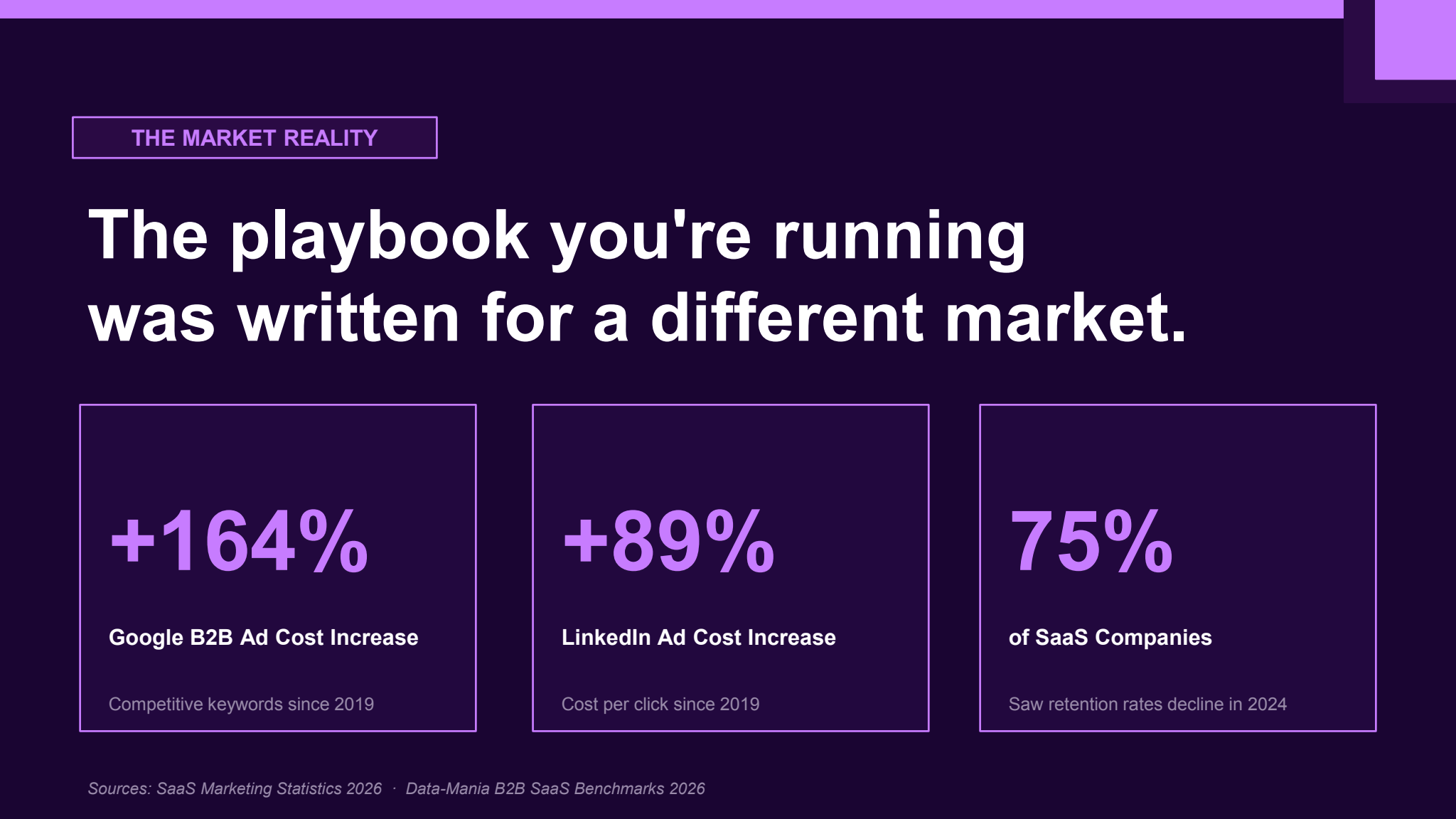
Google keyword ad costs are up 164% since 2019. In the same period, LinkedIn’s cost per click has risen 89%. These aren't blips or anomalies; they're structural shifts. The channels we've relied on for years are simply not delivering the returns they once did.
And while we're spending more to acquire customers, we're keeping fewer of them. 75% of SaaS companies saw retention rates decline in 2024. That's a huge number, and it matters enormously when you understand what net revenue retention (NRR) means for your business.
NRR is the percentage of revenue you retain and grow from your existing customer base. Above 100% is the goal, because it means your expansion revenue outpaces whatever you lose to churn. The top B2B SaaS performers are hitting around 120% NRR. The median sits at 106%, and companies with NRR above 100% grow about twice as fast as their lower-NRR peers.
Unfortunately, while NRR now defines valuation, fundraising ability, and board confidence, most growth teams are still running an acquisition-first playbook. Community-led growth is the most direct lever I've seen for moving NRR, and most teams aren't building it.
What your buyers are doing before you even know they exist
Think about the buyer journey for a moment. Before a prospect ever engages with your sales team, they're already deep into research. They're reading community forums. They're checking G2. They're scrolling LinkedIn threads. They're looking for peer validation from people who've actually used your product.
Buyers are 57% to 70% of the way through their vendor research before your sales team even picks up the phone. By the time they reach you, they've already formed an opinion.
This matters for more than just acquisition. Every prospect who enters your pipeline already convinced by genuine peer validation converts faster, onboards with clearer expectations, and stays longer. Shorter time to value leads to faster expansion. Faster expansion means better NRR.
The deal velocity data is striking. Common Room's analysis of community-led deals found that 72% close within 90 days, versus just 42% for marketing-led deals, a gap that shows just how much friction community trust removes from the formal buying process.
The question isn't whether community shapes your buyer journey. It's whether you're present in that journey or not.
For expert insights like this straight to your inbox twice a month, sign up for Pro+ membership.
You'll also get access to a range of certifications, a complimentary Summit ticket, 50+ tried-and-true templates, members-only workshops, and much more.
So, what are you waiting for?
What community-led growth actually is
Before we go any further, let's define what we mean by community-led growth. I hear different definitions in different organizations, but here’s what it all boils down to.
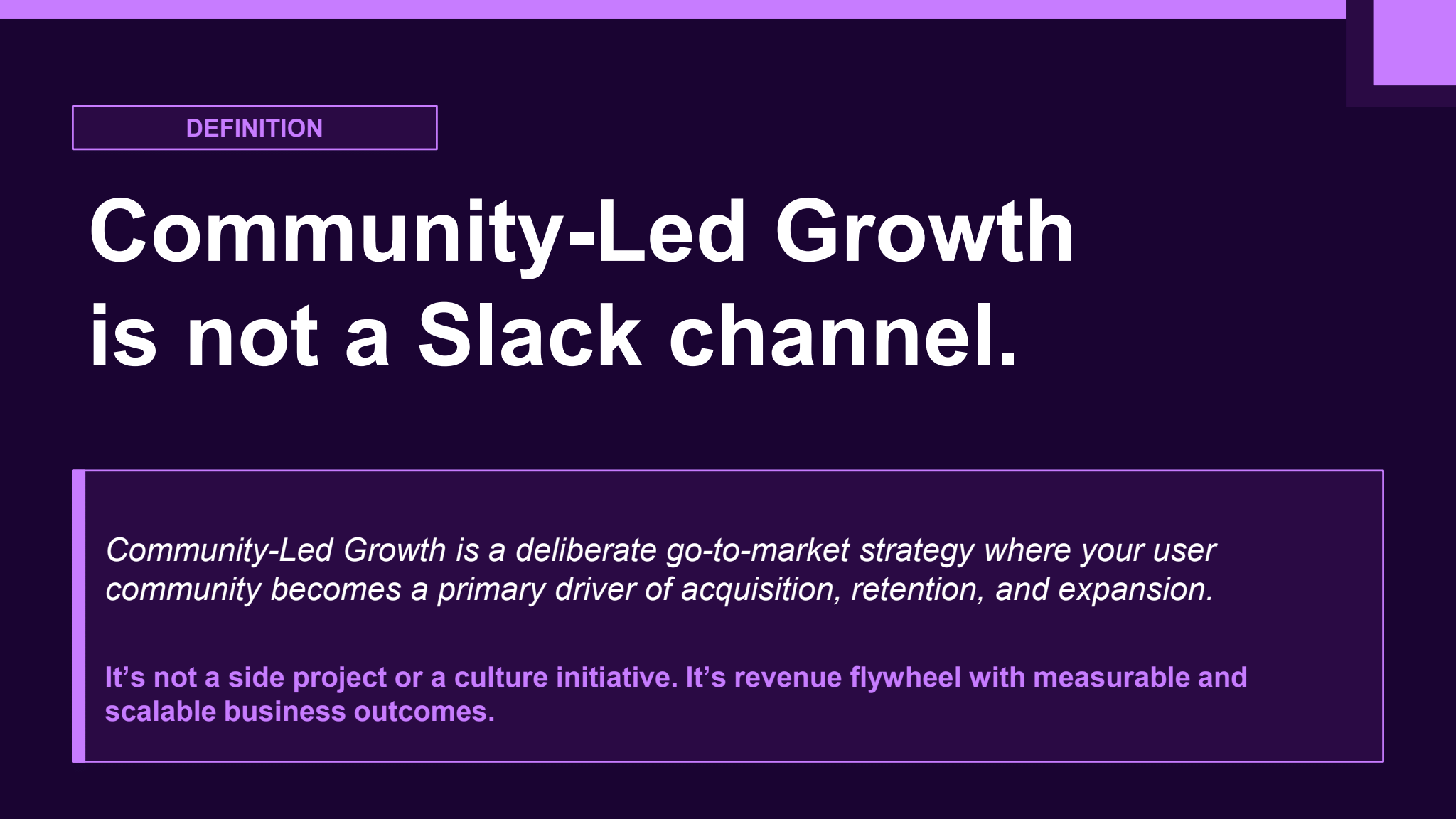
Community-led growth isn't a Slack workspace. It's not a customer newsletter or a LinkedIn group that posts twice a month. Those are tactics.
Community-led growth is a go-to-market architecture, one where your community is deliberately wired into your acquisition pipeline, your retention strategy, and your expansion playbook.
Think of it as your NRR engine. Most companies try to improve NRR through customer success programs that activate after the sale. Community-led growth is different because it bakes in retention and expansion intent from the very first interaction. By the time your CS team engages at renewal, community members are already invested. They have peer relationships, shared context, and a reason to expand.
Take HubSpot, Salesforce Trailblazer, GitHub, and Figma. The organizations don’t treat their communities as a side project – they know that they’re competitive moats that drive NRR at scale.
Three examples of community-led growth in action
Let me walk you through three very different product contexts where community-led growth has worked, so you can see beyond the obvious use cases.
Example 1: Modern Health
Modern Health is a mental health platform, where I led content marketing. During COVID, we faced a real tension: the platform was scaling fast, but therapist availability nationwide was critically limited, and the product team had to design around that constraint.
The solution was called Circles: provider-led sessions with small groups of members experiencing the same challenges: things like burnout, racial trauma, and parenting stress. It wasn't one-to-one therapy; it was community-based care.
The behavioral insight was simple: most people won't ask for individual help, but they will attend a group – and they did. In the first week, 88% of sessions were completely full. 53% of attendees booked multiple sessions afterward. What was particularly interesting was that 50% of those registrants had never engaged with Modern Health before.
By year two, 36,000 members across 21 countries had attended a Circle. Fast Company named Circles one of the most world-changing ideas of 2021.


Become a CMO Insider
Thank you for subscribing
Get exclusive insights, frameworks, and strategies from marketing leaders driving real business impact.
An email has been successfully sent to confirm your subscription.
 Follow us on LinkedIn