



.png)




For a long time, B2B go-to-market (GTM) strategy followed a well-known path. Set your ICP. Draw a map of the funnel. Make plans for campaigns every three months. Give leads from marketing to sales and see what happens. It was organized, repeatable, and worked for a while – mostly because buyers were more predictable and it was easier to control the channels.
That world has quietly gone away. Buyers today don't go in straight lines or wait for campaigns to "activate" them. They do their research, switch between channels, get more people involved, and expect things to be relevant before they even raise their hands.
Most decisions have already been made by the time teams see a deal coming together. In this situation, static playbooks don't work well because they are made for sequences, not signals.
AI doesn't just speed up old processes; it changes the way GTM works. Rather than simply following set plans, AI-powered systems watch for patterns as they happen – like changes in intent, behavior, and early signs of demand. They’re always learning, changing their targeting and messaging in real time, and connecting what they learn across marketing, sales, and product.
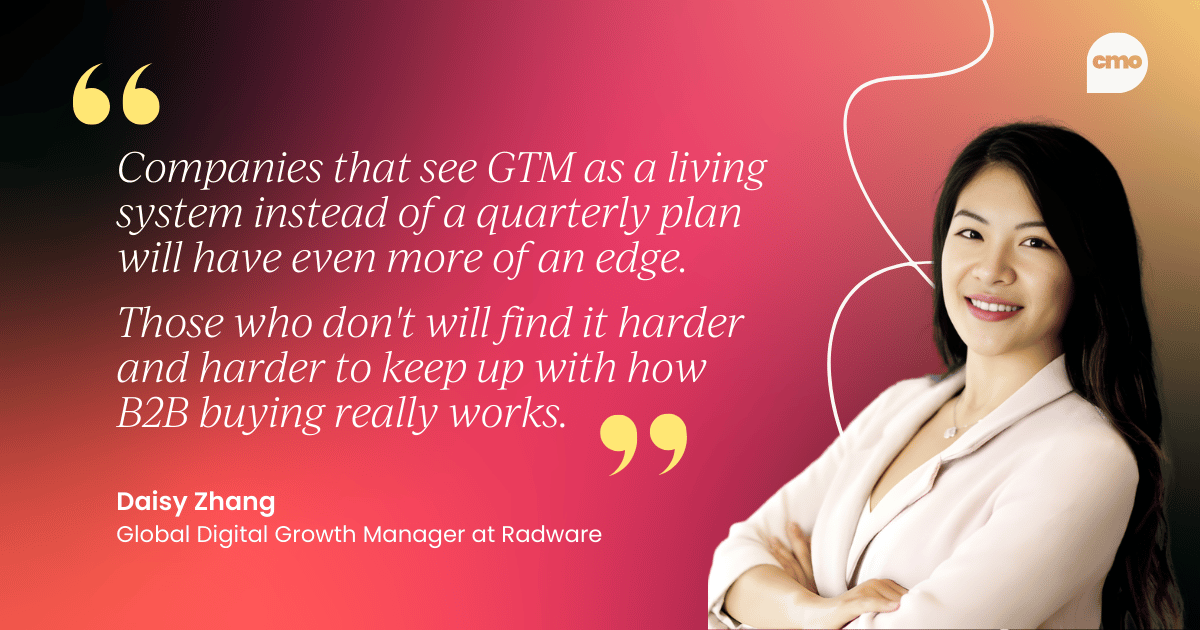
This change from playbooks to patterns is structural. Companies that see GTM as a living system instead of a quarterly plan will have even more of an edge. Those who don't will find it harder and harder to keep up with how B2B buying really works.
The problems with old GTM playbooks
Traditional GTM methods make things clear and predictable: set up an ICP, create campaigns, move leads through the funnel, and check performance every three months. But there are now some clear structural problems:
1. Fixed ideas in a changing world
Standard ICPs, which are usually based on firmographics or industries, think that past deals can tell you what will happen in the future. In reality, buyer priorities change quickly based on the economy, how people use technology, and how competitors act.
Studies show that B2B buying journeys are no longer straight lines. Buyers skip steps, loop back, and often do a lot of the discovery work online before talking to vendors directly. This complexity makes static funnel stages less useful.
2. Feedback loops that are too slow
It's not good enough to wait a few months or even a quarter between launching a campaign and evaluating its success. The market has already changed by the time traditional analytics show a change in how buyers act.
CMOs have found that AI automation can speed up content creation and bring trends to light sooner. However, without a system that can adapt, insights still take too long to get back to you.
3. Sales and marketing departments often don’t work together
MQL to SQL, sales to account teams, and so on are all examples of handoffs in traditional models. But data shows that sales and marketing often have trouble agreeing on what buyers want and what signals they are sending, which can hurt revenue. People who buy things today want to see the whole experience. Separate GTM functions make that hard and make it harder to work together.
In the end, playbooks don't work in markets with a lot of signals and quick changes because they see buyer behavior as stages that can be predicted instead of as patterns that change over time.
What "pattern-driven GTM" really means
A pattern-driven GTM model starts with a simple idea: your revenue engine shouldn't be based on set rules. It needs to learn. Instead of following a set order of campaigns and handoffs, the system keeps an eye on the market and changes how it acts when it sees new signals.
It's not mysterious or abstract what AI does here. It's useful. Today's machine-learning systems are adept at finding connections in data that are too subtle, too noisy, or too fast-moving for people to keep track of. They look at thousands of small actions, like page visits, content engagement, product use, and response timing, and find patterns that show where interest is growing or fading.
That ability shows up in GTM in a few very clear ways:
- The idea of a fixed ICP starts to fade. The system doesn't lock in personas at the beginning of the year. Instead, it groups accounts based on how they act over time. Accounts that act in similar ways start to group together, even if they don't look the same on paper.
- You don't wait for intent; you see it. Instead of relying on form fills or stage changes in a CRM, the system looks for early signs of buying momentum, such as repeated content consumption, changes in usage patterns, and activity from multiple stakeholders.
- Messages stop being fixed. Outreach and content change based on what someone is doing right now, not what group they were put in months ago. Not campaign calendars, but the tone, timing, and focus change based on the situation.
When you put all of this together, it shows a shift away from GTM based on averages and assumptions and toward GTM that reacts to real behavior as it happens. It's not so much about sticking to a plan as it is about spotting patterns early and doing something about them before they lose their value.
How AI is changing the GTM stack
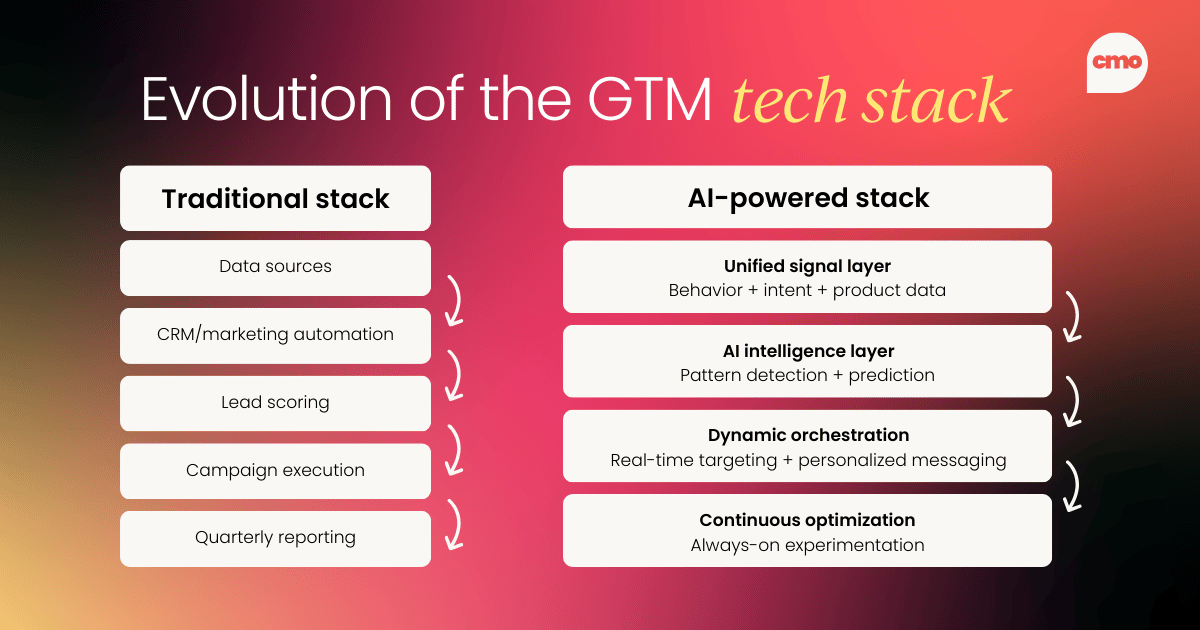
AI is changing the basic parts of the GTM technology stack in marketing, sales, and revenue operations.
Combining intent and signal
Modern GTM systems combine signals from many sources, such as behavioral, contextual, and external intent datasets, into single views. These combined signals let AI score and rank accounts much more accurately than just simple lead scoring. McKinsey points out that AI can combine data from different sources to help make better decisions faster and set better priorities.
Scoring and predictive ICP
AI models look at patterns in past deals and use those patterns to make predictions about new accounts. This lets businesses guess what actions lead to a desire to buy, instead of just looking at fixed factors like size or industry.
Personalization and adaptive messaging
Generative AI and NLP systems let you send messages that change based on what's going on right now. For example, you could change your outreach based on how people have interacted with your content or products recently. This feature changes campaigns from fixed sequences to flexible systems that can change while they are running.
Independent optimization
AI can try out different messages, offers, and times, and then quickly shift the focus to the strategies that work best. This "continuous experiment" way of thinking moves away from quarterly A/B testing and toward always-on optimization.
From funnel thinking to dynamic growth loops
The classic funnel shape – top, middle, bottom – doesn't show how B2B buying really works anymore. Buyers don't neatly go through stages. They learn new things along the way and change direction, stop, loop back, and bring in new stakeholders. Thus, GTM strategies based on linear progression are increasingly out of touch with the market.
Instead, a looped model is forming, where each action affects the next one. A spike in product use, a return visit to pricing, and attendance at a webinar all add context to each other. That context goes back into the system and changes how accounts are prioritized, which messages are shown, and where teams should focus next.
When this feedback loop runs almost in real time, the company starts to act differently. The marketing, sales, and product teams no longer have to wait for reports or quarterly reviews. They’re reacting to the same real-time picture of demand, changing course as patterns emerge instead of after performance has already gone off track.
This isn't about making current campaigns run faster or automating them. It's a change in the way GTM decisions are made. Companies are starting to let live signals decide when, how much, and how involved they are in activities instead of sticking to fixed calendars and planned stages. This makes GTM a system that changes all the time instead of a series of planned steps.
The new jobs in B2B marketing teams
As go-to-market strategies become more flexible and based on data, the marketing team will have to change to keep up. It's not enough to just add a few AI tools to the stack. You need to rethink who owns decision logic, how insights flow, and where accountability lies.
The rise of strategic data architects
One of the biggest changes is the rise of what I call "strategic data architects". They operate at the crossroads of marketing, sales, and engineering, turning business questions into data models and signal frameworks.
Their job is to make sure that the company doesn't have too much data but is organized in a way that makes it easy to make decisions in real time. They work closely with engineers and data scientists, but they know as much about revenue priorities as they do about pipelines and APIs.
The emergence of AI-native demand strategists
Along with them, we are seeing the rise of demand strategists who are native to AI. They don't start with a set order of emails or ads like traditional campaign managers do. They start with guesses, predictive models, and feedback loops.
They know how to read what the algorithms are showing them, like which accounts are getting more attention and which messages work best in which situations. Then they change the programmes to fit. They don't launch campaigns as much as they steer a living system.
The changing role of RevOps
The job of revenue operations is also very different. RevOps can't just be a back-office reporting unit that focuses on CRM hygiene and attribution models anymore.
RevOps is the glue that holds the revenue engine together in a pattern-driven environment. It makes sure that data definitions are the same across teams, that automation layers can talk to each other, and that AI outputs are actually used in frontline workflows. RevOps is often the closest thing to a systems architect for the whole GTM function in many companies.
Together, these changes reveal a broader shift in people's thinking. Marketing teams are moving away from following set plans and toward creating, keeping up, and improving adaptive systems.
Having the best campaign calendar is no longer what gives you an edge over your competitors. It comes from making a revenue organization that can learn and adapt faster than the market around it.
A maturity model: From patterns to playbooks
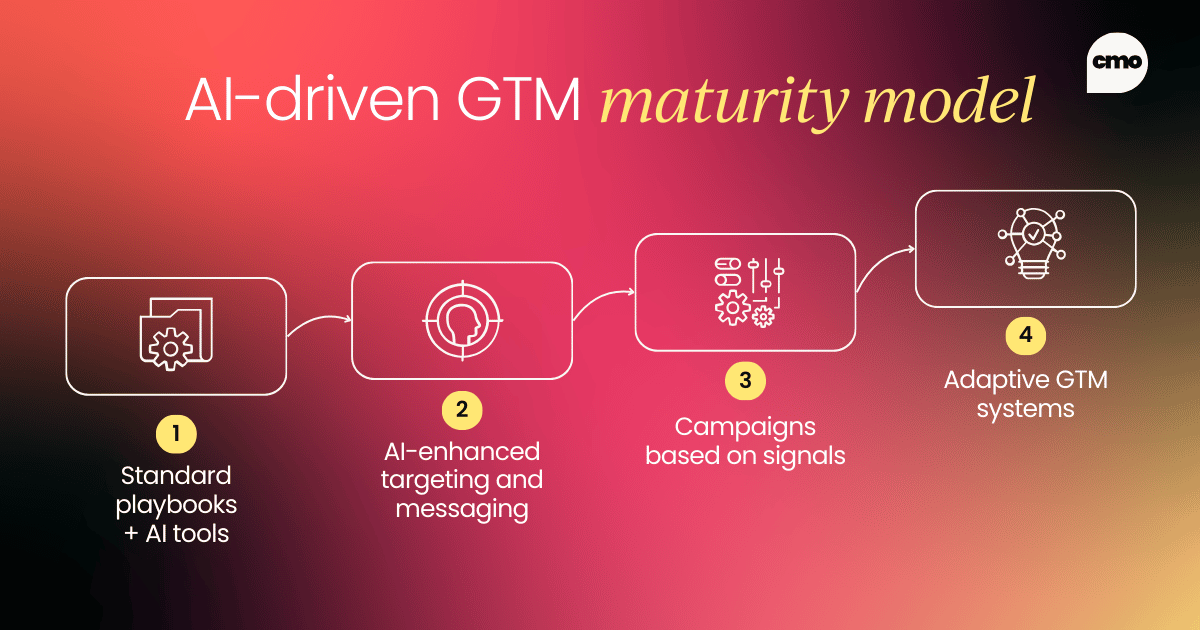
As companies adopt AI-driven GTM, they go through different stages of growth:
Stage 1: Standard playbooks and AI tools
Early adoption means using AI for certain tasks, like making content or improving leads, while the overall strategy stays the same. AI is an extra feature, not the main one.
Stage 2: AI helps with targeting and messaging
AI started to help with ICP refinement and message personalization, but people are still in charge of when and how campaigns run.
Step 3: Campaigns based on signals
AI constantly checks intents and changes targeting and messaging on the fly. Campaigns go from being based on a schedule to being based on an event.
Stage 4: GTM systems that can adapt to anything
AI systems find patterns and change GTM priorities on their own across channels, changing how much money is spent, what messages are sent, and how people interact in real time.
This last step is similar to autonomous revenue systems, where AI constantly adjusts strategy to fit the changing market.
Real-world business scenarios
IBM: AI as a layer for strategic decisions
IBM's research and AI practice focuses on using AI as a decision-making tool across all parts of a business, not just as a way to make things more efficient. This systemic view makes GTM fit with the goals of the organization and makes it easier to change decisions quickly.
McKinsey Insight: Setting priorities in real time
McKinsey's research shows that AI can combine data from many different sources to find useful insights. This lets sellers focus on the next best actions before traditional signals even show up.
Trends in large B2B surveys
Recent surveys show that most B2B companies are actively putting money into AI for marketing and intent signal detection. This shows that the industry knows that AI is no longer optional but essential for competitive GTM.
In conclusion
Moving from static playbooks to pattern-driven GTM is not just an upgrade to the tools; it's a change in strategy. It sees GTM as a system that is always changing and adapting, with AI as the main interpreter of patterns and decision-maker.
It's clear what senior B2B leaders need to do: start restructuring revenue architectures right away. Move teams around, put money into signal-centric data infrastructure, and use AI as the decision layer that replaces fragile playbooks with strong, pattern-aware strategy.
You won't just make execution better; you'll also change how revenue is made on a large scale in the AI era.


Become a CMO Insider
Thank you for subscribing
Get exclusive insights, frameworks, and strategies from marketing leaders driving real business impact.
An email has been successfully sent to confirm your subscription.
 Follow us on LinkedIn