.png)







Created by:
 Bryony Pearce
When marketing and sales aren't aligned, leads fall through the cracks, fingers get pointed, and revenue suffers. This framework gives you a clear, structured foundation for getting both teams on the same page, from how leads are qualified and handed off to how performance is tracked and accountability is maintained.
What is a marketing-sales SLA framework?
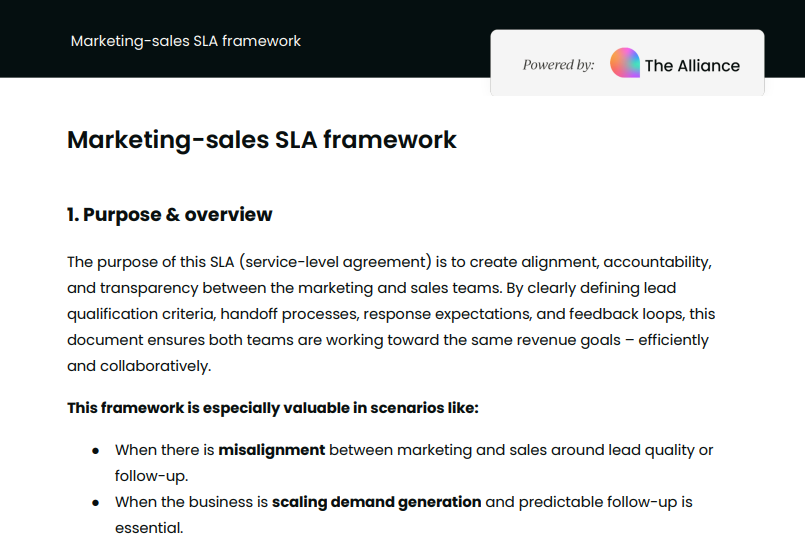
A marketing-sales SLA (service-level agreement) framework is a formal but practical document that defines the rules of engagement between your marketing and sales teams. It sets out exactly how leads are qualified, how and when they're handed off to sales, what response times are expected, and how both teams feed information back to each other to keep improving.
Think of it as the operating agreement that keeps both teams pulling in the same direction, with shared definitions, clear ownership, and a process for resolving issues when things don't go to plan.
Who is it for?
This framework is for senior marketing leaders (CMOs, VPs of Marketing, and Heads of Demand Generation) who are responsible for the relationship between marketing output and sales performance. It's also highly relevant for revenue operations and marketing operations professionals who own or oversee the lead management process.
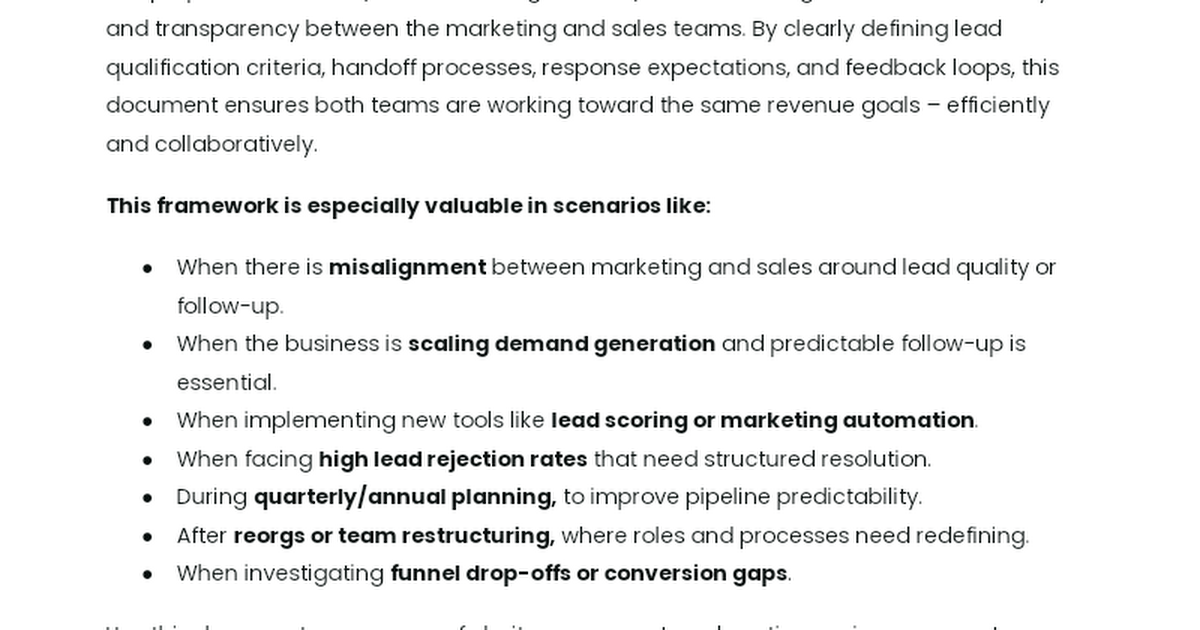
You'll find it particularly useful if you're scaling your demand generation function, dealing with friction between your marketing and sales teams, implementing new lead scoring or automation tools, or trying to get a clearer picture of what's happening at the top of your funnel.
How to use the framework
The framework is organized into seven sections, covering everything from lead qualification criteria through to escalation paths. Here's how to get the most out of it:
- Start with the MQL criteria: The lead qualification section is the foundation of everything else. Make sure your definition of a marketing-qualified lead reflects your actual ICP before you fill in anything else.
- Customize it to your org: The framework comes with example criteria and response times, but these are starting points, not prescriptions. Update every section to reflect your team structure, tooling, and sales motion.
- Align with sales before you finalize it: An SLA only works if both sides have bought in. Share a draft with your sales leadership early and build in time to get their input on the handoff process and response expectations.
- Use the reporting section to drive accountability: The metrics and review cadences outlined in section six aren't just for tracking; they're how you catch problems early and demonstrate marketing's contribution to pipeline.
- Revisit it regularly: Treat this as a living document. As your team scales, your ICP evolves, or your tech stack changes, your SLA should too.
Done well, a marketing-sales SLA builds the kind of trust between teams that makes hitting revenue targets a whole lot more achievable.
Get your marketing-sales SLA framework



Become a CMO Insider
Thank you for subscribing
Get exclusive insights, frameworks, and strategies from marketing leaders driving real business impact.
An email has been successfully sent to confirm your subscription.
 Follow us on LinkedIn