


.png)




2025 was the year AI moved from experiment to reality. Teams built AI teammates, buyer behavior shifted with AI search, and the teams that pushed past "faster" into "different" proved what's possible when you put people first and move forward with AI.
Most companies are still stuck on "faster." And focusing on productivity alone is a trap.
Now we're heading into 2026. More companies will pile in. AI capabilities will keep advancing. The messy middle is coming. But we have proof now. We proved it together in 2025. Now we scale it together in 2026.
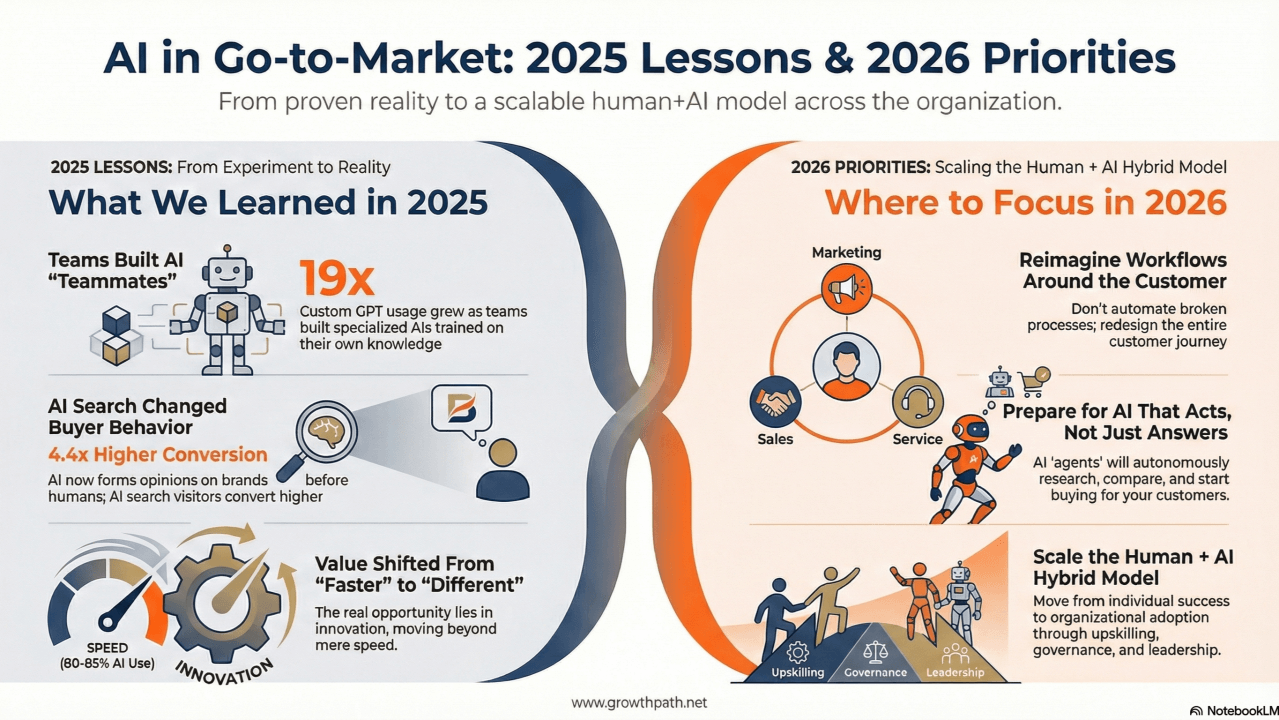
What 2025 proved:
- People built AI teammates: Custom GPT usage increased 19x last year
- AI search changed buyer behavior: AI now forms opinions about your brand before humans do
- Results moved from faster to better to different: Speed was the start, but reimagined work is where humans become essential
Where 2026 is headed:
- Reimagine workflows around the customer, not your org chart
- Prepare for AI that acts, not just answers
- Scale the human + AI model, from pockets of success to how the whole org operates
We don't have to figure this out alone. The trailblazers are reaching back to help. A rising tide lifts all boats.
AI video explainer and AI podcast versions of this article
To support different learning styles, this article is available as a 7-min AI video explainer (see below) and a 12-min AI podcast with two AI hosts. If you haven't seen these AIs in action, they're worth a view. The tech is advancing in amazing ways. I used Google's NotebookLM to create these and personally reviewed them for accuracy and responsible AI use.
7-minute AI video explainer
What 2025 proved
1. People started building AI teammates
People moved from chatting with AI to building AI teammates trained on their own knowledge, guidelines, and how they work.
The data confirms what I've been seeing. OpenAI's State of Enterprise AI report shows custom GPT usage increased 19x this year. Top-performing companies send 7x more messages to custom GPTs than average companies. Moderna went from 750 custom GPTs in April 2024 to over 3,000 a year later.
Here's what a human + AI team could look like:
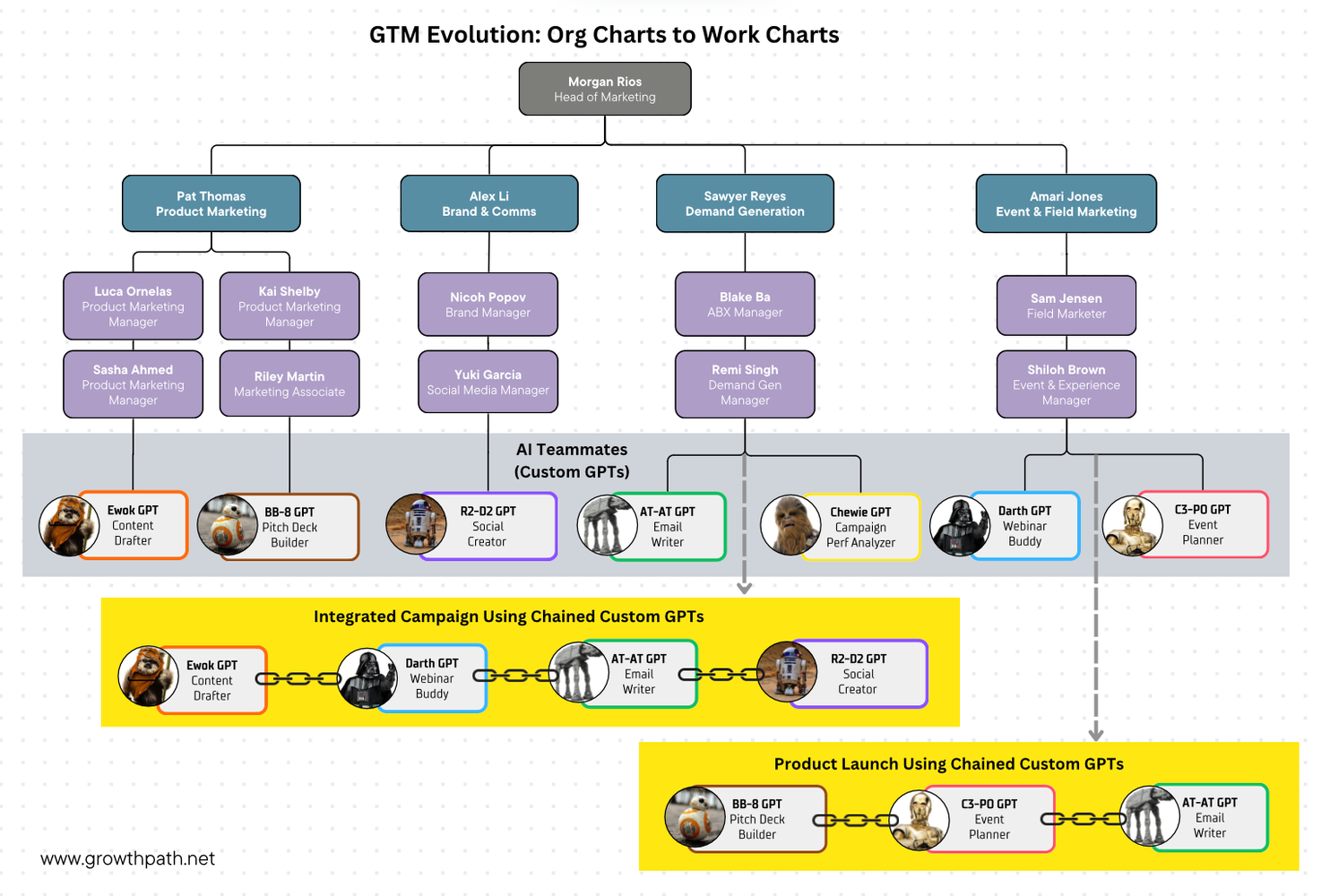
Across teams I worked with, the pattern was the same. Digital twins of their thinking and voice. Specialized AI teammates for positioning, content, competitive intel, and sales enablement.
Some went further, building "thinking systems" where AI teammates work together while you observe and learn. Others "vibe coded" AI apps in minutes by simply using plain English. Here's how, with some examples, including ROI calculators, choose-you-own-adventure dashboards, and interactive enablement games.
2. AI search changed buyer behavior
AI now answers buyer questions directly, often without sending them to your website. Buyers get recommendations, comparisons, and opinions about your brand before they ever talk to your sales rep.
And these buyers convert. A SEMrush study found AI search visitors convert at 4.4x the rate of regular organic traffic. They've already compared options. They arrive ready to act.
The insight that changed how I think about this; AI forms opinions about your brand before humans do.
GTM teams need to think about:
- Visibility (does AI know you exist?)
- Sentiment (how does AI describe you?)
- Recommendation (does AI choose you for the right situations?)
As Wil Reynolds, VP of Innovation at Seer Interactive, simply put it during October's Marketing AI Conference in Cleveland:
"We need to be seen, believed, and chosen in AI search."
If AI struggles to understand what you do and who you're best for, human buyers face the same problem. Worse yet, AI can draw its own conclusions.
3. Results moved from faster to better to different
Speed came first. Then quality. But the third wave is where the real opportunity lives: doing work that wasn't possible before.
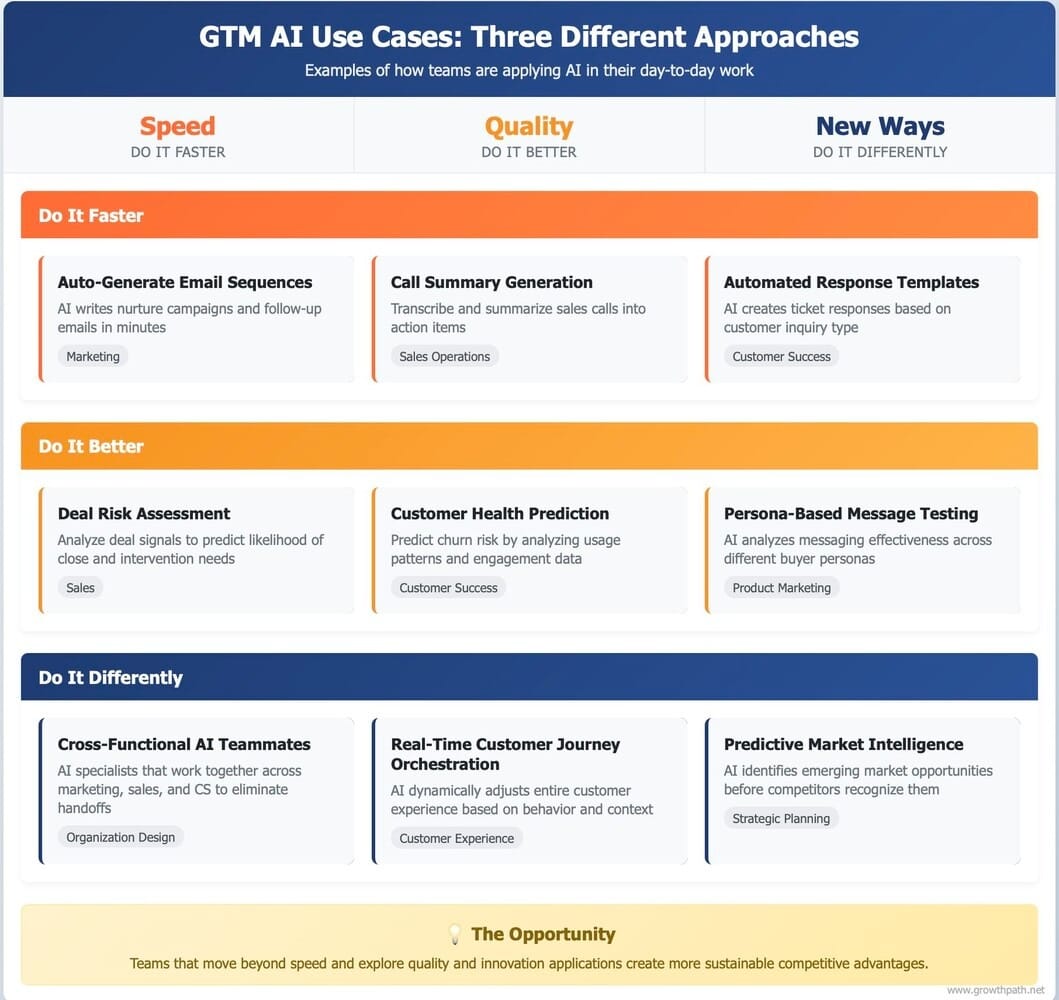
Based on my work with GTM teams, here's roughly how AI use breaks down:
- 80–85% focuses on speed: "Do this task faster"
- 10–15% focuses on quality: "Do this task better"
- 3–5% focuses on innovation: "Do it differently"
The risk is stopping at speed. One team that pushed through all three saw 75% faster content creation, 98% lead qualification accuracy, and 35% improved campaign performance.
If we only teach AI to do our jobs faster, we risk becoming unnecessary. AI is cheaper, doesn't sleep, and doesn't make typos. But when we push into quality and innovation, we become essential. Reimagined work requires human judgment, creativity, relationships, and strategic thinking. AI enables it. Humans drive it.
The question for 2026: different for what purpose? The answer is the customer.
Where to focus in 2026
The teams that succeeded in 2025 proved the model works. Now the question is, how do we scale it, and toward what end?
Let’s explore three priorities we should be focusing on.
1. Reimagine workflows around the customer
Your customers don't care about your org chart. They see your company as one entity. They expect the same experience no matter which team they're talking to.
AI is forcing this into the open. When data flows across systems and AI can see the entire customer journey, the gaps between product, marketing, sales, and customer success become visible. The cost of slow handoffs shows up in dollars. Misaligned goals become impossible to ignore.
McKinsey's 2025 State of AI report confirms this. Workflow redesign drives the biggest impact from gen AI. Yet only 21% of organizations have redesigned their workflows. Most are still bolting AI onto existing processes.
G2 just made a structural move that signals where this is heading. They created their first-ever President of Go-to-Market role, consolidating teams under one leader. Their CEO, Godard Abel, explained why:
"The way software buyers make decisions is transforming fast, with AI reshaping how they research and purchase. To meet this new norm and help our customers succeed, we're leaning into tighter alignment between marketing and revenue."
Here's a real-life workflow example of what this looks like. One team redesigned their SDR workflow with AI teammates at each step. Instead of generic sequences, each prospect gets messages tailored to their role, company, and industry.
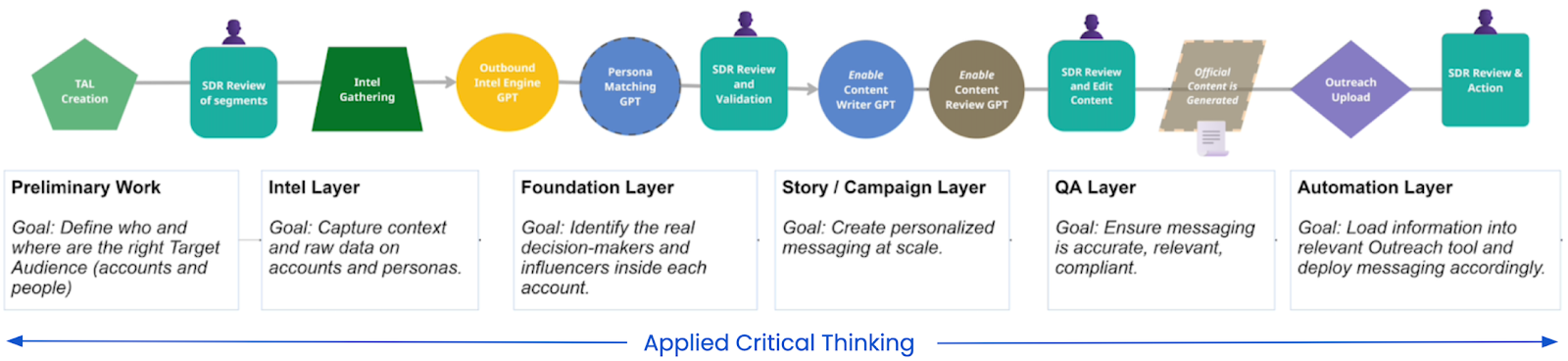
Early results from this workflow:
- 1–3 hours saved per day per rep
- 2–3x improvement in open rates (from 15% to 40%)
- 100+ hours saved per week across the team
If you’re looking to adopt this approach, avoid the trap of automating old processes, especially broken ones. When we automate broken workflows, AI amplifies what's broken. The goal is reimagining work, not just speeding it up.
2. Prepare for AI that acts, not just answers
In 2025, AI search changed how buyers research. In 2026, AI will start acting on their behalf.
The term "agent" is everywhere right now, which makes it virtually meaningless. Here's what actually matters: AI is moving from answering to acting autonomously.
Here’s a simple way to think about it:
- Automation: You design the steps. AI runs them.
- Agents: You describe what you want. AI figures out how.
Today's AI can plan, execute, and analyze on its own. Think deep research, computer use, ChatGPT's agent mode. You don't tell it which websites to visit or how to pull findings together. It figures that out. It doesn't yet set its own goals or learn across tasks, but we can see that's where we're headed.
I tested this using ChatGPT's Agent Mode as a mystery shopper. I asked it to research and compare project management tools. The AI didn't just gather information. It browsed websites, formed preferences, created ratings, made recommendations, and tried to start the webinar sign-up process. See the results below.
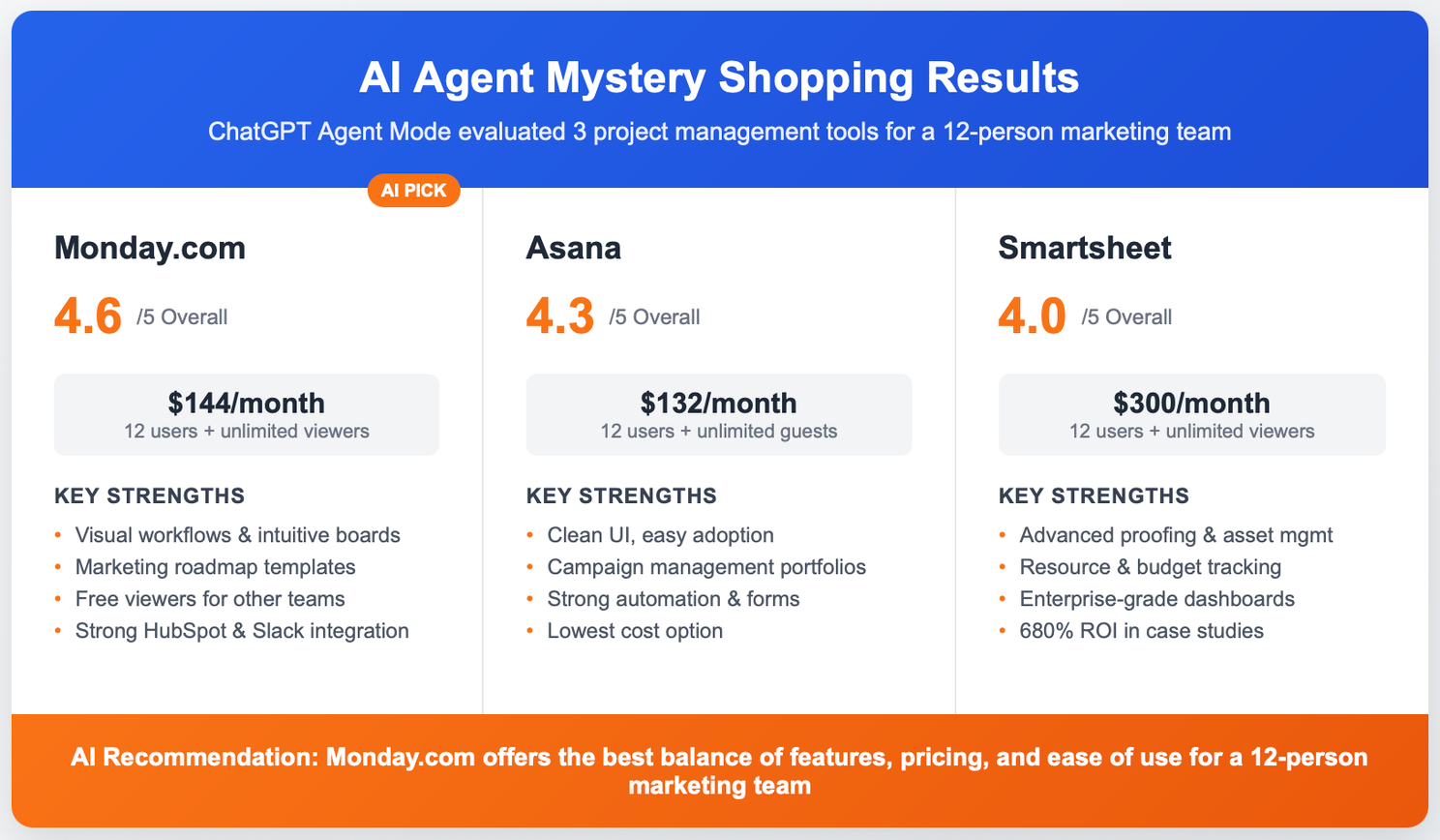
Additionally, it evaluated the experience with the various websites – how easy it was to find information, where it was getting stuck, and what actions it wasn't able to complete.
This matters for two reasons:
- Your customers will use agents: AI will research, compare, shortlist, and start buying on their behalf. Your website needs to cater to both humans and the agents that help the humans. We need to make sure that both can get to what they need and do what they need to do easily.
- Your team will use agents: AI teammates will coordinate work across platforms and systems. The workflows you design today need to account for AI that acts, not just helps.
When AI acts on its own, human judgment matters more, not less. Your ability to guide AI, set guardrails, ask the right questions, and know when to step in becomes essential. This is why critical thinking and responsible AI practices aren't nice-to-haves. They're how you stay in control.
3. Scale the hybrid human + AI model.
The trailblazers have proven that humans and AI work well together. Now the challenge is scaling across the organization.
The trailblazers were self-motivated, curious, and willing to push through friction. You can't expect the whole org to have that same drive.
And let's be honest about the human side. The fear is real. "If AI can do parts of my job, what happens to me?" That question deserves an honest answer.
Compassionate leadership means this: you have a responsibility to upskill and reskill your employees. Not because it's nice, but because it's your job. You hired them when they had the skills your business needed. The needs changed. Your job is to give them skills to compete now.
This makes business sense. Upskilling people who know your culture costs less than hiring new talent. And AI skills are an investment in their careers, not just your company.
Real investment is people first, AI forward. Understand their concerns. Inspire them with what's possible. Give them hands-on training and space to learn with others. And use AI yourself. You can't just hand out licenses and send a Slack announcement.
Anna Griffin, Chief Market Officer of Commvault, on what comes next:
"We're past experimentation. Now it's about making this real for the whole org. Clear decision rights, connected processes, less friction. And we have to hold ourselves accountable as leaders. Not just expecting our teams to change, but creating the conditions for them to succeed."
Scaling also requires infrastructure:
- Governance: Who decides what AI teammates and workflows get built? What guardrails ensure responsible use? How do you maintain quality as more people create more?
- Quality: One team created 211 AI teammates during experimentation and kept 57 in regular use. Not every AI teammate earns its place. That's the messy middle – and it's a sign you're doing it right.
- Enablement: Everyone can build AI teammates, but cross-platform workflows need specialized skills. Often it's ops, working with IT and legal, to make it happen.
Megan Cabrera, VP of Marketing Operations at Sophos, shares:
"We let everyone build their own AI teammates. That's where creativity and experimentation happens. But when workflows need to connect to CRM, marketing automation, or other core systems, that's where my team steps in. We work with IT and legal to make sure it's done right. Democratized creation, centralized integration. That's how you scale without creating chaos."
The Rule of Thirds applies. In most major changes, roughly…
- One third will lead the change
- One third will follow with support
- One third won't embrace it
Your responsibility looks different for each group. Leaders need room to run. Followers need guidance and support. Those who won't embrace it need help finding where they'll thrive.
Before you sort your team, ask yourself, have I truly invested? Do I use AI myself? Or did I just expect people to figure it out while I watched from the sidelines?
Nice leadership keeps everyone comfortable and sets them up to fail when the world changes. Compassionate leadership invests in people, sets clear expectations, and makes tough decisions when needed.
The year ahead
2026 will be messier than 2025. More noise, more hype, more pressure. AI capabilities will keep advancing. The path won't be straight.
We're navigating new waters together. None of us has all the answers. Give yourself grace. Give your team grace. The fact that you're engaged puts you ahead of most.
But we have proof now. Proof that people can build AI teammates that actually help. Proof that humans and AI work better together than either does alone. Proof that reimagined work creates value that faster work alone never could.
The teams that went first in 2025 are reaching back to help. The frameworks exist. The playbooks are being written. The trailblazers are willing to share what they've learned.
This is happening. The transformation is real.
This is doable. We proved it.
And we don't have to figure it out alone. A rising tide lifts all boats.
This article was originally published in Liza Adams’s Practical AI in Go-to-Market newsletter.


Become a CMO Insider
Thank you for subscribing
Get exclusive insights, frameworks, and strategies from marketing leaders driving real business impact.
An email has been successfully sent to confirm your subscription.
 Follow us on LinkedIn