.png)






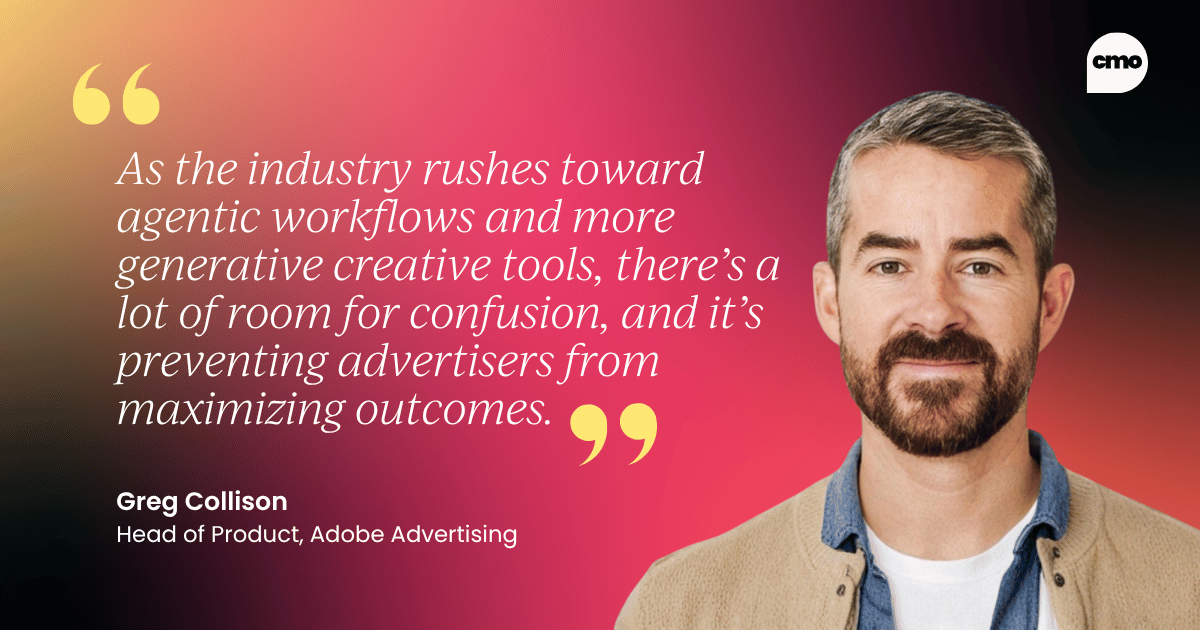
AI tools will fundamentally reshape how advertising platforms operate. (They already have!) But as the industry rushes toward agentic workflows and more generative creative tools, there’s a lot of room for confusion, and it’s preventing advertisers from maximizing outcomes.
Part of the challenge of AI adoption comes from the fact that the industry often talks about “AI” as if it’s a single capability. In reality, marketers are encountering three distinct categories of AI, each serving a different purpose.
1. Predictive AI
This is the oldest and most foundational form of AI used in advertising platforms. These systems analyze massive volumes of signals to predict outcomes such as:
- The likelihood that a user will engage with an ad
- The influence of context on the user
- The optimal bid price needed to win an auction without overpaying
This predictive machinery sits at the heart of performance advertising. It determines how efficiently a platform allocates budget and how effectively it identifies valuable audiences. For many demand-side platforms (DSPs), these systems have been evolving for more than a decade. Some are better than others.
A global retail brand, for example, might run campaigns across multiple DSPs and notice similar audiences delivering very different results. The difference often comes down to the quality of predictive models under the hood.
One platform may be better at predicting the value of each user, the value of every context, and the clearing price for every auction to determine not just who to target, but how much to bid in each moment. Over time, that advantage compounds, driving more efficient spend, higher conversion rates, and ultimately a better return on media investment without increasing budget.
2. Generative AI
These tools have been the hot topic of the past 18 months. They create new content such as ad copy, images, video variations, or campaign assets. They dramatically accelerate creative production and experimentation.
Generative AI is powerful because it reduces the manual work required to build and test creative variations. AI-powered content generation can unlock personalization and experimentation that ultimately boosts overall ROI. It complements, but does not replace, predictive AI.
Consider a travel company launching a seasonal campaign across multiple markets. Instead of relying on a handful of static creatives, generative AI allows the team to produce multiple variations tailored to each audience segment. Creative that highlights family-friendly resorts performs better for one segment, while adventure-focused messaging resonates with another.
The result is both faster production and a steady stream of fresh, relevant creative that feeds into the platform’s predictive systems, improving performance over time.
3. Agentic AI
Here lies the newest layer of AI for advertising. These systems act more like assistants or operators inside the platform. They help marketers set up campaigns, interpret results, troubleshoot issues, and make recommendations automatically.
Agentic AI is largely about workflow efficiency. It reduces the amount of manual work required to manage campaigns and helps marketers move faster.
On the operations side, a mid-sized marketing team might employ AI agents to manage the day-to-day mechanics of campaign execution. The agents guide users to optimal campaign setup, thereby enabling better overall performance. And, instead of manually adjusting budgets, troubleshooting delivery issues, or pulling reports, the agents flag underperforming segments, suggest optimizations, and even implement routine changes automatically.
What used to take hours of hands-on management becomes a series of guided decisions. The team moves faster and spends more time on strategy, but the impact of those actions still depends on the strength of the predictive and data foundation beneath it.
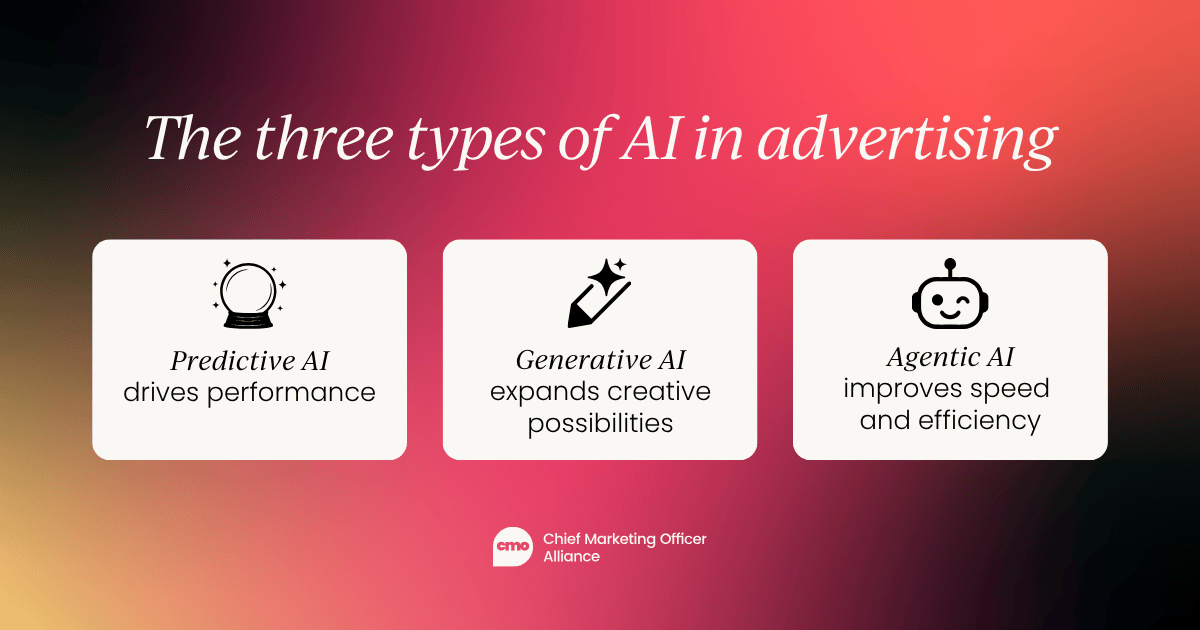
All three forms of AI are valuable. But they do very different things:
- Predictive AI drives performance.
- Generative AI expands creative possibilities.
- Agentic AI improves speed and simplicity.
Confusing these roles can lead marketers to focus on the most visible capabilities rather than harnessing the full mix in a way that best serves the brand.
Why performance still comes first
Agentic AI will likely become one of the most visible changes in advertising platforms. It will simplify campaign setup, automate routine tasks, and help marketers operate more efficiently. But simplicity alone does not guarantee performance.
Agentic systems can help configure a campaign or automate a workflow, but they can only optimize within the limits of the platform’s underlying performance engine. If that engine isn’t strong, the automation simply gets you to a lower ceiling faster.
Think about it this way: two cars may both have self-driving features, but that doesn’t make them equal. Put the same autonomy into a racecar and a minivan, and both might move forward with less effort from the driver, but they will not deliver the same ride. The underlying engine still determines how well the car performs.
The same is true in advertising.
That’s why the most effective platforms will combine all elements: intelligent agentic experiences paired with robust predictive systems and generative AI to unlock creative optimization. The agents create simplicity. The predictive models drive results. The generative AI boosts ROI with more engaging creative. When those systems are designed to work together, the platform can both reduce operational complexity and maximize performance.
The questions marketers should be asking
Given the speed of AI development, many of today’s headline-grabbing features will quickly become standard. What feels novel now will soon be expected. Rather than racing to adopt every single new tool that crosses the industry headlines, marketers need a practical way of assessing their current approaches and partners to ensure they’re keeping pace with what’s possible:
- Start by assessing performance. Are you fully using your organic site traffic to train predictive models to maximize ROI? Are you actively testing multiple DSPs to understand performance capabilities? If not, you could be missing out on the latest performance innovations.
- Are you experimenting with generative AI tools to build more ad variants to power personalization and experimentation? If not, your media budget likely isn’t as productive as it could be.
- Are your DSP partners innovating with agentic experiences to eliminate the busy work and help you focus on high-value actions? If not, you won’t benefit from the efficiency gains that agents offer.
AI can streamline workflows, reduce manual work, and help marketers get more value from a platform. However, it does not, on its own, raise the platform’s performance ceiling. It simply helps marketers reach that ceiling more efficiently.
For example, an AI agent layered on top of a DSP might automatically configure campaigns, suggest optimizations, or troubleshoot delivery issues. But those recommendations can only be as effective as the DSP’s underlying bidding models, auction dynamics, predictive systems, and completeness of data being used to determine how media is bought.
A DSP rich with first-party data will have a more profound impact with AI. Those with stronger underlying signals and a more complete understanding of the user journey will outperform others.
That’s why practical AI in advertising is not about chasing the newest feature in isolation. It's about maximizing business outcomes while eliminating busy work. In the end, the winners will be the ones that harness the power of AI across performance, creative, and agents.


Become a CMO Insider
Thank you for subscribing
Get exclusive insights, frameworks, and strategies from marketing leaders driving real business impact.
An email has been successfully sent to confirm your subscription.
 Follow us on LinkedIn