.png)






Templates and frameworks to pair with this playbook
I have a confession to make: I got really good at building something that didn't matter.
I've sat in rooms presenting beautiful charts, with green lines trending up and to the right. I’ve led QBRs where everyone nods along, and leadership leaves feeling great about the quarter. We'd walk out, grab lunch, and forget the whole thing.
In those scenarios, the numbers were true. The growth was real. But the story those numbers were telling? Fiction. Comfortable, dashboard-friendly fiction. That's what I want to explore in this article.
Many of us have fallen into the same habit. We've gotten very good at measuring motion, and we've convinced ourselves that motion is the same as momentum. It isn't.
Think about a hamster on a wheel. It’s racking up an impressive RPM and going absolutely nowhere. A lot of the sales and marketing processes I see today look exactly like that. We've spent years perfecting the wheel, analyzing it, and putting sensors on it. Some of us have entire Slack channels dedicated to discussing wheel velocity with genuine passion.
I’m here to propose that we get off the wheel.
The three metrics that are quietly misleading you
There are probably three metrics sitting on your dashboard right now that you checked this morning as part of your routine. They give you some information, sure. However, that information may be actively misleading.
Misleading metric #1: Marketing qualified leads (MQLs)
The MQL. Our most beloved metric, and the one that has launched a thousand arguments between sales and marketing.
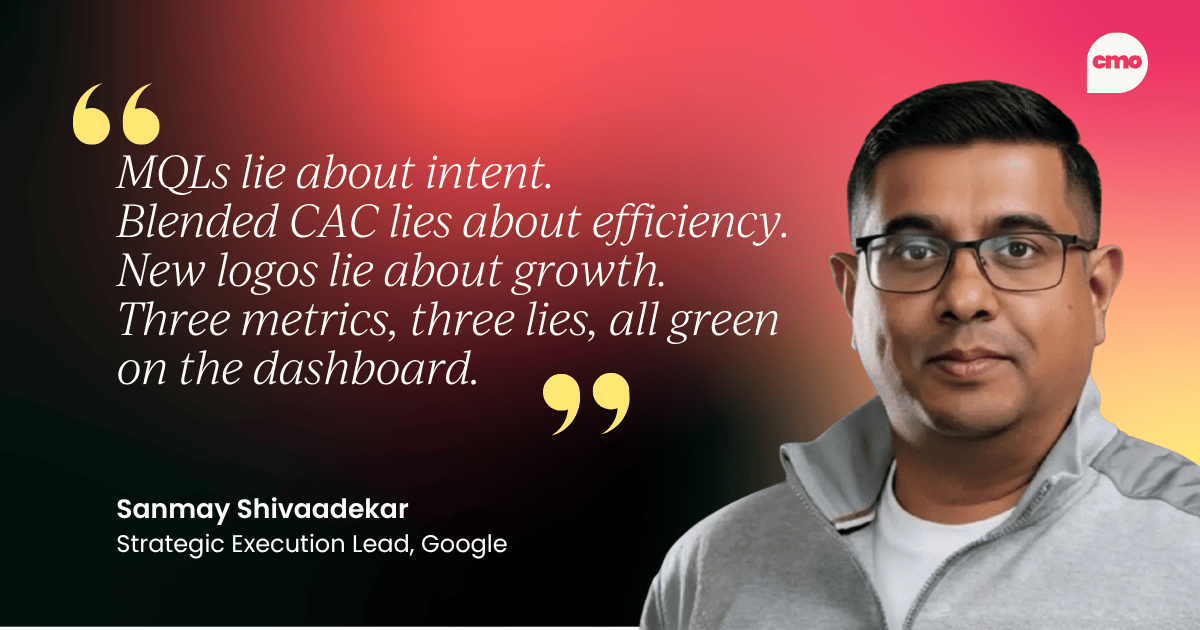
Here's the reality of what an MQL measures: someone downloaded a white paper. Someone entered a work email, which, if we're being honest, might be the spam address they use for everything they don't actually want to read. And we call that “qualified”.
Qualified by what standard, exactly? All we really know at that point is that this person is interested in free content. If I downloaded a quantum computing white paper yesterday, it doesn't mean I'm buying a quantum computer today.
The MQL tells you nothing about the why. Why now? Why this product? What's actually happening in their world that makes your solution relevant to them?
A director of finance visiting your pricing page in Q3 during their planning season is a fundamentally different signal from an MBA student pulling your white paper for a class assignment. Both of those show up in your MQL count. Both look identical on the dashboard, but the context is completely different, and the MQL metric doesn't distinguish between them at all.
For expert insights like this straight to your inbox twice a month, sign up for Pro+ membership.
You'll also get access to a range of certifications, a complimentary Summit ticket, 50+ tried-and-true templates, members-only workshops, and much more.
So, what are you waiting for?
Misleading metric #2: Customer acquisition cost (CAC)
I cringe whenever someone gives me a single blended CAC number. "We're optimizing for $340 CAC." It’s precise, scientific-sounding, and pretty much useless. Blended CAC hides everything interesting because it's an average.
Think of it this way: if I tell you the average temperature in a room is 72 degrees, you'd nod and say that sounds comfortable. But what if one end of the room is at 40 degrees and the other is at 104? Someone's freezing, someone's getting a heat stroke, but on average we're doing fine.
That's what blended CAC does. It lets you walk into a leadership meeting and say the building isn't on fire when, technically, half of it is. It masks channels that are hemorrhaging cash and subsidizes them with channels that would have grown regardless. The inefficiency stays hidden, and you keep optimizing for a number that tells you nothing about where the real problems are.
Misleading metric #3: New logos closed
“Fifty new logos this quarter” – it looks great on a slide.
But here's what often gets overlooked: the ten existing customers you've grown three times over the past year are probably worth far more than those fifty new logos.
The way sales incentives are typically structured, we celebrate first dates when we should be celebrating marriages. Then we're surprised when net revenue retention (NRR) starts slipping and churn creeps up.
Replacing ROI with ROIn
So, what do we replace these misleading metrics with? We talk a lot about return on investment. I want to introduce a different frame: ROIn, return on intelligence.


Become a CMO Insider
Thank you for subscribing
Get exclusive insights, frameworks, and strategies from marketing leaders driving real business impact.
An email has been successfully sent to confirm your subscription.
 Follow us on LinkedIn