.png)




Nobody knows exactly what the next decade will bring. That’s one certainty. Anyone who tells you otherwise is either selling something or hasn't spent enough time in the trenches to understand how fast things are moving in the marketing world.
But here’s what I do know as a CMO: things are moving faster than most boardrooms are comfortable admitting, and the brands that will own their categories in 2036 are making foundational decisions right now.
Ten years ago, a brand was a logo, a tagline, and a media budget. Five years ago, it became a content strategy. Today, it’s a conversation. By 2036, it will be a living, AI-orchestrated presence that exists simultaneously inside data centers, across social channels, in the personal reputations of your people, and in the cognitive habits of every prospect who has ever touched your company.
What follows is my honest attempt to provide you with an educated guess at what the next decade holds, not as a futurist, but as a practitioner who has to make real decisions in the present using signals already visible today.
The death of the monolithic corporate brand
The idea that a company's brand lives primarily in its visual identity, its advertising, or its official communications channels is already on life support. What’s replacing it is both more human and more technological: a distributed brand ecosystem where the organization itself is only one element, and increasingly not the most trusted one.
By 2036, brand trust will be radically decentralized. Buyers will default to the signal they find hardest to fake: real human beings who genuinely know something and are visibly associated with a company. This is not a prediction; it’s already the direction of travel.
A recent Refine Labs data study found that personal LinkedIn profile content often generates five times more engagement than company page content. Bain & Company found that founder-led companies outperformed the S&P 500 by more than two times over the past decade.
The writing is on the wall.
By 2036, your company's most valuable brand asset will not be trademarked. It will be the person on stage, in the podcast, in the LinkedIn feed, in the long-form YouTube video, the human whose reputation has become indistinguishable from your organization's promise.
What changes dramatically over the next decade is the infrastructure available to build and amplify those human brands at scale. The AI systems that will make hyper-personalized brand experiences achievable for companies of any size are already being built.
Leaders as living brand assets: The rise of personal brand capital
People follow people. I know that sounds simple, almost too simple for a piece about AI and the future of branding. But I keep coming back to it because it’s the one truth that all the technological change of the next decade will amplify rather than replace.
The brands that will win are the ones where real human beings – leaders, founders, subject matter experts – are visibly and consistently connecting with buyers. We already see it happening.
Karen Chalmers, Vice President of Marketing & Partnerships at interVal, a SaaS platform that gives accounting firms, financial institutions, and wealth advisors automated insights for SMB clients, framed the shift succinctly:
“Humans instinctively trust other humans more than monolithic brands, and now the algorithms reward people more than brands too.”
She argues the strongest organizations will not treat brand as a centralized corporate function, but as something distributed across employees, executives, and subject matter experts alike.
“People buy from people they trust. Even in B2B, it’s still person to person.”
Marc Benioff: The power of founder-led growth at Salesforce
And in many businesses, the leader is the brand. Take Marc Benioff at Salesforce. To many investors, Salesforce simply is Benioff. As one J.P. Morgan analyst put it:
"Marc can't live separately from Salesforce. This is his identity."
How does the industry account for Benioff’s brand equity? His personal brand, built on values-first leadership, stakeholder capitalism, and a willingness to take public positions most CEOs avoid, became the company's brand and a meaningful driver of its ecosystem. That ecosystem of businesses, consultants, and app developers was projected to generate $1.6 trillion in new revenue between 2020 and 2026.
More recently, Benioff turned a routine quarterly earnings call into an influencer-style livestream from the top of the Salesforce Tower: broadcast-quality microphone, YouTube stream, customer interviews.
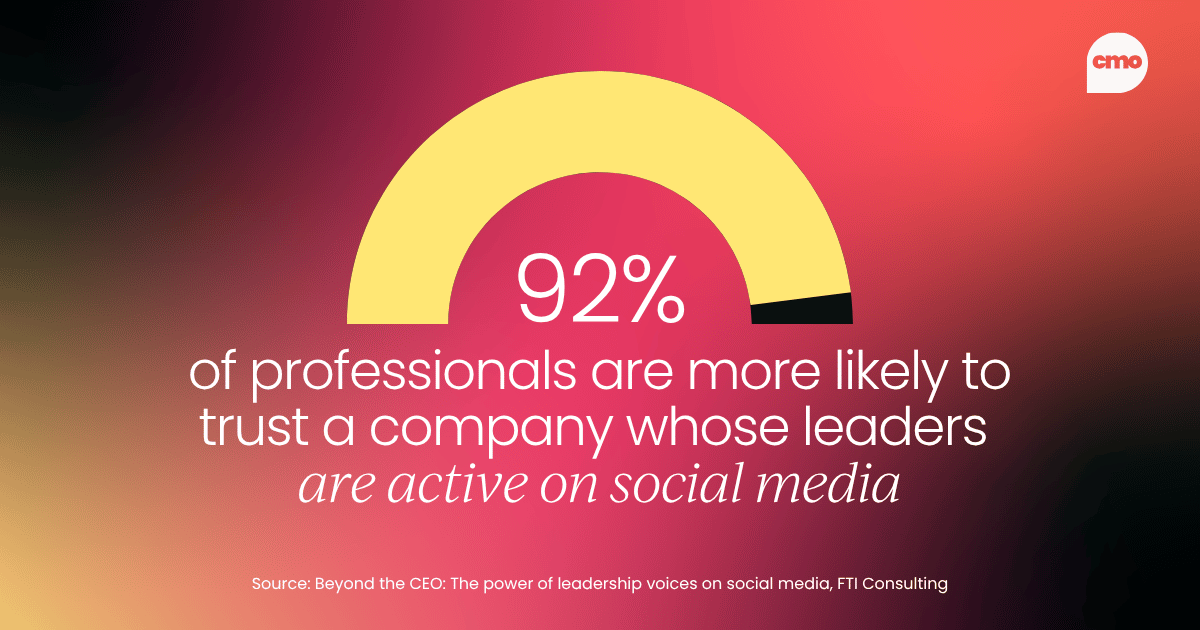
A Fortune cover story noted that 92% of professionals say they are more likely to trust a company whose senior leaders are active on social media. Benioff has understood that longer than most. He’s both the proof of concept and, it should be said, the cautionary tale. When his public persona missteps, the brand feels it immediately. That two-sided risk is precisely what makes a leader brand so powerful and so consequential.
Drew Arciuolo and VKTRY: When personal brand drives acquisition
Then there’s Drew Arciuolo at VKTRY, a sports performance company known for its patented carbon-fiber performance insoles used by athletes at every level. The example that follows is closer to the ground and, for many of us running marketing functions at growing companies, more instructive, more grassroots, and more real, as it’s a true example of how brands break through.
Drew is VP of Marketing at VKTRY. When he joined the family business full time after graduating as a Division I baseball player in 2018, VKTRY was still relatively unknown. The company had a differentiated product and strong technology, but limited visibility.
Drew built his own visibility alongside the brand. He spent 115 days a year on the road capturing authentic athlete reactions on video, building a content engine that eventually generated millions of organic impressions per day. He also narrowed the company's focus from a broad athletic audience to highly engaged performance niches, helping the brand build a loyal following through direct-to-consumer channels and athlete-driven storytelling.
The strategy worked. In May 2026, VKTRY was acquired by Scholl’s Wellness Company, parent company of Dr. Scholl’s, in a deal that positioned the brand as a high-growth leader in the athletic performance category. The acquiring company cited VKTRY’s “viral e-commerce business,” “hyper-loyal customer base,” and authentic connection with athletes as key drivers behind the acquisition.
Drew himself became a recognized voice in the DTC marketing community, speaking at industry events and appearing on podcasts that drove awareness of both his own brand and VKTRY's. His personal brand and the company brand grew together, each amplifying the other.
You don’t need to be a billion-dollar CEO for this to work. You need to show up, build genuine trust with a real audience, and let the compounding do the rest.
Why personal brand capital is the next frontier for CMOs
These examples are not outliers. They’re early signals of a structural shift. By 2036, the most strategically important question in a CMO's annual plan will not be "What is our creative platform?" It will be: "Whose personal brand is our growth engine, and how do we build the infrastructure around it?"
We’re entering the age of what I call personal brand capital: the measurable brand equity that individual executives and thought leaders accumulate through their public presence, and its direct correlation to company revenue. This is not a vanity exercise. Within a decade, private equity firms, acquirers, and public market investors will have models that price personal brand capital as a distinct asset class on the balance sheet.
The mechanics of building leadership brands will look very different by 2036. AI will function as a permanent partner in the process. Not replacing the human voice, but dramatically lowering the effort required to maintain consistent public presence.
A CEO who today publishes two articles a quarter will be able to sustain a weekly cadence without sacrificing quality, because AI handles the structural labor while the human brings the genuine insight and editorial judgment. The human stays in the driver's seat. AI handles the engine.
Beyond content production, AI will handle what I think of as the signal layer: monitoring which content themes are gaining traction with specific audience segments, which speaking formats are converting for different buyer personas, which relationships in a leader's professional network are warming or cooling. Those insights surface in real time so a leader's public presence stays calibrated to market opportunity rather than running on instinct alone.
A NOTE ON THIS ARTICLE: LIVING PROOF
I want to be transparent about something directly relevant to this argument: this article is evidence of exactly what I am describing with respect to leveraging AI. I used AI to help write it. Not to generate ideas I do not have, but as a thinking partner. A back-and-forth brainstorm. A structural collaborator that helped me move from the thoughts in my head to the piece you are reading now, faster and more clearly than I could have done working alone.
The ideas, the perspective, the pattern recognition sitting behind every paragraph: those are mine. The AI helped me scale them into something worth your time. That is the point. That is the future.
And for those wondering whether this changes the authenticity of what you have read: I would argue it does the opposite. It freed me to focus entirely on the substance.
AI-powered hyper-personalization: When the brand knows you
Let me be direct about this one, because it is the shift I’m most confident in: hyper-personalization will be the norm. Not a differentiator. Not a premium capability. The baseline expectation.
And I want to say something I don’t hear discussed enough in CMO conversations: your CRM stopped being a list of names about five years ago. Most organizations have not fully absorbed that yet, but it’s true.
With the emergence of AI, your CRM has become the absolute brain of your company, an intelligence engine with near-endless capacity to help you understand every step of the buying process in ways we simply never had available before.
The prospect journey, the client relationship, the renewal conversation, the upsell opportunity – your CRM now holds a living, learning map of all of it. Companies that still treat it as a contact database are leaving extraordinary competitive advantage on the table.
This reframe matters because it is the foundation for what hyper-personalization actually means in practice. It means a complete dismantling of the assumption-based marketing that has defined our profession for decades.
We’ve always built personas: semi-fictional composites constructed from surveys, focus groups, and whatever behavioral data we could stitch together. The truth is that most personas are educated guesses dressed up in PowerPoint. By 2036, with AI and data genuinely converging, we’ll no longer guess. We’ll know.
From personas to precision: What the research tells us
McKinsey's landmark Next in Personalization study found that companies growing faster drive 40% more of their revenue from personalization than their slower-growing counterparts, and that personalization consistently produces 10 to 15% revenue lift, reaching as high as 25% for the most capable organizations.
BCG and Harvard Business School's David Edelman put a precise number on the opportunity in their 2024 book Personalized: Customer Strategy in the Age of AI. A $2 trillion prize is available to companies that get this right.
A BCG survey of 23,000 global consumers found that more than 80 percent want personalized experiences, yet two-thirds have received personalization that felt inappropriate, inaccurate, or invasive. That gap between expectation and execution is the opportunity.
Gartner took it further in early 2026, predicting that 60% of brands will use agentic AI to deliver streamlined one-to-one interactions by 2028. Their senior researcher put it plainly:
"This marks the end of channel-based marketing as we know it."
Writing in Harvard Business Review, HBS professors Julian De Freitas and Elie Ofek made the case that AI's role in brand management goes well beyond automation. It fundamentally changes what brand management can know and do, enabling a level of individual insight that no human team could previously achieve at scale. The implication is a transformation in the quality of a brand's understanding of the people it serves.
"In 2036, your brand will not have one voice. It will have a million, each one calibrated to the individual receiving it, in the channel they prefer, at the moment they are most receptive, with the message most relevant to where they actually are in their journey."
The style guides, tone of voice documents, and message hierarchies that CMOs have spent careers perfecting won’t disappear, but they will function differently. Rather than prescribing a single voice that speaks to everyone, they’ll establish the values envelope within which AI-generated personalized communications must operate. Brand governance becomes about protecting authenticity at the edges, not enforcing uniformity at the center.
Four priorities that separate the CMOs of 2036 from the rest
And here is what makes this personally urgent for me right now. As a CMO, I’m dead focused on figuring out exactly this: how to leverage and scale AI in ways that are operationally grounded and commercially meaningful.
Four things keep me up at night and get me out of bed in the morning:
- Understand our clients' pain points like never before: Not the pain points we assume they have. Not the ones they mentioned in last year's discovery call. The ones they are living with right now, that they may not yet have language for. AI gives us the first genuinely powerful tools to get there.
- Personalize our value to them: Not a personalized subject line. Not a mail merge. Genuine personalization of the value proposition itself, calibrated to what this particular client actually cares about at this particular moment in their journey.
- Message our differentiating factors better: Most companies, including very good ones, are not communicating what actually makes them different. They are communicating what they think sounds impressive, which is not the same thing. AI helps us get closer to the truth of our differentiation and find language that makes buyers feel it.
- Do all of it as meaningfully and credibly as possible: Metrics are secondary to me right now. I know that is not what most CFOs want to hear. But if we build the systems, the intelligence infrastructure, the personalization capability, the human brand platforms, the metrics will follow. Building for the next decade is the priority. The numbers will catch up.
That orientation, systems before scorecards, is what I think separates CMOs who will lead their organizations into 2036 from those who will be explaining why last quarter's campaign underperformed.
Why strategic implementation matters now
Forward-thinking CMOs should begin building personal brand programs now – not as a social media initiative, but as a revenue infrastructure investment. The companies that systematize this in 2026 and 2027 will have a three-to-five year compounding advantage over those who wait for the market to force their hand.
Steve Keifer, Chief Marketing Officer of Ordway, a finance automation platform for recurring revenue billing and revenue recognition, believes the deeper issue is not just personalization, but declining institutional trust itself.
“Buyers are educated on marketing tactics. They know online reviews, search results, and analyst reports can be manipulated or subsidized.”
As a result, buyers increasingly trust peers more than polished corporate messaging, turning instead to networking events, private Slack communities, Zoom conversations, and customer advocacy networks for recommendations. Keifer argues these authentic, word-of-mouth ecosystems, what many marketers now call dark social, will only grow more influential in the age of AI.
He’s right. The more synthetic and automated the information environment becomes, the more valuable trusted human recommendation becomes. AI may scale distribution, but trust will remain stubbornly human.
The brands that will win the next decade are not those that personalize most aggressively, but those that personalize most trustworthily. As AI capabilities expand, consumer sensitivity to manipulation will sharpen in parallel. The organizations that use data to genuinely serve rather than extract will build durable loyalty. The others will be filtered out.
AI influencers: The question no one wants to ask directly
It would be intellectually dishonest to write a piece about branding in 2036 without addressing AI influencers directly. They already exist. They’re already generating revenue. By 2036, they will be more sophisticated than anything we can currently imagine.
The trajectory is clear. AI-generated personas, some fully synthetic, some digital twins of real executives or creators, will be viable brand ambassadors for certain product categories and certain audience segments. They offer availability, consistency, cost efficiency, and unlimited scalability. A fully AI brand ambassador never has a scandal, never goes off-message, never demands a renegotiated contract.
And yet I would argue that the rise of AI influencers will ultimately increase the premium on demonstrably human, authentic brand voices. As synthetic content floods every channel, the emotional value of genuine human presence and genuine human vulnerability will increase sharply. Authenticity will become scarce. Scarcity creates premium.
The most sophisticated brands of 2036 will use AI influencers and synthetic content strategically – for reach, for efficiency, for 24/7 presence in markets where speed matters more than depth. They’ll simultaneously invest heavily in the human voices that create irreplaceable trust and category authority. The brands that go all-synthetic will discover, in due course, that they have optimized themselves into a commodity.
The disclosure imperative is not optional. By 2036, the regulatory environment around AI-generated brand content will have matured significantly. Brands that try to pass synthetic influencers or AI-generated testimonials as human will face legal exposure and the far more damaging reputational consequence of getting caught. Transparency is both the ethical and the commercially smart choice.
The channel landscape in 2036: Branding in proliferating media
What I tell my team is this: hang in there. I know things are moving fast. That can feel overwhelming when you’re trying to hit quarterly targets and simultaneously figure out what your channel strategy looks like in three years.
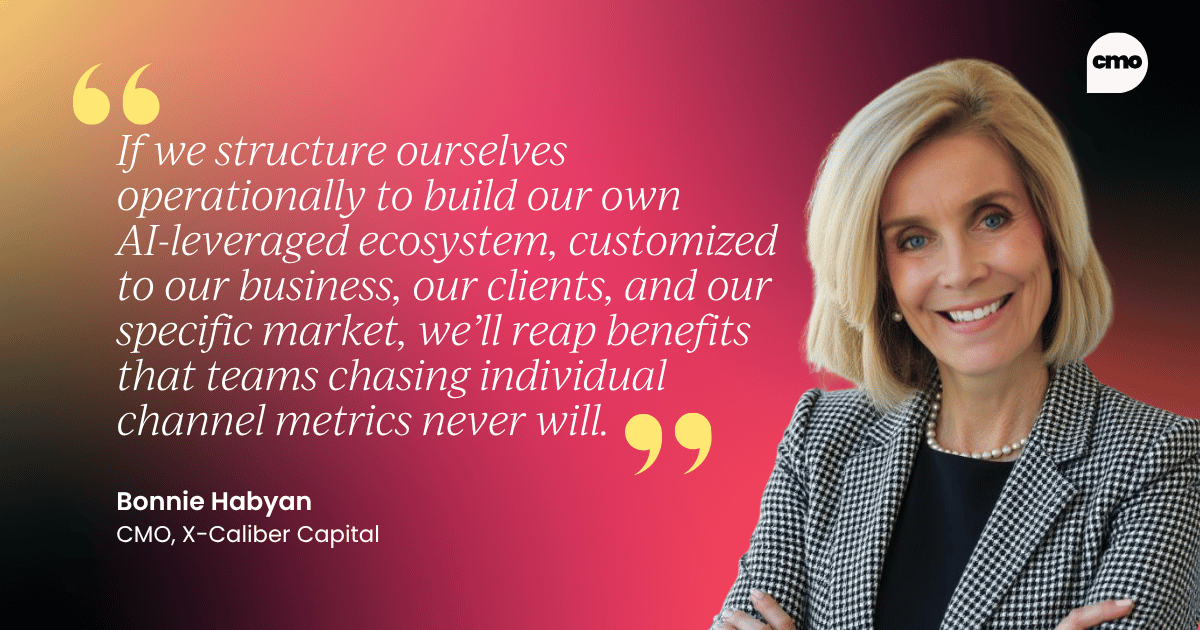
But here’s what I genuinely believe: if we structure ourselves operationally to build our own AI-leveraged ecosystem, customized to our business, our clients, and our specific market, we’ll reap benefits that teams chasing individual channel metrics never will. The companies that will own their categories in 2036 are the ones building that infrastructure now, not the ones optimizing last quarter's numbers.
My message is not to panic about which channels are rising or falling; it’s to stop being so focused on today's metrics and start positioning for the future. Because here is what that future looks like: when you’ve built the right AI-connected systems, the data and intelligence flowing through them will give you more control over those metrics than you have ever had – not less.
The irony is that the path to better measurement runs directly through the work that feels hardest to justify in a dashboard today.
Stop planning for channels. Start building infrastructure.
The channel landscape itself will keep fragmenting at a pace none of us can fully plan for. Brand touchpoints will include environments that don’t yet have stable names. AI-mediated conversations where an intelligent assistant recommends your company to a prospect who never ran a conventional search. Spatial brand experiences in mixed reality environments. Generative audio and video formats where brand content is assembled in real time rather than distributed as fixed assets.
Consider what we’ve already lived through: TikTok did not exist in a meaningful form fifteen years ago. Podcasting as a mainstream brand channel is barely a decade old. Now apply that velocity to the next ten years and try to plan for specific channels. You can’t. What you can do is build the kind of AI-connected marketing infrastructure that finds your audience wherever they are, without you having to guess in advance where that will be.
Harvard Business Review's March 2026 piece "Preparing Your Brand for Agentic AI" put a striking number on how fast this is already happening: two-thirds of Gen Z and more than half of Millennials have already started using large language models to research products. Brands that have not thought carefully about what their company looks like inside an AI recommendation are already behind.
As the authors found when analyzing how leading AI models represented major liquor brands, incomplete or incorrect AI data can lead to serious misrepresentation without a brand even knowing it is happening.
From SEO to GEO: why your brand's AI presence is already falling behind
The most consequential channel shift to plan for is one already underway but not yet fully appreciated by most brand leaders: the rise of AI as the primary discovery and recommendation layer.
As large language models become the first point of contact for an increasing share of research and purchase journeys, the question "what does our brand look like on Google?" gets supplemented by an equally important one: “what does our brand look like to an AI recommending solutions to our target buyer?”
Search engine optimization has an AI-native equivalent, call it generative engine optimization, and the brands that understand this in 2026 will have a structural advantage that compounds for years.
The implication is not that brands must be everywhere – that path leads to diffusion and incoherence. It means brand architecture must become modular and principle-based. If your brand can only be expressed through the formats and channels you planned for, it will be left behind by every new surface that emerges.
The brands that thrive in 2036 will be those whose identity is so clearly defined at the values level that it translates coherently across formats that did not exist when the guidelines were written.
The organizational shift: Brand as infrastructure, not as an intangible
This is the one I’m most personally invested in, because it gets at something that has frustrated me for the better part of a career: the perpetual struggle to prove the value of brand investment in the language that CFOs and boards actually speak.
Marketing departments will become more scientific. Full stop. The ability to custom-build systems, ingest proprietary knowledge, pinpoint data at the individual account level, and connect brand activity to revenue outcomes will fundamentally change what it means to run a marketing organization.
What has historically been treated as an intangible asset on the balance sheet, something you feel in the room but cannot quite put a number on, will become quantifiably tied to growth metrics in ways that have simply not been technologically possible before now.
The ROI question that marketers have been asked to answer for decades, and have often had to answer with proxies, attribution models full of assumptions, and a certain amount of hand-waving, will get genuinely easier to address. Not because the question becomes simpler, but because the data infrastructure to answer it honestly will finally exist.
AI systems that can connect the dots between a prospect's first brand touchpoint and their eventual purchase decision, across a complex multi-channel journey that unfolds over months, will give CMOs a level of evidentiary confidence that changes the boardroom conversation entirely.
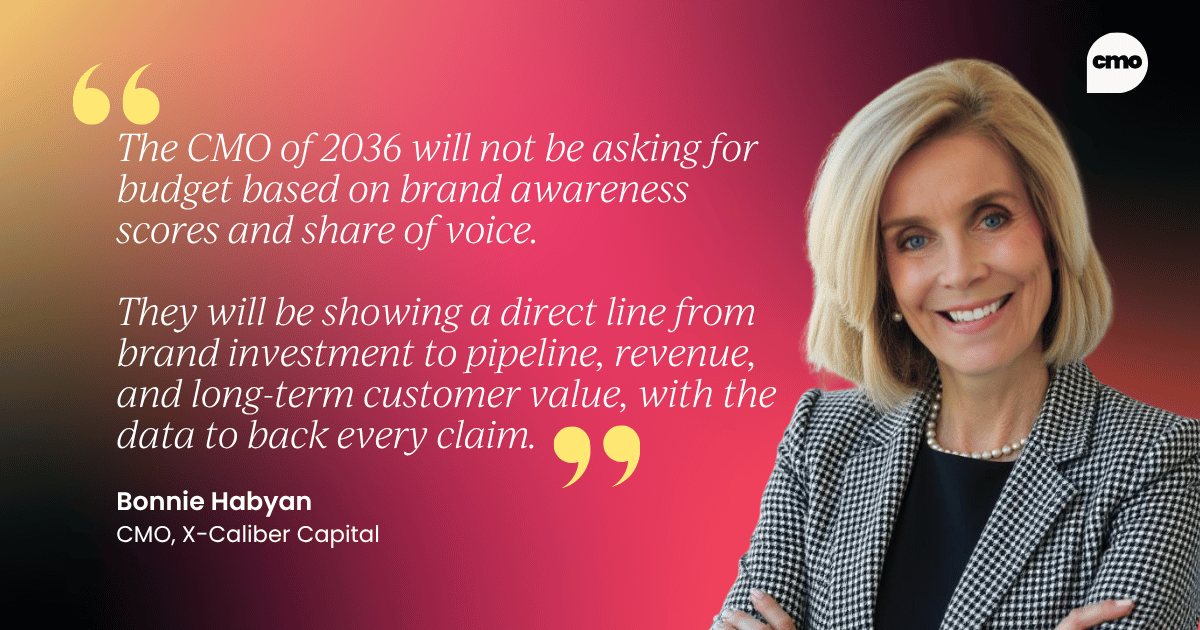
The CMO of 2036 will not be asking for budget based on brand awareness scores and share of voice. They will be showing a direct line from brand investment to pipeline, revenue, and long-term customer value, with the data to back every claim.
In practical terms, the systems, data pipelines, AI tools, and governance frameworks that produce and maintain brand experience will be as fundamental to the company's operations as its technology stack or its financial reporting systems.
Every customer-facing team – sales, customer success, product, HR – will have brand tooling embedded in their workflows. The CMO's most important conversations will be with the CTO and the CFO, not about budget allocation but about data architecture and measurement strategy.
The brands that will define their categories in 2036 are being built today. Not in creative reviews, but in data strategy meetings, AI capability roadmaps, and decisions about which humans to invest in and build platforms around. The window is open. It will not stay open indefinitely.
Nobody has the full picture of what 2036 looks like. But from where I sit, the direction of travel is clear, and the decisions being made right now will determine who leads and who follows when we get there.
The foundations are being built today.
Hyper-personalization. Human-led brand presence. Scientific marketing measurement. Channel intelligence that replaces guesswork with precision. These are not distant ambitions. They’re the investments that separate category leaders from the rest. The next decade will reward those who start now.


Become a CMO Insider
Thank you for subscribing
Get exclusive insights, frameworks, and strategies from marketing leaders driving real business impact.
An email has been successfully sent to confirm your subscription.
 Follow us on LinkedIn