.png)






Over half of marketing leaders believe their tech stacks are incomplete – yet budget pressures and integration headaches are keeping the gaps open. Here's what the data says, and what to do about it.
The marketing technology landscape has never been more complex – or more consequential.
As AI tools multiply and economic pressures tighten, CMOs face a delicate balancing act: invest in the capabilities needed to compete, while squeezing maximum value out of the tools already in place.
This year's CMO Insights data reveals a sector in transition, defined by divergent spending strategies, persistent stack gaps, and a growing demand for integration over innovation.
The martech gap: most CMOs feel underequipped
A slim but significant majority of CMOs (54%) believe their current martech stacks have meaningful gaps. That figure alone should prompt reflection, but the context makes it more striking: this sense of under-investment is rising.
The share of CMOs who feel their spending is insufficient climbed eight percentage points from the previous year, suggesting the problem is getting worse, not better.
"The desire for a unified customer view — a true 360-degree perspective on behavior across all channels — is the defining unfulfilled need in marketing technology today."
When asked to describe the nature of these gaps, CMOs consistently returned to the same themes: fragmented data, siloed systems, and the absence of a single, coherent view of the customer.
The ambition for a unified data lake or integrated funnel system – one that consolidates touchpoints and eliminates the inefficiencies of stitching together disparate tools – remains largely aspirational for most organizations.
What's blocking progress
Budget constraints are the most-cited barrier, but they tell only part of the story. Integration complexity is almost equally significant, and the two problems compound each other. Investing in a new tool that doesn't connect cleanly to existing systems doesn't just waste money; it creates more fragmentation.
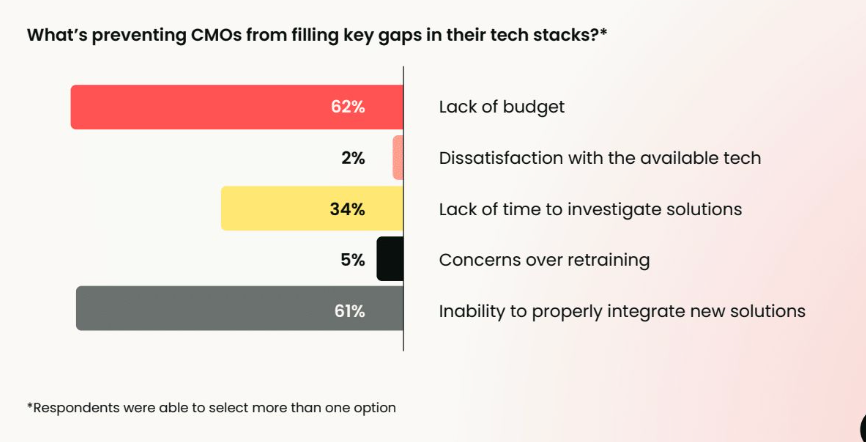
The near-tie between budget and integration as barriers is telling. It signals that the problem isn't simply a lack of resources – it's a structural challenge.
CMOs are increasingly aware that throwing money at point solutions rarely produces the integrated, insight-driven martech environment they need. The harder question is how to architect a stack that actually holds together.
Some CMOs also pointed to non-technical gaps: a shortage of SQL proficiency on their teams, and a broader organizational struggle to communicate marketing's value in a language that resonates with the CFO. These are as much cultural and talent challenges as technology ones.
The tools CMOs rely on most
Despite the gaps, most organizations have built meaningful foundations. HubSpot and Google Analytics dominate as the most widely-used platforms, with Salesforce Marketing Cloud and SEMrush also commanding large user bases.
The data reflects a market that has largely standardized on a core set of CRM, analytics, and advertising platforms.
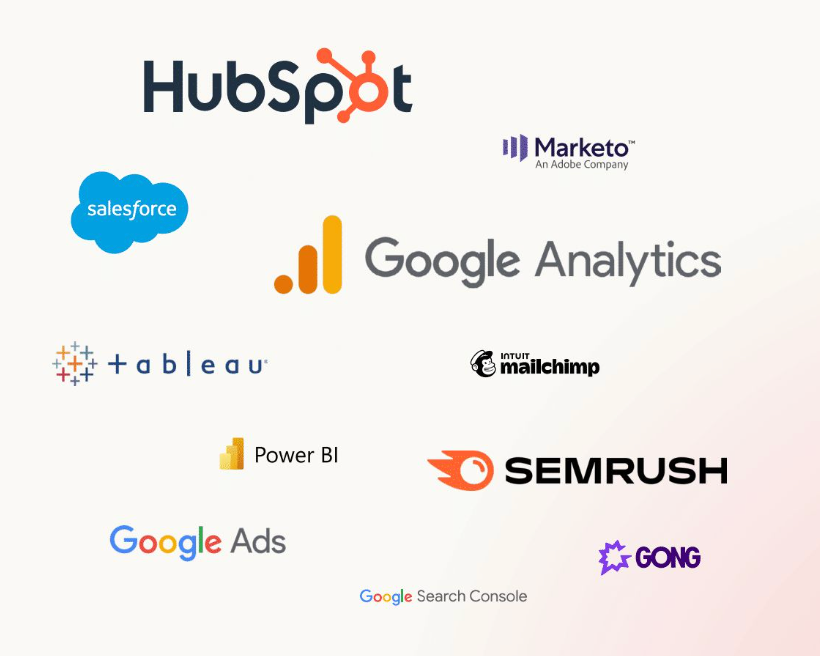
What's notable is what the list doesn't show: robust multi-channel attribution tools, AI-driven lead generation platforms, and fully-developed content management systems all surfaced as critical gaps in the qualitative responses.
Many CMOs have the traffic and CRM data covered, but struggle with the connective tissue – the tools that tie attribution, content performance, and pipeline data into a coherent picture of marketing ROI.
A tale of two spending strategies
Perhaps the most striking finding in this year's data is the dramatic divergence in martech spending between startups and more established organizations.
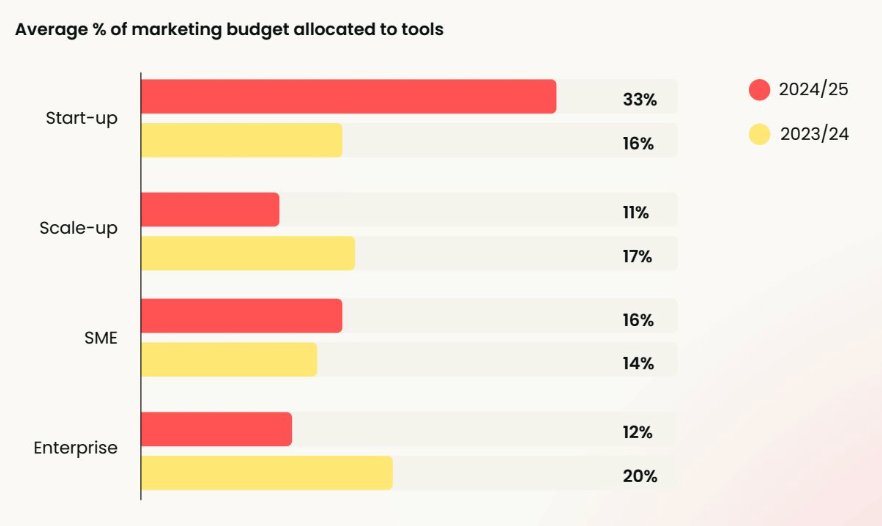
Startups have more than doubled their martech share – from 16% to 33% of marketing budgets – a surge almost certainly fueled by the explosion of affordable, AI-powered tools that promise to compress the gap between small teams and large ones.
For a startup trying to scale quickly, the calculus is clear: automation and intelligence are cheaper than headcount.
Enterprises and scale-ups, meanwhile, are pulling back. The retreat from 20% to 12% among enterprise organizations is a sign of maturity rather than disillusionment with technology.
Having accumulated large, complex stacks over the years, many enterprise marketing teams are now focused on optimization rather than expansion. The question has shifted from "what tool should we add?" to "are we actually using what we have?"
"For enterprises, the ROI conversation has flipped: the biggest gains now come from consolidation and deeper use of existing platforms, not new procurement."
What this means for CMOs in 2026
The data paints a clear picture of what the year ahead demands. For CMOs across all organization types, three priorities stand out.
First, the integration imperative cannot be deferred. With 61% of CMOs citing integration failure as a barrier to investment, and the recurring desire for a unified customer view still unmet, the case for investing in integration infrastructure – whether that's a CDP, a data warehouse, or simply better API connectivity – has never been stronger. A stack of excellent but siloed tools will continue to underperform.
Second, the measurement gap is a strategic liability. Without robust attribution and ROI tracking, marketing leaders will struggle to defend budgets in a cost-conscious environment.
Closing this gap isn't just an operational improvement; it's a political necessity. CMOs who can clearly tie spend to pipeline will have more room to invest in the capabilities they need.
Third, the people and skills dimension deserves more attention than it typically receives. Technology gaps are visible and easily quantified; skills gaps are harder to see but equally limiting.
The CMOs who invest in elevating their team's data literacy – and in articulating marketing's value in financial terms – will be better positioned to capitalize on the tools they already have.
The martech landscape of 2026 won't reward organizations with the longest list of tools. It will reward those who have built stacks that actually speak to each other, teams that know how to use them, and leaders who can demonstrate the returns.


Become a CMO Insider
Thank you for subscribing
Get exclusive insights, frameworks, and strategies from marketing leaders driving real business impact.
An email has been successfully sent to confirm your subscription.
 Follow us on LinkedIn