.png)




The role of the CMO has shifted more in the last five years than most organizations are willing to admit.
You can see the disconnect in how companies talk about marketing versus what they actually need from it. On paper, marketing is still expected to generate pipeline, support sales, and build brand awareness. In practice, those outputs alone aren’t enough to sustain growth, especially in markets where competition is tighter, buyers are more informed, and product differentiation is harder to maintain.
What’s really happening is this: growth challenges that used to be solved with better campaigns are now rooted in how the entire go-to-market motion is designed. And when that system is misaligned, no amount of incremental marketing optimization is going to fix it.
That’s where the modern CMO operates.
The CMO as a GTM architect
At a certain point, you realize most “marketing problems” don’t originate in marketing.
It might be positioning that doesn’t quite reflect how buyers think about the problem. Or a sales motion that’s disconnected from how demand is actually created. Or a product experience that doesn’t reinforce the story being told in-market.
Over time, these gaps compound. Marketing works harder to compensate, and the system becomes increasingly inefficient.
I’ve seen the opposite play out as well, and it’s a completely different dynamic. When marketing forms tight partnerships with sales, customer success, and product, the entire system starts to click. The customer journey feels seamless. Internal teams operate from the same playbook. Feedback loops tighten in a way that actually improves the product, which then improves the user experience, which then feeds growth.
World-class CMOs lean into that responsibility. They think in terms of how the system works end to end, and they take ownership of making sure it does.
Positioning as a living system
Positioning is one of those areas where small misalignments create outsized impact.
When it’s slightly off, you don’t always notice immediately. Pipeline still gets created. Deals still close. But there’s friction everywhere. Conversations take longer than they should. Buyers hesitate in ways that are hard to diagnose. Pricing becomes a negotiation rather than a reflection of value.
I’ve spent a good part of my career helping organizations reposition around “bet the company” AI products. High stakes, high scrutiny, and very little room for error. What stands out every time is how tight the line is, and that balance is the foundation for everything else.
You’re not just telling a story to prospects. You’re aligning customers, users, employees, executives, and the broader market around a new narrative at the same time. Push too far in one direction, and you lose credibility. Stay too close to the old story, and nothing changes.
Most teams treat positioning as a messaging exercise. Something you define, document, and roll out. The best teams treat it as a dynamic system tied directly to revenue performance.
They stay close to the source:
- Actual conversations with prospects, customers, and team members
- Real customer behavior, not just survey responses
- The language buyers naturally use when they describe their problems
And they revisit it more often than feels comfortable, because the narrative keeps evolving. When positioning is right, you feel it everywhere. When it’s not, you feel that too.
The shift to revenue engines
Sadly, ‘brand’ is effectively a four-letter word in the SaaS world, and the traditional demand generation model was built for a different buying environment.
It assumed a relatively linear journey: generate leads, qualify them, pass them to sales, and convert. That model breaks down when buying committees expand, when research happens before any form is filled, and when customers expect meaningful value long before they engage with a salesperson.
World-class CMOs build revenue engines that account for the full lifecycle.
They connect product-led entry points with sales-led expansion. They focus on account-based efforts where the opportunity justifies it. They invest in lifecycle marketing that doesn’t stop at acquisition, but continues through adoption, expansion, and retention. And they measure everything that can (realistically) be measured.
Pipeline volume becomes less interesting on its own. What matters more is the quality of that pipeline, how quickly it moves, and what happens after the deal closes. Revenue durability becomes the real signal.
This requires tighter alignment across functions, but it also creates a more resilient growth model. One that isn’t dependent on constantly feeding the top of the funnel just to maintain momentum.
Execution as the true differentiator
The best marketing organizations feel different. There’s a level of clarity in how work gets done that allows teams to move quickly without creating chaos.
Roles are well-defined. Processes are repeatable where they need to be, and flexible where they should be. Feedback from sales and product flows naturally into marketing decisions, rather than getting lost or delayed.
There’s also a level of pragmatism around measurement. Attribution is never going to be perfect. Trying to force precision where it doesn’t exist often leads to worse decisions, not better ones. Instead, strong teams build directional signal – enough to understand what’s working, where to invest, and when to adjust.
Over time, that discipline compounds. Execution becomes a competitive advantage in itself.
AI as an accelerator, not a substitute
I’ve gone deep here with my own team. We’ve built out an entire set of AI agents that touch just about every part of the marketing function. Content, research, internal workflows, and even early-stage analysis. The impact has been real. We’re moving faster. We’re covering more ground. We’re amplifying what the team can do.
But it’s important to be clear about what it hasn’t done. It hasn’t 10x’d our pipeline. It hasn’t magically multiplied productivity to some extreme level where humans are no longer needed.
That’s not because the technology isn’t good – some of these agents are incredibly advanced, but they still require human judgment at critical moments. They need someone to step in and shape the message, make a call, or add the layer of nuance that makes something actually resonate. That human layer is the difference between something that technically works and something that lands.
Where I’ve found this matters most is with leadership alignment. There’s a real temptation to overestimate what AI can deliver in the short term. Setting expectations early and grounding them in how the system actually works makes a huge difference.
Setting expectations at the executive level
One of the more subtle, but critical, parts of the CMO role is expectation management with GTM leaders, CEOs, and boards.
I found myself right in the middle of this at a past venture. The CEO asked the marketing team to lead a full company rebrand while also launching our biggest product to date, all on top of the day-to-day work required to keep growth on track. On paper, all of it made sense. In reality, it was a collision of priorities.
The way through it wasn’t pushing back in isolation. It was creating alignment.
I got him in the room with the team. We mapped out what the work actually looked like, where the constraints were, and what realistic timelines and outcomes would be if we wanted to do all of this well. That conversation changed everything. It gave us the space to reset expectations, align on tradeoffs, and ultimately push timelines in a way that protected both the work and the business.
That dynamic shows up more often than people think. It’s there when long-term brand investments are expected to produce immediate pipeline. When growth is assumed to be linear in unpredictable markets. When marketing is asked to compensate for deeper issues in product or sales. And increasingly, when AI is expected to unlock exponential gains overnight.
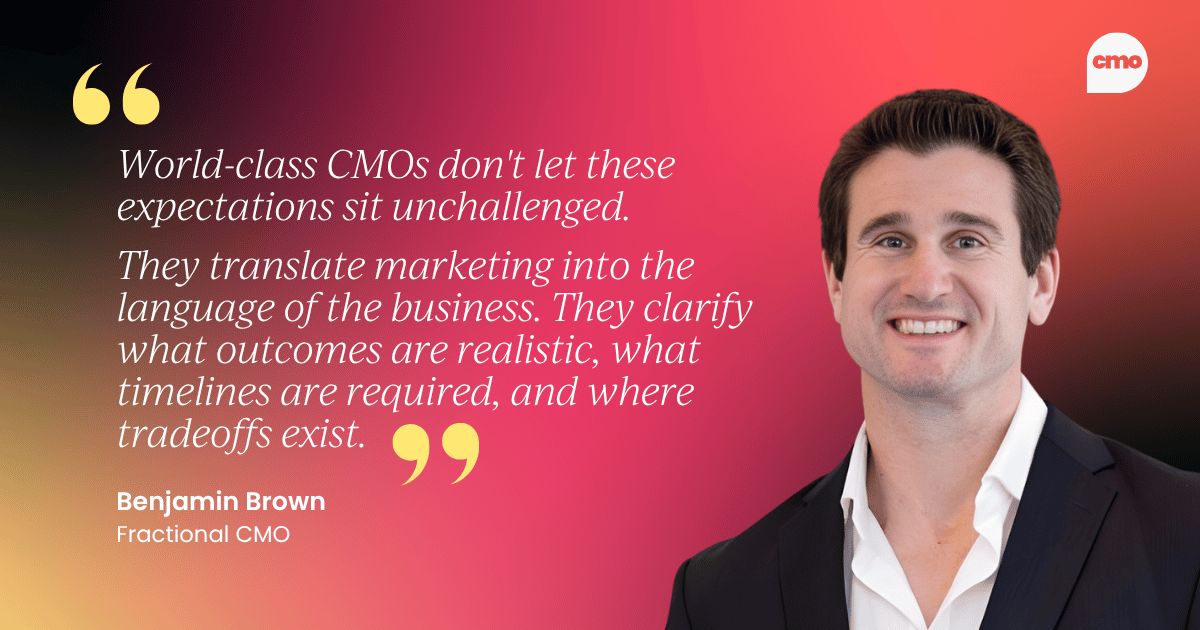
World-class CMOs don’t let these expectations sit unchallenged. They translate marketing into the language of the business. They clarify what outcomes are realistic, what timelines are required, and where tradeoffs exist between speed, quality, and scale.
Building teams that can sustain performance
None of this works without the right team behind it. And building that team is less about filling roles and more about creating an environment where strong operators can perform at a high level.
That starts with clarity. Clear ownership, clear priorities, and a clear understanding of what success looks like. It continues with a deliberate effort to reduce unnecessary complexity, so teams can focus on the work that actually moves the needle.
One of the simplest – and most overlooked – ways to build a strong team starts before someone even joins.
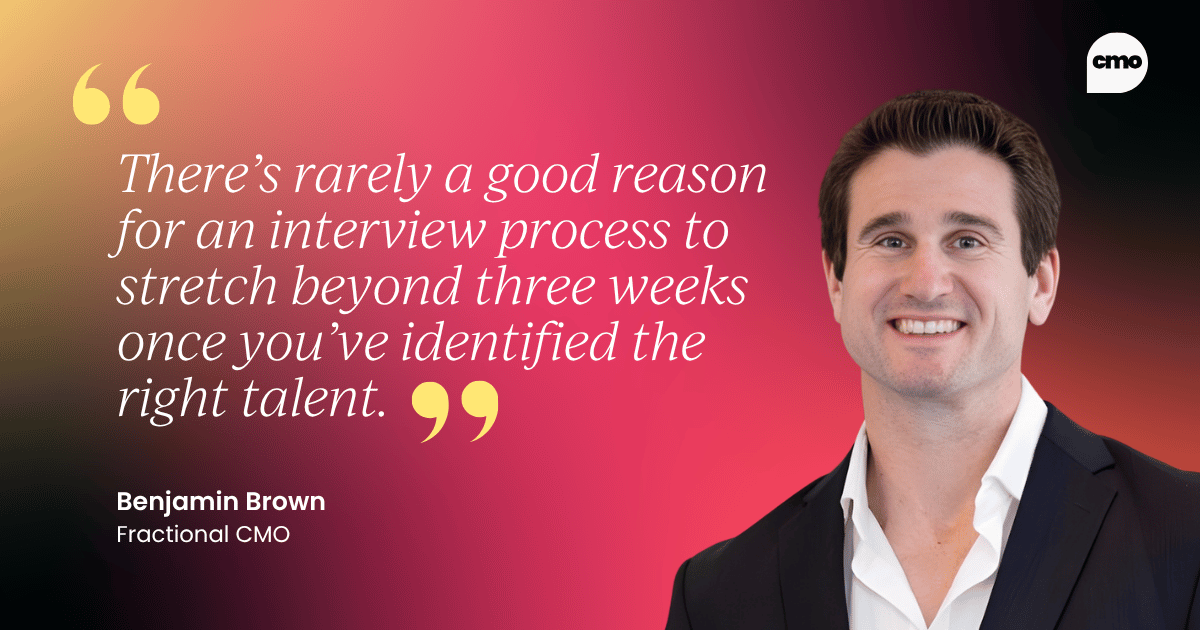
The candidate experience matters more than most teams realize. I make a point to stay directly involved with top candidates throughout the interview process, and work closely with HR to keep things moving efficiently. There’s rarely a good reason for an interview process to stretch beyond three weeks once you’ve identified the right talent. If that’s a hot take, I’m always open to further conversation here.
Beyond hiring, it comes down to developing leadership within the team.
As companies grow, the limiting factor is rarely output. It’s the ability to scale decision-making, accountability, and strategic thinking across more people. CMOs who invest in this early create organizations that can sustain performance as the business evolves.
Piecing it together
The role of the CMO is no longer centered on producing more marketing. It’s about building a system that allows the company to grow in a consistent, scalable way.
A system where positioning reflects real buyer understanding. Where demand generation connects to revenue outcomes. Where execution is disciplined but adaptable, and where new technologies like AI enhance – rather than distract from – what actually matters.
The best CMOs aren’t the ones doing more. They’re the ones designing systems that make everything else work better.


Become a CMO Insider
Thank you for subscribing
Get exclusive insights, frameworks, and strategies from marketing leaders driving real business impact.
An email has been successfully sent to confirm your subscription.
 Follow us on LinkedIn