.png)




B2B buying has changed. In the past, B2B sales professionals largely controlled the flow of information. Today, buyers are in control. They research, compare, and engage with your brand long before your sales team even knows they exist.
The marketing journey now plays a much bigger role in the B2B customer journey than many realize. On average, a purchase involves 76 touches across 3.7 channels and more than six stakeholders. About 70% of that journey happens in marketing’s hands, before a prospect ever raises their hand.
For larger companies (over 250 employees), the journey is even longer, averaging 242 days to revenue.
The challenge, and opportunity, is for marketers to understand and influence this journey at scale.
The power of the long game: Planting seeds and the 95/5 rule
Because B2B journeys are long (Dreamdata’s B2B LinkedIn Benchmarks show an average of 211 days from the first anonymous touch to a closed-won deal), marketers need to think beyond immediate conversions.
This is where the 95/5 rule comes in:
5% of your target market is "in-market" at any given moment, actively ready to buy.
95% are future buyers, still in research or consideration mode.
If you only focus on the 5%, you risk missing a big chunk of your future buyers.
Marketing’s job is to plant seeds early, share insights, educate, and make sure information about your company, products, or technology is easy to find. Buyers are self-educating themselves way before sales get involved.
For channels like LinkedIn, the importance of this long-term influence is especially clear. Based on Dreamdata research, social touches average 222 days from first engagement to closed-won deal, much longer than paid search (87 days) or review sites (70 days).
That means if you want to justify your investment in social, marketers need tools that measure full-funnel performance, not just clicks or website visitors. You need to see the first touch and the interactions in between that eventually led to revenue.
Measuring what really matters
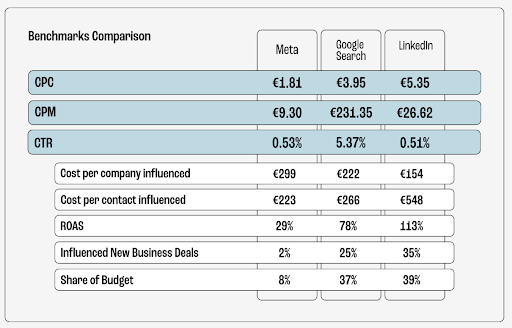
It’s easy to see leading metrics like cost-per-click and assume LinkedIn is expensive, €5.35 per click can make any marketer flinch.
But the lagging metrics tell a different story: according to Dreamdata research, LinkedIn has the highest return on ad spend (ROAS) at 113%, outperforming other major platforms.
This illustrates a key point for B2B marketers: don’t optimize only for short-term metrics. Measure influence across the entire journey, and you’ll see which channels truly drive pipeline and revenue.
How to pick up on signals of intent earlier
Marketing’s role extends beyond generating leads; it’s about identifying and acting on buyer intent before a prospect fills out a form.
For example, an account engaging repeatedly with content about pricing or product comparisons signals potential buying intent. To act on these signals, marketers need visibility into anonymous, company-level behaviors, a growing necessity in long, complex B2B journeys.
Platforms like Dreamdata use integrations with LinkedIn’s Company Intelligence API to make these signals visible. With Dreamdata’s new integration to LinkedIn Company Intelligence, marketers gain visibility over the organic and paid engagements and impressions on your company profile, showing you early signs of intent.
These insights can then be applied to:
- Refine ad targeting: Build dynamic audiences around accounts showing high engagement and automatically sync them to ad platforms like LinkedIn. This ensures budgets are focused on the accounts most likely to convert.
- Enable sales: Trigger real-time notifications to sales teams (e.g., via Slack or Microsoft Teams) when high-intent accounts are engaging. This allows sales to reach out proactively, often before the account even becomes a marketing-qualified lead (MQL).
By surfacing company-level engagement signals, B2B marketers can act on early intent, turning passive interactions into actionable pipeline opportunities long before form submissions.
Content that answers questions
But how do you support those early-stage potential buyers?
Marketers have to make sure that their content answers frequently asked questions and addresses common pain points.
In addition, thought leadership content can build your credibility, nurturing accounts over the long journey, and helping prospects self-educate, ensuring your company stays top-of-mind across the extended buying cycle.
Key takeaways
- Measure full-funnel results: Stop focusing only on leading indicators like clicks and website visits. Prioritize lagging metrics that matter, such as pipeline contribution and closed-won revenue.
- Embrace orchestration: Marketing should act as the hub for GTM strategy, collaborating with sales, aligning on accounts, and activating insights at the right time.
- Act on intent signals: Leverage AI and company-level data, including early engagement signals from LinkedIn, to convert passive engagement into actionable sales opportunities.
The B2B customer journey is long, complex, and increasingly anonymous. Marketers influence far more of it than they realize.
By embracing the long game, measuring true impact, and acting on early intent signals, marketers can guide buying journeys with greater precision, long before prospects ever fill out a form.


Become a CMO Insider
Thank you for subscribing
Get exclusive insights, frameworks, and strategies from marketing leaders driving real business impact.
An email has been successfully sent to confirm your subscription.
 Follow us on LinkedIn