.png)






"If everyone uses the same AI models, everyone gets the same outcomes. Whatever skills you have, the same skills are available to the next person. What makes the difference is humans: your character, your personality, the way you work with people.
"There’s no AI skill for interpersonal skills. You can mimic it, but you can’t delegate it. In a board meeting, you don’t have agents. You have only yourself.” - Tomer Zuker, Founder of Pave Your Way
I’m Tomer Zuker, Founder at Pave Your Way, a strategic marketing consultancy. I spent years in senior marketing roles at Microsoft, IBM, and AWS, and later served as CMO and VP Marketing at AI and cybersecurity startups, before starting my own practice. The conversation in the quote above is the one I'm having most often right now.
The one I actually want to have here is about something that gets quietly ignored at most companies: CMO tenure is the shortest of any role in the C-suite, and the usual explanation for why doesn’t hold up.
(You can also listen to Tomer’s episode on our podcast, CMO Convo, right here, watch the video version below, or keep reading in blog format.)
CMO tenure is the shortest in the C-suite
Research on this goes back years. Harvard Business Review has tracked CMO tenure for a while, and the last figures I read put it around 18 months. In the European market, where I work, it feels closer to 12 to 18 months in practice. Spencer Stuart’s research from 2024 puts a similar number on it. Compare that to CEOs, who average around four years, and CMO tenure is the lowest of any C-suite role, by a wide margin.
Most people explain this with performance or attribution: the CMO couldn’t prove ROI, so they got let go. I don’t reject that. Performance pressure and attribution gaps are real. As a CMO or VP of marketing, that’s the daily routine, the quarterly conversation about what marketing actually contributed.
But performance doesn’t explain the pattern. If it did, you’d expect strong CMOs to stay longer than weak ones. That’s not what happens. I’ve watched colleagues get pushed out of companies where they were doing genuinely well, in some cases specifically because they were doing well.
Why CMOs get blamed and CFOs don’t
Marketing has just as many numbers behind it as any other function: cost of acquisition, LTV, brand equity, and revenue attribution, etc.
The difference is what happens to those numbers once they’re in the room. When a CFO reports quarterly numbers, nobody questions the numbers. When a CMO reports pipeline contribution, the head of sales usually already has a different story ready. When brand metrics improve, the product team often takes the credit. When revenue misses, marketing is first in line to take the blame.
That’s a genuinely tricky position to be in, and it’s why I ended up building a model around the political side of this question.
 Finola McDonnell
The political layer nobody wants to name
There's a version of this explanation that almost nobody says out loud: some CEOs feel threatened by a visible CMO.
Visibility comes with the role. A CMO is expected to show up in the media, on stages and at conferences, and to be present inside the company as well as outside it. Not every CEO knows how to sit with that.
The metrics won't show you this. It's one more reason a CMO's personal brand needs tending while they're in the seat, not only between jobs.
The two axes that actually predict a CMO’s survival
My first attempt at a model used a strong-versus-weak axis for both the CEO and the CMO. It fell apart almost immediately once I compared it to real cases. I could point to CEOs who were commercially successful, well regarded by the board, and effective by every conventional measure, who still felt threatened by a high-visibility CMO. By the strong-weak logic, that CEO was strong. Something else was going on in the relationship.
So I replaced the CEO axis with secure versus threatened. A secure executive can sit across from a strong counterpart without reading their competence as a threat. A threatened executive, regardless of their own track record, reads a high-performing peer as a political risk.
I made a similar move on the CMO side. I started with something like strategic authority, but the more I tested it against real cases, the more it came down to one thing: is this person visible inside the organization, or invisible?
Visibility here means something specific. Does the CFO understand your pipeline contribution? Does the head of sales see you as an ally worth defending? Does the CEO know, in concrete business terms, what would be lost if you left?
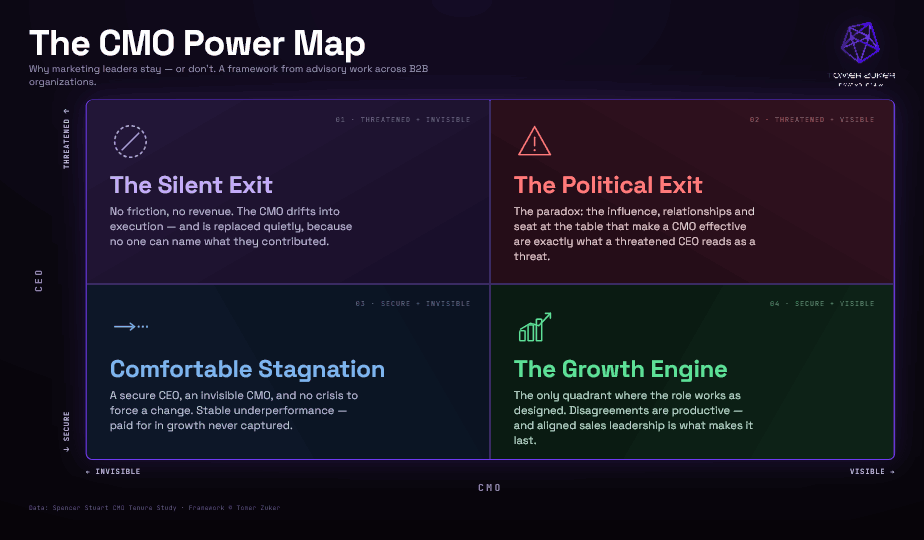
Put those two axes together, and you get four patterns.
The silent exit
A threatened CEO and an invisible CMO is the silent exit. It’s the quietest quadrant politically. There’s no friction, no confrontation.
The CEO is comfortable, but marketing drifts into pure execution: activity without strategy, campaigns without revenue impact. Eventually the CMO is replaced quietly, because nobody can really articulate what they were doing.
The political exit
A threatened CEO and a visible CMO is the political exit. This is the one I’ve seen most often, usually with genuinely talented CMOs who arrive before their time.
The CMO does exactly what the role demands: builds coalitions, speaks pipeline language, earns credibility with the CFO and the head of sales. Professionally, that’s a success. To a threatened CEO, it reads as competition. The exit is political, and no CEO frames it that way out loud.
Comfortable stagnation
A secure CEO and an invisible CMO is comfortable stagnation. There’s no dramatic exit here; it’s quieter and subtler than that.
The CEO has the security to work with a strong, visible CMO, but isn’t getting one, probably because of a hiring or qualification gap. Nobody’s in conflict. Nobody feels urgency. The cost is the growth the company never captures, and nobody ever calls it a failure, because there’s no friction to point to.
The growth engine
A secure CEO and a visible CMO is the growth engine. It’s the only quadrant where the role functions the way it’s designed to.
The CEO has the security to engage with a CMO who builds influence internally and externally and can challenge assumptions, and the CEO has the tolerance to accept those challenges. There’s strategic disagreement, but it’s a productive one.

What the marketing-sales relationship tells you
Of the four, the growth engine is the rarest, and the research backs up why it matters. Spencer Stuart’s work points to the relationship between marketing and sales as one of the strongest predictors of long-term CMO stability. Two secure people at the top build the foundation for it.
I’ve lived the alternative. I was hired into a company specifically because of a hard conflict between the CMO and the CRO. The CMO lost, left, and took the entire marketing team with them.
My first meeting in that role was with the CRO, to understand their KPIs and how they actually saw marketing, before anything else. It’s the same move for a CRO as it is for a CMO.
Three questions to ask before you take the CMO job
Performance and KPIs are the hard skills side of this. Everything from here is the soft skills side, and I think soft skills is a bad name for it. These are the skills that actually make the difference once everyone has access to the same AI models and the same baseline capability. You can mimic interpersonal skills with a tool. You can’t delegate a board meeting to an agent.
Companies run rigorous hiring processes for a CMO: strategic thinking, creative judgment, track record, culture fit, sometimes over three to nine months. Almost none of them formally assess the two variables in this model: security and visibility. So if you’re the CMO, the diligence is on you.
Has the CEO engaged with your strategic perspective during the interview process, or consistently redirected you toward execution? That’s one of the clearest signals available before you join.
What actually happened to the CMO before you, not the official story, the real one? It’s hard to get a straight answer to this, but it’s the most important question on the list. Check Glassdoor too.
Can the head of sales describe, in specific terms, how marketing currently contributes to the pipeline? A vague or purely optimistic answer usually means you’re walking into an invisible seat.
 Sabrinthia Donnelly

Three questions to ask before you hire one
If you’re the CEO, the same diligence runs the other way.
Are you genuinely comfortable with a CMO who becomes more visible than you expected, who builds relationships across the C-suite on their own?
Have you had this exact conversation before? Repeated short tenures in the same role say more about retention than about hiring. I’ve seen organizations where CMO tenure was under a year, and it kept repeating. People have patterns and so do organizations.
Does your head of sales have a real working relationship with marketing?
Whichever side of the table you’re on, the dynamics that decide your fate in this role are mostly knowable before you join.
Ask the right questions, from the right people, and do the diligence before you say yes. The fit question depends more on the relationship, on how you position yourself and the marketing function inside the organization, and on how you build a working relationship with the rest of the C-suite, than it does on hard skills and competencies alone.


Become a CMO Insider
Thank you for subscribing
Get exclusive insights, frameworks, and strategies from marketing leaders driving real business impact.
An email has been successfully sent to confirm your subscription.
 Follow us on LinkedIn