.png)





“CEOs and boards seem to have lost the understanding of how this process works, and think that a great product will just magically sell itself.”
That’s Benjamin Brown, VP of Marketing at ReBiz, describing a shift that many marketing leaders are feeling right now. In fact, 65% say the pressure to prove the return on investment (ROI) of their work has intensified over the last three years… but why?
We’re breaking it down for you right here so you can see exactly what’s pushing that number up.
What’s driving the pressure
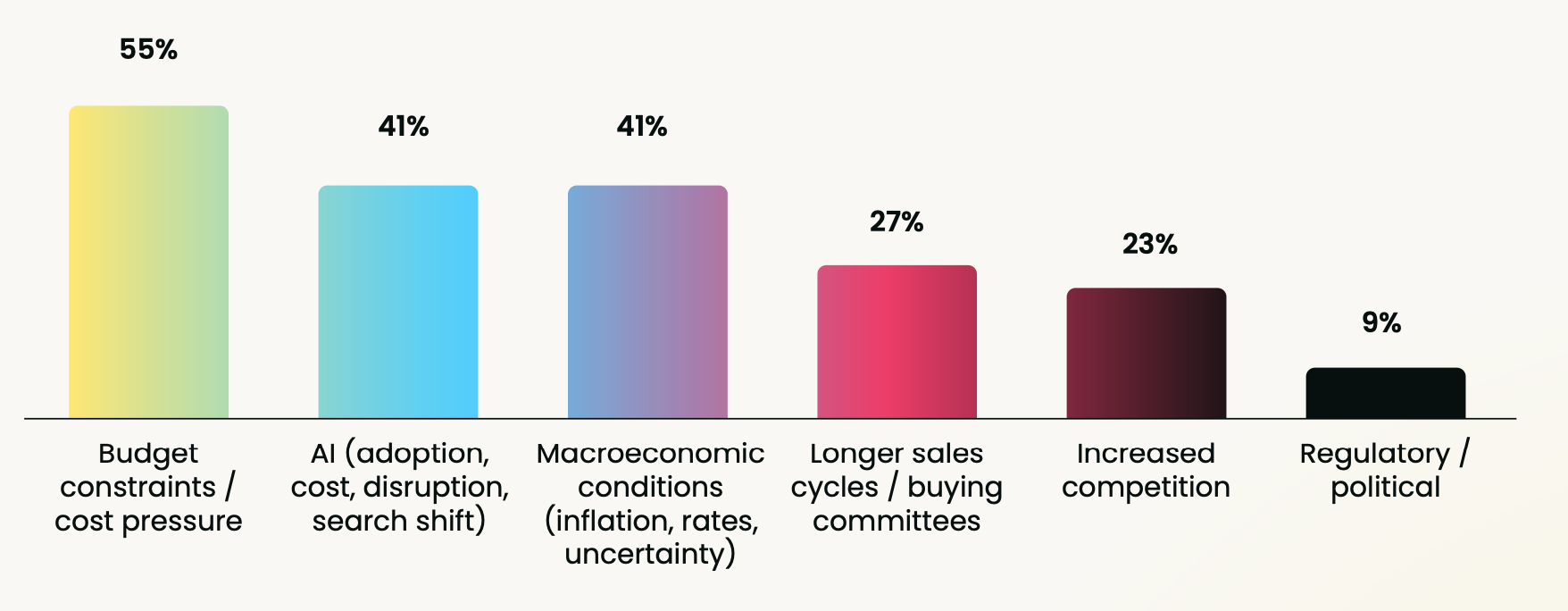
Budget tops the list, but it's not the whole story. Five other pressures are piling on at the same time, which is part of why 65% of leaders say the pressure to prove ROI has really intensified this year.
Below, we’ll go through each main cause of this mounting pressure, starting with the biggest.
1. Budget and cost pressure (55%)
55% of marketing leaders name budget and cost pressure as the single biggest driver behind the push on ROI. That’s as direct as the pressure gets. During every budget cycle, the CMO has to justify their funding (and compete for it) in front of leadership.
Erica Gunn, CMO at Canto, described what that pressure looks like day-to-day:
"When budgets are under scrutiny, the 'do more with less' mantra kicks in, but that doesn't mean dropping quality. It means making things go further. Repurposing strong content across new formats and channels rather than starting from scratch every time."
CMOs used to deal with one problem at a time. Now it’s three or four at once. That’s why a flat budget this year can feel tighter than an actual cut did last year. Either way, the conversation always circles back to the same question: what did marketing's share of the budget actually produce?
2. AI costs and adoption (41%)
AI adds to the pressure facing CMOs and other marketing leaders in two ways:
- Workload costs go down because fewer people can produce more content.
- Software costs go up because the AI tools themselves keep getting pricier.
Rebecca Fowkes, Senior Director of Growth and Marketing at VenturEd Solutions, talked about this in more detail, stating:
"Pricing models for AI are changing daily, and they're not getting cheaper... that's where the real budget uncertainty lies."
That unpredictability is the real problem. A normal software subscription used to be easy to plan for. You were given one price, and that’s what you locked in for a year. AI tools don’t work that way. Most vendors bill based on your usage, seat count, or data volume, so a tier change or a new fee for a feature that used to be free can show up mid-year with no warning.
A normal renewal gets negotiated once and settled. AI spend has to be tracked every month, which turns a one-line item into an ongoing headache. That constant tracking makes the ROI math harder too. When the cost side keeps moving, it's tough to hold it still long enough to compare against the results.
3. Economic uncertainty (41%)
Economic uncertainty ties AI for second place, and it feeds the same budget fight from a different direction. When interest rates and demand are hard to predict, finance teams hold spending closer and ask for shorter commitments, which pushes marketing toward quarter-by-quarter approval instead of an annual budget it can plan around.
A CMO defending a campaign this year has to defend it against a moving economic backdrop, not just a fixed number.
Buyers feel that same uncertainty, which is part of why deals are taking longer to close too. That makes the ROI case itself harder to pin down, since the backdrop it's measured against keeps shifting.
4. Longer sales cycles (27%)
Sales cycles matter too, even though they’re ranked lower on the list. Deepak Kumar, CMO at Techies Infotech, said deals that used to close in weeks now take four to six months, because more people want to sign off on each one. He described what that actually looks like:
"We're not struggling to generate awareness or fill the top of the funnel. The challenge is what happens after: buyers engage, show clear intent, and then the process stretches out for months while internal committees deliberate, budgets get re-evaluated, and priorities shift." - Deepak Kumar, CMO at Techies Infotech
When deals stall in committee, marketing teams are forced to spend more time and money re-engaging the same prospects just to keep them from walking away.
5. Competition and regulatory pressure (23% and 9%)
Even smaller pressures don't stay in their lane. Competition (23%) and new regulatory rules (9%) might rank lower on paper, but in reality, they act as force multipliers.
Don Polite, CMO at SKYGEN, pointed to a whole web of pressures hitting marketing budgets at once:
"AI, the decline of third-party cookies, heightened privacy expectations, increasing competition, fragmented media consumption, and consumers who expect highly personalized experiences while giving brands less attention than ever before."
None of these changes replaced the old ones. They just piled on top of them. For a CMO, it means spending extra time and budget retooling basic campaigns just to keep up with changing rules and noise, long before they drive revenue.
Bonnie Habyan, CMO at X-Caliber, sums up the tension perfectly:
"The greatest tension will be between the expanding expectations placed on marketing and the resources available to meet them... Marketing organizations are now expected to manage brand, demand generation, data, AI, content, search, public relations, events, executive positioning, internal communications, external communications, and customer experience.
“At the same time, they are expected to move faster, operate more efficiently, and provide clearer evidence of financial contribution."
Suddenly, that 65% figure makes complete sense. CMOs aren't just dealing with one big crisis. They’re fighting off five or six separate pressures, all hitting at once.
 Jason Hemingway

Why marketing lost the benefit of the doubt
Part of this can be attributed to tighter budgets. The rest comes down to old excuses that quit working around the same time.
Felicitas Sommer, VP of Marketing and Communications at PriceHubble, explained it this way:
"Three years ago, marketing could still defend spend through brand rationale and attribution models that gave it the benefit of the doubt. That latitude has largely disappeared... Budget scrutiny tightened across the board after 2022, and marketing was rarely protected.
“At the same time, the tooling to track revenue contribution improved enough that 'we can't measure it' became a harder argument to make."
Boards started asking harder questions right as better tools made it possible to answer them. Marketing used to say, 'we can’t measure that.' Now it usually can.
Not every leader felt this. Tobias Roediger, CMO at Junto, said: "The pressure is about the same. I haven't seen a marked change."
Mehak Chowdhary, VP Marketing at Test Gorilla, gave a useful middle view:
"I actually don't think the pressure to prove ROI is fundamentally new... What has changed is the expectation of precision and speed... there was more tolerance for directional reporting. Today, leaders are expected to answer much harder questions, much faster."
Don pointed to a root cause behind the cost-center label: marketing's own definition of its job got too narrow.
"The conventional wisdom that marketing's primary purpose is to generate leads needs to be challenged.
"Modern marketing should be accountable for creating customer value, improving customer experiences, strengthening retention, increasing lifetime value, and driving sustainable growth. Lead generation remains important, but it is only one component of a much broader growth mandate."
A CEO who sees marketing as a lead machine usually ends up calling it a cost center too. Leads are easy to count and easy to price per unit, which makes marketing look like a vendor you negotiate down, not a function that grows the business. Widen the job description to things like retention and lifetime value, and marketing starts looking less like a line item and more like a lever.
CMOs trust their strategy more than their proof
Our CMO Insights 2026 report revealed that most respondents rated confidence in their own marketing strategy at 7.5 out of 10, with most landing between 7 and 9. This data shows the plan itself isn’t what’s shaking CMOs’ confidence.
Then we asked about the tools meant to prove that strategy works, and confidence dropped fast. The tech stack’s support for measurement came in at 3.3 out of 5, or 66%. Confidence in attribution data (the systems that connect a specific marketing activity to an actual sale) came in even lower at 2.8 out of 5, or 56%, the lowest score in the whole study.
This data shows exactly where the weak point sits. Attribution is the one link in the chain that turns marketing’s work into a number a CFO can actually check, and it’s the part CMOs trust the least.
Marketing leaders believe in their plan, but they trust the proof behind it a lot less, and that gap runs anywhere from 10 to 20 points depending on what you ask about.
This data shows the real bind CMOs are in: boards want faster, harder proof right as CMOs admit, in the same survey, that the system meant to produce that proof is the weakest part of their setup.
Why measurement keeps failing
Ask a CMO if it's gotten easier to find the data they need, and most won't give a clean yes or no. 32% say access improved over the last year. 27% say it's still hard, mainly because of a messy CRM, missing history, or no real budget for proper tools.
Dave Steer, CMO at Webflow, named the actual cost of this:
"A fragmented stack in and of itself isn't a crisis. Its effects show up as conversion data sitting in three different places and reconciling in none of them, and a team that's confident in its strategy but can't fully trust the numbers behind it."
When we asked how leaders approach attribution, tracking which marketing activity gets credit for a sale, the answers split seven different ways. Even the most common method, pipeline contribution, gets used by less than 1 in 3 leaders.
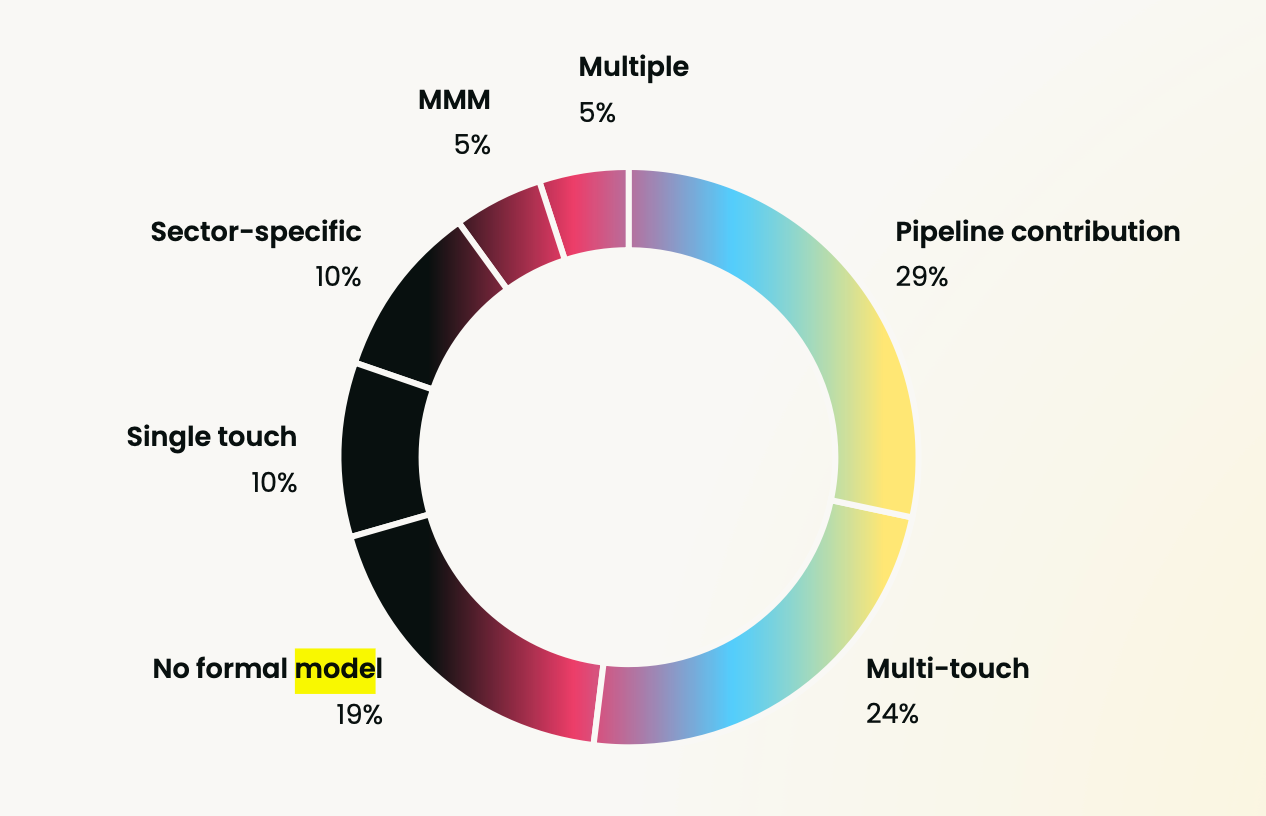
The rest use a mix of other approaches, including some leaders who run several models at once because, as Rebecca Fowkes put it, "none of them are perfect."
61% name poor integration between tools as their biggest barrier to closing gaps in their tech stack, second only to budget.
Don Polite has watched this pattern up close:
"More technology does not automatically create better marketing. Many organizations invest heavily in platforms, automation tools, and data systems before developing a clear customer strategy. This often results in complexity, underutilized capabilities, and disappointing returns."
His fix: pick the strategy first, then the tools: "The technology should amplify strategy, not replace it."
Bonnie Habyan challenges a different habit: chasing perfect attribution.
"I would challenge the idea that everything marketing does should be measured through immediate, direct revenue attribution.
"Marketing should absolutely be accountable, but accountability and perfect attribution are not the same thing... If we only value the final touchpoint, we misunderstand how trust is built."
Her solution is a framework built from several kinds of evidence:
- Awareness
- Engagement
- Qualified meetings
- Pipeline movement
- Completed revenue
 Saima Chadney

3 ways CMOs are rebuilding trust with finance
Every leader in this report described the same problem: boards want proof, and the usual numbers aren’t landing fast enough. These three found different ways through it, and none of them waited for perfect attribution data to show up first.
1. Reframe the pitch
Shikha Agarwal, VP Consumer Marketing at Yelp, swapped "give me budget" for a different pitch entirely:
"We converted the budget conversation to an investment conversation... It's no longer a give me budget conversation; it's a do you want to invest in this money-making machine?
“This approach sidesteps the attribution problem running through the rest of this report. Finance signs off on investments with an expected return. Agarwal's pitch gave them exactly that framing, which made the budget conversation shorter and the yes easier to get.”
2. Build one scorecard
The case for marketing doesn't get rebuilt from zero every budget cycle. At Purdue University, CMO Kelly Hiller built one scorecard that mixes earned, owned, and paid impressions with prospective-student awareness, brand perception, and partnership interest.
“A standing scorecard works differently. It gives finance a running record to check marketing's claims against, built up over time rather than rebuilt from scratch each cycle.
"For a function graded on how fast it can answer hard questions, having an answer already built and waiting cuts straight through that pressure.”
3. Make one big, measured bet
Raj Thamanna, VP of Marketing Operations and Analytics at CoreWeave, joined the company 20 days before its IPO (the biggest US tech listing since 2021) with no systems and no data in place. His team spent the whole year's budget on a launch campaign, then had to go back and ask the CFO for 5 times more. His line sums up the fight:
"Budget follows belief... marketing is not a cost center to be managed; it's a growth engine to be measured."
The campaign he built, a sponsorship with the Aston Martin F1 team, drove a 600% jump in searches for CoreWeave's products and a 225% jump in website traffic, while the rest of the industry's traffic was falling. The next year's marketing budget ended up three times bigger than the year before.
“Thamanna's case worked because the proof showed up fast, in numbers finance already tracks: traffic, search volume, next year's budget. When trust can't be built slowly, one big bet with clear, fast numbers behind it can close the gap just as well.”
All three examples turn marketing's work into proof finance already trusts: investment language, a running scorecard, or fast numbers tied to a bet. That's exactly the kind of proof the rest of this report says boards are demanding faster than ever.
What to take from this
The CMOs getting heard in 2026 share one habit: they turn marketing data into numbers finance already trusts, fast enough to keep up with how quickly boards now expect an answer.
A few places to start, based on what worked for the leaders in this study:
- Build one scorecard for marketing's value, so the case doesn't get rebuilt from scratch every budget cycle.
- Name your attribution model out loud, even if it's imperfect. 19% of leaders in this study have no formal model at all, and that's a harder position to defend than picking one and explaining its limits.
- Fix the integration gaps in your tech stack before adding another tool. 61% of leaders say poor integration between tools is their biggest blocker.
- Change the words in your budget pitch before you change the numbers. Framing spend as an investment with a return, not a request for budget, makes the ask easier for finance to say yes to.
Marketing's 2026 budget problem comes down to translation: making the case in the 90 seconds a CFO gives you, with numbers they already trust.
FAQs
What percentage of CMOs say ROI pressure has increased in 2026?
65% of the 50 senior marketing leaders surveyed in the CMO Insights Report 2026 said the pressure to prove ROI rose significantly over the last 3 years. 20% said it stayed about the same, and 15% said the pressure itself didn't change, but the speed to prove it did.
What's driving ROI pressure on marketing teams in 2026?
Budget and cost pressure (55%), AI costs and adoption (41%), economic uncertainty (41%), longer sales cycles (27%), competition (23%), and regulatory pressure (9%), based on the same study of 50 marketing leaders.
What attribution model do most CMOs use in 2026?
No single model dominates. 29% use pipeline contribution as their primary method, 24% use multi-touch attribution, and 19% have no formal attribution model at all.
How is AI increasing ROI pressure on marketing budgets?
AI is cutting the cost of producing marketing work while raising the cost of the tools that do it. Pricing models shift often, which makes AI spend one of the hardest line items for CMOs to plan around and defend to finance.
Why are longer sales cycles making ROI harder to prove?
27% of marketing leaders name longer sales cycles as a top pressure. Deals that used to close in weeks now take 4 to 6 months, which pushes the revenue marketing gets credited for past the budget cycle that funded it.
How can CMOs rebuild trust with finance?
Leaders in the report used 3 tactics: reframing budget requests as investment pitches, building one standing scorecard instead of rebuilding the case every cycle, and backing a single, well-measured bet with fast, trackable results.


Become a CMO Insider
Thank you for subscribing
Get exclusive insights, frameworks, and strategies from marketing leaders driving real business impact.
An email has been successfully sent to confirm your subscription.
 Follow us on LinkedIn