


.png)





Most companies still budget for language the way they'd budget for shipping: how many languages, what's the cost, and how long will it take?
That framing misses what's actually at stake. 15 languages aren't 15 translation jobs. They're 15 chances to build a brand experience that actually belongs in that market.
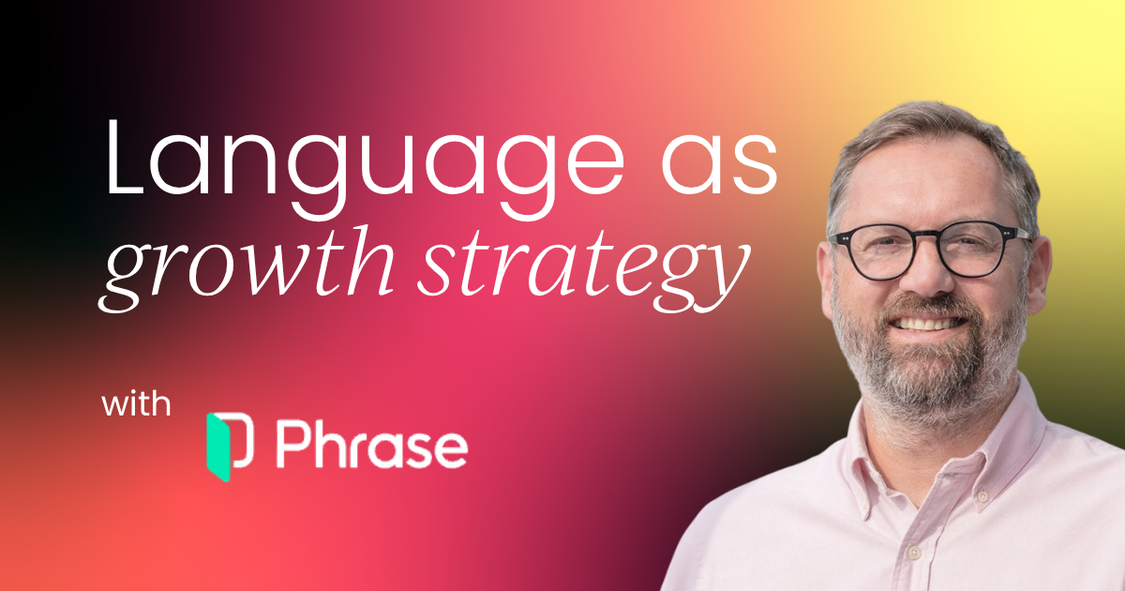
Jason Hemingway, Chief Marketing Officer at Phrase, has spent the last four years watching that shift play out across global enterprises. In this blog post, he breaks down:
- Why customer data alone doesn't move the needle without the right content layer behind it.
- Where the gap between global strategy and local execution actually opens up.
- What AI is doing to the speed and cost of building culturally fluent content at scale.
You can also listen to the full conversation on the CMO Convo podcast or watch it right here:
Why customer data alone doesn't move the needle
Marketing got very good at understanding customers around 10 years ago, when martech was exploding, and people started investing in customer data platforms. Segmentation and behavioral analytics came to the forefront and grew into a market of its own over the last decade.
What I noticed was that business outcomes didn't move at the same pace. Most enterprise teams have a strong idea of who their customers are and what they care about, but the performance of things like personalization plateaus. It gets to a point and stops.
The disconnect is simple: understanding the customer isn't enough on its own. The real test is whether that understanding actually improves engagement, the brand experience, or satisfaction. If the content layer that insight sits on doesn't respond to it, the value of everything you're delivering is limited. You end up with precise targeting and real customer understanding, but the content hasn't evolved in the same way.
We see that with the customers we work with at Phrase. We have a global fintech customer operating across many markets, with real-time trading alerts and account updates that influence what their customers do. The targeting in each region was good, but some of the messaging was slightly off, and customers would hesitate because the information wasn't culturally nuanced to what they needed.
In some markets, customers needed more clarity and reassurance before acting on an alert or update. Once they introduced more structure into how that communication was expressed, with tone and context reflecting each region's differences, satisfaction rates increased, something like 70 to 90%.
So the constraint wasn't the insight. It was the systems needed to deliver that insight with context, and how organizations set up their technology to use it when communicating across regions.
 Eleanor Hecks

Connecting global strategy to local execution
There's often a gap between where global strategy sits and where local execution happens. Businesses tend to be strong at the centre:
✔️ Clear messaging
✔️ Strong positioning
✔️ Well-developed campaigns
The breakdown happens because one central place creates the work in a single context, then adapts it afterward. That relies on local teams taking what global has done, reinterpreting it, ingesting it, and adjusting it. Over time, that leads to misalignment because you're not scaling the content; you're scaling the
rework.
In large enterprises where buying decisions involve multiple stakeholders, central campaigns often lean on speed and innovation messaging that resonates in some markets and not others.
Customers in other markets expect more depth, more validation, and a different kind of understanding before they engage, because that's the culture they're used to. So regional teams step in and rebuild things, which is an expensive and slow way of doing it because it means you're fixing things at the end of the process rather than earlier.
Underneath that is an ecosystem problem: content created in one system, then adapted, distributed, and measured separately. Even if each part works on its own, the system isn't coordinated. What you need is a connected infrastructure and tighter coordination between teams.
We see this with one of our customers, a software company with strong campaigns, where all the different versions were going out at different times. You'd wait for a campaign to clear before it went to a given market, so time to market was slow, which diluted the impact a campaign could have if launched everywhere at once.
The result was inconsistent performance, and management asking why things were delayed when they wanted everything out at the same time, in every market they operate in, so they could be efficient. So the gap is really centralized versus localized, and what you need on top of that is connected infrastructure and tighter coordination.
 Saima Chadney

Building context into content from the start
Context is massively important to what you're trying to do, and content isn't consumed in a controlled journey anymore. That's even more true now with AI-driven interfaces, search, and recommendation channels. You don't control the sequence or the timing. You have to create content that's relevant wherever the customer is when they're interacting with your brand, and it can't just be well-crafted; it has to align with the moment it appears in.
That moment is shaped by more than audience data:
- The channel
- The cultural expectation
- Regulatory constraints, in regulated markets
- The intent of that person
Most traditional workflows treat context as something applied after content is created, a review step, a refinement, which is what regional teams have often handled. If it needs to adapt at the speed customers actually interact with your brand, it has to adapt continuously.
Generative AI is changing that:
- Context becomes part of the initial input, rather than something bolted on afterward.
- The style guides you'd give regional teams are evolving the same way, built straight into how content is dynamically created and designed from the outset.
- AI-driven quality checks can run on that content, based on a style guide that's dynamic and updated to a customer's cultural context and what they're trying to do with your brand in that moment.
That relevance, the context layer, is what you can scale with generative AI and manage market to market.
How do global and local teams build the bridge between them?
Leadership sets the global strategy, local teams understand their local markets, and it's the connective thread running through those teams where things can fall apart.
At the central level, the brand can be well defined, and things like messaging, tone, and positioning are all strong. The issue is when that expression gets applied across local markets without considering how it will land with the person receiving it, and rigid guidelines that prioritize consistency above everything else are usually where problems start.
What you want isn't more control at the center, it's clearer boundaries. It's designing a system with guidelines that define what stays consistent, and letting teams adapt within them, supported by systems, technology, and structure people can actually use.
We had a customer, a software company, with huge volumes of content across multiple regions. What they put in place was a shared system where brand intent was clearly defined and embedded into how content was produced from the outset. That let teams adapt content for their markets while keeping everything aligned at scale. It's all very well doing this for one piece of content, but without a design system, infrastructure, or technology behind it, you can only do it in a couple of markets, not every one. So what you're really looking for is scale.
 Bonnie Habyan

What does it mean to treat language as a creative multiplier?
This is where it gets interesting, because it's the shift I think businesses need to make. When organizations think about language in a global context, most of the time they think about it as a cost, or as something complicated:
- How many languages do we need?
- What's the budget?
- How long is it going to take?
Treating it as a creative multiplier flips that entirely. Instead of asking how you manage 15 different languages, you ask how you use 15 languages to create 15 distinct brand experiences.
Every language carries its own texture, rhythm, and emotional range. A tagline that's clever in English probably doesn't work in French, or doesn't work in Japanese. What you need is to give teams the freedom to use the context of their market to find the right expression.
The goal isn't identical wording; it's consistency of impact. It's flipping the question toward emotional resonance. When you get that right, your brand doesn't just exist in a local market. It feels like it belongs there, like it's natural. You have to give it some flex to let that happen, within guidelines.
Most businesses leave that on the table because they still think of language as a cost to manage, rather than a global asset. Done well, language can:
- Speed entry into new markets.
- Increase engagement.
- Build more users on a software platform.
- Make customers feel happier with what you deliver, because you're speaking to them relevantly in their own language, without a central mandate that it has to be done one way.
It's hard, though. It's not simple. That's where you need to think about the people, process, and technology underneath it. The technology has evolved to a point now where you can do this more easily, more quickly, and at lower cost than you used to be able to.
It's something people need to think about more carefully. We've all been in situations where it becomes an afterthought, where you think, oh yeah, we do need to do that.
My whole approach is: bring it forward. Bring it into the planning process, into the structure and the systems. Don't build the central version first and then figure out how to adapt it for, say, German. Think from the beginning about how it has to be adapted. If you start pulling that forward, we call it shifting left, it changes how you think about the whole thing.
How can technology help marketing leaders expand into new markets?
AI is a big hype cycle. Everyone's talking about it, but there's a kernel of truth in a lot of that hype.
Before AI and LLMs, launching a campaign across 15 markets meant weeks of coordination between copywriters, and if you're a big business, translators, reviewers, and compliance teams in regulated markets too, before the brand teams even came in to look at it. It was linear, slow, and expensive. By the time content reached the market, the window for that campaign had narrowed.
Now content can be generated and adapted continuously. Some tools adapt it instantly, and what's emerging goes further. It's not just models creating content; it's systems that can take action within guardrails, managing more of the content lifecycle: generation, adaptation.
But the part people outside localization tend to miss is quality. You can't do it all. There's a real question around quality levels with generative AI. The whole idea of AI slop is an example of something none of us want. You want quality evaluation, and then you want to optimize and reuse what you've created.
Things are moving quickly, even in the last six, 12, 18 months. I was reading something from Gartner recently that said 40% of enterprise applications will embed these kinds of agents by the end of this year, up from about 5% a year ago.
That's a structural change happening across marketing technology. What really matters is that it works best when it's embedded into the tools and processes teams already use, rather than sitting alongside them as another thing to manage. It's a quiet revolution, in that sense. The value doesn't come from adding more technology; it comes from how well that technology connects to everything else you do across marketing, content, and product.
A bigger shift is what it does to economics. Traditional multilingual personalization used to cost a fortune, and was mostly reserved for big brands with deep pockets. Now it's accessible to mid-market companies too, who can deliver culturally fluent content with the right guardrails and platforms behind them.
When the friction drops between not being able to afford something and being able to do it, you can experiment more, deliver more value to customers, test new markets, and treat those markets as a learning opportunity, running experiments and learning quickly. That's a genuinely different way of thinking about it.
 Benjamin Brown
How will AI reshape brand strategy, localization, and personalization?
I see it converging: brand strategy, marketing personalization, and localization are all converging, and the most significant structural shift is probably on the marketing side.
Marketing has been structured around functions that are loosely connected, but not as connected as they could be: brand, content, regional execution, personalization, digital teams, each with their own workflows, tools, and teams.
That model breaks down at scale, or becomes difficult, and what AI is doing is removing the need for manual coordination. You're moving toward systems that take in intent and context and carry it through to everything you want to execute, across all of those functions.
Adapting content and context for different markets is part of that, but it's no longer something passed along a sequential chain and reinterpreted at each stage. It becomes a set of inputs at the beginning, and that's how content gets generated and adapted from the start. Personalization isn't layered on top. It's embedded in the beginning of how content is created and then delivered.
I should caveat all of this: I don't think it removes the need for human judgment, far from it. It elevates where humans add value. It takes out the automation and production mechanics that used to bog teams down, and puts more time on strategy and the decisions about how the brand shows up in different markets with different audiences. I think those teams converging is a good thing.
My message to other CMOs is to think about whether you're doing this the old way, when different tools could speed up a lot of what you're doing, and to look at how you build competitive advantage by building this into your infrastructure.
I'd encourage everyone to go and talk to their localization team. If you don't have regular meetings with them, bring them in. When you're thinking about campaigns, about growth, about new markets, or markets you've never gone to because it was too difficult before, ask whether that's an opportunity.
People will find opportunities in the convergence of those roles. As you connect the roles, you connect the technology and the ecosystem around them. AI gets embedded into everything, and you reduce the friction between teams. I see it converging, and I think that's a good thing.
What mindset shift does a marketer need to go global?
If I had to put it in a single line: design for global from day one.
A question I'd encourage every marketing leader to sit with is this: if we designed our next campaign for 15 markets from the outset, instead of doing it for one market and adapting afterward, what would we actually do differently? How would the brief change? What teams would we need in the room at the beginning? What technology would we need? And what would the timeline look like, compared to the timeline we'd end up with if we didn't think about any of this upfront?
Sit with that question, and it changes everything. It reframes the conversation so multilingual execution stops being a logistical challenge and becomes part of the growth strategy.
A connected ecosystem, designed for global from the outset, is really what you need to be asking yourselves. The opportunity is there, and it's getting more accessible and easier to act on.


Become a CMO Insider
Thank you for subscribing
Get exclusive insights, frameworks, and strategies from marketing leaders driving real business impact.
An email has been successfully sent to confirm your subscription.
 Follow us on LinkedIn