.png)






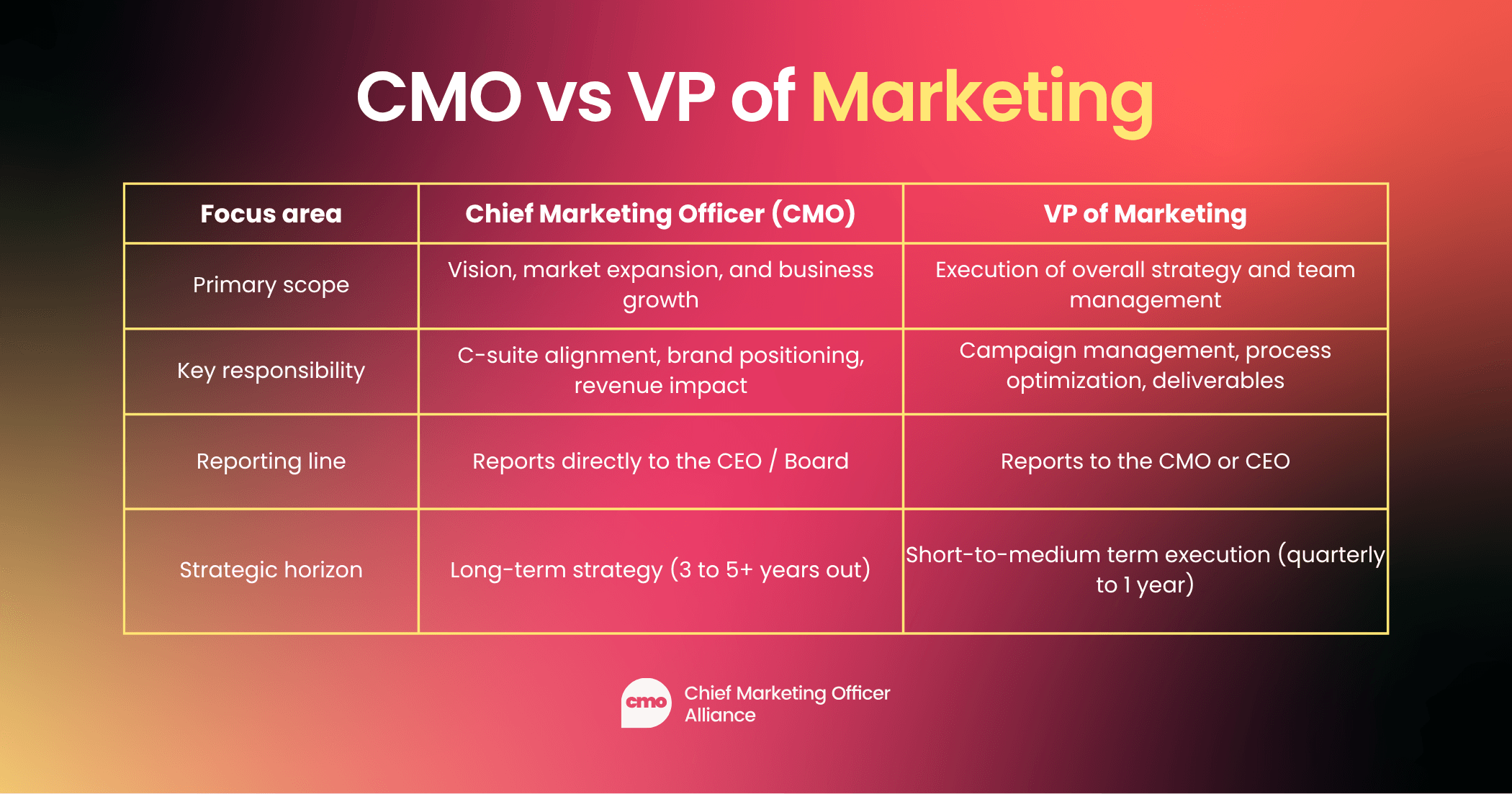
A Chief Marketing Officer (CMO) sets the main strategy, guides the brand, and reports to the company board. A VP of Marketing is the hands-on leader who brings that strategy to life by managing the team, running daily campaigns, and keeping daily operations on track.
Below is a quick breakdown of how the roles of CMO vs VP of Marketing differ:
Because these titles get tossed around as if they’re the same thing, it’s easy to get confused about which ladder you’re climbing. Are you building a track record for the C-suite, or are you wired for a top-tier VP role?
If you’re not sure which path is for you, we’re here to help. Below, we break down the real differences in responsibilities, skills, and pay, so you can choose the right track for your career.
What does a CMO do?
The CMO is a company's top marketing executive. But don’t let the title fool you, the job goes way beyond marketing. A great CMO looks past day-to-day department tasks to focus on how marketing drives growth for the whole business.
Core responsibilities of a CMO
Strip away the title and here's what a CMO actually owns:
- Steering long-term brand vision and global strategy.
- Mapping marketing goals straight to the bottom line.
- Allocating department budget and defending spend to the board.
- Rallying sales, product, and CS around a single go-to-market strategy.
- Giving marketing a permanent seat at the C-suite table.
Moving to the C-suite gives you serious leverage, and the data proves it. During her session at our CMO Summit in Amsterdam, Trix van der Vlueten (CMO at The Social Hub) shared a striking stat from McKinsey:
“Companies with a CMO involved in decision-making see 1.4 - 2.3x more revenue growth.”
That highlights the core difference. A VP of Marketing focuses on managing the team and hitting execution goals. A CMO steps back to connect those marketing outcomes directly to whole-company revenue growth.
Must-have CMO skills
Stepping into a CMO role requires a complete shift in mindset. You’re no longer judged by how well a campaign performs, but by how your leadership shapes the company's financial future.
Mastering these high-level skills will help you succeed in the role:
1. Enterprise strategy & P&L mastery
Great CMOs ditch the marketing jargon for business speak (think profit margins, unit economics, and pipeline velocity). Instead of explaining how a campaign works, you're proving how every dollar spent impacts the bottom line and drives long-term business value.
2. Board & C-suite influence
Your primary audience isn't your team anymore; it's the CEO, CFO, and board. You need the confidence to defend long-term brand building to finance leaders focused strictly on quarterly returns, translating marketing metrics into business outcomes the C-suite actually cares about.
3. Market architecture & category design
Rather than chasing next quarter's targets, you are looking three to five years down the road. That means spotting industry shifts early, defining new categories, and evolving the brand before the market leaves you behind.
4. Leadership & talent building
The toughest leap is letting go of tactical work. As a CMO, your job is designing high-performing org structures, hiring powerhouse VPs and Directors to run the execution, and guiding the company through high-stakes brand crises.
The skills executive teams are looking for
What executive teams expect from marketing leaders has shifted dramatically over the past year. According to our CMO Insights Report 2026, tech and AI savviness rocketed from the least-valued skill in 2025 (named by just 8% of CMOs) to the #1 most-valued skill in 2026, at 72%.
Meanwhile, traditional data literacy, which topped the list in 2025 at 62%, dropped to 45% (sixth place out of seven). While analyzing performance numbers used to be enough, today’s market demands leaders who know how to leverage modern AI tools and technology to drive efficiency. If you’re preparing for a C-suite leap or building out your leadership team, tech and AI fluency is now the primary gap to close.
 Bryony Pearce
Who do CMOs report to?
CMOs report directly to the CEO. Without full buy-in from the top, you won't get the budget, authority, or runway needed to build a long-term brand. But building that trust is harder than most people realize.
During a recent session at one of our events, Patricia Harris, CMO of Blue Yonder, shared a brutal reality: 80% of CEOs don't fully trust their CMOs.
That stat is a major wake-up call. At the C-suite level, trust is currency. Without it, your budget gets slashed after one slow quarter, and your strategic vision gets picked apart.
Reporting to the CEO doesn't mean you automatically have their support. You have to earn it from day one. (If you're looking to bridge that gap, check out Erin McCallion’s guide on how to build a productive CMO-CEO working relationship.)
 Erin McCallion
A day in the life: Big influence, higher pressure
If you want to understand the CMO role, just look at their calendar. While VPs are down in the trenches running campaigns, CMOs spend their days in executive syncs, strategy sessions, and board meetings.
It can look glamorous from afar, but that seat carries serious weight and short lifespans. As Toni Allen, Chief Engagement & Growth Officer, explained when looking at the state of the role:
"The average tenure now, according to the latest Fortune 500 tenure of CMOs, is about 3.9 years. And that's gone down from 4.1 years. And you will hear other citations… I've heard as low as 1.7 years."
If you look at the top spending brands, the timeline gets even tighter. Justin Vaughan-Brown, VP of Product Marketing & Strategic Comms at Camunda, highlights:
"Average CMO tenure at top-100-advertiser companies is 3.1 years."
So, what’s a day in the life of a CMO really like?
High-level influence, big-picture decisions, and constant pressure to prove your worth before time runs out.
What does a VP of Marketing do?
The VP of Marketing runs the marketing department day-to-day. They translate big-picture business goals into clear and actionable plans. In this role, they guide team leads across demand gen, product marketing, and content to hit performance targets.
Core responsibilities of a VP of Marketing
Behind the title, a VP of Marketing handles four main areas:
- Campaigns: Running programs across every active channel.
- People: Hiring, managing, and coaching the team.
- Brand: Overseeing PR, content calendars, and design consistency.
- Reporting: Presenting ROI metrics to executive leadership.
VPs might not define the company's long-term vision, but they have to prove the current campaigns get results. Raj T., VP of Marketing Operations and Analytics at CoreWeave, sums up the role:
"I'm not a CMO, but I'm the person who must answer the question every CMO gets from their CFO... What's the ROI? How do we know it's working?"
That's the VP role in one sentence: accountable for the results, without always being the one who called the strategic shot.
This role comes with a different kind of pressure than the CMO because it’s less about defending the vision to the board, and more about defending the execution to everyone above you.
VP of Marketing skills
The VP of Marketing needs a mix of sharp operational skills, team leadership, and tactical know-how to keep campaigns running smoothly and numbers moving in the right direction.
Some of the most important VP of Marketing skills include:
Campaign execution & channel mastery
VPs stay close to the actual work, knowing exactly which channels generate leads and which burn budget. Instead of focusing on 5-year visions, you’re constantly optimizing active campaigns across paid media, SEO (and now GEO and AEO), content, and events to keep sales opportunities coming.
Performance analytics & ROI defense
Your main reporting line goes straight to leadership asking one question: Is it working? You need deep fluency in conversion rates, Customer Acquisition Cost (CAC), and channel data inside and out so you can defend your quarterly budget with real proof.
Budget management & resource allocation
The CMO agrees on the total budget with the CFO, but you decide where those dollars actually go. You balance software costs, agency fees, and ad spend to get the absolute best return for the business over the next few months.
People management & team building
While a CMO manages high-level leaders, a VP works directly with functional managers (like heads of Demand Gen, Product Marketing, and Content). You spend your time removing daily roadblocks, setting clear team targets, and helping your staff hit their numbers.
Tech stack & building processes
A strategy is useless if your system breaks. VPs build the internal workflows and oversee the marketing tech stack, from CRM integrations to marketing automation, ensuring leads move smoothly through the funnel to sales.
Sales & product alignment
Marketing cannot work in a bubble. A VP works side-by-side with Sales leaders to smooth out lead handoffs and aligns with Product teams on launch schedules so every campaign directly supports revenue.
 Steve Kearns
Who does the VP of Marketing report to?
In larger companies, the VP reports straight to the CMO. But in smaller or scaling companies that don't have a CMO, the VP often reports directly to the CEO or COO.
This reporting structure is a big reason these two titles get mixed up. Seeing a VP report to the CEO usually just means the company hasn't created a CMO role yet, or simply doesn't need one.
What a "day in the life" looks like
Instead of sitting in high-level board meetings, a VP spends their day in the thick of things. Their typical calendar usually includes:
- Team management: 1:1s, helping your department leads solve last-minute problems, and checking if everyone is actually hitting their numbers.
- Campaign management: Digging into channel stats, approving creative, and moving budget around when something isn't performing.
- Internal syncs: Debating pipeline quality with Sales and trying to figure out if Product is actually going to launch that new feature on time.
It’s a hands-on role focused on real-time execution. You have to stay close to the daily work because at the end of the quarter, the results land squarely on you.
What company stage warrants each role
Titles often depend more on company size than actual ability. A "CMO" at a 10-person startup is doing a completely different job than a CMO at a 500-person company.
Here’s a quick example of how the scope is often broken down:
By revenue, roughly:
- Under $5M → Head of Marketing
- $5M–$20M → VP of Marketing
- $20M+ → CMO typically warranted
By team size, it tracks pretty closely:
- Solo to 3 people → Head of Marketing
- 4 - 10 people → VP scope
- 10+ people → CMO-level scope
The real tell?
Are you executing someone else’s strategy, or are you defining it from scratch? Titles lie, but that distinction doesn't.
That shift in scope also changes your priorities:
- Startup CMOs are heads-down on growth (50% name it their top priority, while 0% focus on profitability).
- Enterprise CMOs play a balanced game (33% focus on growth, 25% on profitability). (Source: CMO Insights Report 2025)
Just keep in mind: even at $20M+, the CMO seat isn't guaranteed. Justin Vaughan-Brown points out that 31% of S&P 500 companies don't have a CMO, and 58% have no marketing lead in the C-suite at all.
A big company doesn't automatically mean the role exists; sometimes you have to prove why they need one.
Salary & budget benchmarks: What do these roles pay?
A bigger title doesn't automatically mean a bigger paycheck. Company size, funding stage, and equity structure can matter far more.
According to our Future of Marketing report, VPs of Marketing reported a higher average salary ($206,857) than CMOs ($132,571), with Directors of Marketing landing in between ($148,333).
Why the gap?
Early-stage startups often throw around "CMO" titles when budgets are small, while VP roles concentrate at larger, well-funded companies with deeper pockets.
Title alone doesn't predict your paycheck, but company size, funding stage, and equity structure do.
A lot of "CMO" titles get handed out freely at smaller or earlier-stage companies where the budget doesn't match the title, while VP roles cluster more at larger, better-funded companies with deeper pockets. Worth remembering before you chase a title over a package.
A few more numbers worth knowing:
- Compensation climbs sharply with experience: median pay rises from $125,000 at 15–19 years of experience to $223,000 at 20–24 years. It then declines to $150,000 (25–29 years) and $100,000 (30+ years), likely as people shift into advisory, fractional, or lower-pressure roles later on.
- 23.5% of equity holders receiving packages over $200k are primarily CMOs and VPs of Marketing, so total comp can look very different from base salary alone
Making the choice
There's no universally "better" path here, just a better fit for you. If the idea of owning a five-year vision and defending it to a board energizes you more than it exhausts you, aim for CMO. If you'd rather stay close to the work and you love working close to the campaigns, the team, and the numbers you can point to and say "I built that", then a VP of Marketing role might be for you.
Ready to build toward it?
Whichever path you're leaning toward, CMO Alliance membership puts you in the room with marketing leaders living both sides of it - through our Summits, our community, and direct access to the people quoted throughout this piece.


Become a CMO Insider
Thank you for subscribing
Get exclusive insights, frameworks, and strategies from marketing leaders driving real business impact.
An email has been successfully sent to confirm your subscription.
 Follow us on LinkedIn