.png)





Connecting your marketing and brand metrics to actual profit and loss (P&L) impact usually boils down to one of four core methods:
- Run an incrementality test with a proper holdout group.
- Bridge the gap by connecting brand data to a measurable behavior that leads to revenue.
- Build a bottoms-up view of your funnel using unit economics.
- Reframe your reporting so that every single metric carries a clear financial consequence.
Most CMOs end up blending more than one of these approaches depending on what they’re measuring and who they’re presenting to. But there’s a catch. Blending these methods assumes you already have a seat at the "financial table," which, as we know, isn't always the case (even for senior marketers).
Fractional CMO Melanie Hunter Yell recently made an interesting point about this. She noted that when she polls rooms full of senior marketers, at least half admit they've never actually seen their own company's P&L. Her point is, if you haven't seen it, you don't know the assumptions baked into it. So, how can you build a marketing plan that delivers against it?
Figuring this out is becoming urgent, because the pressure to tie marketing to real dollars is only mounting. While most marketers (53.8%) expect their budgets to grow in the next three to five years, the Future of Marketing 2025 report notes that this spend is shifting rapidly toward initiatives where attribution is clearest.
It’s a frustrating roadblock, but you don't have to navigate it alone. When a CMO recently brought this exact challenge to our CMO Alliance Slack community, fellow marketers quickly jumped in to help.
We’ve taken some of our favorite answers from that thread to share with you. Each offers practical advice on translating your marketing efforts into board-ready language.
Why does the marketing and finance disconnect exist?
The disconnect between marketing and finance exists because the two departments measure the business at opposite ends of the timeline. Marketing relies heavily on leading indicators, like brand awareness and consideration. These signal future market shifts long before a transaction ever happens. Finance, however, operates entirely on trailing indicators such as locked-in revenue, costs, and payback periods.
Those financial numbers are easy to audit, but they don't tell you a thing about what's coming next. Because finance and marketing look at different points in time, the two departments don't naturally speak the same language.
We actually saw this firsthand in our Future of Marketing report. When we asked marketers how they measure ROI, most pointed to things like leads (63.4%) and conversion rates (62.2%). Hard financial numbers (like actual revenue (46.3%) and customer acquisition cost (41.5%) were way further down the list. This suggests that even when marketing teams talk about ROI, their numbers are often still a step or two removed from the actual bottom line.
Of course, not all marketing metrics are this tough to translate. Performance metrics (think clicks, conversions, MQLs, and ROAS) measure activity right before a transaction happens. Since they sit so close to the finish line, they usually have a fairly direct, easy-to-prove line to revenue.
The tech itself is a big part of the problem. According to our CMO Insights Report 2025, over 50% of CMOs feel like they just don't have the right tools in their stack. When asked what they're missing most, better ROI measurement and multi-channel attribution were right at the top of the list.
But when it comes to brand health, the communication gap widens. As Melanie puts it:
"We're talking in clicks and reach and engagement and MQLs, but the rest of the leadership team don't want to hear anything unless it's got a pound sign in it."
Ultimately, this means that connecting the dots between brand health and the P&L is almost always on us as marketers, not finance.
If you’re ready to start speaking finance's language, we’ve rounded up the battle-tested strategies four marketing experts use to get it done.👇
 Erin McCallion
Approach 1: Run an incrementality test with a defensible holdout
Cory Peterson, VP of Marketing and Sales Operations at LED Lighting Supply, recommends running a long-term incrementality test.
The key?
You need a holdout group solid enough that finance can't shoot it down.
"The only real way to get a near-perfect line of sight that can make finance comfortable is running a long-term experiment (incrementality test) with a well set up and defendable hold-out group." - Cory Peterson, VP of Marketing and Sales Operations.
This is the gold-standard approach because it answers the exact question finance cares about. Namely, what happens if we don't spend this money? By focusing on that, rather than just trying to correlate brand movement with sales after the fact, you deliver causal proof. You avoid handing finance a flimsy correlation they can easily poke holes in.
Using a holdout group (a market, region, or segment that doesn't get the investment) gives you a clean, undeniable comparison rather than just an educated guess.
The tradeoff is time. A truly defensible test requires careful planning, a solid sample size, and the patience to let it run long enough for finance to trust the results. Because of this, it’s the perfect tool for proving the value of a sustained investment, rather than a quick one-off campaign.
If you're ready to try this, three things make or break a defensible test:
- Agree on the holdout market and the success metric with finance before you start, not after. Doing this will help ensure the result is trustworthy, rather than disputable.
- Pick a test length long enough for brand effects to actually show up, which usually means weeks or months, not days.
- Resist the urge to call it early just because the numbers look flat in week two. A holdout test only earns finance's trust if you let it run its full course.
Approach 2: Let customer behavior bridge the gap
Nicholas Testa is a Special Operations influence expert and offers an approach that’s a bit simpler (and much faster) to put into practice. Find a specific customer behavior that sits comfortably between your brand metrics and your revenue, and use it as a bridge.
“Connect the brand data to a measurable behavior, then connect that behavior to the financial impact. The behavior is the glue between awareness/consideration and financial impact." - Nicholas Testa, U.S. SOF Psychological Operations
This strategy works well when you already have behavioral data sitting in that middle ground. This includes metrics like site visits, demo requests, branded search volume, and sales cycle length. The goal is to find the specific behavior that reliably moves alongside your brand metrics, and then show finance how that behavior has an established link to revenue.
Sure, it's a little less airtight than a strictly controlled experiment. But if you don't have the time or budget for a full-scale incrementality test, this is often the most practical place to start.
If you can show finance a behavior that moves in both directions with your brand activity (not just when you're actively pouring money in), that becomes a much harder correlation for them to wave away.
Approach 3: Build a bottoms-up unit economics view
Deborah Katz, Interim Vice President, Integrated Marketing Strategy at adQuadrant, takes us deep into the actual mechanics. Her advice is to capture the unit economics for every single touchpoint in your funnel, and let that bottoms-up view shape how finance looks at your marketing spend.
"Ideally, you'd know the unit economics for every customer touchpoint all the way through the funnel. That bottoms-up view should inform how Finance understands marketing investment, proposed new spend, failed experiments, and efficiency or scaled wins." - Deborah Katz, Interim Vice President, Integrated Marketing Strategy
Here's how she breaks it down in practice:
"For example, if I know my CPL, Lead-To-Paid CVR, and the time horizon for my target payback period, I have three concrete metrics to validate against and optimize towards.
“If I then add spend to something seemingly "offline" like a conference, I make sure the reporting I share with finance allows us both to understand the incremental leads, paying customers, and their time horizon to payback from that tactic, to validate to myself, and finance, whether or not the conference was worth the investment." Deborah Katz, Interim Vice President, Integrated Marketing Strategy
Getting that visibility for "offline" events is crucial because they aren't just a minor line item. According to the Future of Marketing 2025 report, 30.6% of marketers spend the majority of their budget on events. If those interactions aren't tracked and just get lumped into "direct" traffic, finance is completely blind to one of marketing's biggest investments.
Deborah's approach doesn't need a long-running test. It works tactic by tactic, in near real-time, all while using language finance already speaks (cost, conversion, payback period, etc.).
The tradeoff is that it's harder to apply cleanly to pure brand-building activity that doesn't have an obvious "lead" to count. But that is exactly where Nicholas's behavioral bridge or Cory's incrementality test can step in to fill the gap.
You have to give each offline tactic something trackable. Try using a unique QR code, a dedicated landing page, a specific discount code, or even a simple "How did you hear about us?" field at signup.
That way, those leads can always be traced directly back to the tactic that produced them, instead of landing in a mystery bucket no one can act on.
Approach 4: Reframe the reporting, not just the math
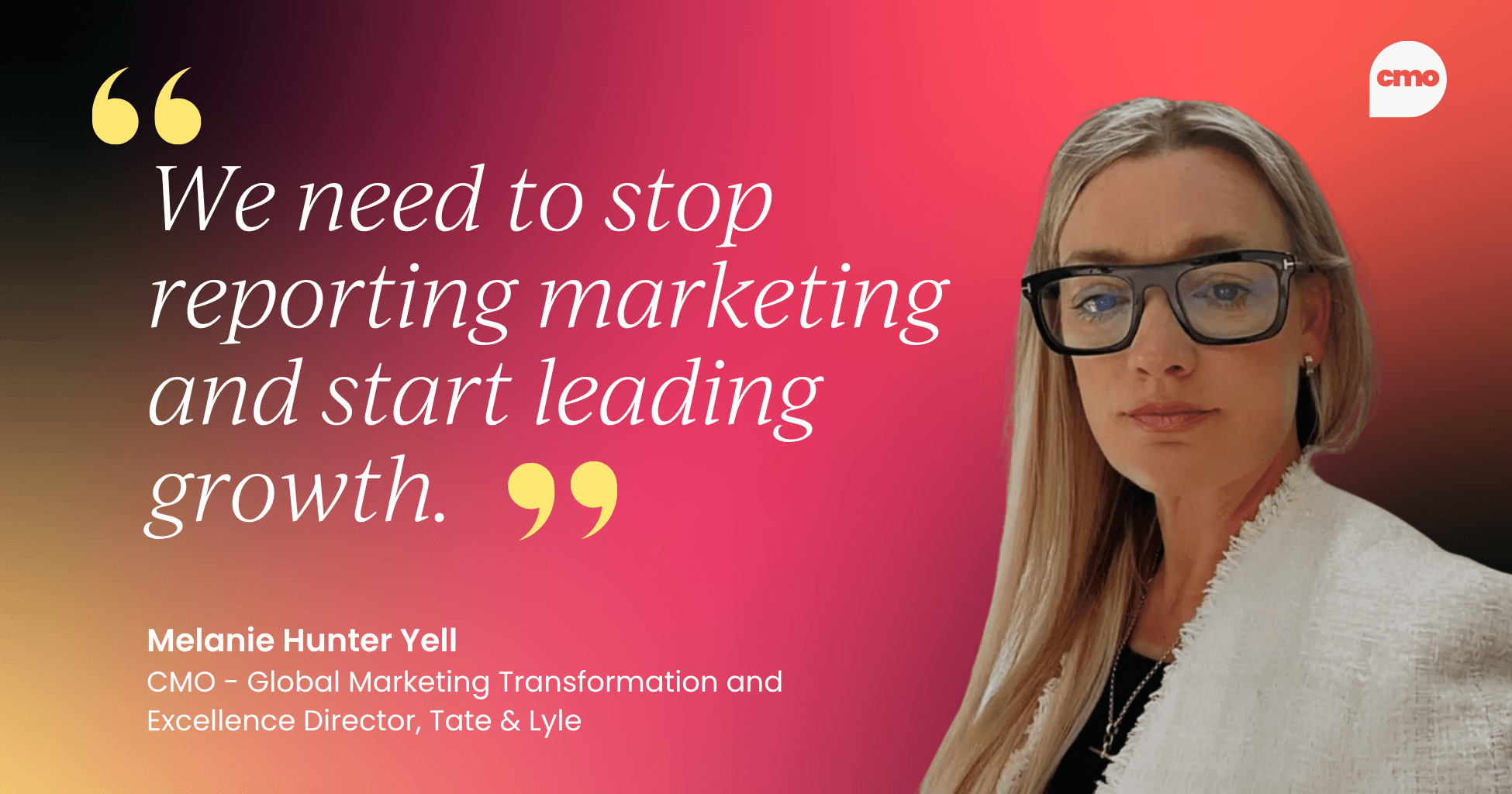
The first three approaches all focus on the math and how to actually calculate the link between brand data and revenue. But Melanie Hunter Yell (Global Marketing Transformation and Excellence Director at Tate & Lyle) argues there's a layer above the calculation that matters just as much: how you actually report it.
In her experience, most organizations already have the data marketing needs. What's missing is the habit of translating that data into language that the board, including the CFO, understands.
"It's not a measurement problem, it's a translation problem." - Melanie Hunter Yell, Global Marketing Transformation and Excellence Director.
Her rule of thumb for her own team is simple: every metric needs an equal sign after it.
"We're doing x activity, there's an equal sign, and what comes after that? There should always be an equal sign, and there should always be a pound sign, whatever currency we're operating in." - Melanie Hunter Yell, Global Marketing Transformation and Excellence Director.
She also points out that "growth" itself means different things at different companies, and that mismatch is often the real source of friction between departments.
A scale-up chases top-line growth until it needs to prove profitability. A big corporate might flip between prioritizing revenue and market share week to week. If your CEO cares about revenue but the board is hyper-focused on valuation, marketing simply can't win. You can't build solid metrics if there isn't an aligned business strategy to attach them to in the first place.
Once you have that alignment in place, Melanie argues that marketing should take ownership of four specific numbers. Each of these plugs directly into the P&L logic that finance already trusts:
- Revenue quality and mix: not just how much revenue, but whether it's profitable, repeatable, full-price business, since "not all revenue is equal".
- Margin: because "top line growth at a really high acquisition cost is not good growth".
- Retention: what it costs to lose a customer, and the value retention adds back.
- Lifetime value versus customer acquisition cost: the number that flags a structural problem if CAC is rising while LTV isn't.
When it comes to brand building specifically, she pushes back hard against treating it as a discretionary, nice-to-have line item.
Her metaphor for this is spot on: performance marketing "harvests" the demand that already exists in the market today, while brand building "plants" the demand you'll need tomorrow.
Both matter, but they operate on completely different time horizons. To get finance on board, she suggests presenting your marketing spend like a diversified investment portfolio, broken down into three distinct buckets:
- Short-term investments where you can point to next quarter's results.
- Medium-term investments building consideration and trust.
- Long-term investments "like pensions and capital investment."
She also adds one incredibly useful layer of nuance to Cory’s incrementality-testing approach. Before you drive yourself crazy trying to track every last click, take a step back.
"Attribution is not really the problem," she states. "I think the main problem is the lack of alignment around what growth looks like."
In other words, better measurement alone won't close the gap until the leadership team agrees on what growth actually means for the business at its current stage.
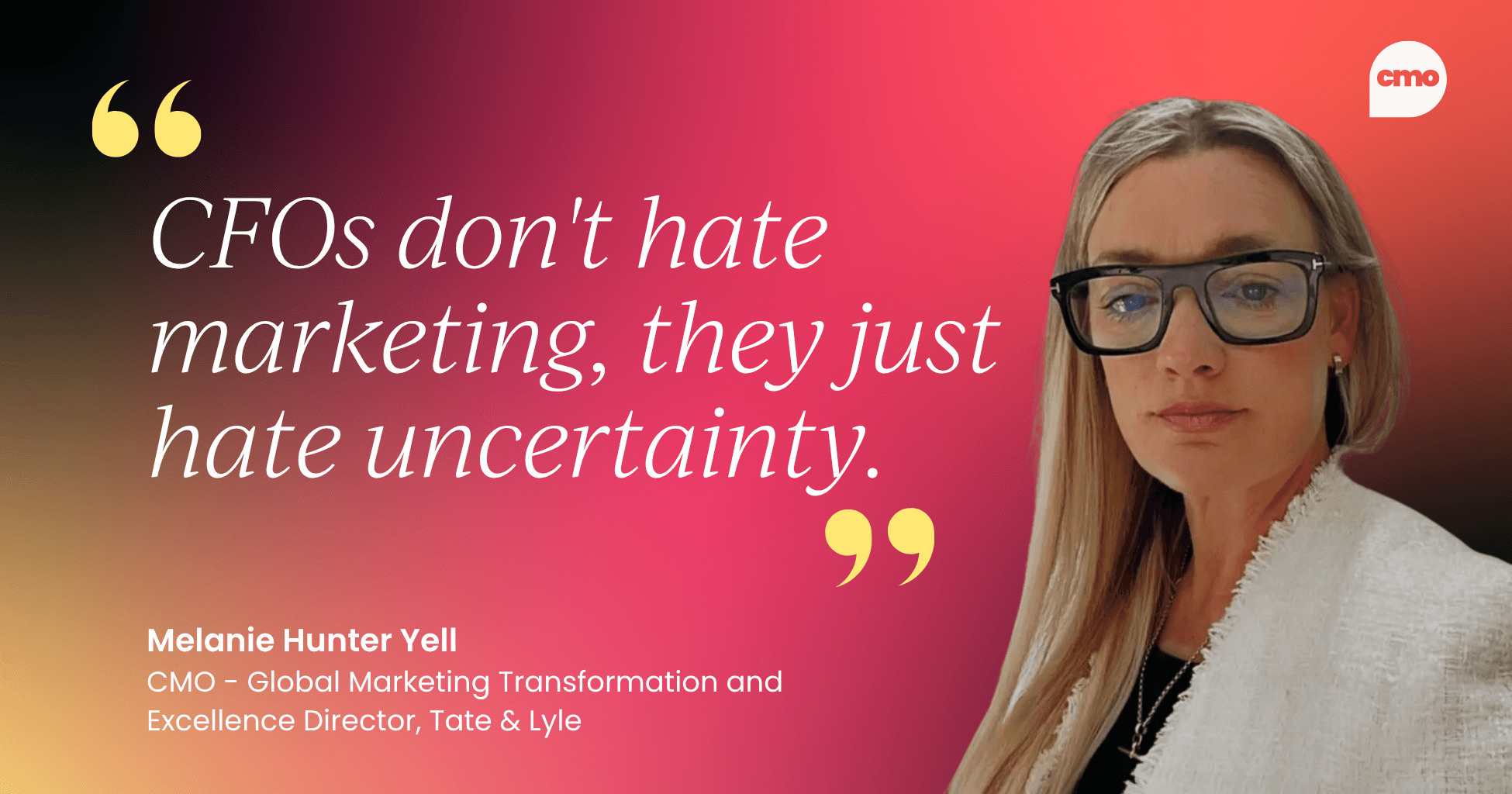
And when it comes to the CFO relationship itself, she dropped a line that every marketer should probably put on a sticky note on their desk:
It’s a great reminder that a lot of the tension in the boardroom isn't personal. It’s just two different functions operating with wildly different tolerances for ambiguity.
Which approach fits your situation?
These four approaches aren't mutually exclusive. Most CMOs end up combining more than one, depending on what's being measured and who's in the room.
Here’s a quick cheat sheet on when to use which:
- Testing a new channel or a sustained investment? Go with an incrementality test. A solid holdout group will give you the cleanest, most undeniable causal read.
- Need something faster using data you already have? Lean on the behavioral bridge. Find that middleman behavior connecting your brand metrics to revenue, and build your case around it.
- Managing spend across tons of tactics (even the offline ones)? Build a bottoms-up unit economics view. This ensures every single tactic reports back in the cost, conversion, and payback terms finance already inherently trusts.
- Struggling to get airtime for numbers you already have? Borrow Melanie's equal-sign rule. Take a step back and restructure the report itself entirely around financial consequences and investment horizons.
If there's one common thread through all of this, it’s that the bridge to finance is never just the brand metric itself. It's always whatever sits between that brand metric and the P&L line, whether that’s a controlled comparison, a proxy customer behavior, a chain of unit economics, or simply a brilliantly reframed report.
Ultimately, building that translation layer is on us as marketers. And it’s a job we need to finish before we walk into the CFO conversation, not while we're sitting in it.
Have a different way you bridge brand data to financial impact? Drop it in our CMO Alliance Slack and keep the conversation going.
FAQs
How do you connect marketing to P&L?
You connect marketing to P&L by tying every metric to a lever finance already tracks. You can do this with incremental revenue via a holdout test or marketing mix model, margin contribution, CAC relative to lifetime value, or payback period. Report against at least two together so no single number has to carry the whole argument.
How often should CMOs review metrics?
CMOs should review performance metrics like spend and conversion rate weekly, since they move fast, but check brand metrics like awareness and share of search only monthly or quarterly, since more frequent tracking just adds noise. Save the full commercial narrative for the board for whatever cadence the CFO already reports on, usually quarterly.
Which brand metrics predict revenue growth?
Share of search (the share of category search volume going to your brand) has the strongest evidence behind it for predicting revenue growth. Research from Les Binet shows it can predict market share shifts up to a year out. Mental availability, how easily your brand comes to mind in a buying moment, is a second well-evidenced predictor.
Do finance and marketing work together?
Finance and marketing work together less than either function would like, but that's improving as more companies embed a dedicated marketing finance business partner inside the marketing team. Where the relationship works well, it's usually built on a regular CMO-CFO working session that never reaches the boardroom, not a single annual budget meeting.
Which marketing metrics does Finance care about the most?
Finance cares most about customer acquisition cost, the LTV-to-CAC ratio, payback period, and marketing-sourced or -influenced pipeline. All four can be reconciled against the general ledger, which is what makes them trustworthy by default.
Which marketing metrics does Finance care about the least?
Finance cares least about metrics with no established link to cost or revenue: impressions, reach, social engagement, and brand awareness reported without a financial model attached.
How do you account for the time lag between marketing spend and realized revenue?
You account for that lag by modeling "adstock," or carryover effect, in a marketing mix model. This captures how impact decays over weeks or months instead of landing all at once.
How do you justify brand marketing on a P&L when it doesn't drive immediate sales?
You justify it the way finance already frames R&D or capital investment: as an asset that compounds, not a cost that should convert immediately. Strong brand equity lowers future customer acquisition cost and increases price elasticity, so the return shows up later as margin rather than an immediate revenue spike.
Which marketing attribution model does Finance trust the most?
Finance trusts incrementality testing and marketing mix modeling most, and multi-touch attribution least, since MTA is a black box vulnerable to platforms over-crediting their own channels. MMM in particular has seen a resurgence since privacy changes broke a lot of cookie-based tracking. That recommendation also reflects current practice. Our research shows that first-touch (36.1%) and last-touch (31.2%) were still the most widely used attribution models, and 61% of marketers said data integration was their biggest attribution challenge.


Become a CMO Insider
Thank you for subscribing
Get exclusive insights, frameworks, and strategies from marketing leaders driving real business impact.
An email has been successfully sent to confirm your subscription.
 Follow us on LinkedIn