.png)




What does “AI-powered” even mean anymore? The term has become so watered down amid the race for companies to prove their AI worth that it’s become devoid of meaning.
Today’s AI claims feel like when martech exhausted the term “personalization.” Every pitch deck, company homepage, and social post touted a technology’s ability to deliver a 1-to-1 consumer experience. Soon, that wasn’t enough, and software buyers wanted to know more about the data layers driving personalization and see the ROI.
AI sits in a similar place. Companies tout agentic capabilities and AI-powered solutions, but buyers want to know the credibility behind the AI. What are the real-world outcomes? What is the AI trying to solve?
When I joined Appriss Retail as CMO, one of the first things I did was go back to basics: I interviewed customers, ran LinkedIn surveys, and asked our buyers directly, “What’s believable to you about AI?” and “What makes our solution trustworthy?” The answers were clarifying and shaped everything about how we position AI and go to market.
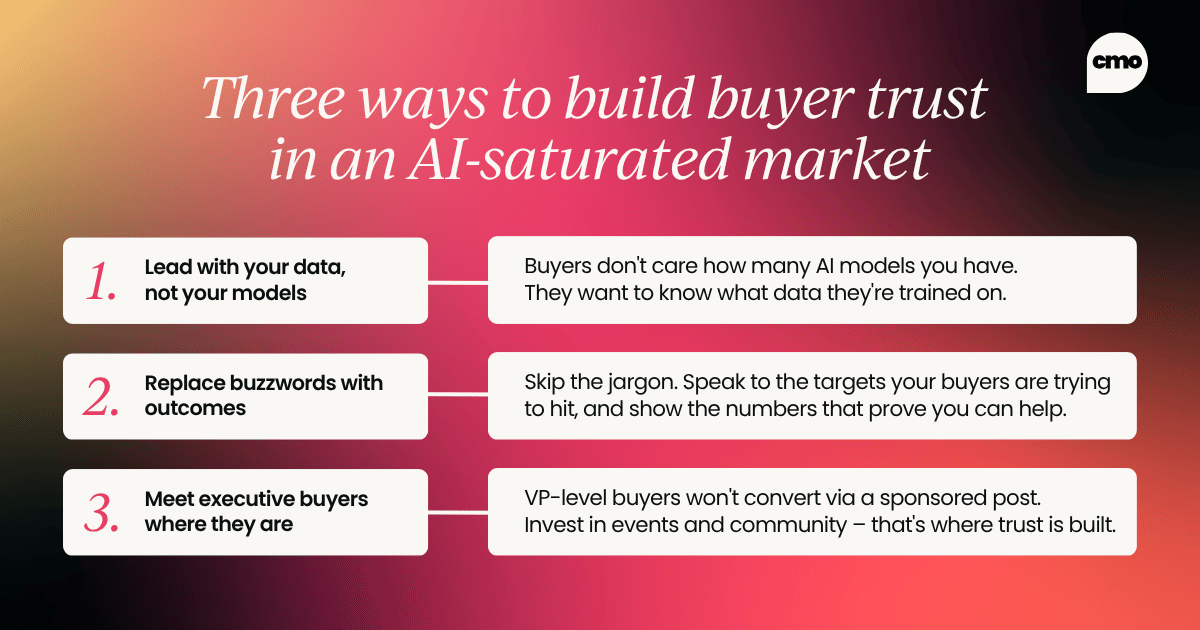
Leading with data
In plain terms, our buyers told us they couldn’t care less about how many AI models a company has. They care about data. Appriss Retail has more than a dozen AI models, and each one is impressive, but the buyers wanted to know what data our AI models were trained on.
For us, that feedback was a fundamental shift. Customers care that Appriss Retail sits on 20-plus years of cross-channel transaction data, covering 40% of all U.S. retail transactions across more than 150,000 locations. We also operate consortium-wide, which means when a retailer plugs into our platform, they’re not just getting their own data; they’re getting intelligence from a network of 100-plus retailers.
That’s the competitive moat. The data is the real differentiator.
Delivering proof
The second thing our buyer research told us: focus on the outcomes.
This sounds obvious, but the loss prevention and returns management industry continues to get it wrong. Visit the homepages of various tech vendors in the space, and you’ll find language like “Unlock Agentic Commerce” or “AI Decisions for the Future of Retail.” Who is that for? What does it mean for someone trying to hit a shrink or returns reduction target by Q3?
We lead with outcomes. For our Secure product (shrink and exception analytics), that’s 6x faster root cause identification. For our Engage product, it’s an 8-12% reduction in returns and claims. This means teams can stop shrink and fraudulent or abusive returns before it hits margins.
We also adjusted our long-running annual returns report to reflect outcomes. The 2026 Total Retail Loss Benchmark Report found that U.S. retailers absorbed $706 billion in merchandise returned in 2025, but it also highlighted areas of “preventable” fraud, abuse, and shrink, totaling $166 billion. We know that the retailers we talk to are sitting somewhere inside that number, and we provide support in tackling that number.
Gaining executive-level trust
Our buyers at Appriss Retail are VP-level and above. They’re loss prevention directors, CFOs, operations executives, and many with law enforcement and strong analytics backgrounds. They have a low tolerance for noise and a high bar for credibility. They aren’t going to convert off a sponsored post, but they will take a meeting after a trusted peer speaks highly of us, or after a substantive conversation at an industry event.
With everything we do in marketing, we try to keep this audience in mind, and that’s reflected in our budget. More than half of our marketing spend goes to events, industry conferences, and our own community-building initiatives like The Takeback Talks, which are closed-door meetings that we’ve just launched for VP-level and above leaders across retail categories to share a room and discuss broad industry challenges together.
It’s events like these where relationship-building happens. So, for an enterprise company with a long sales cycle and a buyer group that doesn’t convert via website subscription, this isn’t optional. It’s a primary lever.
LinkedIn, content, and PR are where we build awareness at scale, and we do it with organic content first and paid social as a secondary layer.
Redefining the attribution pipeline
Multi-touch attribution models and mixed media modeling are not how I think about pipeline. For enterprise B2B, that level of mathematical precision is largely fiction anyway – there are too many touchpoints, too many stakeholders, and too long a sales cycle for any model to give you a reliable single-source answer.
What I use instead is a funnel-stage model tied to budget, measuring MQAs (marketing-qualified accounts), SQAs (sales-qualified meetings), and SQOs (qualified pipeline opportunities).
The conversation I have with finance every month is not about which channel gets credit for the deal. It is: are we hitting our stage-by-stage goals? If MQAs are strong but SQAs are lagging, maybe we take budget from paid social and put it toward an event that guarantees us 10 more one-to-one meetings. The levers are visible. The decisions are clear.
This matters for CMO credibility with the CFO. You don’t need to claim attribution for every dollar. You need to show that your investments move the funnel in a predictable direction. That’s a conversation finance can follow, and one I’ve found they respect far more than a complex waterfall model that no one believes.
Demonstrating company credibility
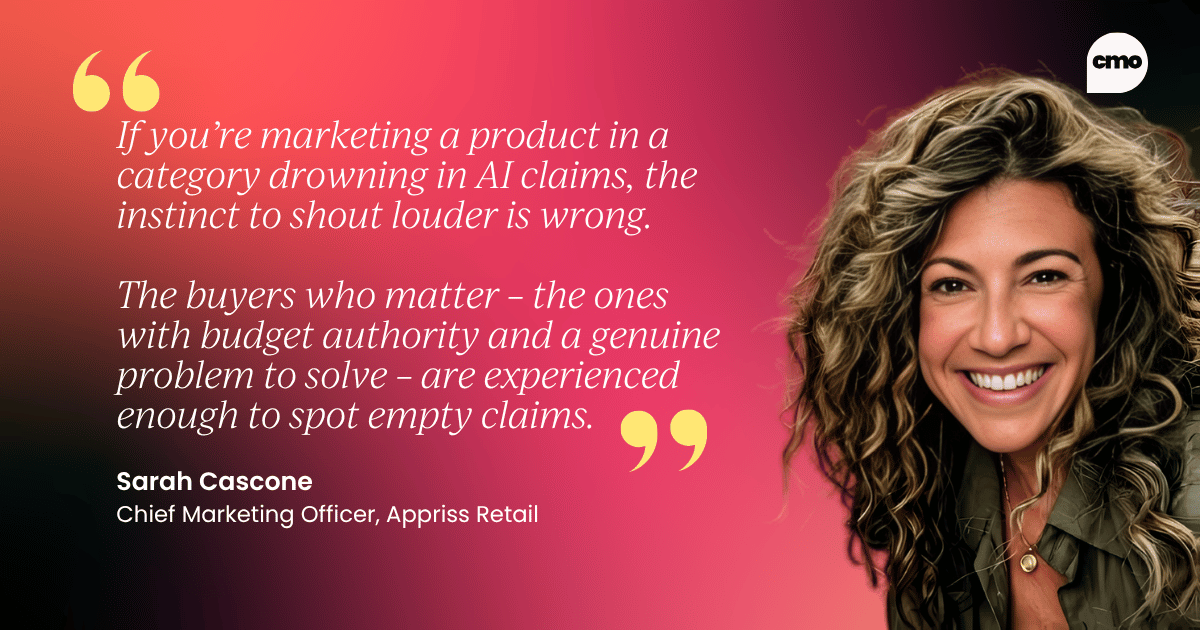
If you’re marketing a product in a category drowning in AI claims, the instinct to shout louder is wrong. The buyers who matter – the ones with budget authority and a genuine problem to solve – are experienced enough to spot empty claims. They’ve been pitched before.
Leading with the data foundation builds trust. Replacing “AI-powered” with a specific outcome earns credibility. And showing up where your buyers make decisions, which, in enterprise, is almost never a form on your website, fuels connections.
AI noise isn’t going to go away. Companies need to get better at filtering it and distilling it to be credible. This is how to gain trust in a whitewashed AI era.


Become a CMO Insider
Thank you for subscribing
Get exclusive insights, frameworks, and strategies from marketing leaders driving real business impact.
An email has been successfully sent to confirm your subscription.
 Follow us on LinkedIn