.png)







A campaign goes live on Monday. By Thursday, the product team has shipped two features that change what the product actually does, deprecated a third the campaign was built around, and renamed the workflow at the center of the messaging. None of it was wrong when it launched. It was just out of date by the end of the week.
This is the part of the job nobody warns you about. Most marketing leaders in tech can handle a tight budget or a skeptical board. What wears them down is subtler: the product never holds still long enough to be marketed. The thing you’re selling on Friday is not quite the thing you described on Monday, and the gap is your problem to close.
The messaging is always behind
In a business that ships continuously, marketing is structurally behind the product. By the time a message is researched, written, approved, and live, the product has already moved underneath it.
This isn’t a process failure that a better content calendar will fix; it’s the reality of the work. Engineering iterates in days. Positioning takes weeks to get right, and longer to land in a buyer's head. You are asked to tell a stable, confident story about a product that is, by design, refusing to stand still.
A product has two layers:
- The churning layer is the features, the workflows, the names. All of it can change, often by next week.
- The stable layer is the buyer problem the product was built to solve. It barely moves at all.
Build the message on the first layer, and it’s out of date by Thursday. Build it on the second, and it survives the next release.
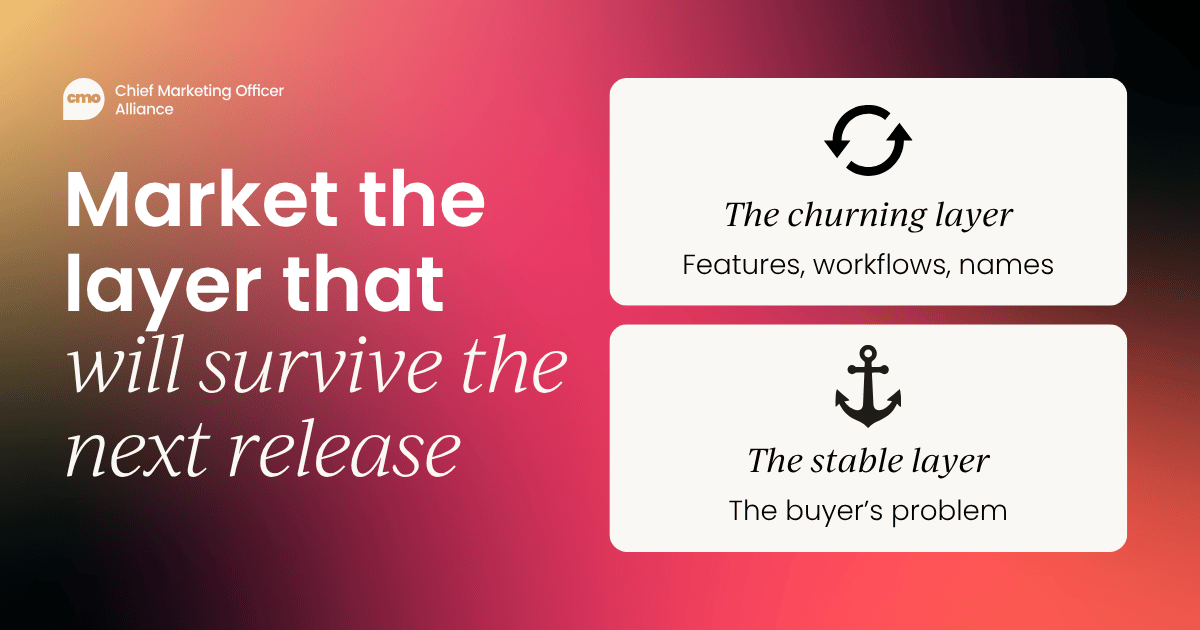
The answer is not to market the churn; it’s to build on the layer that doesn’t move.
The test is simple. A message that says "now with automated valuation reports" dies the moment that feature is renamed or folded into something else. A message that says "your analysts spend less time defending numbers to the regulator" still holds, because the buyer's problem has not changed.
Same product, two messages, one of them disposable.
The problem multiplies across markets
A single market is hard enough. Run marketing for a company operating across many countries and the problem multiplies.
The product ships once, globally, but it does not land the same way everywhere. A feature that matters in one market may be irrelevant in another. The buyer in Frankfurt is regulated differently than the buyer in Paris or London. The competitive set changes by border. The same message has to be translated, localized, and made true in each place at once.
Now the messaging isn’t just chasing a moving product; it’s chasing it in several directions simultaneously, through teams who each know their own market better than headquarters does.
The job of the marketing leader is to keep a coherent global story intact while giving regional teams enough room to make it land locally. That balance breaks quickly if the message is anchored on a feature that may not even matter everywhere. The center has to hold the why and keep it consistent. The regions own the how.
Centralizing the whole message fails because the bottom layer differs by country. Centralizing only the stable layer works because that part is actually shared.
Attribution on a moving target
Software companies measure everything, which sounds like an advantage until you’re the one being measured by it.
Every touch is tracked. Every campaign carries a number. Every number ends up on a dashboard that someone in finance reads differently than you do. But you’re not measuring a fixed product. You’re measuring how the market responded to a version of the product that may no longer exist.
A campaign underperforms, and the cause might be the message, the channel, or the simple fact that the feature it promoted shipped late or changed shape mid-flight. The attribution model cannot tell you which, and finance does not want to hear that the target moved.
So, stop defending the churning layer campaign by campaign. That fight cannot be won on the dashboard.
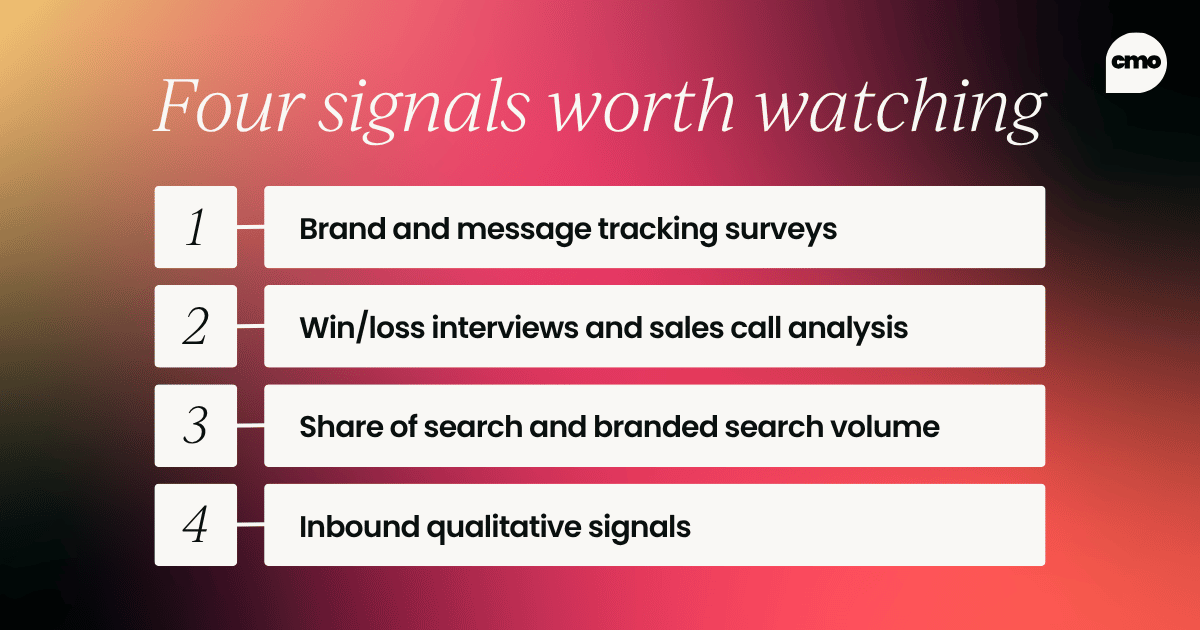
Measure the stable layer instead: whether the market understands the problem you solve better than it did a quarter ago, whether the buyers who matter associate that problem with you. Those are slower signals, but they are the right ones:
- Brand and message tracking surveys show whether your category framing is landing over time.
- Win/loss interviews and sales call analysis reveal whether buyers describe their problem in your terms or a competitor's.
- Share of search and branded search volume indicate whether the market is coming to you for this problem specifically.
- Inbound qualitative signals, the language prospects use when they first reach out, tell you whether the positioning has taken hold.
None of these move on a campaign timeline. That’s exactly why they matter.
The product owns conversion
The faster the product ships, the more of the buying experience lives inside it, and the less of that experience marketing directly controls.
A free trial, an onboarding flow, a usage-based upgrade prompt: these are marketing surfaces owned by people who do not report to marketing. So, the role carries enormous responsibility for revenue with limited direct command over the moments that actually convert. Every product release reshapes those moments again.
That makes the job as much organizational diplomacy as positioning.
The leverage is to bring the stable layer into the product conversation early. Not opinion about the feature, but evidence about the buyer problem. Marketing leaders are often the only people in the room arguing from the buyer's point of view rather than the roadmap. That’s not a weakness; it’s one of the most useful things they can do.
The buyer already knows
The modern software buyer has read the reviews, compared the alternatives, and formed a view before marketing ever reaches them. By the time a prospect raises a hand, much of the decision is already underway.
A changing product makes this harder. The buyer's view may be based on a version that no longer reflects what the product does, and correcting that without overclaiming is delicate work.
The job is no longer to inform the buyer; it’s to be the most credible voice in a room they entered on their own. Being right matters more than being loud. One unanchored claim costs more trust than ten careful ones earn.

In finance and real estate, where buyers are often regulated institutions deciding under scrutiny, this is paramount to being taken seriously. Credibility compounds slowly and disappears quickly, and a product that keeps moving gives you more chances than you would like to get it wrong.
The team keeps relearning
If the product changes every month, so does the knowledge the team needs to market it. The org chart is the visible version of this problem, but the deeper one is quieter: the team is always slightly behind on what it is actually selling.
AI sits on both sides of this. It’s part of why the product keeps moving faster, since AI features now ship into the roadmap at a pace that resets the messaging again and again. It’s also the thing that helps a marketing team keep pace, drafting, localizing, and updating at a speed that used to be impossible.
That makes AI useful here, but not in the simplistic way people often describe. It’s not a replacement for judgment; it’s a way to close the gap between what the product does today and what the team can credibly say about it.
The harder question is what to ask of people once the tool exists, which parts of the work are worth protecting as human judgment, and which were never the point. Keeping a team fluent in a product that will not stand still, and deciding what the company should actually claim about it, is one of those parts that stays stubbornly human.
Adaptation speed without strategic clarity is just drift. Moving fast only helps if you know what you are moving toward.
What the job asks
A marketing leader's real job is not to keep up with change, but to keep the story anchored while everything around it moves.
Strip away the specifics, and the role comes down to holding a position while the thing you are positioning keeps changing under you.
Feature-led messaging falls behind. Problem-led messaging holds. Attribution measures a target that has already moved. The product owns the moments that convert. The buyer arrives already decided, sometimes about a version that no longer exists. And across regions, all of it happens several times over at once.
None of this is solved by a better dashboard or a bigger budget. It’s solved by a single discipline applied everywhere: build on the layer that does not move.
The buyer's problem and the reason the product exists are the one stable thing in a business engineered for change. Nearly everything that makes this job hard gets easier when the marketing is anchored there instead of on the feature of the week.
The product will keep moving. Your job is to stay attached to the part of it that doesn’t.


Become a CMO Insider
Thank you for subscribing
Get exclusive insights, frameworks, and strategies from marketing leaders driving real business impact.
An email has been successfully sent to confirm your subscription.
 Follow us on LinkedIn