


.png)







Marketing in regulated industries isn’t about moving fast and breaking things. It’s about moving deliberately, building strategies that drive growth while holding up under scrutiny from compliance and regulatory stakeholders.
If you’ve worked in finance, healthcare, or legal, you’ll recognize the tension straight away. You’re expected to deliver results, but every campaign operates within a framework of rules and approvals.
Once you're operating inside a regulated environment, one truth becomes hard to ignore:
You’re not just marketing to customers; you’re communicating within systems designed to protect them.
When regulation stops being theory
One of the earliest moments that shaped how I approach regulated marketing came while working in education on UK government-funded campaigns.
At The Skills Network, I managed teams working on initiatives aligned with Department for Education (DfE) guidelines. I particularly remember the Skills for Life campaign. On the surface, it looked like any other campaign:
- Clear audience targeting
- Strong messaging
- Defined outcomes
But once we received the DfE guidance, everything tightened. Messaging and assets had to align precisely with:
- Funding eligibility criteria
- Government-approved terminology
- Policy-backed claims
- Skills-for-life logo placement
Even something like “improve your career prospects” had to be carefully considered. If it implied an outcome that couldn’t be guaranteed under the program, it had to be reworked.
There wasn’t a legal team rewriting the copy. Instead, cross-functional compliance and regulatory stakeholders interpreted the rules and ensured messaging and visuals aligned with them.
At the time, it felt restrictive. However, looking back, it forced a level of discipline that most marketing teams never develop: clarity over creativity and accuracy over assumption.
The people who actually shape your campaigns
One of the biggest misconceptions in regulated marketing is who you’re really working with. If you’re currently in a regulated marketing role, you will know that it’s rarely legal teams directly.
Across education, legal services, and non-profit work, I’ve consistently worked with:
- Compliance managers
- Regulatory or governance stakeholders
- Risk teams
- C-suite stakeholders
These roles sit between legal frameworks and marketing execution. They translate rules into reality:
- What you can say
- What needs evidence
- What crosses the line
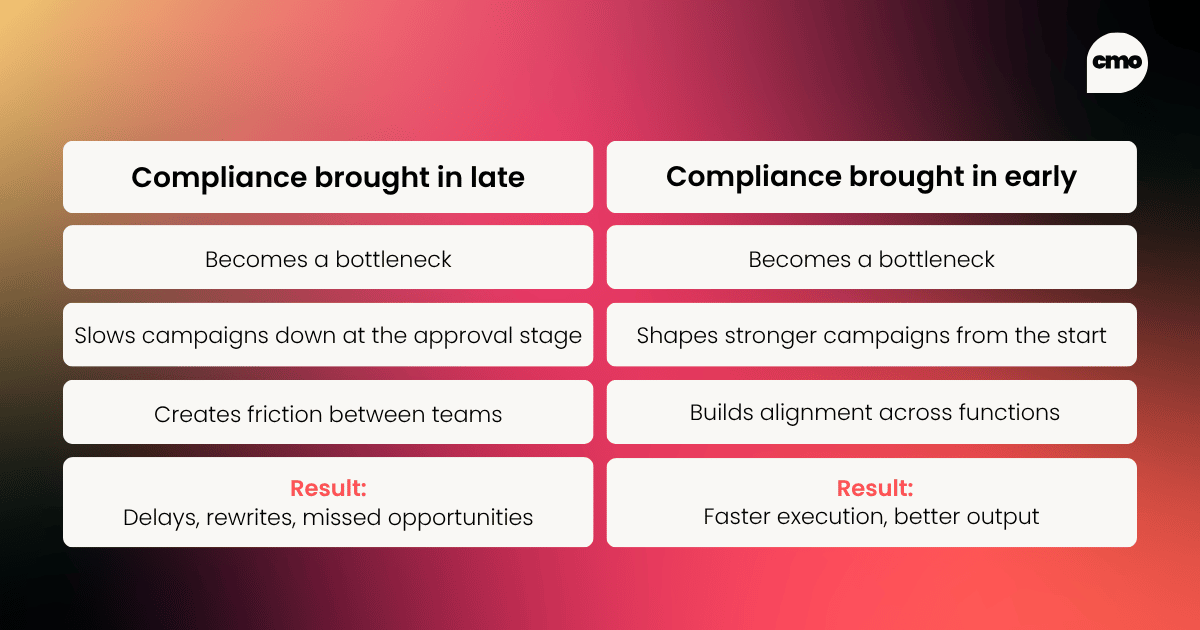
Here’s what I’ve learned: if you bring them in late, they will slow you down. If you bring them in early, they will help shape better campaigns.
Legal marketing: Where language carries risk
When I stepped into the role of Head of Marketing at a solicitors firm, it brought a different level of challenge. Because in legal marketing, the risks aren’t abstract; they’re immediate.
You can’t:
- Promise outcomes
- Overstate expertise
- Suggest certainty where none exists
Even small wording choices matter. For example, phrases like “We guarantee results” and “You will win your case” aren’t just risky; they’re non-compliant.
So marketing becomes an exercise in precision.
Instead of bold claims, you have to focus on:
- Demonstrating expertise through content
- Using case-based examples carefully
- Building credibility through consistency
This is where marketers may struggle. They become so cautious that their messaging loses impact and becomes all fluff.
The challenge isn’t to say less. It’s to say things better: more clearly and with more intent.

What non-profit marketing teaches you about trust
Working with several NGOs introduced me to another layer of complexity; this time primarily driven by resource constraints rather than regulation.
With budgets tight, paid media isn’t always viable. So, growth had to come from:
- Organic content
- PR and storytelling
- Strong use of owned channels
There was no room for wasted messaging. Everything had to resonate. Interestingly, this environment reinforced the same principle that regulated industries demand: trust-first marketing.
Because when you can’t rely on aggressive tactics or budget, you rely on credibility. That’s what drives engagement.
When marketing in regulated industries goes wrong
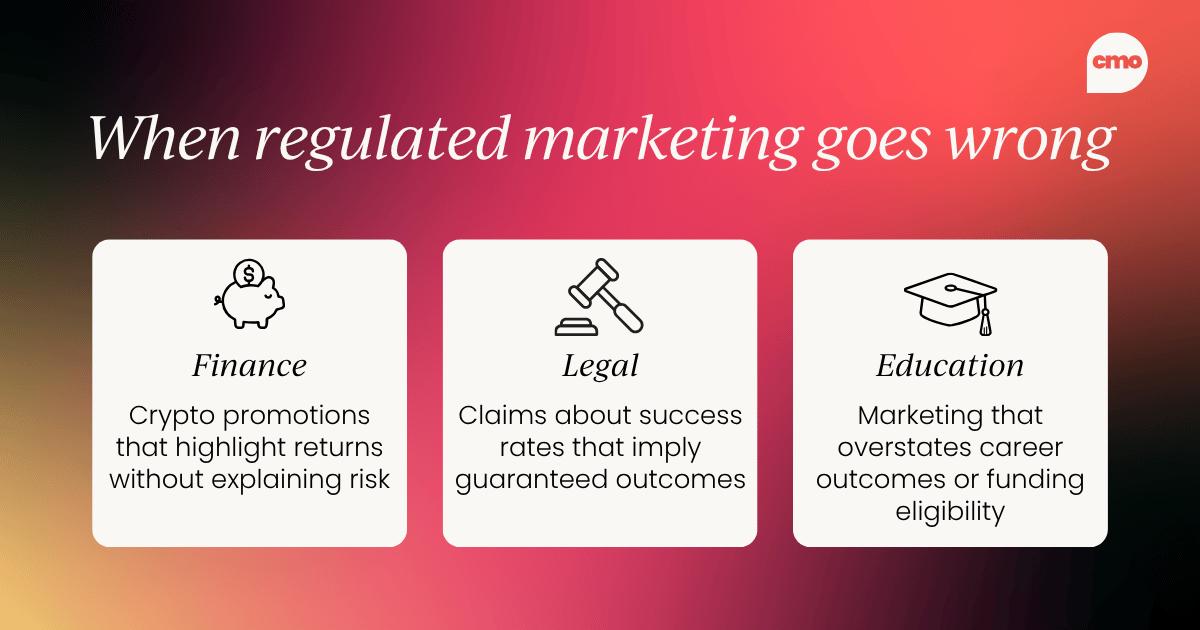
When regulated marketing fails, the consequences go beyond performance metrics. The following real-world examples highlight this clearly.
Financial services and crypto promotions
Regulators like the Financial Conduct Authority (FCA) have taken action against misleading promotions, especially in crypto.
Some campaigns have come under fire for using influencers without proper disclosure, highlighting returns without explaining risk, or creating urgency around high-risk investments.
The issue wasn’t just messaging. It was that compliance wasn’t fully embedded in the process.
Legal sector missteps
Legal firms have also faced scrutiny for misleading claims about success rates, suggesting guaranteed outcomes, or using testimonials that imply certainty.
Often, these weren’t intentional violations, but in regulated industries, interpretation matters more than intent.
Education sector scrutiny
Education marketing has faced challenges around overstated career outcomes, misleading course benefits, or lack of clarity around funding eligibility. This is something I’ve experienced directly.
Even small inaccuracies can impact trust – and in some cases, access to funding or opportunities.
The pattern behind these failures
Across industries, the same issue appears: marketing moved ahead of compliance, not alongside it.
The processes aren’t aligned enough. That’s where risk enters the ecosystem.
What actually works in regulated marketing
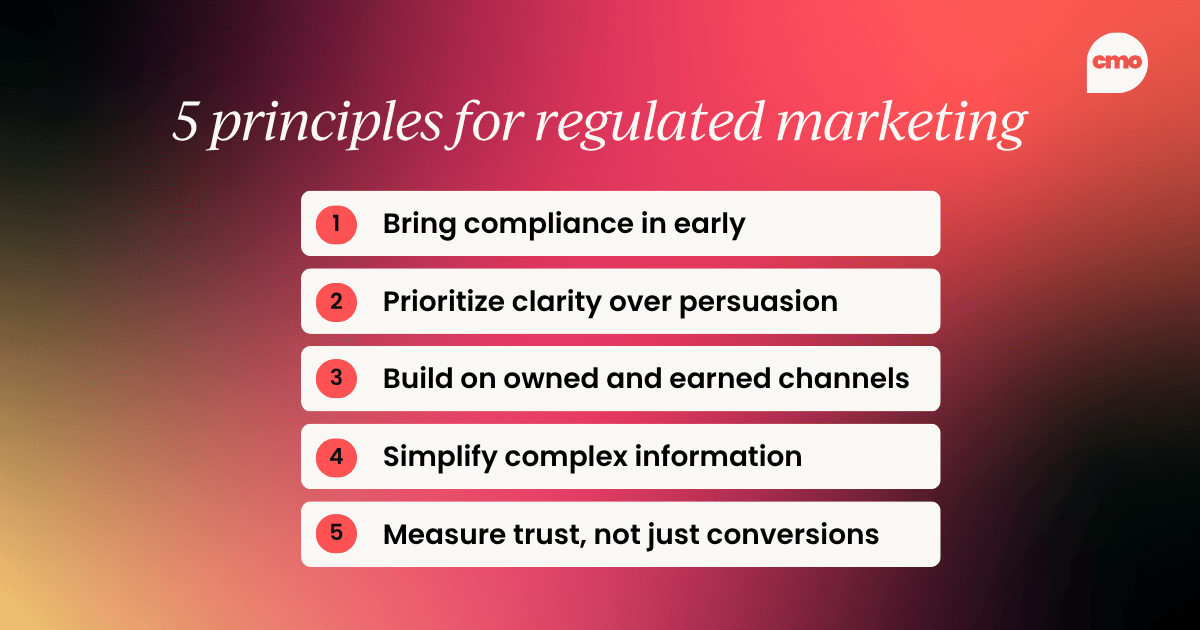
From experience across education, legal, and non-profit sectors, five principles consistently deliver:
- Bring compliance into the process early: Not at the approval stage, at the planning stage. This turns compliance into a collaborator – not a bottleneck.
- Focus on clarity over persuasion: Overly persuasive messaging rarely survives review. Apply clear, accurate communication.
- Build around owned and earned channels: When restrictions limit activity, your owned channels become essential. These include content, email, organic social, and PR. This approach proved especially effective in non-profit work, where constraints forced smarter strategies.
- Learn how to simplify complex information: Whether it’s legal language, funding criteria, or policy, your role is to make it understandable in layman's terms, without distorting it. This is one of the most valuable skills in regulated marketing.
- Measure trust, not just conversions: Conversion metrics matter. But in regulated industries, long-term growth depends on credibility, engagement quality, and audience trust.
Why regulated marketers are better positioned for what’s next
As search evolves, particularly with AI-driven summaries, there’s a shift toward:
- Clear answers
- Structured information
- Credible sources
This creates an advantage because these are exactly the qualities regulated marketing already demands.
What once felt like a limitation is now fast becoming a strength.
What this means for CMOs and heads of marketing
Leading marketing in a regulated industry isn’t just about growth; it’s about building systems that support performance, compliance, and trust.
From education campaigns shaped by government frameworks…To legal marketing where every word carries risk…To non-profit environments where trust drives everything…
You don’t win in regulated marketing by pushing boundaries blindly.
You win by understanding exactly where those boundaries are, and building something credible and sustainable within them.
The brands that succeed are always the ones people trust.


Become a CMO Insider
Thank you for subscribing
Get exclusive insights, frameworks, and strategies from marketing leaders driving real business impact.
An email has been successfully sent to confirm your subscription.
 Follow us on LinkedIn