.png)




Templates and frameworks to pair with this playbook
Let me start with a question that I think every marketing leader has been wrestling with over the last twelve months:
Are we scaling a system that's built for the future? Or are we stretching it to its breaking point?
For most organizations, the honest answer is more complicated than we'd like to admit.
I’m going to share a framework for how to think about architecting demand inside a modern, AI-influenced go-to-market (GTM) system. One that connects demand generation, customer journeys, and lifecycle thinking into a single, scalable engine.
I’ll be upfront: I'm not here to tell you AI will solve everything, but to help you think clearly about where it truly moves the needle, and where the hype is outpacing reality.
The system has been showing cracks for a while
Let me paint a picture of where we are right now.
60% of Google searches now end without a single click. Think about what that means for your demand engine. Most of them were built on the assumption that people search, click, visit your site, fill out a form, and enter your funnel. That entire motion is eroding.
Meanwhile, 42% of companies that launched AI initiatives in 2025 abandoned most of them by year-end because they bolted AI onto systems that weren't ready for it.
Here's the uncomfortable truth. Most go-to-market systems were designed for a world where buyers came to us through search, forms, and outbound marketing. That world is fragmenting. Rather than resist it, the answer is to embrace it intelligently, and that starts with understanding what kind of system you're working with.
If you're at a startup or early-stage company, this is easier. You don't have legacy tech, dirty data, or years of inorganic growth layered on top of fragile integrations. You get to build from a clean slate.
For mid-size and enterprise companies that have been around a while, the challenge is considerably harder. You have historical context embedded in legacy systems, institutional knowledge living in people's heads, and data that AI can’t interpret without the human common sense and intuition that built it in the first place.
The tension between AI's promise and your system's readiness is what this whole conversation is really about.
For expert insights like this straight to your inbox twice a month, sign up for Pro+ membership.
You'll also get access to a range of certifications, a complimentary Summit ticket, 50+ tried-and-true templates, members-only workshops, and much more.
So, what are you waiting for?
How buyers are discovering, evaluating, and deciding in 2026
Buyer behavior has fundamentally shifted across all three stages of the buyer journey. Let's walk through each one, starting with discovery.
The discovery stage
AI overviews now appear for roughly 70% of commercial-intent queries on Google.
ChatGPT has 800 million weekly users – possibly covering your entire addressable market – asking questions and getting answers, without ever visiting your website.
And increasingly, discovery is happening in social watering holes like Reddit, GitHub, Stack Overflow, and Quora – places where real conversations happen between real practitioners. Community, buyers, and evangelists are becoming more important than ever.
Evaluation
Then there's the evaluation stage. 71% of B2B researchers start with a generic search for a solution to a specific problem, and they're directing themselves through that journey.
We used to recognize that about 57% of the buyer journey happened before anyone talked to a salesperson. Now it's closer to 70%. Peer validation, reviews, community posts, and word-of-mouth far outweigh polished vendor content.
Decision making
Finally, there's the decision-making stage, and it's getting more complicated by the day. Buying committees have grown from an average of six people to around ten, and decision cycles are stretching out to match. More stakeholders means more opinions to align, and that takes time.
It also means a single-channel approach doesn't cut it anymore. Companies that coordinate outreach across email, LinkedIn, phone, and paid ads see significantly higher conversion rates than those relying on a single channel.
The implication of all these changes is clear. Your demand engine can no longer be a downstream activity that just generates leads. It has to be a foundational part of your GTM system, one that shapes and responds to behavior across the entire buyer journey.
The architecture: Building for the full revenue lifecycle
This brings us to the question of architecture. What does an AI-ready GTM system actually look like?
The starting point is a mental model shift. The traditional funnel that ended at closed-won is no longer the endpoint. In a recurring revenue business, closed-won is only the midpoint.
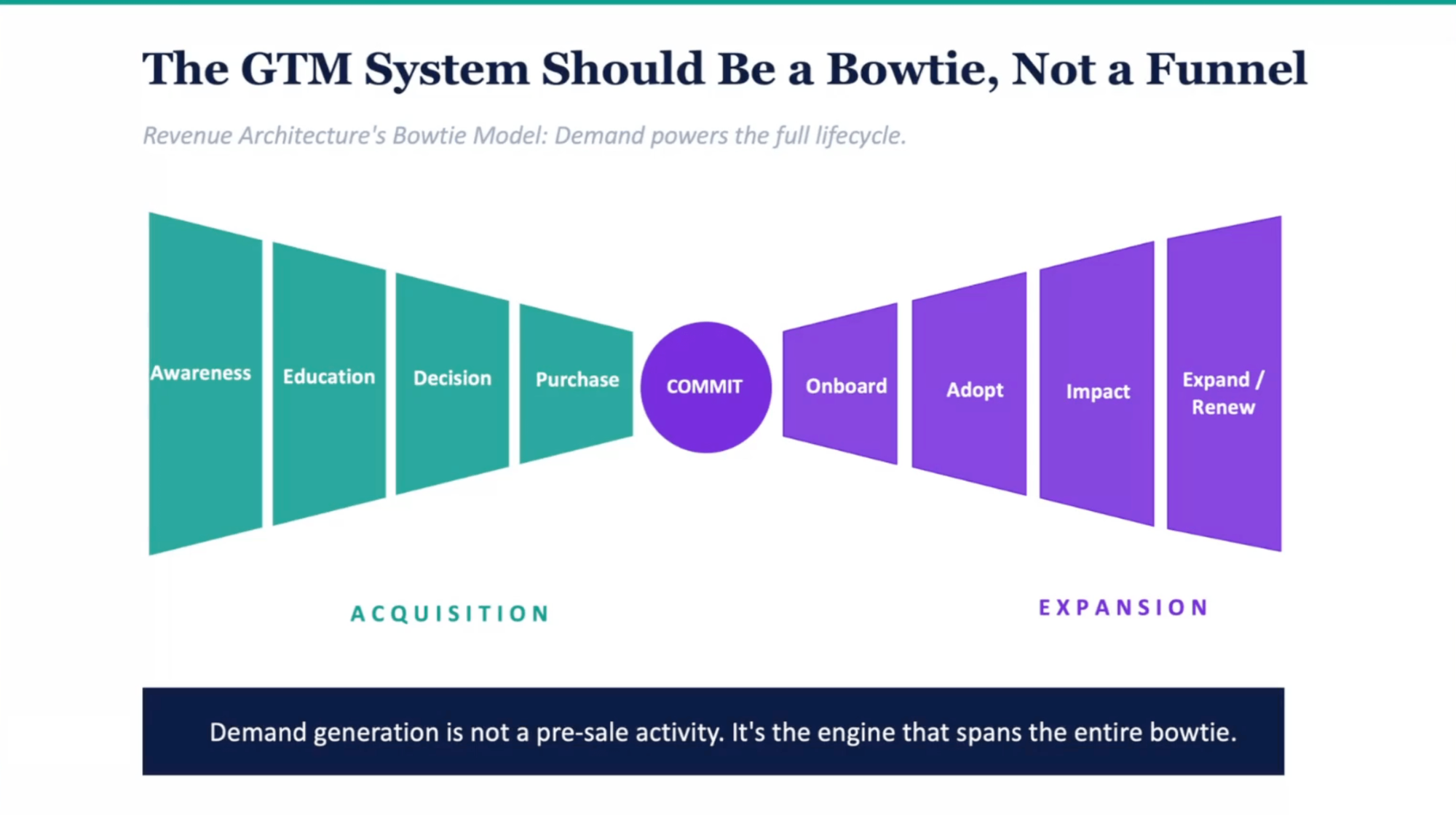
The bow tie model captures this well. On the left, you have acquisition: awareness, education, decision, and purchase. On the right, you have expansion: onboarding, adoption, impact, and expand or renew. The pivot point in the middle isn't the finish line – it's the commit stage, where the relationship really begins.
What's critical is that the customers who onboard successfully, adopt deeply, and see real impact are also the ones chattering on GitHub or Reddit, answering questions your future buyers are asking. The content they create is shaping your pipeline, often without you even knowing it.
Demand gen has traditionally been confined to the left side of that bow tie: top of funnel, lead gen, MQLs. But in a modern GTM system, demand thinking needs to run its full length, from awareness through to expansion and renewal. You're designing an entire demand system – a content strategy, messaging architecture, and a narrative curation process – that connects through the entire customer lifecycle.
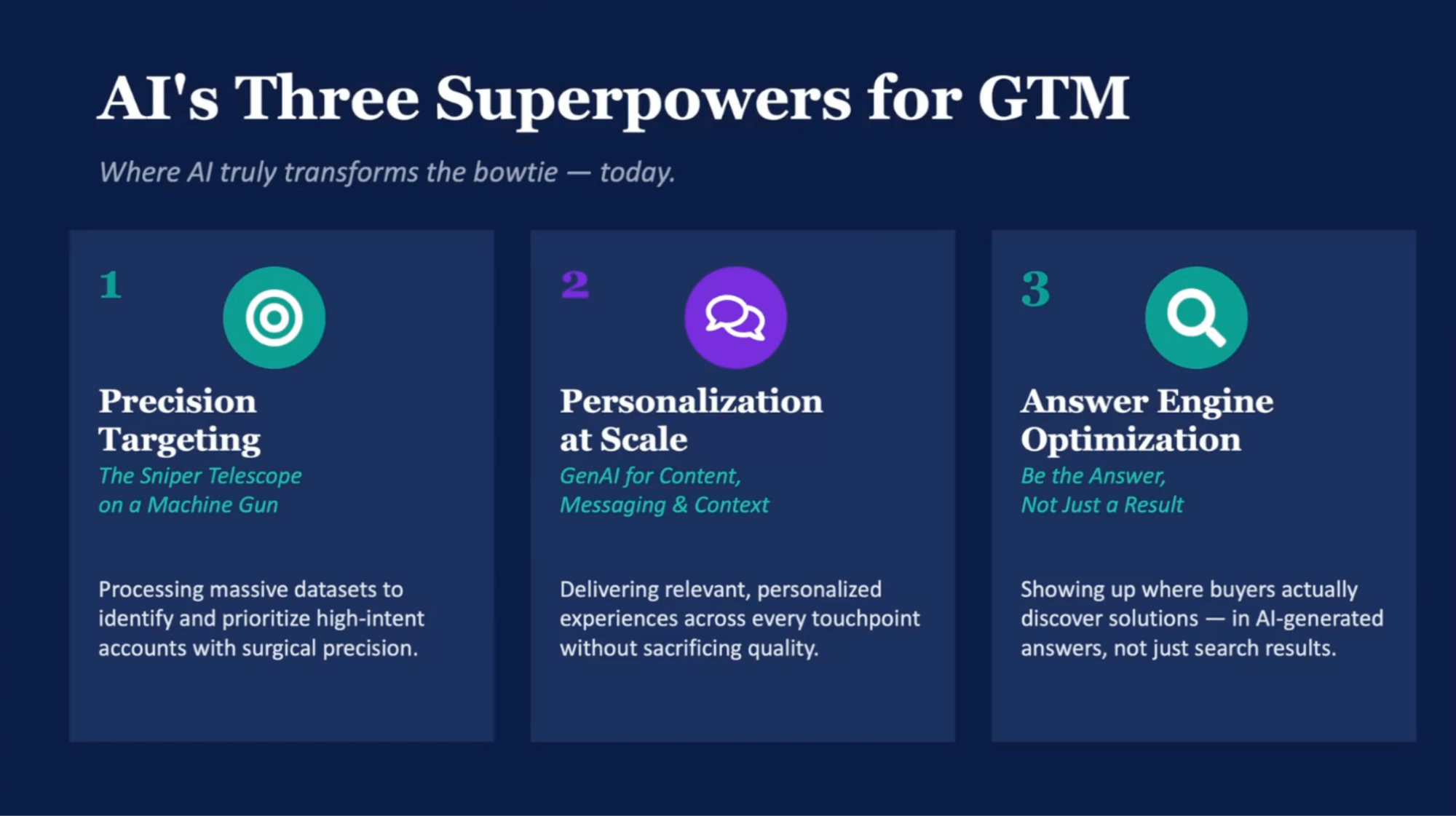
AI’s three superpowers for GTM
So, where does AI actually fit into this structure? In my view, it gives GTM teams three main superpowers right now.


Become a CMO Insider
Thank you for subscribing
Get exclusive insights, frameworks, and strategies from marketing leaders driving real business impact.
An email has been successfully sent to confirm your subscription.
 Follow us on LinkedIn