.png)




If your pipeline is mostly built on form fills, it's probably more fragile than your dashboard is letting on.
I've worked with enough B2B marketing teams to recognize the pattern. On paper, leads are coming in. MQL targets are being hit. Cost per lead is within range. But something feels off, and when you dig into pipeline contribution, conversion rates, or just have an honest conversation with sales, the cracks start to show.
Here's the thing: that's rarely a channel problem. It's a strategy problem.
And at the heart of it is a distinction that's still widely misunderstood. The difference between demand generation and lead generation.
Let's define lead gen and demand gen properly
I'll keep this simple, because the confusion usually starts with people using the terms interchangeably.
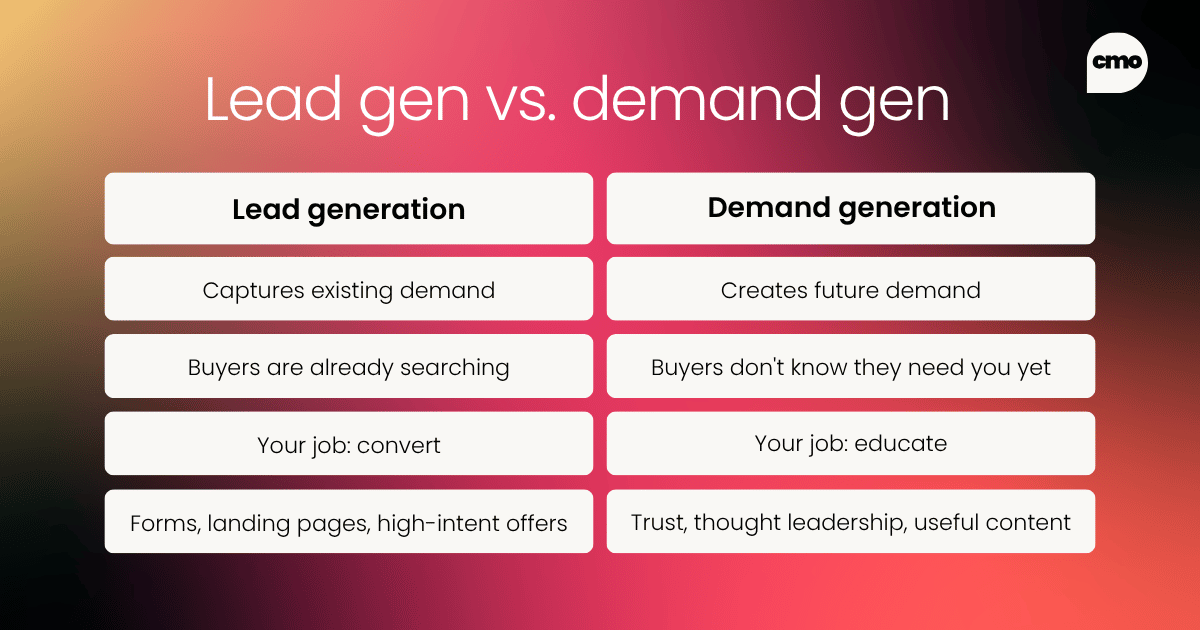
Lead generation captures demand that already exists. Buyers are in-market, actively searching and comparing. Your job is conversion: forms, landing pages, high-intent offers.
Demand generation works earlier. It's about helping buyers understand their problem before they're ready to speak to anyone. It's about building genuine trust, shaping how people think, and being useful long before there's a deal to be done.
The analogy I keep coming back to: lead generation is harvesting, demand generation is farming.
Both matter, but most teams are heavily over-optimized for harvesting, and barely invest in actually growing the crop.
How the lead gen vs demand gen imbalance shows up (and yes, I've seen all of these)
Lead volume looks fine. Pipeline quality doesn't.
In my current role leading demand generation and go-to-market at Jisc, a £150M+ revenue environment, we went through this exact reckoning.
We were generating consistent lead volume through gated content and paid campaigns. Everything looked healthy from a reporting standpoint. But when we looked at what was actually converting into qualified opportunities, the picture was messier. Sales were flagging that conversations weren't landing well. Buyers weren't ready.
We hadn't done enough work earlier in the journey to shape understanding before the point of capture. Once we shifted focus toward earlier-stage demand creation, more ungated content, stronger problem framing, content built to educate rather than convert, the lead volume actually dropped. But the quality improved. Conversations got better. Pipeline followed.
Less volume, better outcomes. That's a hard sell to a board used to tracking MQLs, but it's the right call.
Cost per lead keeps climbing with no proportional return.
When you rely heavily on paid acquisition, you're essentially competing with every other vendor for the same narrow pool of in-market buyers. We saw this during planning cycles where increasing spend just made leads more expensive, not more plentiful or more valuable.
The shift came when we started investing more in demand creation alongside capture. Engaging a broader audience earlier meant we weren't so dependent on expensive high-intent channels. You can't harvest your way out of a rising CPL problem. You have to expand the pool, not just chase it harder.
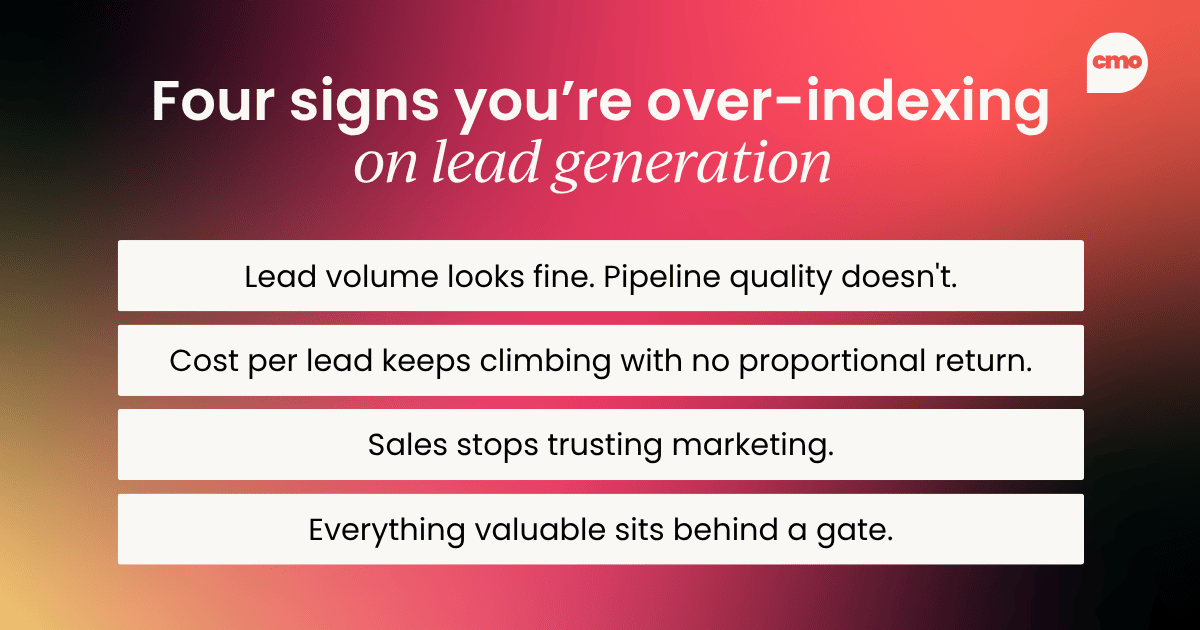
Sales stops trusting marketing.
This one's subtle, but it's a real warning sign. It shows up as slower follow-up on marketing leads, lower prioritization, and sales reps increasingly relying on self-sourced pipeline.
It's rarely about effort. It's about trust, or the lack of it. And it almost always traces back to marketing optimizing for volume while sales cares about quality.
The turning point, in my experience, comes when both teams stop talking about leads and start talking about pipeline. Shared metrics, shared definition of a good opportunity. That's when things start to repair.
Everything valuable sits behind a gate.
Earlier in my career, I leaned hard into gated content. It generates contacts, yes. But it also limits reach and actively reduces the trust-building you need to do upstream.
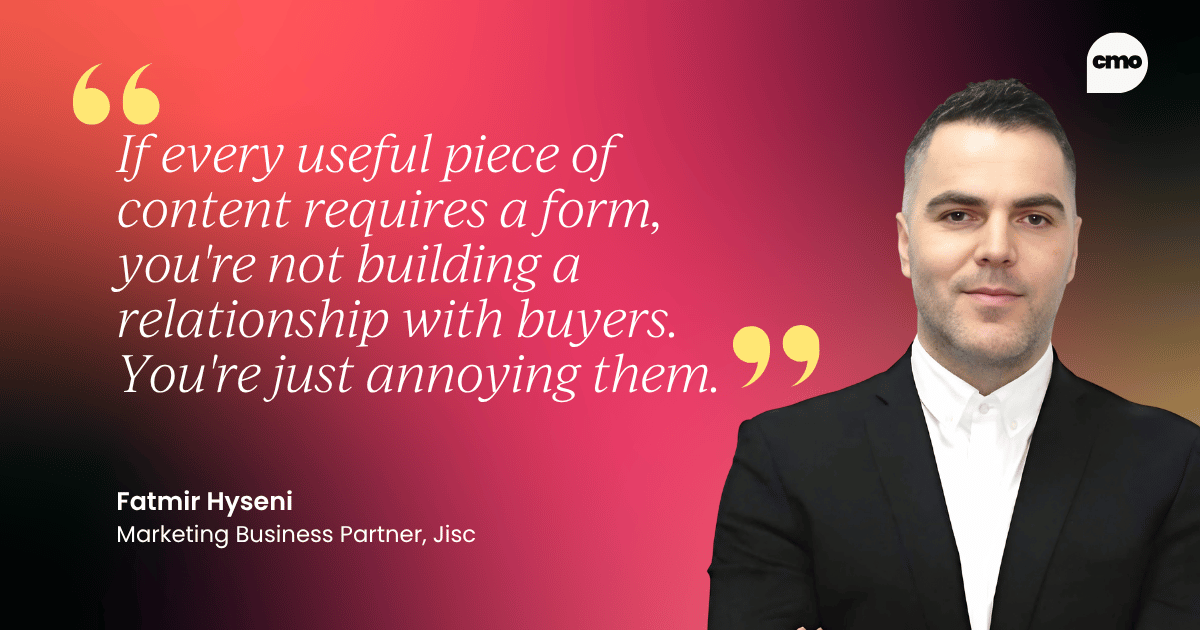
The buyers I want to reach are self-educating. They want to make their own decisions before they ever speak to sales. If every useful piece of content requires a form, you're not building a relationship with them. You're just annoying them.
Shifting to more open, genuinely useful content made a real difference. More engagement, better-informed leads when they did convert.
What a more balanced demand strategy looks like
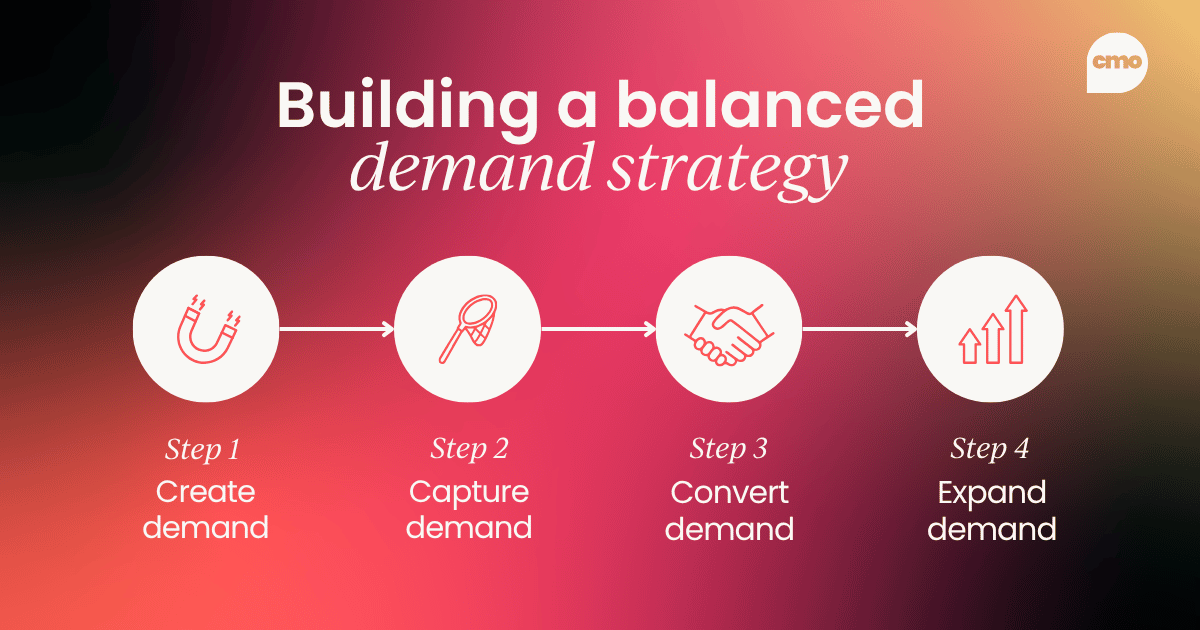
I think about building a balanced strategy as a simple four-part system.
Step 1: Create demand
This is where you build awareness and trust with people who aren't in-market yet.
At Jisc, that's meant investing in sector-specific insights, content that addresses how buyers actually think about their problems rather than how we'd like them to, thought leadership, organic social, and events. The goal isn't immediate conversion. It's to be genuinely useful early, so that when someone enters an active buying phase, the relationship is already there.
Step 2: Capture demand
Once buyers move into consideration mode, this is where your search-driven content, paid search, and high-intent landing pages earn their keep. These tactics work dramatically better when you've done the upstream work. You're not fighting for attention from scratch; they already know who you are.
Step 3: Convert demand
Conversion is less about clever tactics and more about alignment between marketing and sales. Clearer positioning, shared context, faster follow-up. When both teams are working from the same picture, this part tends to improve on its own.
Step 4: Expand demand
Don't sleep on this one. Customer advocacy, referrals, and community often outperform paid channels on both efficiency and trust. Your existing customers are frequently your strongest demand generation asset, and also the most underused.
The implications for CMOs
If you're serious about building a better balance between lead gen and demand gen, three things need to change.
Budget allocation needs honest scrutiny.
Most B2B marketing budgets are still skewed heavily toward capture. The teams seeing the strongest pipeline performance are rebalancing, investing more in earlier-stage demand creation to build something more durable. You cannot harvest what you haven't planted.
Your team structure probably needs to evolve.
Demand generation requires different capabilities from campaign execution: content and storytelling, audience development, organic and community-led growth. In practice, it means thinking more like a media company than a demand capture engine. That's a cultural shift as much as a structural one.
Metrics need to reflect revenue, not activity.
MQLs are easy to track. They're also a poor proxy for marketing's actual impact. Pipeline generated and influenced, conversion rates, sales velocity, and engagement from target accounts tell a far more honest story.
Bringing it together
Demand generation and lead generation aren't competing with each other. You need both.
However, they're not equal in impact, and they're not interchangeable. Lead generation captures existing demand. Demand generation creates future demand, builds trust, shapes buyer preference, and does the slow work that makes everything downstream easier.
Teams that over-index on lead generation end up on a treadmill: chasing short-term results, watching costs rise, delivering inconsistent pipeline.
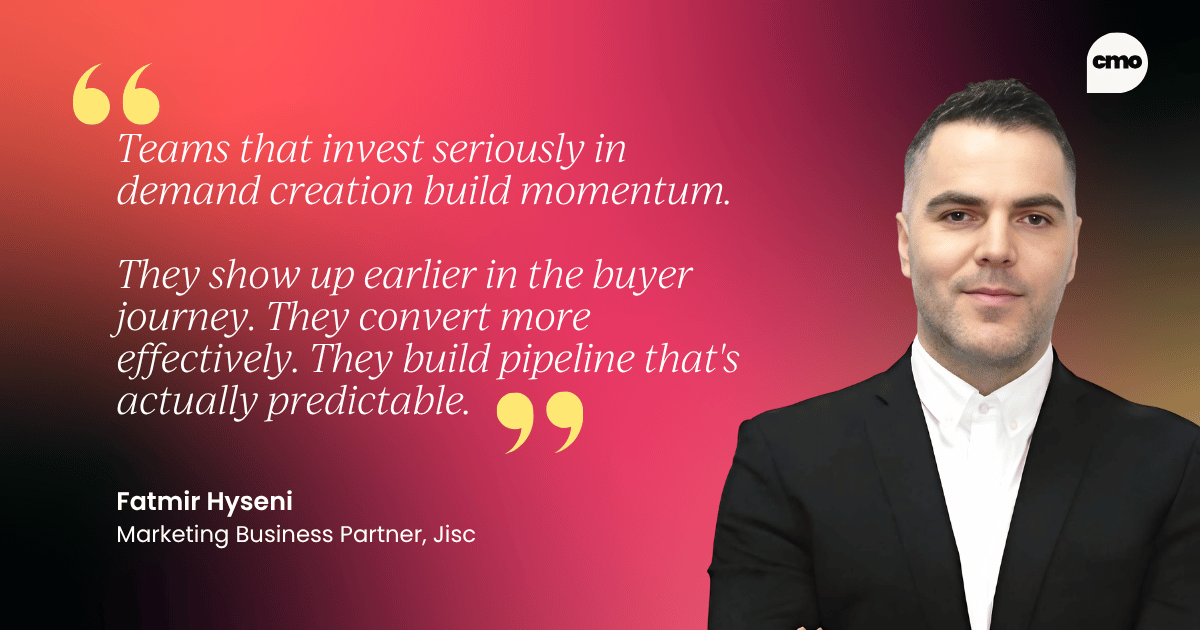
Teams that invest seriously in demand creation build momentum. They show up earlier in the buyer journey. They convert more effectively. They build pipeline that's actually predictable.
The shift isn't really tactical. It's a mindset change from asking "how do we capture more demand?" to "how do we create it in the first place?"
One final thought
The companies with the strongest pipelines right now aren't just better at generating leads. They've done the work so that when a buyer is finally ready to act, choosing them already feels like the obvious decision.
That doesn't happen by accident. And it definitely doesn't happen from a form fill alone.


Become a CMO Insider
Thank you for subscribing
Get exclusive insights, frameworks, and strategies from marketing leaders driving real business impact.
An email has been successfully sent to confirm your subscription.
 Follow us on LinkedIn