.png)




I’m the CMO at Aspect Health, a health-tech company focused on personalized wellness. Over the past two years, I’ve built AI-powered marketing automations that genuinely work – systems that produce ad creatives, run programmatic SEO campaigns, and handle content pipelines with real, measurable results.
But before any of that worked, I failed. Repeatedly. And when I look at the marketing leaders around me who are trying to adopt AI right now, I see them making the exact same mistake I made.
They’re skipping the most important step. They’re jumping straight into building. And that’s why the vast majority of AI marketing automations go nowhere.
The biggest mistake: Building before planning
Here’s how it usually goes. A marketer discovers ChatGPT, Claude, Gemini, or some new AI agent platform. They get excited – understandably so. They open a chat window and type something like “Create a Facebook ad campaign for my product.” Or “Write me ten blog posts about our features.” Or they hear about agentic workflows and think: if I just build a smart enough agent, it will figure out my marketing for me.
The output looks impressive for about five minutes. Then you try to actually use it. The ad copy doesn’t match your brand voice. The blog posts are generic and say nothing your competitors aren’t already saying. The “smart agent” produces work that’s technically correct and strategically useless.
So what do people do? They blame the AI. They say the technology isn’t ready. They go back to doing things manually. Or worse, they keep prompting and re-prompting, hoping that the right magic words will somehow make it click.
I did all of that. I spent months trying to get AI tools to produce great marketing output by giving them better prompts, more context, longer instructions. And I kept hitting the same wall: the output was never consistent, never quite right, and the time I spent fixing it often exceeded the time I would have spent doing the work from scratch.
The problem was never the AI. The problem was me. I was asking the AI to do my thinking for me, when what I should have been doing was thinking first and then asking the AI to execute.
AI is your assistant, not your replacement
This is the mental shift that changed everything for me: AI is not a replacement for your marketing expertise. It’s an assistant. A very fast, very tireless, very literal assistant.
Think about what happens when you hire a junior marketer. You don’t say “go do our marketing.” You give them a process. You tell them step one is this, step two is that, here’s what the inputs look like, here’s what good output looks like. You check their work. You give feedback. Over time, they get better because the process guides them.
AI works the same way. But most people skip the process part entirely. They treat AI like a senior strategist who should just “know” what to do. It doesn’t. It’s brilliant at executing well-defined tasks, and terrible at figuring out what tasks need to be done in the first place.
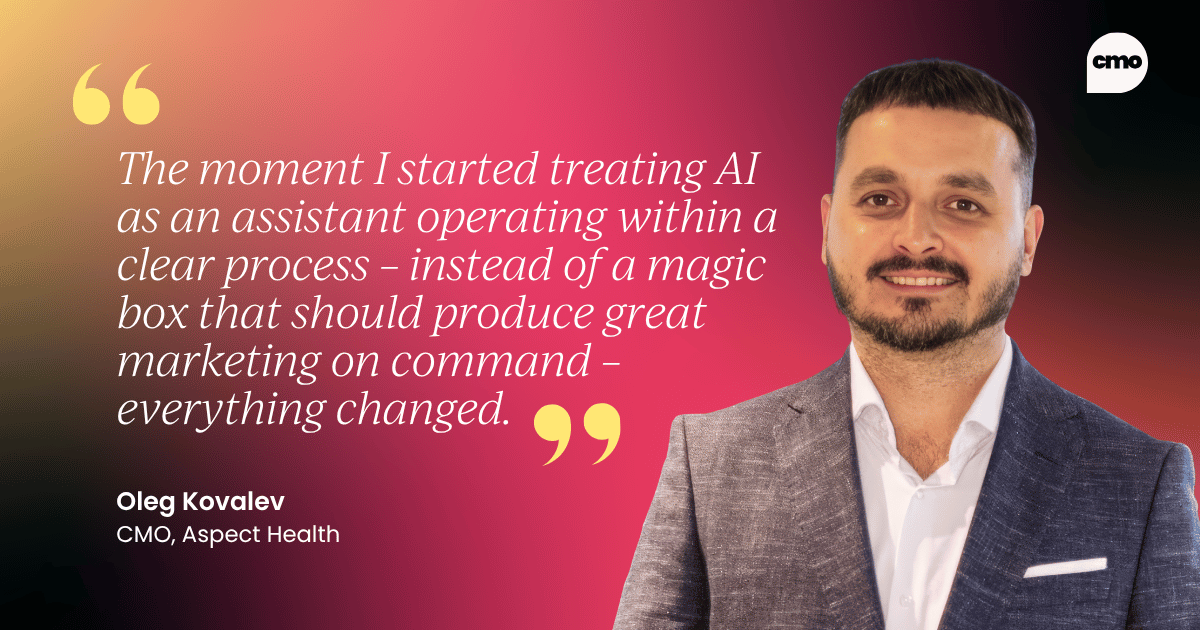
The moment I started treating AI as an assistant operating within a clear process – instead of a magic box that should produce great marketing on command – everything changed.
The fix: Map the business process first
The framework I use now is almost embarrassingly simple. Before I build any automation, before I write a single prompt, before I configure any AI agent or workflow, I map the business process.
I mean a real process map. Steps that go one after another (or in parallel where that makes sense), with defined inputs and defined outputs at each step. Not a vague idea of “first we research, then we create, then we publish.” An actual map where I can point to step three and tell you exactly what goes in and what comes out.
You can even use AI to help you map the process – and I’d encourage you to do that. Ask it to help you think through the steps, identify gaps, and define the inputs and outputs. AI is great at that kind of structured thinking. But the critical thing is that the process map exists before you start building.
Why? Because the process map becomes the backbone of your automation. Every AI agent, every automated workflow, every prompt – they all map to a specific step in the process. They have clear inputs (defined by the previous step’s output) and clear expected outputs (defined by what the next step needs). There’s no ambiguity. There’s no “just figure it out.”
Even a very simple business process – five or six steps with basic inputs and outputs – will make your AI marketing automation ten times more effective than any amount of prompt engineering applied to a vague brief. I’m not exaggerating. The difference is that dramatic.
How I built an SEO factory (and why process came first)
Let me show you what this looks like in practice.
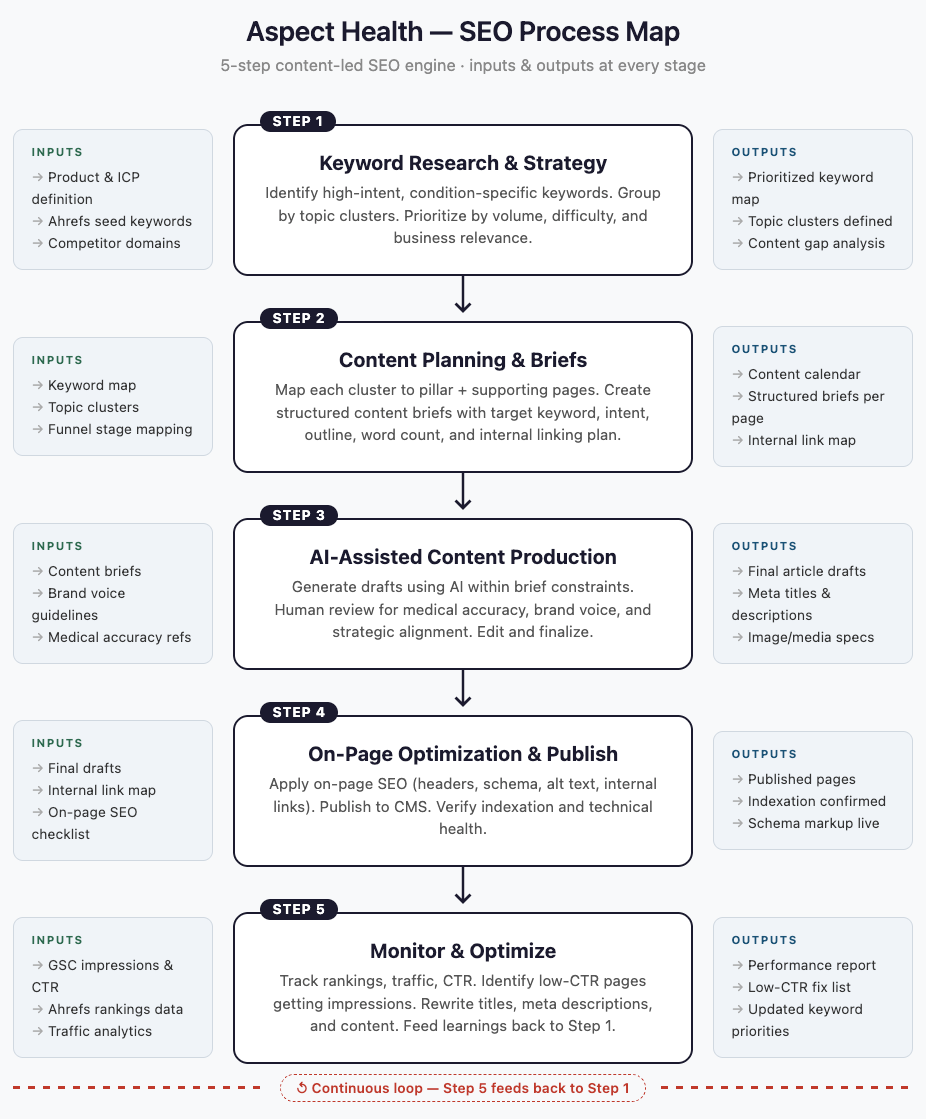
At Aspect Health, SEO is one of our core growth channels. Before I built any automation around it, I sat down and mapped the entire SEO content production process into five major steps. Each step had clearly defined inputs and outputs. Then I broke each of those five steps into smaller substeps – again, with inputs and outputs at every level.
Only after that map was complete did I start building the actual automation. And the difference was night and day compared to my earlier attempts, where I’d tried to just throw AI at the SEO problem and hope for good content.
With the process map in place, every AI agent in the pipeline knows exactly what it’s responsible for. The keyword research step produces a structured output that feeds directly into the content planning step. The content planning step produces briefs that feed into the writing step. The writing step produces drafts that feed into the optimization step. Nothing is left to chance or improvisation.
The result? A system that can produce high-quality, strategically sound SEO content at a pace and consistency level that would be impossible to achieve manually. Not because the AI is smarter than a human SEO expert, but because the process ensures the AI’s output is always aligned with the strategy.
Same principle, different domain: The ad creative factory
I applied the same approach to paid social ad creative production. We need a constant stream of ad banners – different audiences, different messages, different placements. Before the process-first approach, I’d tried letting AI generate creatives from loose briefs. The results were hit-or-miss and required heavy manual rework.
So I went back to basics. I mapped out a six-step process for ad creative production. The process starts with target audience research, moves through competitive analysis, considers the funnel stage and product positioning, and only then gets to the actual creative generation. Each step has clear inputs and clear outputs.
The target audience research step produces a structured audience profile. That profile, combined with the competitive analysis output, feeds into a messaging strategy step. The messaging strategy, combined with the funnel stage and product details, produces a creative brief. The creative brief feeds into the AI-powered generation step. And the generated creatives go through a review and selection step before they’re deployed.
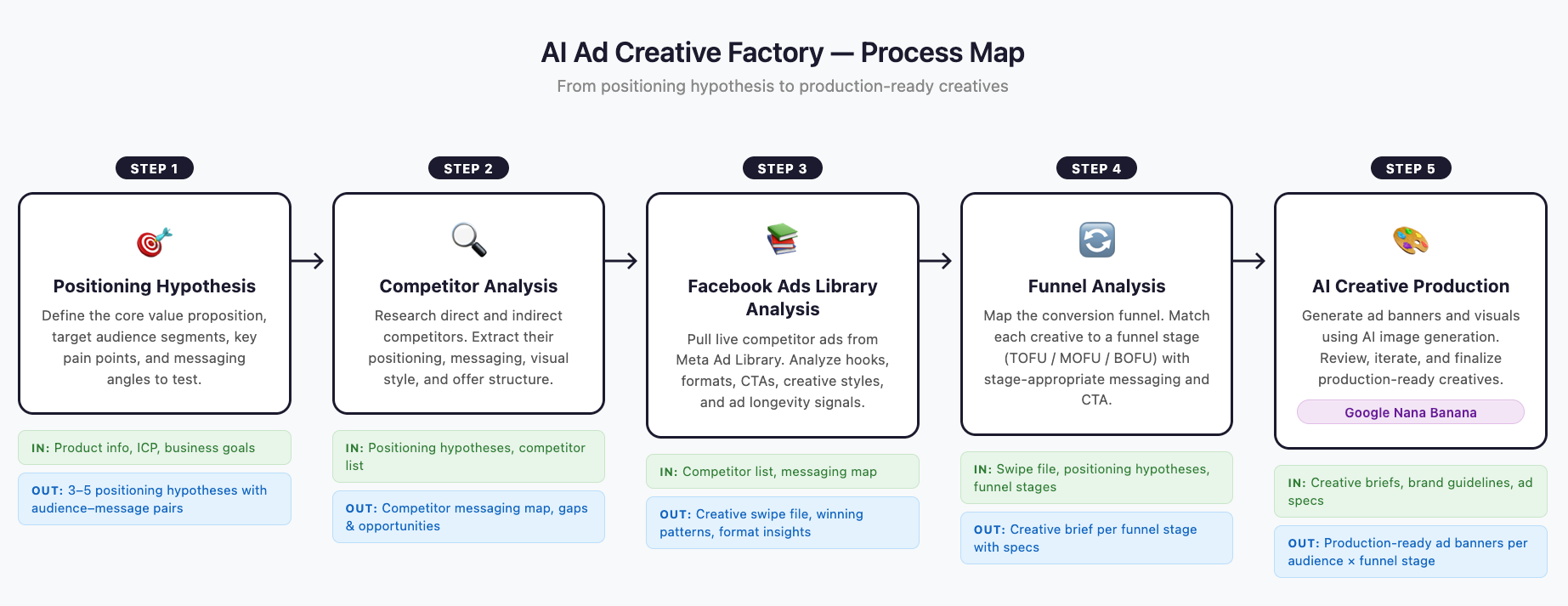
Five steps. Clear inputs. Clear outputs. The AI handles execution within each step. I handle the strategy and quality judgment between steps. The system produces better creatives faster than any approach I’d tried before – not because the AI got better, but because the process gave the AI what it actually needed to succeed.
Why most marketers skip this step
If process mapping is so powerful, why do most marketers skip it?
Because it doesn’t feel like progress. When you’re excited about AI, you want to build. You want to see output. Sitting down to draw boxes and arrows on a whiteboard feels slow and boring compared to opening Claude or ChatGPT and watching it generate something in real time.
There’s also a misconception that AI agents should be smart enough to figure out the process themselves. People hear “agentic AI” and imagine an autonomous entity that thinks strategically, plans its own work, and delivers polished results. That’s not what current AI does. Current AI is extraordinarily capable at executing defined tasks. It’s not good at defining the tasks in the first place. That’s still your job.
And frankly, a lot of the AI automation hype encourages this skip-the-process mindset. The demos always show the happy path: you type a simple request, the AI produces amazing output, and everyone claps. What they don’t show is the twenty failed attempts before the demo, or the fact that the demo prompt was carefully engineered to produce that specific result.
Real marketing automation at scale doesn’t work on carefully engineered one-off prompts. It works on repeatable processes with clear structures. That’s the unsexy truth.
How to start (today)
If you’re a marketing leader who’s tried AI automation and been disappointed, or if you’re about to start and want to avoid the common pitfalls, here’s what I’d tell you:
- Pick one marketing workflow that you run repeatedly. Something you do every week or every month. Ad creative production, content writing, email campaigns, social media scheduling – anything that has a repeatable pattern.
- Map it. Get a whiteboard, a Miro board, a Google Doc, a napkin – whatever works. Write down each step. For every step, write down what goes in and what comes out. Be specific. “Research” is not a step. “Analyze the top 10 competitor ads on Meta, extract their primary headline hook, value proposition, and CTA format, and produce a competitive creative brief” is a step.
- Use AI to help you with the mapping if you want. That’s a great use of AI – it’s a thinking partner, and it’s good at helping you structure your own knowledge. But make sure you end up with a real process map with real inputs and outputs.
- Only then, start automating. Take each step in your process and ask: can AI handle this step if I give it the right inputs? Some steps it can handle entirely. Some steps it can assist with. Some steps still need to be done by a human. That’s fine. The point isn’t to automate everything. The point is to automate the right things within a structure that keeps the whole system strategically sound.
This is the single biggest unlock for AI adoption in marketing. Not better models. Not better prompts. Not fancier agent frameworks. Just a clear business process, mapped out before you start building. It sounds obvious, but it’s the step that almost everyone skips. And that’s why almost everyone fails.


Become a CMO Insider
Thank you for subscribing
Get exclusive insights, frameworks, and strategies from marketing leaders driving real business impact.
An email has been successfully sent to confirm your subscription.
 Follow us on LinkedIn