


.png)




The marketing org chart is currently undergoing its most significant renovation in a decade. For years, we’ve built teams around specialized silos – search, social, content, and performance – but the walls are beginning to thin.
As we look toward the next five years, the evolution of the marketing function is less about adding new seats to the table and more about redefining what those seats actually do.
The future of marketing teams is still deeply human
With AI accelerating at pace, it would be easy to assume marketing teams are heading toward a purely automated, efficiency-first future. The reality is more nuanced and far more interesting.
According to the Future of Marketing report, when marketers were asked how their teams would evolve over the next five years, the responses revealed a clear shift in priorities:
- Becoming more focused on storytelling and creativity: 37%
- Integrating more with other departments: 32.1%
- Becoming more data-driven: 27.2%
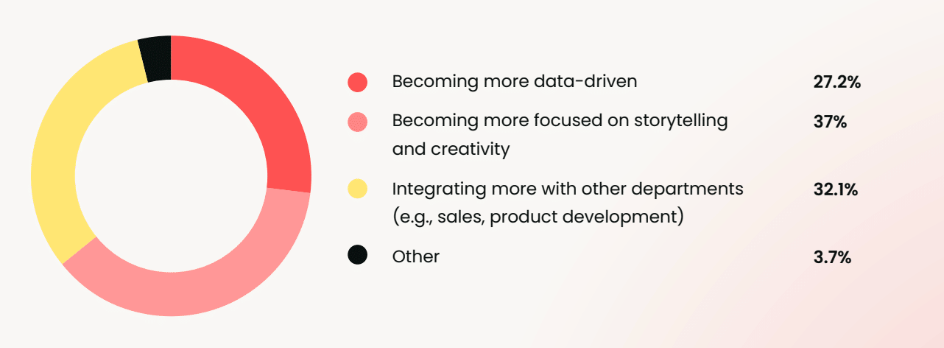
Creativity edges ahead, even as AI adoption grows. That alone says something important.
There’s a growing recognition that as automation increases, differentiation becomes harder to achieve through tools alone. What stands out instead is how brands make people feel, how they communicate meaning, and how well they translate complexity into compelling narratives.
This is particularly telling given how many marketers express concern that AI could dilute human creativity. Rather than replacing it, many leaders are doubling down on it.
As Burak Yedek, Fractional CMO, puts it:
“We're going to shift towards meaning and connection where data and AI reign… Marketers will need more human hallucinations rather than AI… The role will become more intuitive and function as an internal strategy role that connects and reveals the meaning inside a company.”
The rise of the hybrid, “person-shaped” marketer
Alongside this renewed focus on creativity is a structural shift in how marketing talent is defined.
For years, the industry has cycled through different models of specialization – T-shaped, M-shaped, and beyond. Now, there’s a noticeable return to versatility, but with a modern twist.
As Heather Hurd, Head of Marketing at Zander Labs, describes it:
“Here comes the general(ist)... again… I know a little about a lot, and that's worked well for me… when we bring the generalists together, we'll still get plenty of specialized knowledge… creating a well-balanced group that gives the specialists room to shine and allows the generalists to figure out the rest.”
This reflects a broader trend in which marketing teams are becoming ecosystems of complementary strengths, rather than rigid role definitions.
Specialists still matter (arguably more than ever), but they operate within fluid, collaborative structures. Generalists act as connectors, bridging strategy, execution, and cross-functional alignment.
Rossana R. Rodgers, CMO at Authena AG, reinforces this shift:
“The modern B2B marketing team includes data scientists, prompt engineers, and AI content curators alongside strategists. Roles are merging, but strategic clarity and creativity are still irreplaceable.”
For marketing leaders, this creates a new challenge in building teams that are both deep and adaptable, without defaulting to outdated org structures.
AI will expand teams, not just streamline them
AI is now more than just a tool, and is becoming an embedded layer within marketing teams themselves.
Rather than replacing roles outright, it’s reshaping how work gets done and who (or what) contributes to it.
Paul Gray, Partner Marketing at Webflow, captures this shift well:
“The next-gen marketer will have their own AI ‘team’ – a set of trained agents helping with research, ideation, content, optimization, and analysis… Leadership will mean knowing how to manage both humans and machines.”
This reframes productivity entirely. The leverage of a single marketer increases, but so does the complexity of orchestration.
 Charley Gale
Similarly, Chloe Addis, Head of Marketing at Headley Media, points to where real value will sit:
“The true skills will lie in the interpretation of results/data and strategic application.”
Execution becomes faster and more scalable. Judgment, interpretation, and decision-making become the differentiators.
For CMOs, this means thinking beyond headcount and toward capability design:
- How do teams operate with AI embedded into workflows?
- Who owns outputs generated by machines?
- What new skills need to be developed internally?
Marketing is becoming the connective tissue of the business
One of the strongest signals in the data is the growing integration of marketing with other functions. Over 32% of marketers expect deeper collaboration across departments such as sales, product, and IT.
This aligns with how marketing’s remit has already evolved.
Fellow marketer, Islam Gouda, explains:
“The role has shifted from simply generating awareness to owning the full customer journey, from acquisition to retention… marketing teams must now work closely with product, sales, and IT to create unified and measurable experiences.”
Marketing has moved from a downstream function to being embedded across the entire customer lifecycle.
Jelle Boeser, Head of Brand and Digital Marketing at Royal Canin, adds:
“Marketing is shifting from fixed functions to hybrid disciplines. The future belongs to marketers who think cross-functionally by default.”
And from a leadership perspective, this shift is even more pronounced.
Jessica Ruffin, Director of Product Marketing, puts it simply:
“The modern marketing leader is part storyteller, part strategist, part unifier… connecting the dots across teams and customer touchpoints.”
For CMOs, this requires a redefinition of influence. Success is increasingly tied to alignment across the business, not just performance within the function.
The CMO is evolving into a growth architect
As marketing becomes more integrated and data-informed, the role of the CMO is expanding accordingly.
There’s a clear move away from marketing as a service function and toward marketing as a driver of business strategy and revenue.
Alberto Gerin, CMO at Modefinance, frames it directly:
“We're heading to a strategic growth engine, where CMOs are not just brand stewards but revenue architects, data translators, and cross-functional leaders.”
This evolution brings new expectations:
- Ownership of growth, not just pipeline contribution
- Fluency in financial and operational metrics
- Active collaboration with CEOs, CFOs, and product leaders
It also introduces new operating rhythms. Alberto highlights the growing importance of experimentation:
“Real-time, AI-enhanced A/B testing… will be central to how we lead product adoption, growth loops, and innovation cycles.”
Meanwhile, structural pressures are mounting.
As Charlie Grinnell, Co-CEO at RightMetric, notes:
“The org chart is stuck in 2015… We need new operating models, not just new hires.”
The implication is that this transformation must focus on redesigning how marketing actually works.
New models of leadership and talent are emerging
As complexity increases, so does the need for flexible leadership models.
One notable shift is the rise of fractional executives, particularly at the CMO level.
Katherine Lehman, Fractional CMO and Founder of KT Creativity, explains the appeal:
“The more companies you work for… the more unique your perspective… those insights can make or break an organization that is scaling up or stuck in neutral.”
For organizations navigating rapid change, this model offers access to high-level expertise without long-term commitment.
At the same time, it reflects a broader truth that experience diversity is becoming as valuable as tenure.
What this means for marketing leaders
Taken together, these trends point to a fundamental reshaping of marketing teams.
- Creativity is becoming a strategic differentiator
- Roles are blending into hybrid, flexible skill sets
- AI is augmenting teams, not simply reducing them
- Marketing is deeply embedded across the business
- The CMO role is expanding into growth, strategy, and operations
The common thread is orchestration. Marketing leaders are increasingly responsible for connecting systems, people, data, and ideas into something cohesive and impactful.
Or, as the industry continues to evolve, perhaps the simplest way to think about it is this: the future marketing team isn’t defined by its structure, but by how well it adapts, collaborates, and creates meaning at scale.


Become a CMO Insider
Thank you for subscribing
Get exclusive insights, frameworks, and strategies from marketing leaders driving real business impact.
An email has been successfully sent to confirm your subscription.
 Follow us on LinkedIn