.png)







Think of a marketing-qualified lead (MQL) as a hint that someone might actually buy from you. This could take the form of someone grabbing a free guide or clicking an ad a few times. For over ten years, this single number practically ran marketing team board meetings. As long as the MQL count kept climbing, everyone assumed marketing was doing its job. CMOs built entire strategies, teams, and budgets just to keep that number growing.
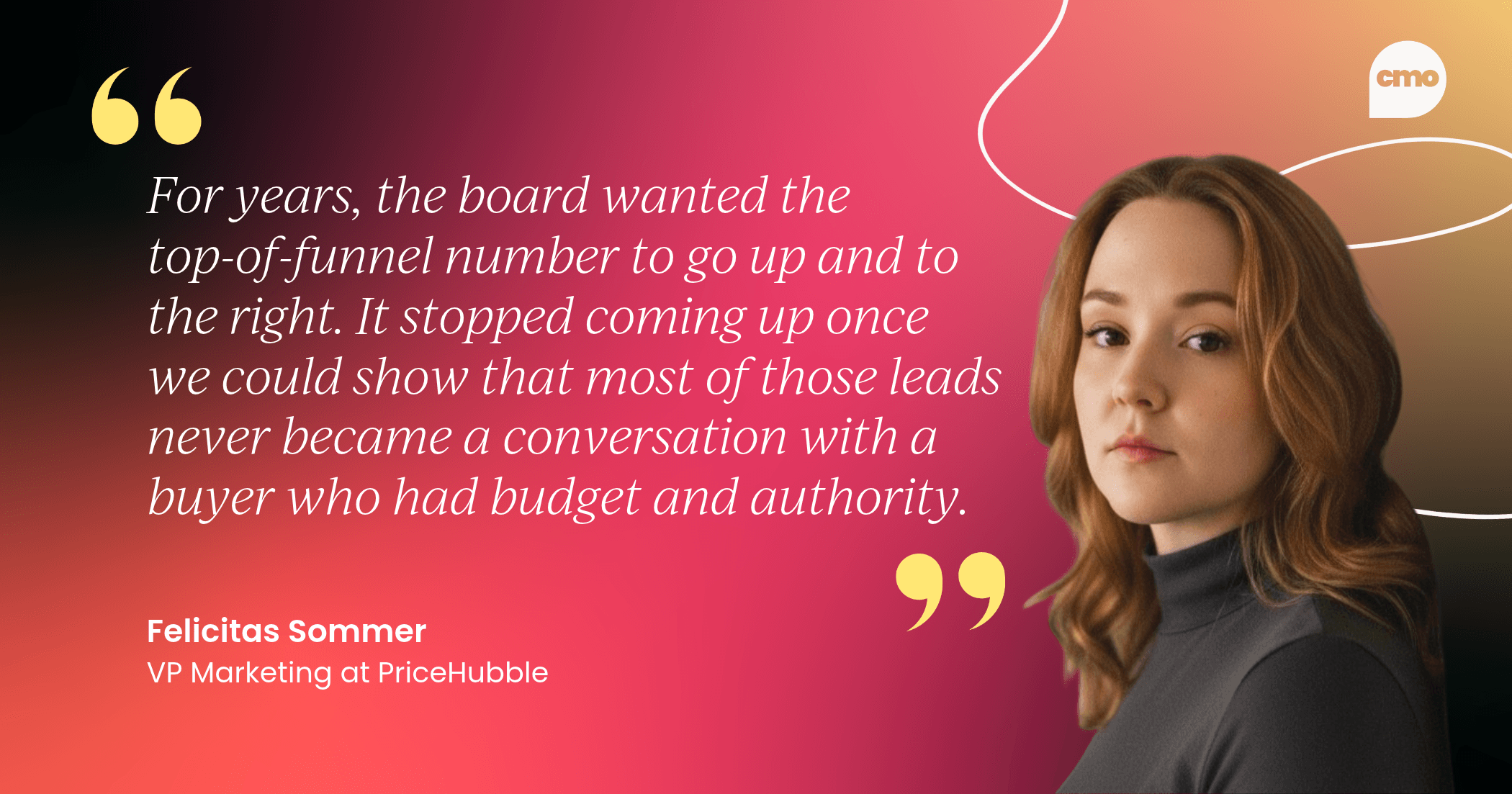
But times have changed, and in 2027, that number will barely get a glance. Boards found out the hard way that more MQLs didn't always mean more revenue. The reality was that most of those leads just never turned into real conversations with people who had the budget and authority to buy.
So, enterprise boards eventually stopped focusing on simple lead counts and began looking for metrics that offer a clearer picture of real business impact.
This piece is a look at which metrics are losing their grip on the boardroom and why. You’ll also hear directly from CMOs and other marketing leaders who’ve already made the change, and uncover the one metric each would stand by when put on the spot. By the end, you’ll have a practical list of what you should include in your next board deck.
Key takeaways
- MQLs are quickly disappearing from board decks. Truth be told, most enterprise boards stopped trusting them long before marketing teams caught on.
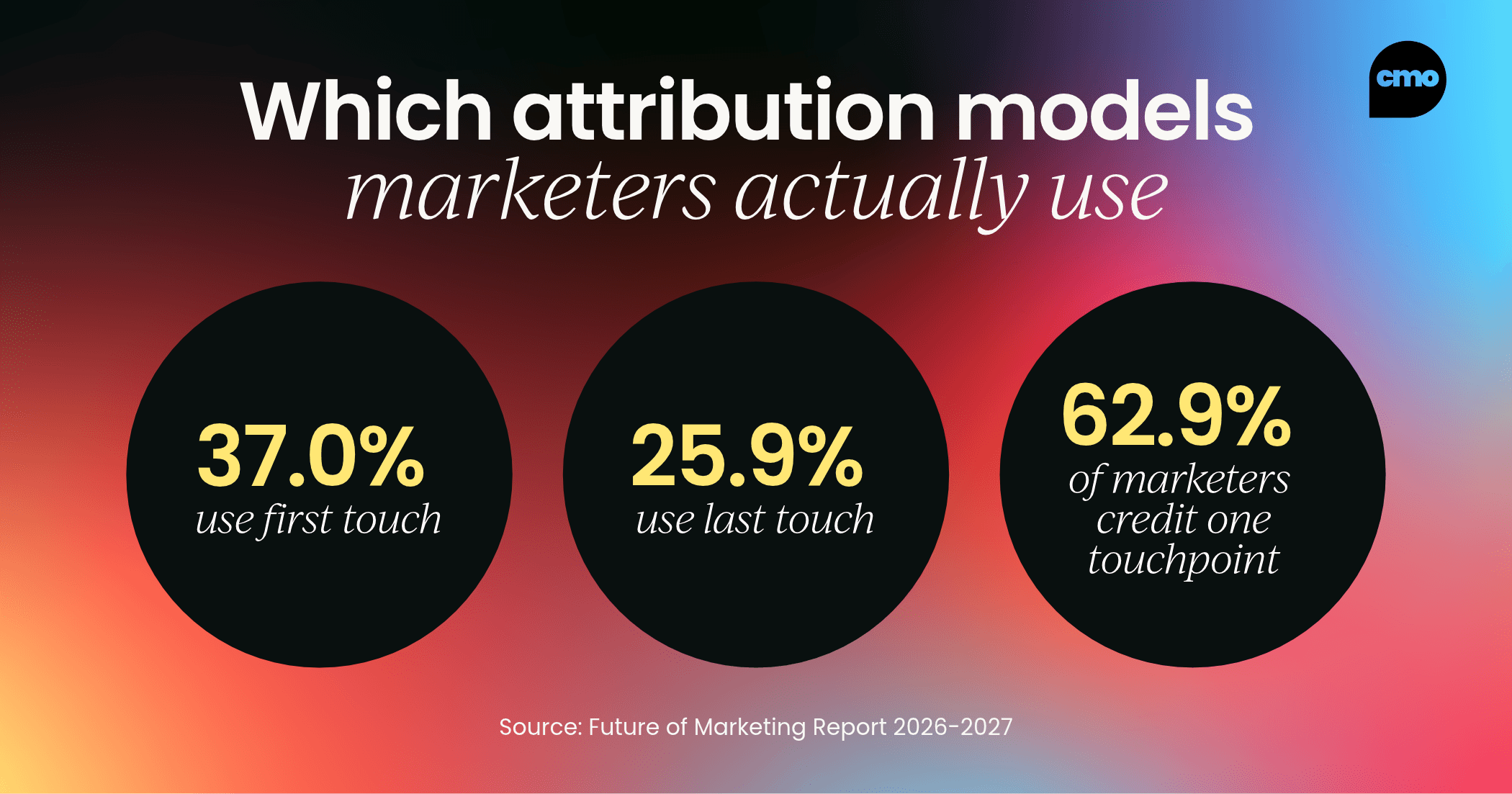
- 62.9% of marketers still attribute an entire sale to a single touchpoint, like the very first or final click.
- Three core metrics are stepping up to replace MQLs: pipeline contribution to sales-accepted opportunities, overall category market share, and marginal efficiency mapped straight to EBITDA.
- When asked, each CMO on our panel championed a different key metric, yet every single answer traced back to tangible revenue finance could verify.
- 65% of marketing leaders say the pressure to prove ROI has risen sharply over the last three years, and confidence in their own attribution data sits at just 2.8 out of 5.
Why marketing is still guessing at what works
To understand why MQLs lasted so long, you have to look at how marketing teams measure success. We asked marketers in our Future of Marketing 2026-2027 Report how they attribute a sale, and the vast majority still trace it back to a single touchpoint: 37% give full credit to the first point of contact, while 25.9% assign it all to the final interaction before closing.
That’s a total of 62.9% of marketers who credit one touchpoint for revenue the whole marketing team helped bring in. Better models exist, ones that spread credit across the real buying journey. But barely a quarter of marketers use them.
These same marketers aren't confused about why this is happening. In fact, 50.6% pointed directly to messy, unreliable data as their primary headache, while 48.2% cited the ongoing nightmare of connecting data across a web of disconnected tools.
Deep down, teams know their attribution models oversimplify reality. Yet, they stick with them anyway because it feels like the safest route to give leadership a sense of certainty about a complex customer journey that rarely offers any straightforward answers.
Without a single source of truth, teams end up prioritizing quick, presentable answers (like a neat MQL count) over long-term clarity. And that habit is exactly what's catching up with them now.
3 metrics enterprise boards are quietly cutting
Once finance teams start poking holes in single-touch attribution, the whole traditional marketing dashboard basically falls apart. Based on insights gathered from industry experts in our report, here are the three familiar metrics losing their grip on boardrooms.
1. MQL volume
MQL volume was the first metric to lose the board’s trust, both in our own report and among the marketing leaders we spoke with. When asked about MQLs, Cory Peterson, VP of Marketing and Sales Operations at LED Lighting Supply, said: "They are the new website traffic when it comes to vanity metrics. You could generate thousands of MQLs that convert into very few sales qualified leads."
Ashlesh Shah, CMO at Canopy Services, made a similar point: "Lead counting was always a noisy operational proxy that offered a false sense of security. At the board level, it has been replaced by Category Market Share, evaluated through the dual lens of Demand Capture vs Demand Creation."
Tallying up leads gave teams a quick sense of progress, but it never actually proved whether they were outperforming the competition. That’s the gap boards simply aren't willing to ignore anymore.
Many marketing leaders agree it could be the end of the MQL. For example, Felicitas Sommer, VP Marketing and Communications at PriceHubble, says the board's appetite for MQL volume held up for years. That changed once it was obvious most of those leads never became a real conversation with a buyer who had budget and the authority to use it.
2. Unqualified website traffic
Website traffic is heading down that same path. In the past, a steady climb in monthly visitors was an easy win to flash on a board slide because it made the brand look visible and relevant.
However, since AI search summaries are eating into traditional clicks and automated bot traffic is muddying analytics, raw visitor counts tell leadership almost nothing about business health.
Fatmir Hyseni, Marketing Business Partner at Jisc, points out that traffic "can look healthy while having little business value."

A site might pull in tens of thousands of readers through broad, top-of-funnel blog posts, yet generate zero pipeline for the sales team. Boards no longer care how many people walked past the storefront; they want to know who walked in ready to buy.
3. Standalone social metrics
Boards have also lost patience with standalone social metrics, including things like impressions and engagement that don't tie back to real business results. High engagement feels great for the marketing team, and it’s easy to screenshot for a monthly update, but a viral post doesn't pay the bills if it doesn't shift buyer perception or move pipeline.
Scott Morris, CMO at Sprout Social, sees leadership pushing past surface-level numbers in favor of actionable market intelligence:
“In my experience, boards have less appetite for social metrics reported on their own, like impressions and engagement. What I see replacing them is a different question: what are customers, the market, and competitors telling us, and what did we do about it?”
Yuvrraj Agarwaal, Chief Strategy Officer at Laqshya Media Group, sums up the trap behind all three of these metrics in five words:
"Reach is rented. Memory is owned."
Think of "renting" attention like buying paid clicks or boosting posts. It costs you every single time someone takes a look, and that moment vanishes just as quickly.
"Owning" space in someone's mind means that when they're finally ready to buy, you're already the very first name they picture, without having to spend an extra cent. And that’s exactly why boards are done paying for rented attention. They want to see proof that you're building lasting demand.
 Charley Gale

Where the board's attention has moved
If MQLs, raw traffic, and social likes are on their way out, what’s taking their place?
As our Future of Marketing report highlights, that shift is already happening. Marketers are now prioritizing revenue (68.7%) and conversions (66.3%) over raw lead counts (63.9%). Enterprise boards are moving away from surface-level metrics to focus on real business outcomes, and three key numbers are taking center stage.
1. Pipeline contribution
The first is pipeline contribution to sales-accepted opportunities. This measures how much of the pipeline marketing generates that the sales team actually agrees is a genuine deal.
Instead of celebrating 1,000 raw leads that sales ignores, this metric forces marketing and sales to agree on quality before anyone takes credit. Felicitas Sommer says what replaced MQL volume at PriceHubble is "pipeline-influenced and sales-accepted opportunities, and increasingly the quality of the conversations our proof points can substantiate, not the count of form fills."
Cory Peterson saw the same pivot at LED Lighting Supply:
"Sales qualified leads were the natural replacement metric as they tie directly to the sales funnel and revenue."
When sales co-signs the number, the board stops questioning whether the leads are any good.
2. Category market share
The second is category market share. Ashlesh Shah frames marketing's impact through what he calls Demand Capture versus Demand Creation: how efficiently the company captures active demand against competitors, and how much it grows the total market.
“We now frame our impact around how efficiently we capture active in-market demand against competitors, and how effectively marketing expands the total addressable market. Market share tells you whether marketing is actually changing your position in the market.”
Tracking MQLs won't show the board if you're actually ahead of the competition. Measuring your category market share clears that up by showing how much of the pie is really yours.
3. Marginal efficiency mapped to EBITDA
Blended MER (Marketing Efficiency Ratio) simply divides your total revenue by your total marketing spend, while marginal efficiency looks at what the next dollar spent actually returns.
Linking this to EBITDA (the company's core operating profit) helps answer a common question that CFOs have: If we give marketing another $100,000, does it actually boost profit, or are we just buying pricey revenue?
Ashlesh argues that traditional multi-touch attribution has been exposed by privacy rules and messy buying journeys as "precise fiction." In its place, forward-thinking teams are using incrementality testing and Blended MER to prove growth isn't eating into profit margins.
“Privacy shifts and non-linear buying journeys have exposed fractional software attribution as precise fiction. Boards no longer waste time debating which digital channel gets credit for a deal. It’s been replaced by Incrementality testing and Marketing Efficiency Ratio (MER) - measuring holistic enterprise growth against total go-to- market spend.” - Ashlesh Shah, CMO at Canopy Services
 Sabrinthia Donnelly

Why finance is forcing this reset
This push for harder numbers reaches well beyond our own research. Gartner found that only 54% of CEOs and CFOs trust their CMO to prove marketing's value to the business.
Our attribution data explains exactly why that trust gap exists.
Half the industry can already name what’s broken in its own measurement, yet hasn't fixed it. Until marketing stops pitching known defects like MQLs and starts reporting on sales-accepted pipeline, market share, and profit margins, that skepticism in the boardroom isn't going anywhere.
The one number worth defending
We asked our panel of marketing leaders a sharper question: If you could defend only one number to your executive team next quarter, which one would you pick?
Here is what they chose:
Getting sales to co-sign your numbers
Felicitas Sommer believes a metric only counts in the boardroom when sales agrees it's real. Everything else is just marketing grading its own homework.
“Pipeline contribution to sales-accepted opportunities. It’s the number that connects marketing spend to revenue the sales team has agreed is real, which is the only version of ‘marketing works’ a CFO actually values. Reach and engagement are inputs. This is the one that survives scrutiny.” - Felicitas Sommer, VP Marketing & Communications at PriceHubble
Proving what wouldn't have happened without you
Yuvrraj Agarwaal isn't interested in taking credit for sales that were going to happen anyway. He wants the number that proves marketing actually moved the needle.
“Incremental contribution. The revenue that would not have existed if we had not shown up. It is harder to produce than ROAS and almost impossible to game, which is exactly why I trust it. Last-click tells the CFO which channel was standing nearest the sale. Incrementality tells them which spend actually created it. - Yuvrraj Agarwaal, Chief Strategy Officer at Laqshya Media Group

Spotting when a good channel goes stale
A tactic that crushed it last year might be quietly burning cash today. Nicholas Testa looks at what your next dollar is doing, not your historical average.
“Marginal returns on marketing spend, because it’s weighted towards what’s working right now, and average returns tend to mask diminishing returns. Focusing on marginal returns also forces us to move beyond the endowment effect and sunk-cost fallacies.” - Nicholas Testa, Influence Advisor and Psychological Operations Veteran
Scaling winners without blowing up costs
For leaner teams, Cory Peterson keeps things grounded in realistic growth, knowing full well that doubling down on a winning campaign takes patience.
“2x. Doubling our best-performing programs, with the expectation that the ramp-up takes 2x as long as anticipated. Ramping smart is paramount to avoid acquisition cost inflation.” - Cory Peterson, VP of Marketing & Sales Operations at LED Lighting Supply
Protecting company profit while you grow
Ashlesh's pick is all about proving to the CFO that marketing growth isn't coming at the expense of the company's bottom line.
“Defending Blended MER proves to the CFO that our LTV:CAC dynamics are healthy on paper and drive revenue at an acceptable margin that protects net profitability. It demonstrates that as marketing investment scales, it predictably yields higher-LTV pipeline without eroding bottom-line margins.” - Ashlesh Shah, Chief Marketing Officer at Canopy Services
Keeping it simple with the tools you already have
Not every team has the data setup for incrementality modeling yet, and Fatmir Hyseni offers a refreshingly practical alternative you can track today.
“The number of qualified opportunities influenced by marketing. It connects marketing activity to something the wider business understands and cares about.” - Fatmir Hyseni, Marketing Business Partner at Jisc
Why finance finally ran out of patience
So why is this shift happening right now, instead of five or ten years ago?
Well, the answer points to finance tightening the purse strings. There seems to be a general reduction in the amount of funding CFOs are willing to give to marketing. To be more precise, they’re done funding metrics that don’t clearly trace back to revenue.
Our CMO Insights report 2026 shows just how tense this pressure on marketing to prove ROI has become:
- 65% of marketing leaders say the pressure to prove ROI has jumped sharply over the last three years.
- 55% name budget constraints as their single biggest headache.
- Meanwhile, the share of CMOs who count finance as a close partner dropped from 35% to 23% this year, even as the stakes of every CFO check-in keep rising.
Even CMOs admitted that their confidence in their own attribution data is around 2.8 out of 5, the lowest rating in our entire study.
Boards used to let comfortable vanity metrics like MQL counts slide just to keep things moving. But today, between shrinking budgets and broken tracking, they’d much rather see an honest, unvarnished number tied directly to real profit.
Put those two forces together, and 2027 is set to be a hard wake-up call. That means it’s time to completely rethink what goes into your next board deck.
Your next board deck
None of this is just wild guessing. It's real advice straight from our panel of marketing leaders when we asked them what actually holds up when you're facing the board. We've boiled it down so you know exactly what to bring into your next deck:
- Build the deck around sales-accepted opportunity contribution, category market share, and Blended MER mapped to EBITDA, not activity counts. If a slide can't trace to revenue or margin, cut it.
- Pick the one number you'd defend under direct questioning. Have it ready before anyone asks.
- Separate what you know, what you can reasonably infer, and what you can't prove with certainty, and say so in the room: here's what we know, here's what we can reasonably infer, and here's what we cannot prove with certainty.
- Don't overclaim. A CMO who overclaims attribution loses more credibility over time than one who's upfront about what's measured and what's believed.
- Watch for Metric Disease. The easiest numbers to produce aren't automatically the ones that matter, and a dashboard built around what's convenient to track will eventually steer strategy toward whatever's convenient to improve.
Want the full picture?
Our Future of Marketing 2026-2027 report covers all of this in more depth, plus chapters on AI adoption, budgets, priorities, and where marketing careers are headed next.


Become a CMO Insider
Thank you for subscribing
Get exclusive insights, frameworks, and strategies from marketing leaders driving real business impact.
An email has been successfully sent to confirm your subscription.
 Follow us on LinkedIn