.png)






Templates and frameworks to pair with this playbook
- Board deck template for CMOs
- General marketing board reporting template
- Budget allocation template
- Growth levers audit checklist
- Pipeline confidence forecast template
Nail the skills
How many times have you felt a knot in your stomach when asked to present marketing performance to the board?
You know you'll be challenged. You've spent twenty minutes walking through engagement and brand awareness figures, only for someone at the end of the table to pipe up with "So what?" There's nothing more deflating.
The scrutiny can feel unjust. Marketing is probably the only function that has to predict the future from historical data while justifying an investment that hasn't converted yet: brand. It's a tough gig, and I’m here to help get it right. In this article, we'll cover:
- How to translate marketing activity into the language of the business
- How to align with your CFO, CEO, and leadership team on what growth means
- The four numbers I believe marketing should own
- How to talk about brand and performance spend like an investor
- How to build commercial credibility across your team
Stop reporting marketing and start leading growth
A lot of the detail we feel the need to share with senior leaders just isn't relevant. It's confusing minutiae. Meanwhile, we keep getting asked the same question: "We spent 12 million, so what did we actually achieve?"
In my view, marketing data has two key jobs. The first is to direct, steer, and optimize for better performance. That's where the minutiae lives.
The second job is to show the cumulative effect of the total marketing strategy, delivered against commercial objectives within the cost envelope. That's the conversation we should be having with the board.
Can you imagine walking into the CFO's office and saying, "Take me through every detail of that pension investment"? We're marketers, and it’s not our job to be interested in that stuff. Being clear about what's relevant across the whole business, and managing that narrative, works the same way.
Speak the same language
Marketers talk in clicks, reach, engagement, and MQLs, while CEOs and CFOs don't want to hear anything unless it has a dollar sign in it. They want to know we're making money and not overspending.
Over the last twenty years, we've become brilliant at measuring activity. We have multiple ways of measuring attribution and tons of beautiful digital data. What we haven't become as good at is translating it into a language that's relevant to the broader business.
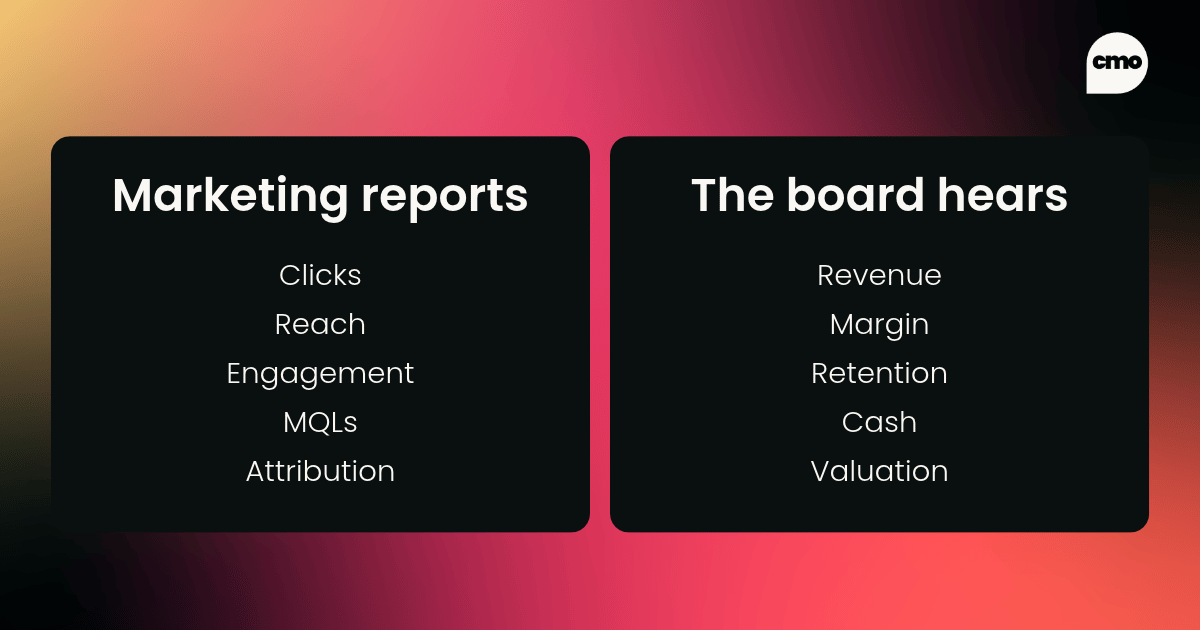
The test I use with my team every day is simple. Whenever someone tells me what activity we’re running, I ask, "And that equals what?" The answer should always come back in money. For example, "We’re launching a webinar series, and that equals $50K in pipeline." If there’s no dollar sign after the equal sign, we’re still talking about activity, not impact.
Most organizations already have all the data and performance material they need. The work ahead is translation: extracting what we have into a language that's relevant to the board and the leadership team.
For expert insights like this straight to your inbox twice a month, sign up for Pro+ membership.
You'll also get access to a range of certifications, a complimentary Summit ticket, 50+ tried-and-true templates, members-only workshops, and much more.
So, what are you waiting for?
Get aligned on what growth means
We can’t translate marketing into the language of the business until we agree on what the business is trying to achieve. That alignment starts with the numbers your leadership team is already working from, so that’s where to begin.
Start with the P&L
I gave a talk a few months back, and I was surprised to learn that half of the CMOs and senior leaders in the room had never seen their profit and loss (P&L) statement. If you haven't seen it, you don't know how it was built or what assumptions went into it, so how can you build a marketing plan that will deliver against it? At the very least, you should see the assumptions behind that number.
Define growth with your leadership team
What growth means is different for every business, depending on its stage. For a scale-up, it's all about top-line growth until the moment the board needs proof of profitability. For a big corporation, the priority is often a mix of revenue, market share, and profitability, and the emphasis can swing.
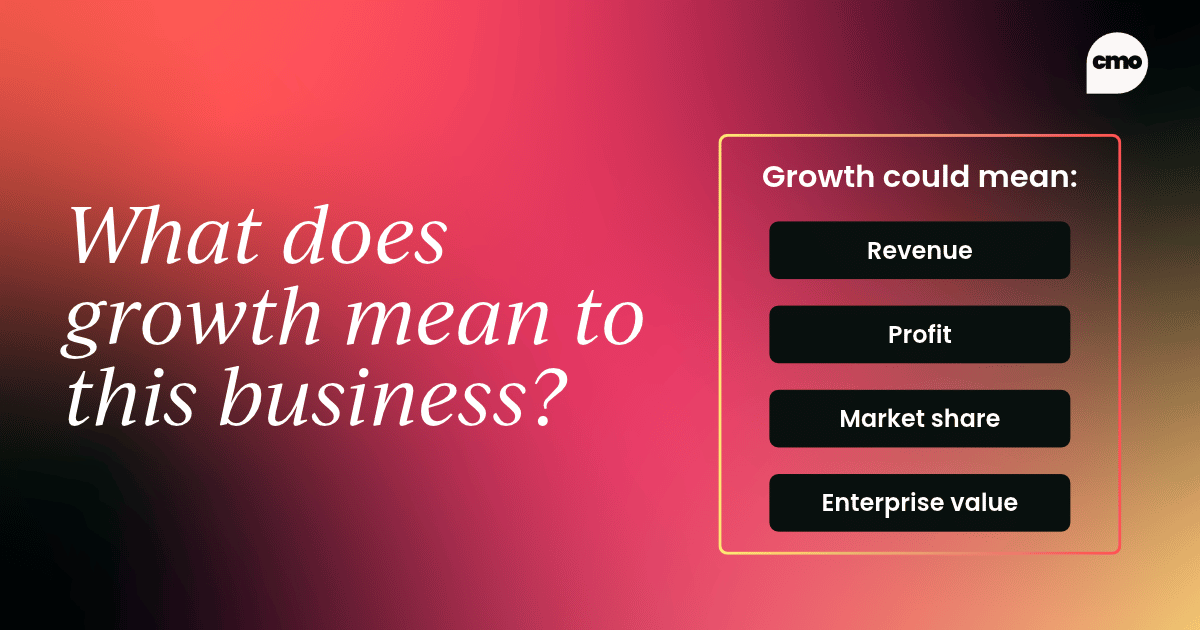
Even when the focus swings from week to week, your team needs to know the core strategy for the year. That clarity matters. If the CEO says it’s all about revenue, but the board says it’s all about valuation, you don’t have an aligned strategy, and you can’t deliver aligned metrics.
And remember: not all revenue is equal. In the scale-up phase, any revenue is good revenue because you're trying to prove market fit. Once you've proved it, the board will start asking you to prove that growth is profitable.
Ask better questions about revenue


Become a CMO Insider
Thank you for subscribing
Get exclusive insights, frameworks, and strategies from marketing leaders driving real business impact.
An email has been successfully sent to confirm your subscription.
 Follow us on LinkedIn