.png)





In 2015, an 11,000-pound steel flywheel in a Poway, California, warehouse decided it’d had enough of spinning at 6,000 rotations per minute. It broke free from its moorings, crashed through the vault's guard rails, punched a hole through the roof, and sent shrapnel flying blocks away. Four workers were injured. The building was condemned.
The company, Quantum Energy Storage, folded within a year.
I think about that flywheel a lot – not because I'm particularly interested in industrial accidents, but because it's a perfect metaphor for what most people get wrong about building momentum. They think the goal is maximum velocity. They forget about containment. They ignore what happens when things come apart.
But there's another flywheel story – one that shows what happens when you get it right. It involves a Porsche, a physics bet that most engineers thought was crazy, and a lesson that changed how I think about business.
The Porsche that ran on physics
In 2010, while every other automaker was cramming lithium-ion batteries into their hybrid race cars, Porsche's engineers asked a different question: what if we stored energy as motion instead of chemistry?
The result was the 911 GT3 R Hybrid – a racing laboratory with a 16-inch flywheel spinning at 40,000 rpm where the passenger seat should have been. When the driver braked, the energy that would normally dissipate as heat instead spun up the flywheel. When they needed extra power – exiting a corner, blowing past a competitor – they pressed a button and unleashed 163 horsepower for eight seconds straight.
The flywheel could charge from empty to full in a single hard braking zone. It could discharge over a million times without wearing out. And while the battery packs in conventional hybrids needed to be replaced three times during a 24-hour race, the flywheel just kept spinning.
At the 2010 Nürburgring 24 Hours, the car led for over eight hours before a mundane engine failure took it out. (The irony: it wasn't the hybrid components that failed.) But the point had been made. While everyone else was fighting chemistry, Porsche had bet on physics – and physics was winning.
"Efficiency is the key to success in endurance racing. The time spent in the pits refueling is time not spent accumulating distance on the track."
– Dr. Wolfgang Dürheimer, Porsche R&D Director
Here's what fascinated me: Porsche didn't just add power. They created a closed-loop system where every lap regenerated its own advantage. Every braking zone – every apparent slowdown – became fuel for the next acceleration. The more they raced, the more efficient the whole thing became.
That's when it hit me. I'd spent over twenty years in corporate tech, and I'd never seen a business operate this way.
The problem with funnels alone
In physics, flywheels are elegant: store energy through momentum, release it when needed, repeat indefinitely. But in business? Most people stop at the funnel. They never build the flywheel.
They build funnels alone.
I spent two decades watching smart people build them. Marketing funnels. Sales funnels. Conversion funnels. The metaphor was everywhere, and it made intuitive sense: pour prospects in the top, apply pressure, and money comes out the bottom.
Awareness → Interest → Decision → Action/Sale.
Simple. Linear. And, I eventually realized, fundamentally broken.
The problem with funnels is that they're extractive. Every customer who comes out the bottom is done. You've converted them. Transaction complete. Now you need to go find more prospects to pour in the top. It's a machine that requires constant feeding, and it's never satisfied.
The funnel treats customers like ore to be processed, not relationships to be cultivated. It optimizes for the moment of conversion and ignores everything that happens after. In a world where acquisition costs keep rising and attention keeps fragmenting, that's a recipe for exhaustion.
I watched companies burn through marketing budgets trying to keep the funnel full. I watched founders grind themselves down chasing the next lead, the next conversion, the next quarter's numbers. The funnel was always hungry.
Porsche's engineers would have looked at this model and laughed. Imagine if their racecar worked like a marketing funnel: burn fuel to go fast, then stop to refuel, then burn more fuel. No regeneration. No compounding. Just consumption.
That's not how you win endurance races. And it's not how you build sustainable businesses. There had to be a better model.
What is the Funnel to Flywheel Loop™?
What if the funnel isn't wrong – just incomplete?
You still need awareness, interest, decision, and action. You still need to convert strangers into customers. But that can't be the end of the story. The funnel needs to feed something.
It needs to feed a flywheel.
That's when I developed what I call the Funnel to Flywheel Loop™ – a framework that connects the linear acquisition model everyone uses to a self-reinforcing growth engine that most businesses never build.
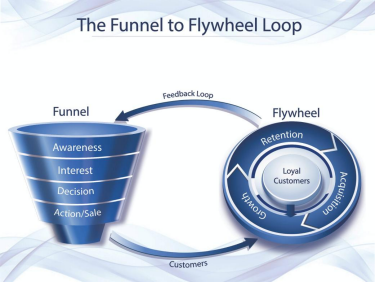
The Funnel to Flywheel Loop™ is a marketing framework that treats customer acquisition as the starting point of growth, not the finish line. Instead of constantly hunting for new leads, you build a system where existing customers generate momentum that compounds over time – through retention, advocacy, and organic referrals that feed back into the top of your funnel.
Here's how it works:
The traditional funnel does its job – Awareness → Interest → Decision → Action/Sale – and converts prospects into customers. But instead of treating that conversion as the transaction's end, it's the beginning of something more powerful.
Customers exit the funnel and enter the flywheel: a continuous loop of retention, acquisition, and growth, all spinning around a core of loyal customers.
- Retention: You keep delivering value. The relationship deepens. Customers stick around not because they're locked in, but because they want to be there.
- Acquisition: Happy customers become advocates. They refer others. They share your work. They do your marketing for you – and it's more credible than anything you could say about yourself.
- Growth: The flywheel accelerates. Each revolution generates more momentum than the last. Growth becomes a byproduct of delivering value, not a desperate hunt for the next lead.
And here's the crucial part: the feedback loop. The flywheel doesn't spin in isolation. It feeds back to the top of the funnel, creating new awareness, new interest, new prospects. Your best customers become your best marketing channel.
The funnel is acquisition. The flywheel is compounding. You need both – but the flywheel is where the leverage lives.
When flywheels explode
But here's where the physics gets dangerous – and where most business advice falls short.
Remember that Poway flywheel? The one that punched through the roof? That's what happens when you build momentum without containment.
The 2011 Beacon Power incident was similar: flywheels spinning at 37,800 rpm, storing enormous energy, until manufacturing defects caused rotors to wobble and disintegrate. The carbon fiber ground into what investigators described as "cotton candy-like material," triggering the cooling system, which generated steam, which blew the chamber covers off explosively. A neighbor felt her walls shake from a quarter mile away.
Here's the physics lesson most people miss: flywheels don't just store energy – they store consequences. When a battery fails, it catches fire. Unpleasant, but containable. When a flywheel fails, it releases all its stored energy at once. The fragments reach velocities comparable to bullets. The more successful you've been at building momentum, the more spectacular the destruction.
Businesses blow up the same way:
- Too fast without containment: Scaling customer acquisition before you can actually deliver value. Your flywheel is spinning, but there's nothing holding it together. When retention fails, the whole thing comes apart – and takes your reputation with it.
- Manufacturing defects: Launching before your core product or service actually works. Small wobbles become catastrophic at high speed. That "move fast and break things" mentality works until the thing that breaks is customer trust.
- No safety margins: Operating at maximum velocity all the time. No slack in the system. No room for error. Burnout is the entrepreneur's flywheel explosion – and it's just as destructive.
Porsche understood this. Their flywheel sat in a carbon fiber safety housing, engineered to contain a catastrophic failure. They didn't just build a power source; they built containment. They thought about what would happen when – not if – things went wrong.
In the Funnel to Flywheel Loop, your containment is the unsexy stuff: your systems, your processes, your ability to actually deliver on what you promise. The feedback loop only works if customers have something worth talking about. Momentum without substance isn't a flywheel – it's a bomb with a delayed fuse.
Building on your own momentum
There's one more lesson from the Porsche story that's easy to miss.
The GT3 R Hybrid's flywheel was self-contained. It regenerated energy from the car's own motion – from its own braking, its own driving, its own activity. It didn't depend on external charging stations or pit crews with fresh battery packs. The system was autonomous.
Too many businesses build their flywheels on rented platforms. They pour effort into social media, where the algorithm can change overnight. They build audiences they don't own, on territory they don't control. And then they're shocked when the platform decides to throttle their reach, change the rules, or disappear entirely.
That's a flywheel without a safety housing. When the platform changes (and it will), you have nothing.
The Funnel to Flywheel Loop needs to spin on assets you control:
- Your email list – you control the relationship
- Your website or publication – you control the content
- Your direct customer relationships – you control the conversation
Social platforms are useful for the top of the funnel – for awareness and discovery. But the flywheel itself needs to spin on ground that you control. Otherwise, you're not building momentum; you're renting it. And rented momentum can be repossessed.
A practical application: The content flywheel
Let me make this concrete. If you're building a content-based business – a newsletter, a personal brand, a thought leadership platform – here's how the Funnel to Flywheel Loop applies:
The funnel (acquisition)
Social media, SEO, guest appearances, collaborations, word of mouth. This is how strangers discover you exist. The goal isn't to maximize followers on rented platforms – it's to move people from awareness to your owned platform: your email list, your community, your direct relationship.
The flywheel (compounding)
- Retention: Deliver consistent value. A weekly newsletter that's actually worth reading. Genuine insights, not recycled platitudes. Content that makes people's lives or work meaningfully better. They stay subscribed because you keep earning their attention.
- Acquisition (from within): Readers share your best work. They forward emails to colleagues. They quote you in meetings. They post your ideas on social media with attribution. Your audience grows your audience – and this kind of growth is stickier than anything you could buy.
- Growth: The flywheel accelerates. More readers means more shares means more readers. Each piece of content generates momentum for the next. You stop feeling like you're pushing uphill.
The feedback loop
Your engaged readers provide ideas, questions, objections, and problems to solve. They tell you what to write about. They point out what you got wrong. They create the content calendar. The flywheel feeds the funnel feeds the flywheel – and the whole system gets smarter over time.
The writing framework: Pain → insight → action
Every piece of content can follow this cycle – it's the flywheel in miniature:
- Pain: Start with a struggle your reader recognizes. Make them feel seen. "You've read the productivity books. You've tried the apps. You're still drowning." This is your braking zone – you're meeting them where they're already slowing down.
- Insight: Reframe the problem. Give them a new lens. "The issue isn't discipline – it's that you're optimizing for the wrong metric." This is the energy storage – you're charging them up with a new way of seeing their situation.
- Action: Give them something concrete to do. A question to ask. A small experiment to run. This is the boost – releasing stored energy into forward motion. And if the action works? They'll be back. The flywheel spins.
Sustainable momentum over maximum velocity
Porsche's GT3 R Hybrid didn't win the 2010 Nürburgring 24 Hours – but it didn't explode either. It ran consistently for over eight hours, demonstrated the concept, and laid the groundwork for future development. The 2.0 version came back a year later – 110 pounds lighter, more refined, better contained.
That's the model: sustainable momentum over maximum velocity.
The Funnel to Flywheel Loop isn't complicated. It's a recognition that acquisition and retention aren't separate activities – they're part of the same system. That the customer you earned yesterday is more valuable than the prospect you'll chase tomorrow. That momentum, properly contained, compounds.
The funnel gets you customers. The flywheel keeps them – and turns them into your growth engine.
But here's the thing about flywheels that most people miss: they're not about speed. They're about momentum – the steady, accumulating force that eventually becomes unstoppable. Not because of any single dramatic push, but because you never stopped pushing. Not because you moved fast and broke things, but because you built something worth sustaining.
That Porsche flywheel could charge from empty to full in a single braking zone and discharge over a million times without wearing out.
Your business can work the same way: capture value from every interaction, store it in systems you control, release it when you need growth, and do it again tomorrow.
Stop thinking in funnels alone. Start building your flywheel.
Just make sure you've got containment.
If you like how I think and write and want more, check out my latest book, live on Amazon: The AI-Accelerated GTM Playbook.


Become a CMO Insider
Thank you for subscribing
Get exclusive insights, frameworks, and strategies from marketing leaders driving real business impact.
An email has been successfully sent to confirm your subscription.
 Follow us on LinkedIn