.png)







As expectations of marketing continue to rise, content is now asked to do it all: drive demand, support sales, build brand trust, educate buyers, and deliver measurable ROI.
Against that backdrop, understanding what actually holds teams back is critical for marketing leaders looking to scale impact, not just output.
The barriers highlighted in our Future of Marketing 2025 report don’t point to a lack of ambition or belief in content. Instead, they reflect the realities of modern marketing organizations: stretched teams, growing scrutiny around performance, competing priorities, and increasing internal complexity.
For CMOs and senior leaders, these challenges are signals of where structure, alignment, and leadership focus can make the biggest difference.
The following analysis explores each barrier through a leadership lens, unpacking why it matters at an organizational level and what practical steps marketing leaders can take to overcome it.
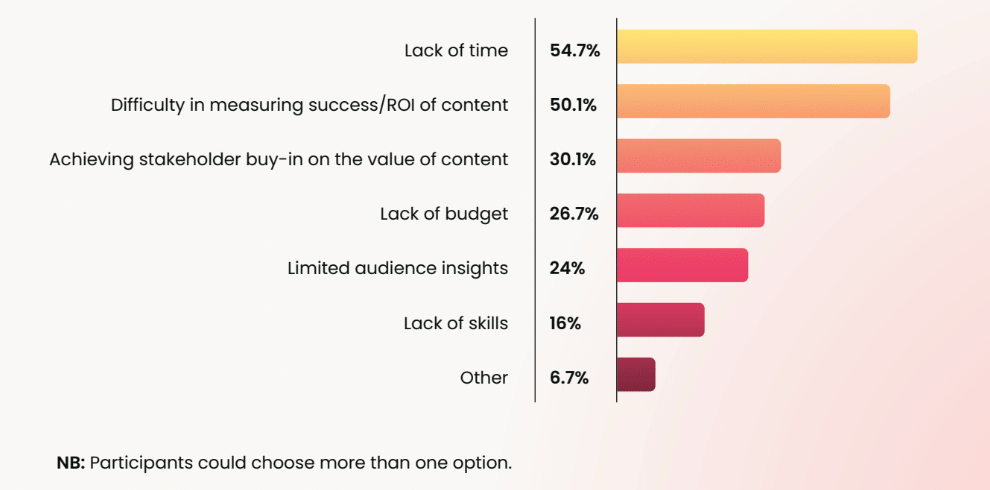
Lack of time – 54.7%
It’s telling that lack of time sits at the very top of the list. For marketing leaders, this usually isn’t about poor time management but a signal of structural overload.
Content has expanded far beyond blog posts into a constant demand for campaigns, social, enablement, thought leadership, video, and internal comms. Yet teams, processes, and expectations haven’t always evolved at the same pace.
From a leadership perspective, this matters because time pressure is often the silent killer of quality and strategy. When teams are stretched thin, content becomes reactive rather than intentional. The risk is burnout and producing a high volume of content that fails to differentiate, convert, or reinforce the brand.
So, what can you do to try tackle this?
Audit where time is actually going
Many content teams aren’t short on effort – they’re short on efficiency. Leaders often underestimate how much time is lost to handoffs, unclear briefs, multiple rounds of approval, and last-minute changes.
A simple audit of how content moves from idea to publish can quickly surface bottlenecks that have nothing to do with creativity and everything to do with process.
Ruthlessly prioritize impact over output
When everything is a priority, teams default to volume. As a leader, you play a critical role in resetting expectations: fewer assets that clearly support core objectives will outperform a constant stream of disconnected content.
This requires saying no – or at least not now – to lower-impact requests, even when they come from other senior stakeholders.
Build content reuse into the strategy
Time pressure often comes from treating every asset as a one-off. Here, you can encourage a “pillar-first” mindset, where major ideas are deliberately designed to be repurposed across channels, formats, and teams. This saves time but also reinforces consistent messaging in the market.
Protect focus time
Constant interruptions, urgent requests, and shifting priorities fragment teams’ ability to think strategically. You must set the tone here. When focus time is protected – and reactive work is truly the exception – teams produce stronger, more intentional content that requires fewer revisions downstream.
Difficulty in measuring success/ROI of content – 50.1%
Nearly half of respondents struggling with measurement highlights a long-standing tension: content is expected to drive growth, but often lacks clear accountability frameworks.
For CMOs, this is particularly significant because content is increasingly scrutinized as budgets tighten and boards demand proof of impact.
The real challenge here isn’t data availability – it’s attribution, alignment, and expectation-setting. Content rarely works in isolation, yet it’s often evaluated as if it should deliver immediate, direct revenue outcomes. This disconnect can undermine confidence in content programs and make it harder to defend long-term investment.
Here are some things you can do to improve this:
Define success before creation begins
Measurement issues often start with unclear expectations. You can improve outcomes by ensuring every major content initiative has a defined role – whether that’s driving awareness, supporting sales, nurturing demand, or improving conversion. When success is agreed upon up front, measurement becomes far less contentious.
Align metrics to buying stages
Not all content should be judged by the same yardstick. Early-stage thought leadership, for example, is unlikely to generate immediate pipeline – but it may influence consideration and trust.
If you align metrics to the buyer journey, it’ll help your team focus on the right signals, rather than chasing metrics that don’t reflect the content’s purpose.
Focus on directional impact, not perfection
Attribution in content marketing will never be perfect, and waiting for flawless measurement often stalls progress. You can encourage your team to focus on trends, correlations, and comparative performance over time. Directionally useful insights are often enough to guide smarter decisions and justify investment.
Educate stakeholders on how content works
Measurement challenges are frequently stakeholder challenges in disguise. When you proactively explain how content contributes across the funnel – and why some benefits compound over time – you reduce pressure for unrealistic ROI expectations and build trust in the program.
Achieving stakeholder buy-in on the value of content – 30.1%
Stakeholder buy-in remains a meaningful barrier, particularly in organizations where content is seen as “nice to have” rather than a growth lever. For marketing leaders, this often reflects misaligned expectations across leadership, sales, and other functions – not a lack of content performance.
This is significant because without buy-in, content initiatives tend to be underfunded, overly constrained, or constantly reprioritized. Teams spend more time justifying their work than improving it. Over time, this erodes momentum and confidence.
Again, there are things you can do to get this stakeholder buy-in.
Speak the language of the business
Content discussions can lose credibility when framed around formats, channels, or creative preferences. When you tie content directly to revenue growth, sales efficiency, customer retention, or brand differentiation, it makes it far easier for stakeholders to understand its value.
Use internal proof points
Stakeholder buy-in strengthens when content is linked to real outcomes: sales teams using assets in deals, prospects referencing thought leadership, or customers engaging with educational content. You can elevate these stories internally to make content’s impact tangible, not abstract.
Bring stakeholders into the process early
Resistance often comes from feeling excluded. Inviting sales, product, or leadership into content planning – even at a high level – creates shared ownership. When stakeholders see their priorities reflected, buy-in becomes collaboration rather than persuasion.
Be consistent
Trust in content isn’t built through one presentation or quarterly update. If you consistently communicate progress, insights, and learnings, it helps content earn its place as a long-term strategic investment rather than a recurring justification exercise.
Lack of budget – 26.7%
While budget constraints are real, it’s notable that this barrier ranks below time and measurement. That suggests many leaders see budget as a constraint to manage, not the root cause of ineffective content.
Still, budget limitations matter because content often competes with performance channels that promise faster, clearer returns. When budgets tighten, content can be first on the chopping block – even though it underpins long-term brand and demand.
 Charley Gale
What does tackling the lack of budget look like in practice?
Maximize existing investment before asking for more
Budget constraints often expose inefficiencies rather than absolute shortages. Focus on improving prioritization, reuse, and clarity of purpose. This can often unlock significantly better performance without increasing spend, strengthening the case for future investment.
Shift from production-heavy to insight-led content
High-impact content doesn’t always require high production value. You can encourage your team to invest more time in insight, narrative, and relevance – areas that often outperform expensive execution when budgets are tight.
Tie content funding to business priorities
Content is harder to cut when it’s clearly linked to strategic initiatives such as market expansion, product launches, or pipeline growth. If you align content budgets to these priorities, you position content as essential infrastructure, not discretionary spend.
Frame content as an efficiency driver
Content can reduce costs elsewhere – by enabling sales, shortening buying cycles, improving onboarding, or reducing reliance on paid channels. When you frame content in these terms, it shifts budget conversations from cost to value.
Limited audience insights – 24%
A quarter of leaders citing limited audience insights points to a deeper issue: content can’t be effective if it’s built on assumptions rather than understanding. For CMOs, this is critical – audience relevance is the difference between content that resonates and content that’s ignored.
Often, insights exist but are fragmented across teams, tools, and data sources. Without a unified view of the customer, content risks becoming internally focused rather than customer-led.
There are a few practical steps you can take.
Leverage existing data better
Many organizations already have valuable audience insight – it’s just scattered. You can encourage stronger collaboration between marketing, sales, customer success, and support to surface recurring questions, objections, and pain points that should directly inform content.
Invest in qualitative insight, not just analytics
Dashboards show what’s happening, but conversations reveal why. If you prioritize interviews, win/loss insights, and direct customer feedback, it gives content teams a much richer foundation for relevance and resonance.
Align teams around shared personas and narratives
Inconsistent audience understanding leads to fragmented messaging. You can drive alignment by ensuring all teams – not just marketing – are working from the same core customer narratives, challenges, and goals.
Make insight gathering an ongoing habit
Markets evolve quickly. Treating audience insight as a living input rather than a one-off project ensures content stays relevant as customer needs, expectations, and buying behavior change.
Lack of skills – 16%
While this ranks lowest, it’s still meaningful. Skills gaps often emerge as content becomes more sophisticated – from storytelling and distribution to analytics and AI-assisted workflows. For leaders, this isn’t just about hiring talent; it’s about future-proofing the team.
The lower percentage may also suggest that teams feel capable but under-supported – lacking time, clarity, or tools rather than raw ability.
This brings us to possible responses to addressing this barrier.
Identify skill gaps that actually limit impact
Not every missing skill is worth addressing. You, as a leader, add value by identifying which gaps genuinely block performance – whether that’s storytelling, analytics, distribution, or AI adoption – and focusing investment there.
Upskill before you hire
Targeted training can often deliver faster and more cost-effective results than expanding headcount. You should invest in upskilling signal confidence in your team while building capability that compounds over time.
Encourage experimentation
Skills develop fastest in environments where teams are trusted to test new approaches. When you create space for experimentation – without punishing failure – you accelerate learning and adaptability.
Balance specialists and generalists
A mix of deep expertise and flexible skill sets helps teams respond to changing content demands. Build this balance to create resilience, not dependency, within your content function.
Final thoughts
Taken together, these barriers paint a clear picture: the biggest challenges in content creation aren’t creative – they’re operational, strategic, and organizational. Time constraints, measurement challenges, and stakeholder alignment all stem from how content is positioned, supported, and integrated within the business.
For marketing leaders, the opportunity lies in shifting the conversation. Content doesn’t need more activity; it needs clearer priorities, stronger alignment with business goals, and the right conditions to succeed.
Addressing these barriers focuses on designing systems that allow content to be effective, sustainable, and credible at scale.
Ultimately, the organizations that win with content will be those where leaders treat it not as a tactical output, but as a strategic capability – one that’s measured thoughtfully, resourced intentionally, and aligned to the outcomes that matter most to the business.


Become a CMO Insider
Thank you for subscribing
Get exclusive insights, frameworks, and strategies from marketing leaders driving real business impact.
An email has been successfully sent to confirm your subscription.
 Follow us on LinkedIn