.png)




Templates and frameworks to pair with this playbook
Can you trust what makes you laugh? Can you trust what makes you emotional, or curious, or genuinely connected to something? Those may sound like strange questions, but for marketers right now, they’re crucial.
Think about that moment after you see a heartwarming video of someone's granny on a skateboard, then pause and wonder: "Wait, is this AI-generated?" That creeping uncertainty is showing up everywhere. Misinformation and disinformation are top global concerns, institutional trust is at historic lows, and audiences are rightfully skeptical.
Without real human touchpoints, there's a ceiling on how much trust you can build. But events, done intentionally, can close that gap. In this article, I’ll show you how. Here’s what we’ll cover:
- The trust crisis and why digital-only marketing falls short
- The event trust stack: a framework for thinking about events as a system
- Creating genuine human moments at events
- How to create and measure events so they become a revenue driver
- Practical first steps for your events strategy
The trust crisis is real, and it's your problem to solve
The World Economic Forum identified misinformation and disinformation as the second most severe short-term global issue in their research this year. That puts it above extreme weather events, cyber insecurity, and even state-based armed conflicts.
We're operating in a world that's simultaneously high entertainment and low certainty. Audiences are consuming more content than ever, but they're also more skeptical than ever. They're not always sure who's on the other side of a message, what the intent is, or whether what they're seeing is even real.
This has a knock-on effect on brand trust. An Edelman survey found that 61% of individuals showed moderate or high distrust toward institutions.
As marketers, we inherit that problem. Our brands are fragile in this environment, and if we're not actively building trust, we may be eroding it without realizing.
The limits of digital-only marketing
Most of us are tracking the usual signals: clicks, scrolls, time on page, form fills. Increasingly, we're looking at answer engine optimization and trying to understand how buyers find us in an AI-mediated world.
These are all useful things to measure, but here's what often gets missed. Digital interactions are, by their nature, low-context. You can have a beautifully designed customer journey, a perfectly sequenced email nurture, a retargeting campaign that follows someone around the internet for weeks. But if that person never encounters a real human from your organization, they start to wonder whether you're genuine.
Think of it like dating. If you've only ever communicated with someone online and you've never met them in person, a small part of you starts to question it. Are they who they say they are? Is this real? Your buyers go through the same thing. The digital journey can take them a long way, but without a real human touchpoint, there's a ceiling on how much trust you can build.
For expert insights like this straight to your inbox twice a month, sign up for Pro+ membership.
You'll also get access to a range of certifications, a complimentary Summit ticket, 50+ tried-and-true templates, members-only workshops, and much more.
So, what are you waiting for?
Why events are doing more work than most people realize
In research conducted across marketers in North America and Europe, 72% said events were their most effective channel across the entire marketing mix. Even TikTok, a digital leader, pours a huge amount of money into in-person activations.
That makes sense. When someone comes to an in-person event, they've made a real decision. They left their home or their office. They carved time out of a calendar that's already competing with a hundred other priorities. That's a level of intentionality you simply don't get from a click.
The same is true for webinars and virtual events, just at a different scale. Someone blocking out an hour in their diary to attend a live session is still making a meaningful commitment. It's a real touchpoint, not a passive impression.
And the trust impact is measurable. In global research we conducted this year, surveying 900 respondents worldwide, 81% said that trust increases after just one in-person event. One event. That's a pretty significant return on what many companies still treat as a line item rather than a strategic channel.
The event trust stack: Thinking about events as a system
One of the most useful frameworks I've come across for thinking about this (full credit to our marketing director for putting it together) is what we call the event trust stack.
The idea is straightforward. Different types of events serve different roles in building trust, and they work best when you think of them as a connected system rather than a collection of standalone activities.
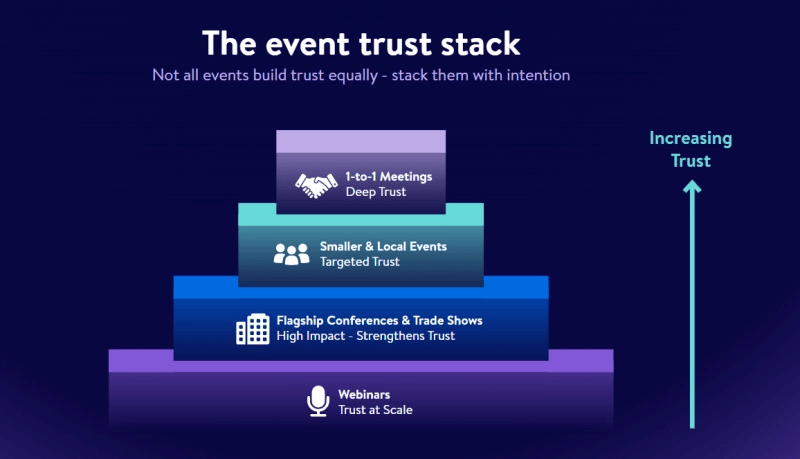
At the base of the stack, you have webinars and virtual events. These give you broad coverage and mass exposure. They're not as intimate as in-person, but they still involve a human voice engaging directly with your audience, which puts them in a fundamentally different category from static content. They're also scalable, which matters when you're trying to reach a large audience consistently.


Become a CMO Insider
Thank you for subscribing
Get exclusive insights, frameworks, and strategies from marketing leaders driving real business impact.
An email has been successfully sent to confirm your subscription.
 Follow us on LinkedIn